
August 22, 2026
Scout 400 LXF Li-Ion - Same Hull, Same Dry Weight, No Diesel Tank
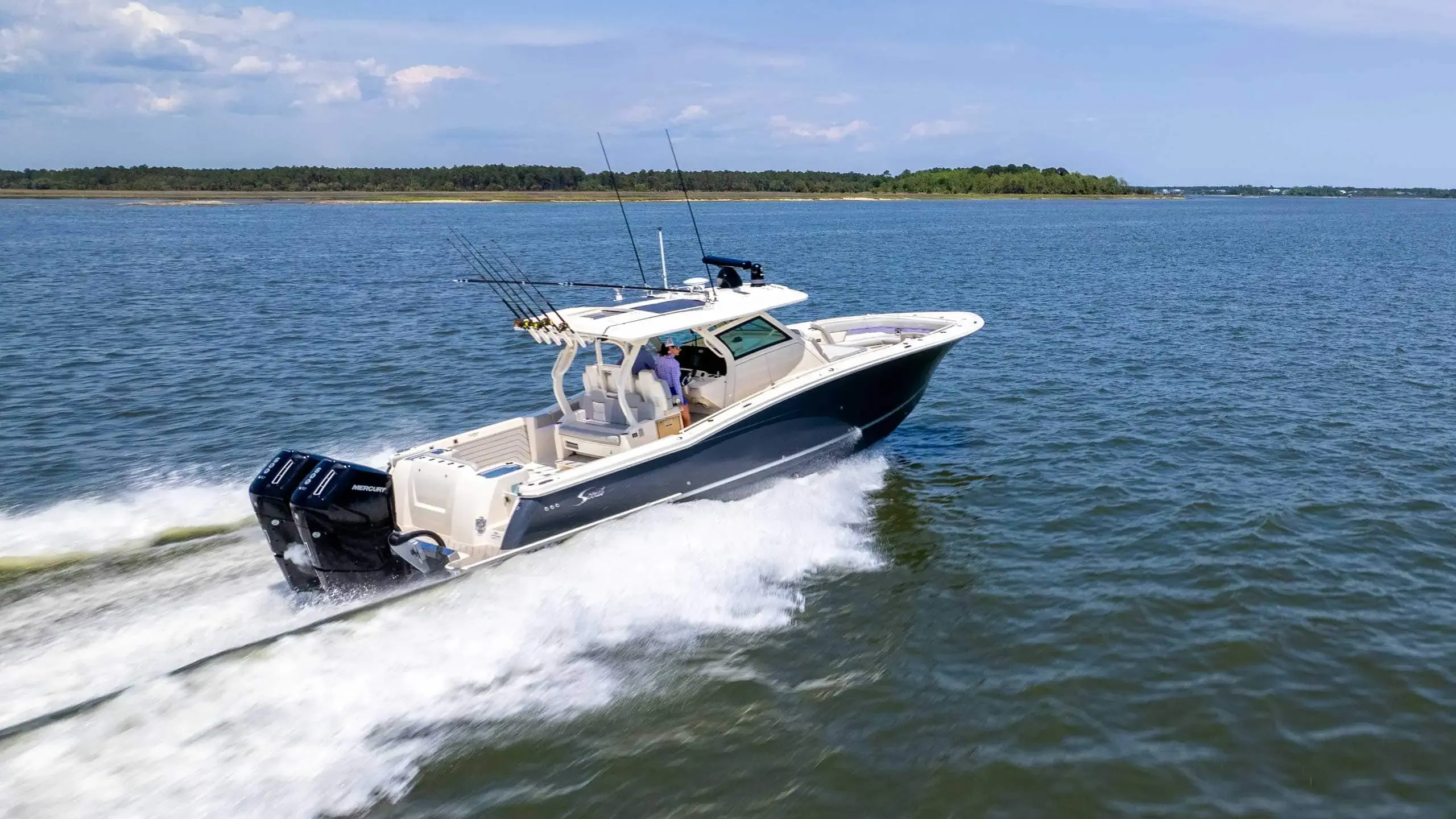
The Scout 400 LXF Li-Ion is the 39'7" 400 LXF with the diesel generator taken out and a 48V lithium-ion system put in its place. Scout publi…
Read the articleThe luxury center consoles — 305 to 530 LXF, 30'1" to 53'5", hand-laid, epoxy-infused and carbon-epoxy hulls
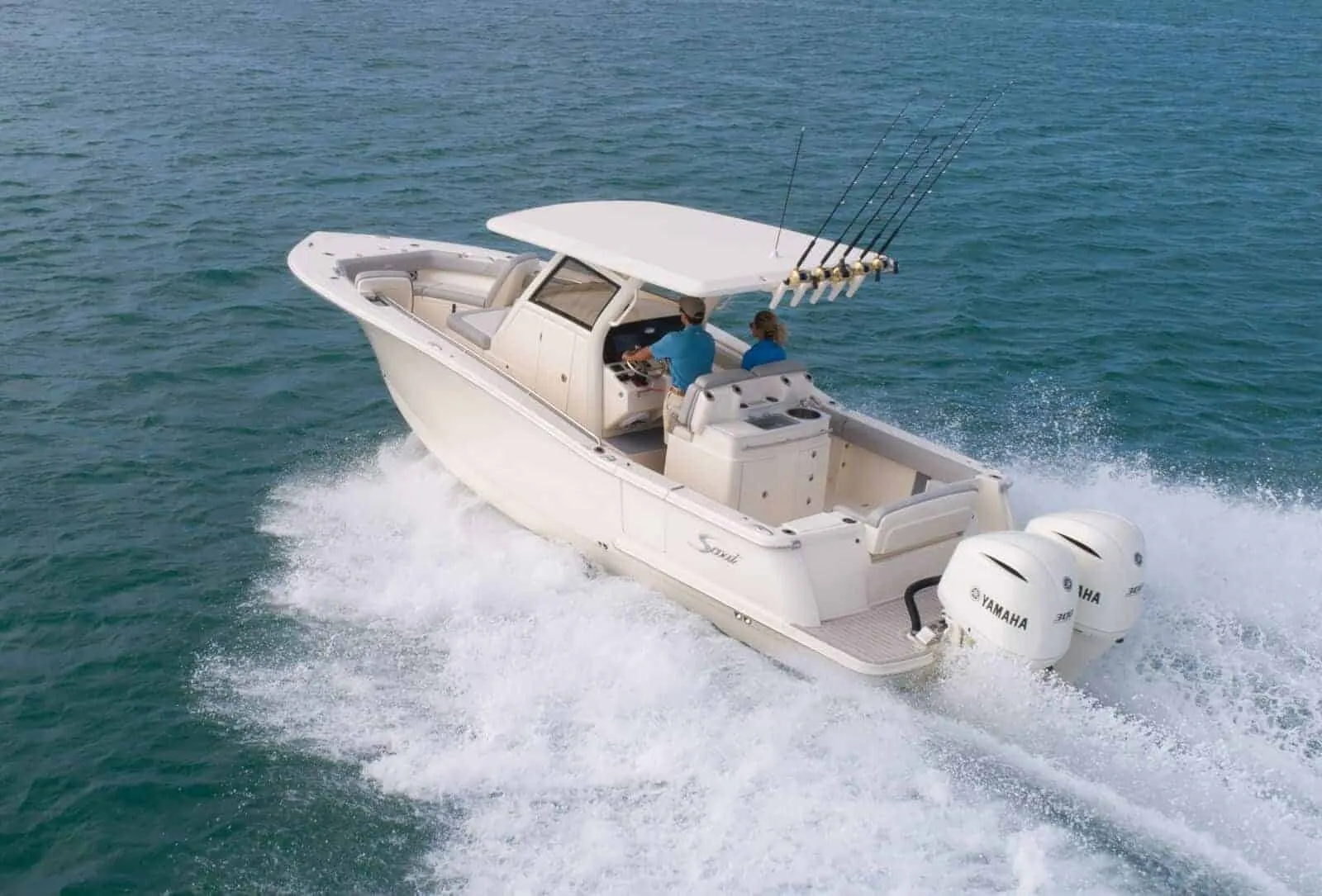
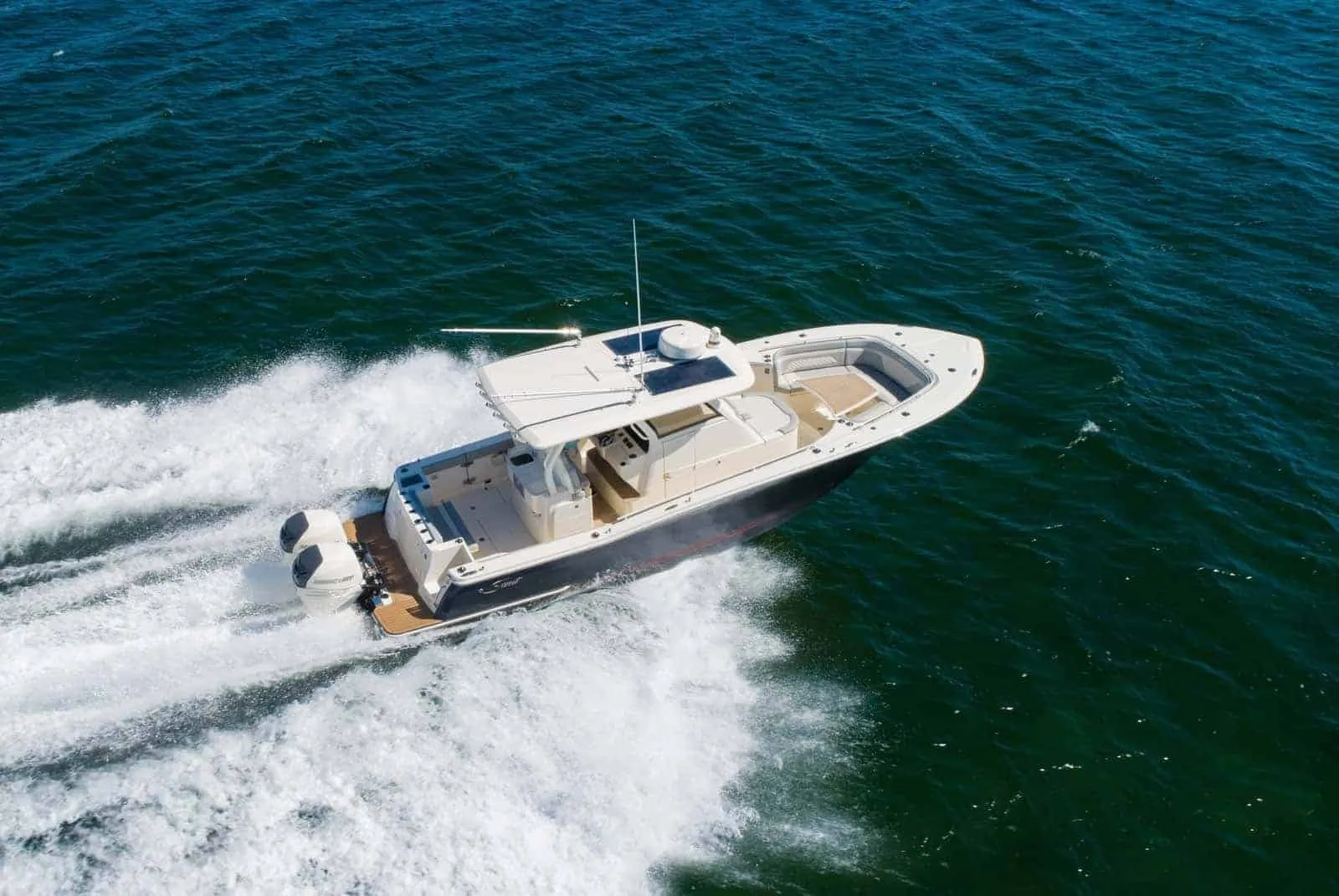
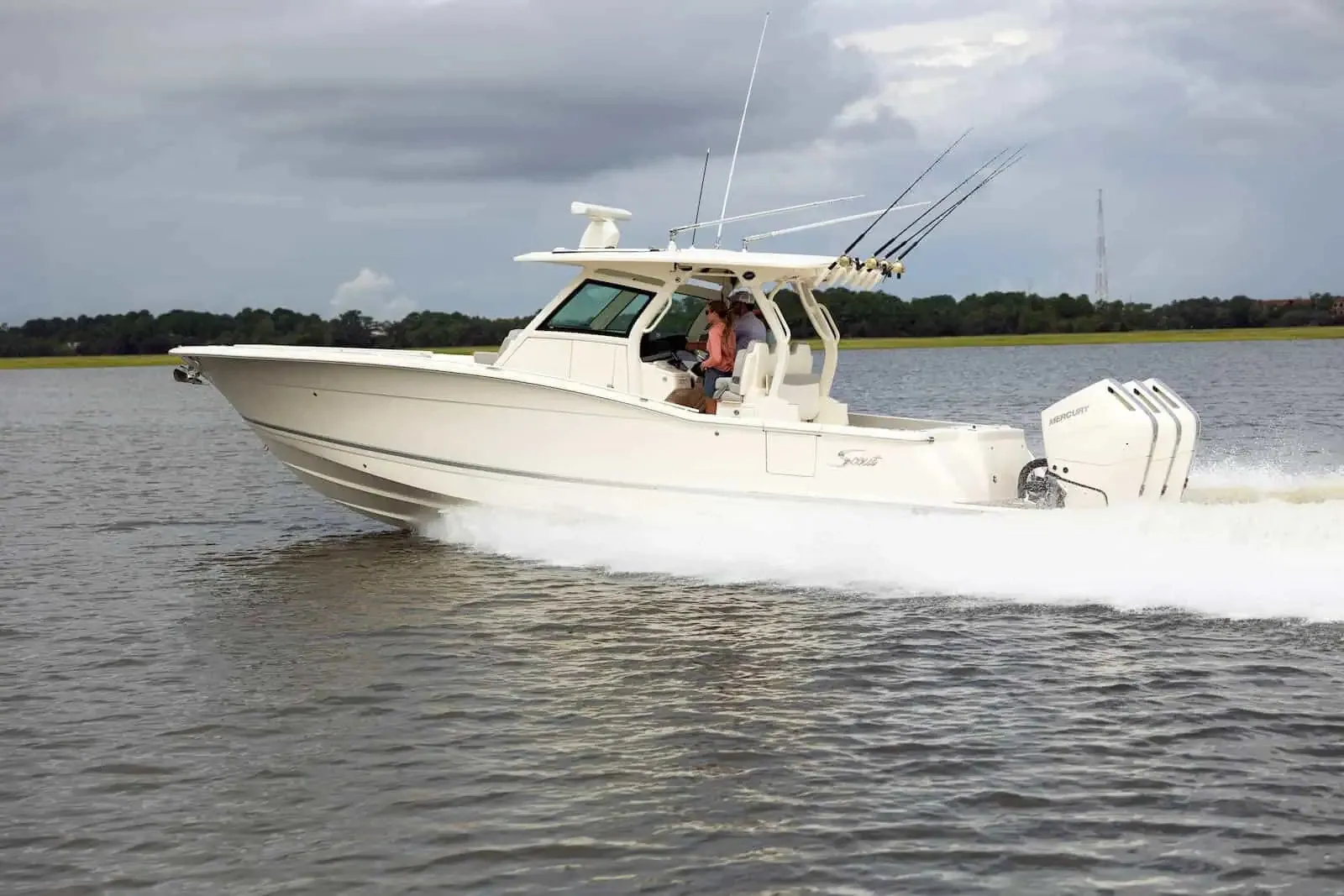
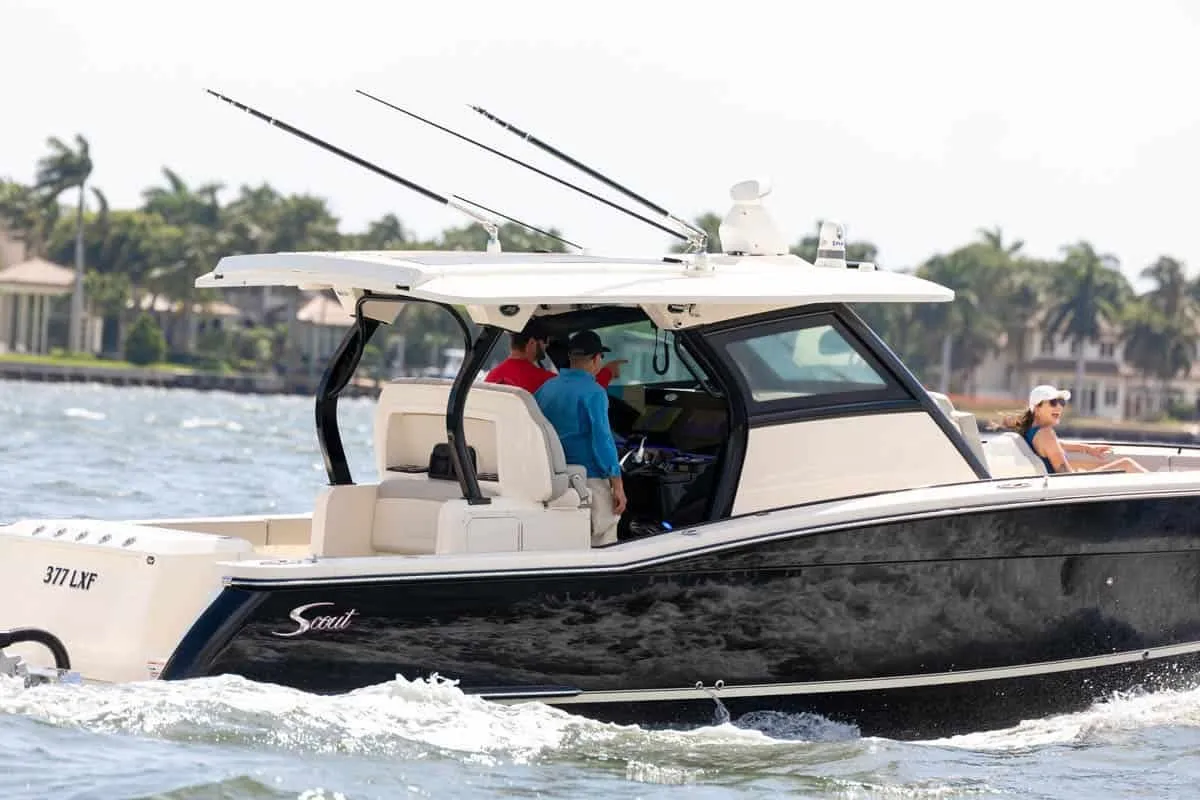
You want one boat that fishes hard at dawn and still has somewhere for your crew to sit down at four in the afternoon. LXF is Scout's answer, and the nine hulls reviewed here are the heart of it.
LXF stands for luxury center console, and the line is where Scout puts its most expensive manufacturing. Every Scout is 100% hand-laid — no chopper guns, ever — but from 33 feet up the laminate is infused with epoxy under vacuum instead of laid wet, and from the 377 up carbon fiber and E-glass become the primary material in that infusion. Scout publishes the weights that follow: roughly 2.4 lbs per square foot for an epoxy-infused laminate, roughly 1.7 for carbon-epoxy, against a conventional layup. That is the whole argument for the line — take weight out of the structure and you can put deadrise, horsepower and accommodation back in without the boat going soft.
The nine here run from the 305 LXF at 30'1" to the 530 LXF at 53'5", and they are not simply the same boat at nine sizes. The 305 is a conventionally hand-laid hull with a cushioned berth inside the console. The 330 and 357 are epoxy-infused. The 377 runs its air conditioning off a lithium bank with no generator aboard. The 400 has a stand-up cabin, a diesel generator and quad-engine or twin-V12 power, and the 400 LXF Li-Ion is that same 39'7" hull with the generator deleted and a 48-volt lithium bank in its place. The 425 puts an enclosed head and shower and a standard 8 kW generator behind 545 gallons of fuel. The 435 LXF Li-Ion takes the 377's no-generator idea up to 43 feet on a 48-volt lithium house system. And the 530 is a two-cabin boat with a queen master, 875 gallons, and five engines on the options list. Above all of them, outside this hub, sits Scout's 67 LX Series — the 670 LXF and 670 LXS, both 66'9".
Every Scout Boats LXF model we review in depth, in the order owners step up through the series.
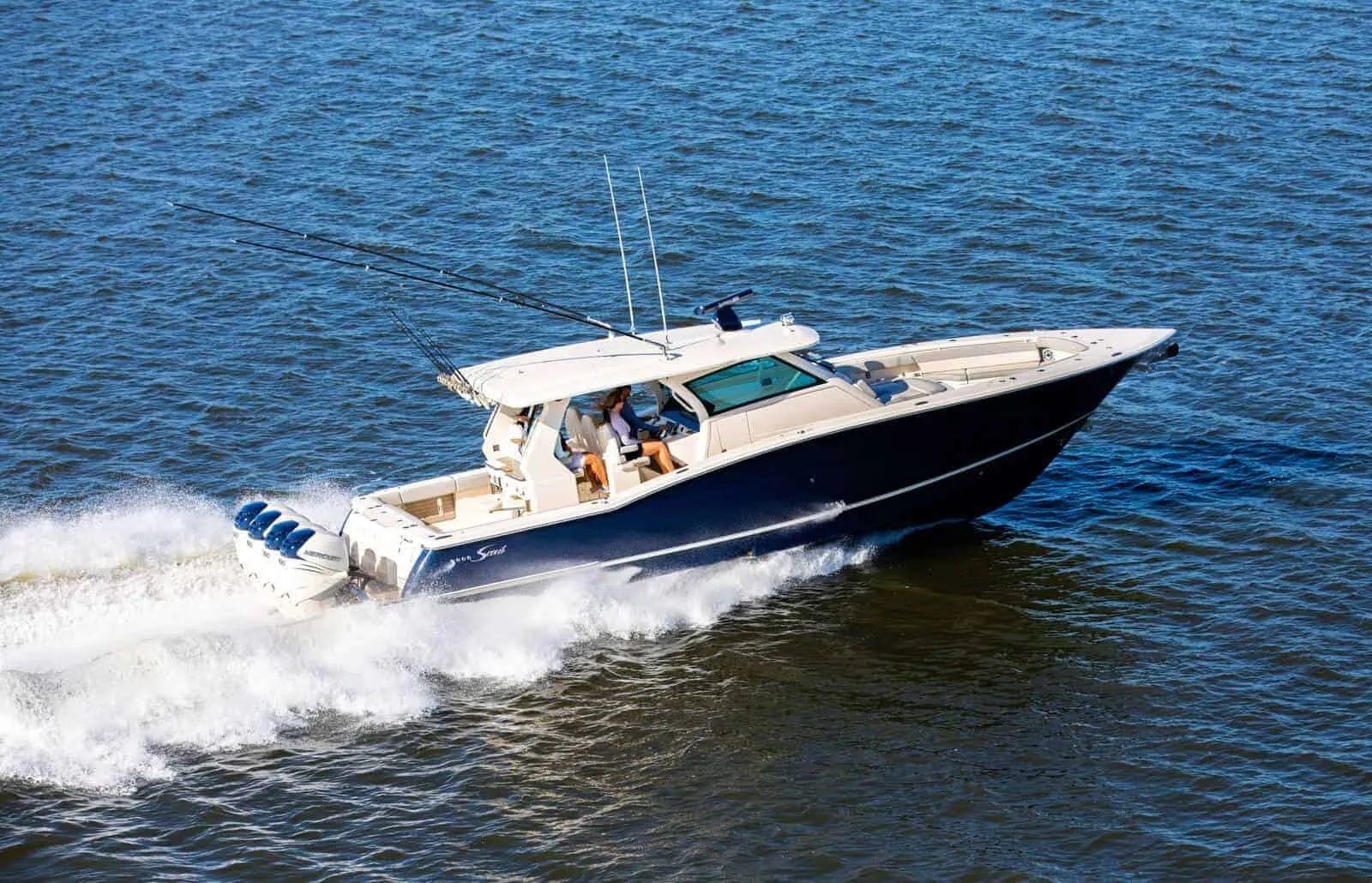
Photo credit Scout Boats.
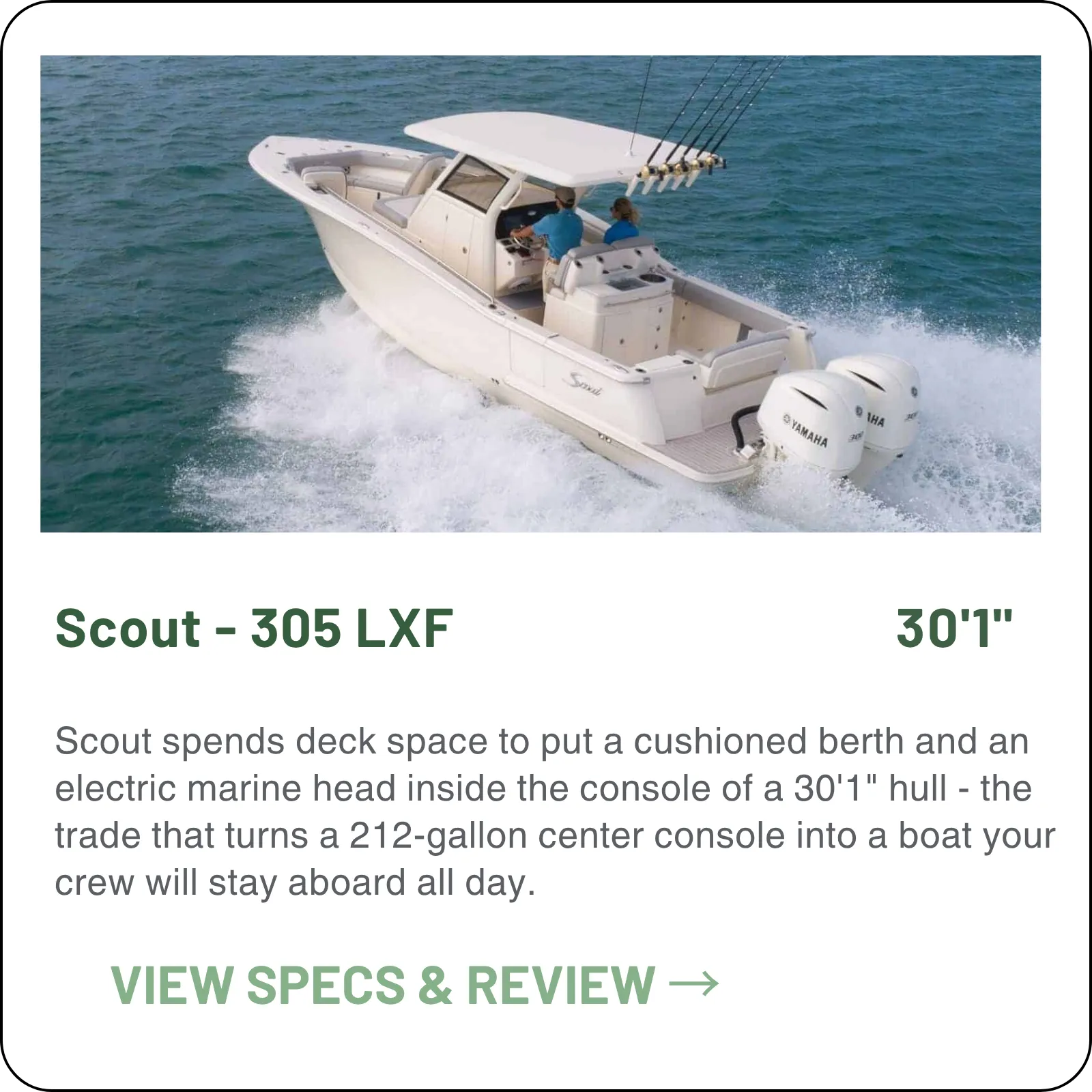
Scout spends deck space to put a cushioned berth and an electric marine head inside the console of a 30'1" hull - the trade that turns a 212-gallon center console into a boat your crew will stay aboard all day.
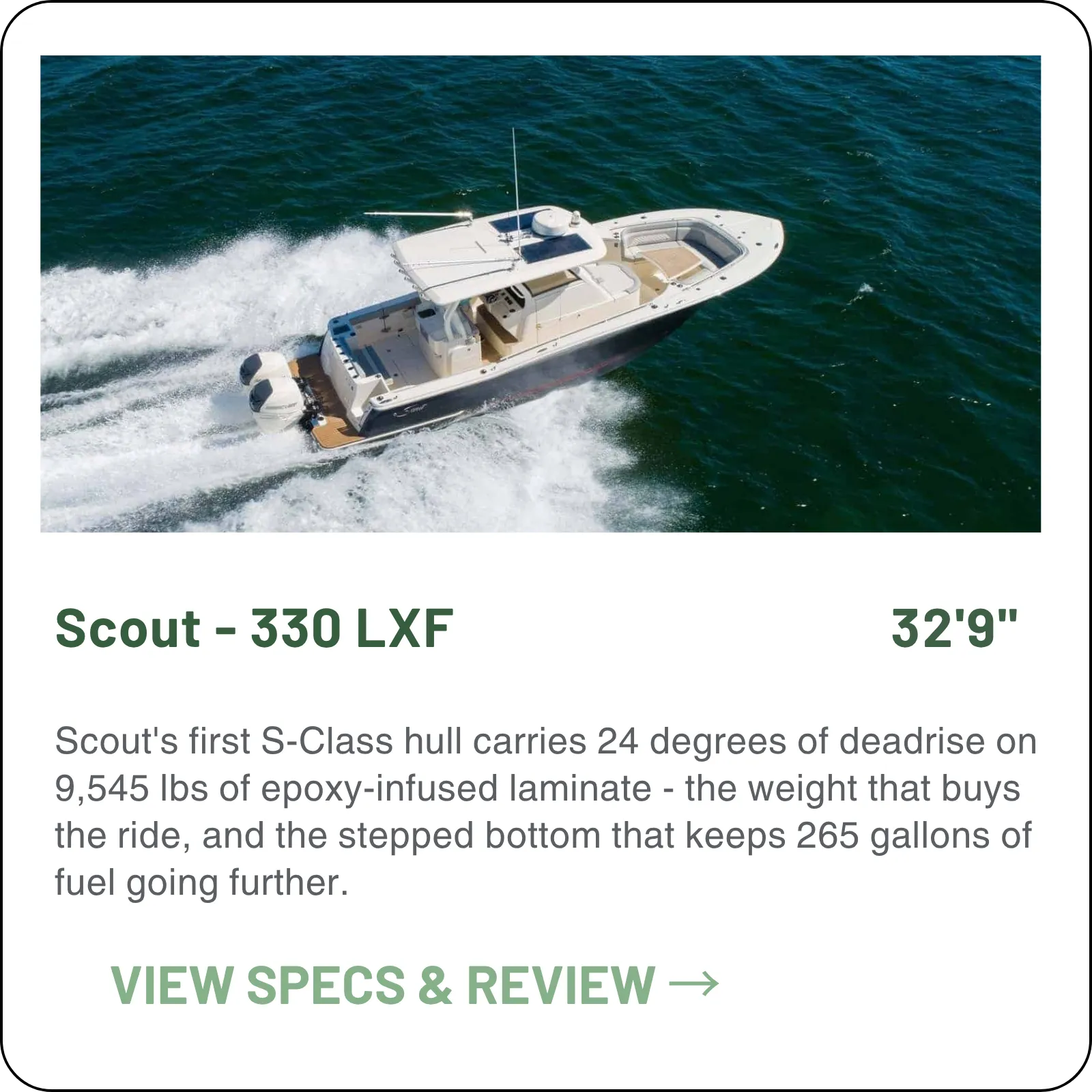
Scout's first S-Class hull carries 24 degrees of deadrise on 9,545 lbs of epoxy-infused laminate - the weight that buys the ride, and the stepped bottom that keeps 265 gallons of fuel going further.
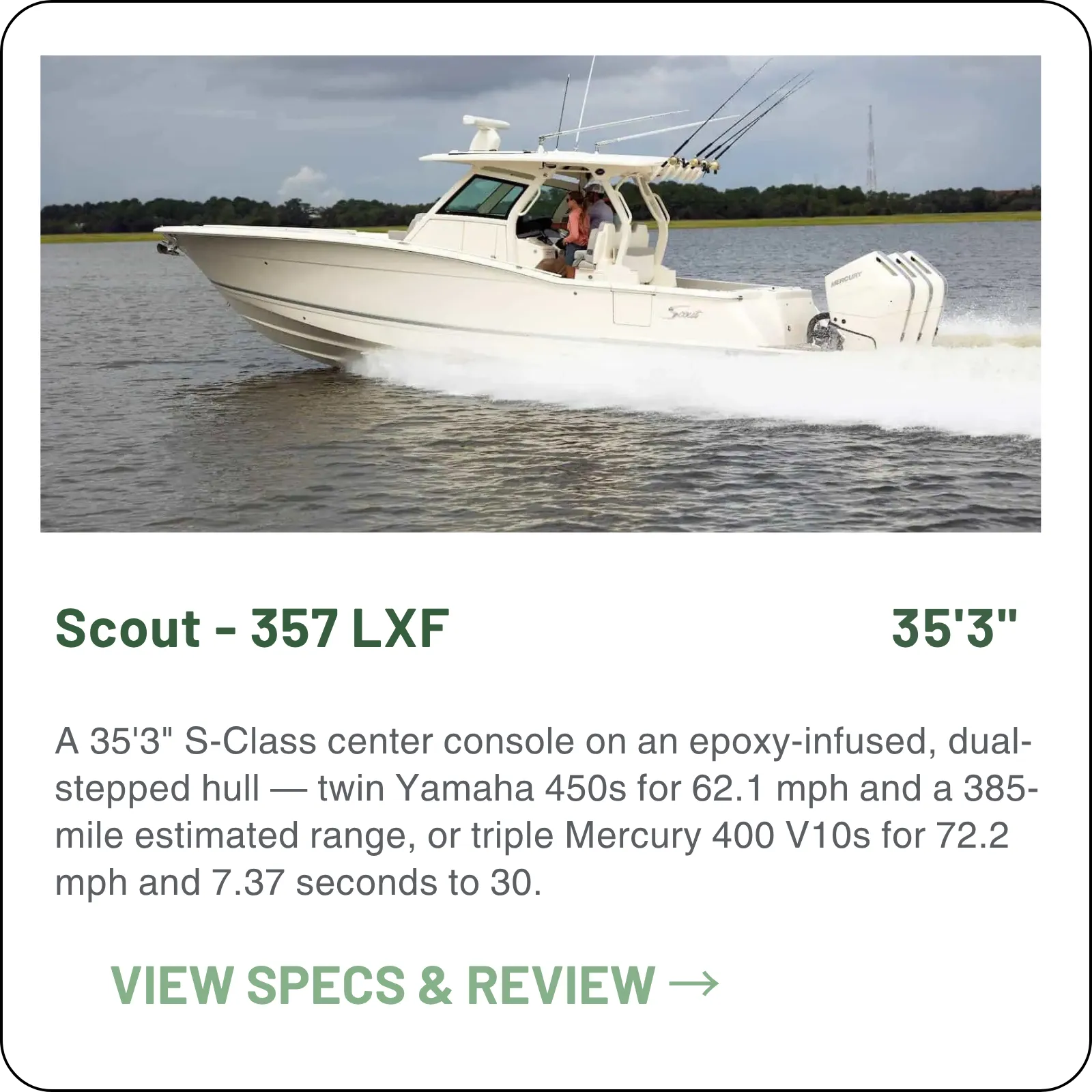
A 35'3" S-Class center console on an epoxy-infused, dual-stepped hull — twin Yamaha 450s for 62.1 mph and a 385-mile estimated range, or triple Mercury 400 V10s for 72.2 mph and 7.37 seconds to 30.
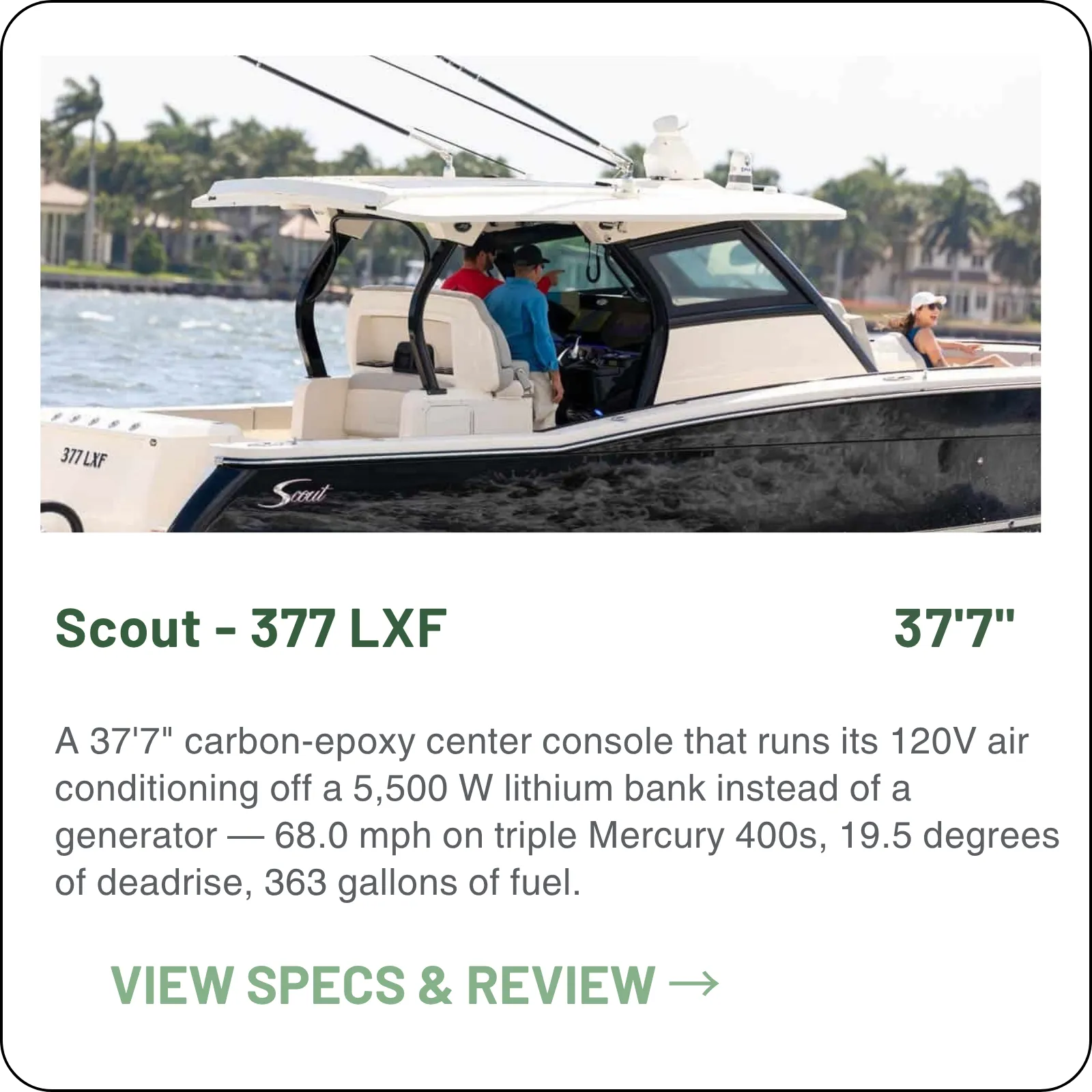
A 37'7" carbon-epoxy center console that runs its 120V air conditioning off a 5,500 W lithium bank instead of a generator — 68.0 mph on triple Mercury 400s, 19.5 degrees of deadrise, 363 gallons of fuel.
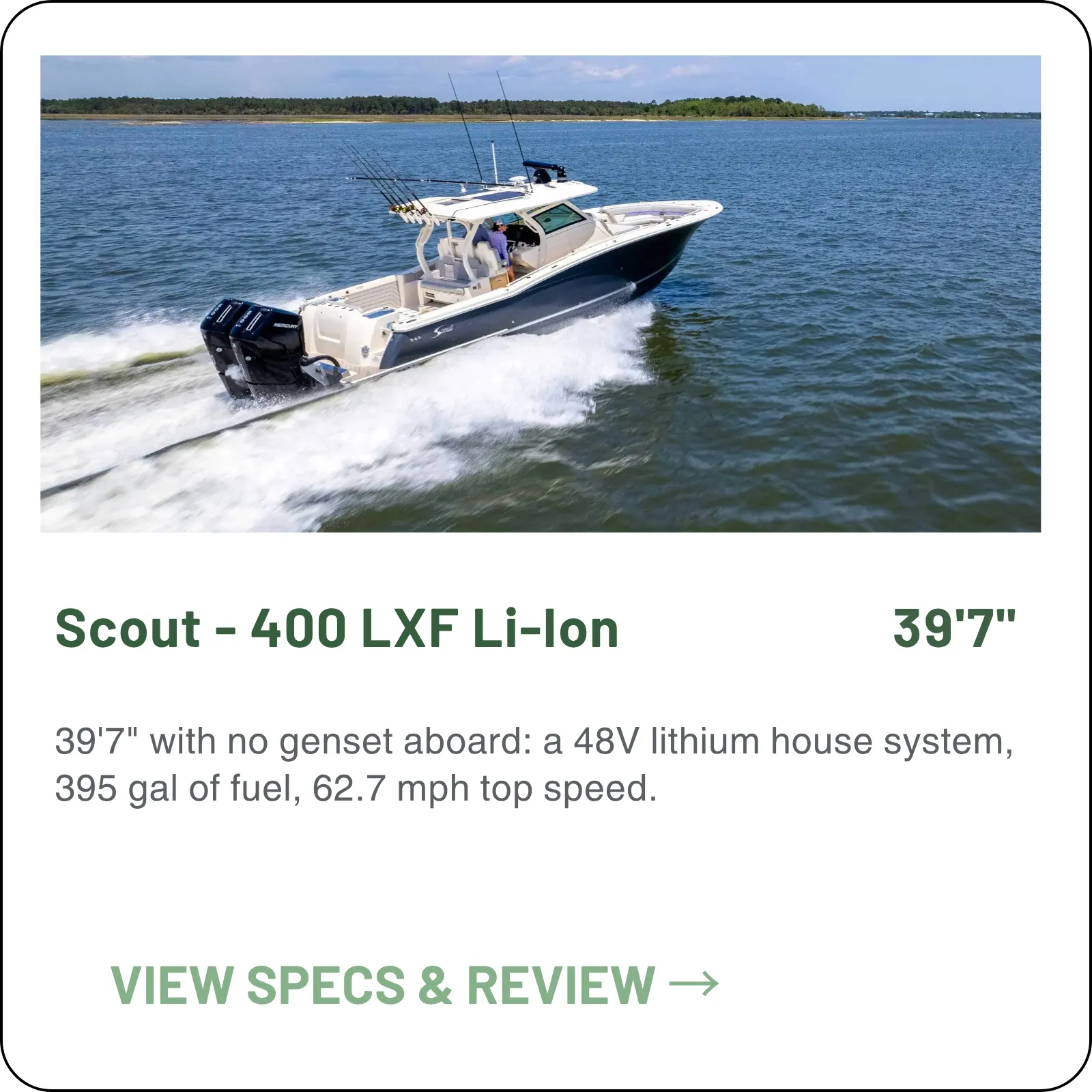
39'7" with no genset aboard: a 48V lithium house system, 395 gal of fuel, 62.7 mph top speed.
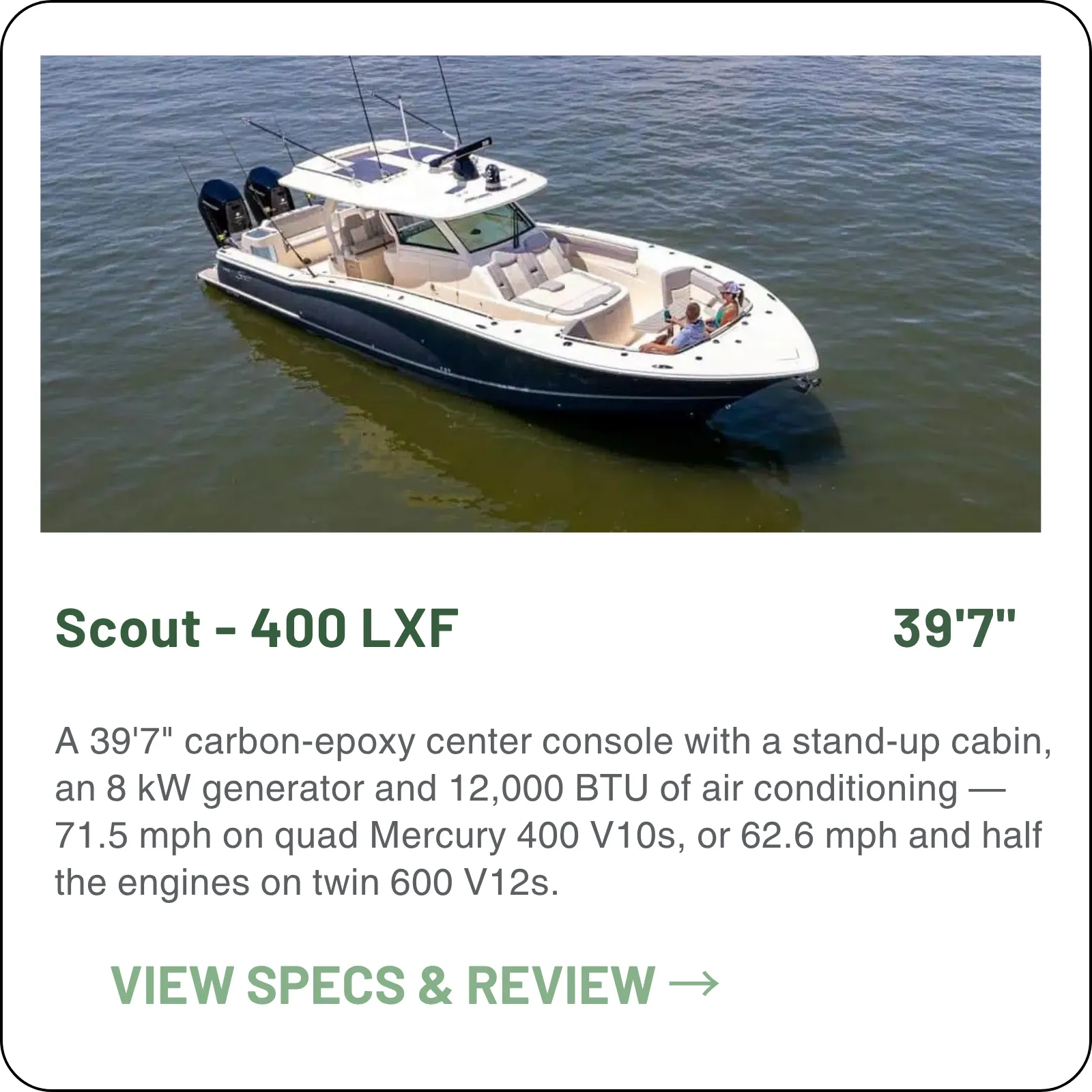
A 39'7" carbon-epoxy center console with a stand-up cabin, an 8 kW generator and 12,000 BTU of air conditioning — 71.5 mph on quad Mercury 400 V10s, or 62.6 mph and half the engines on twin 600 V12s.
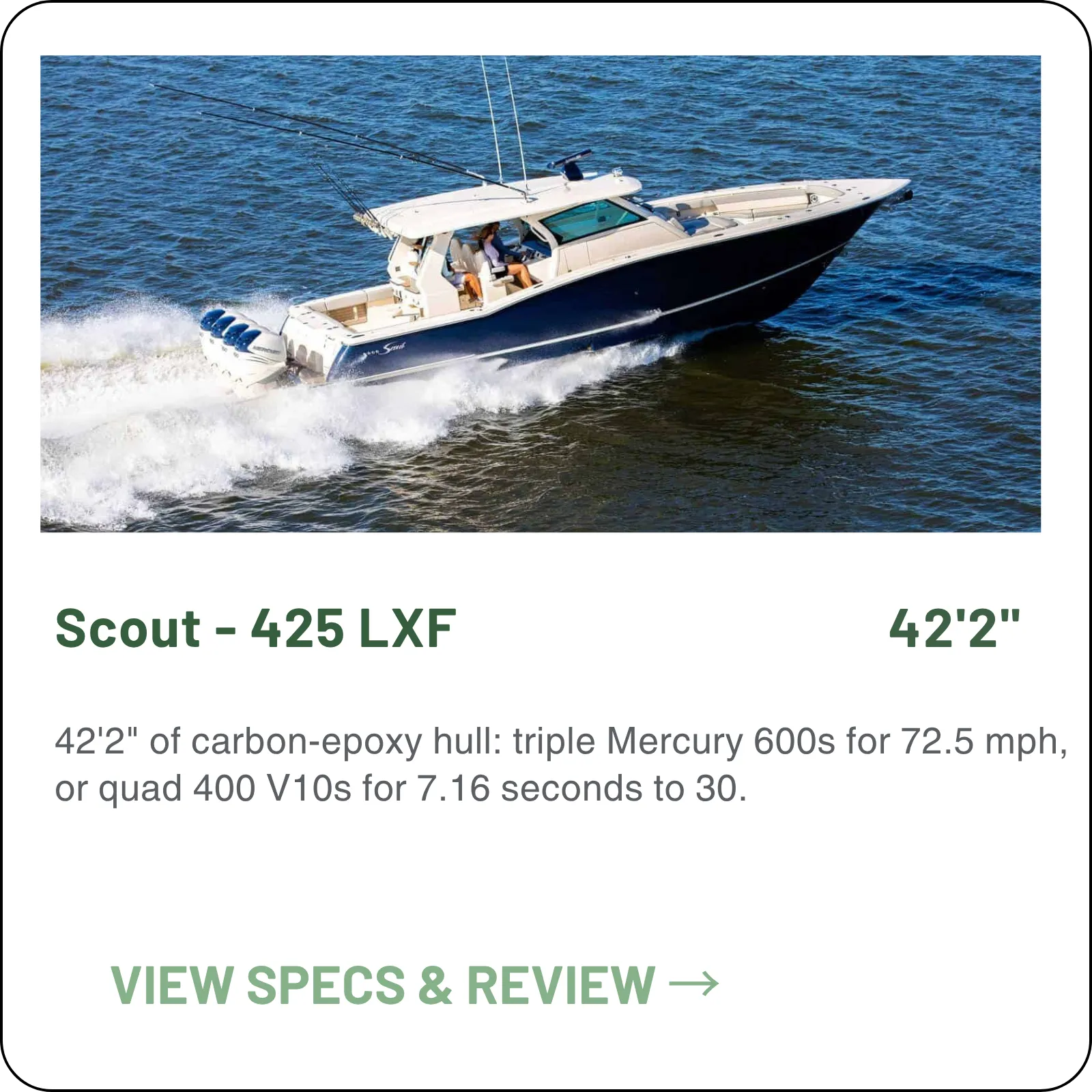
42'2" of carbon-epoxy hull: triple Mercury 600s for 72.5 mph, or quad 400 V10s for 7.16 seconds to 30.
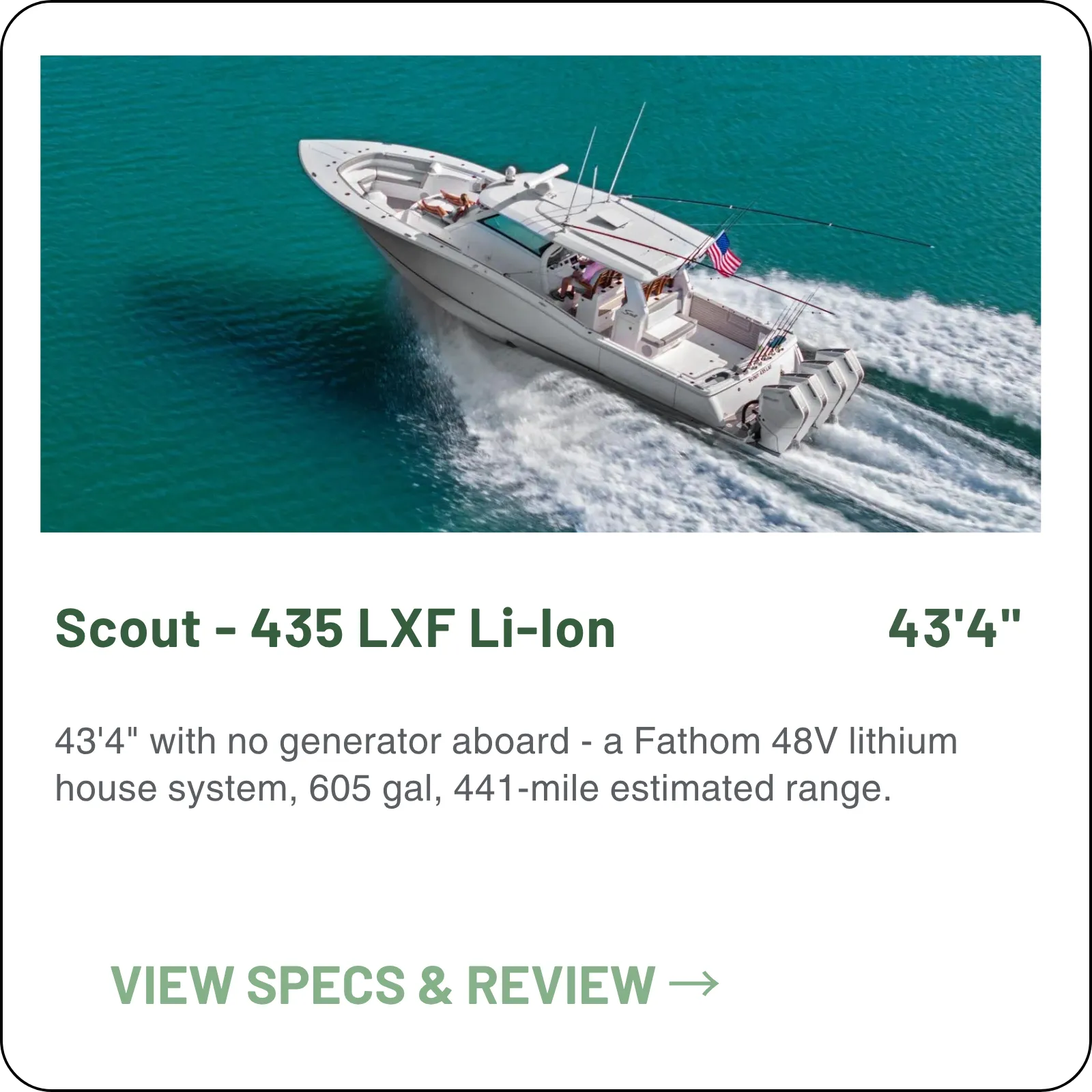
43'4" with no generator aboard - a Fathom 48V lithium house system, 605 gal, 441-mile estimated range.
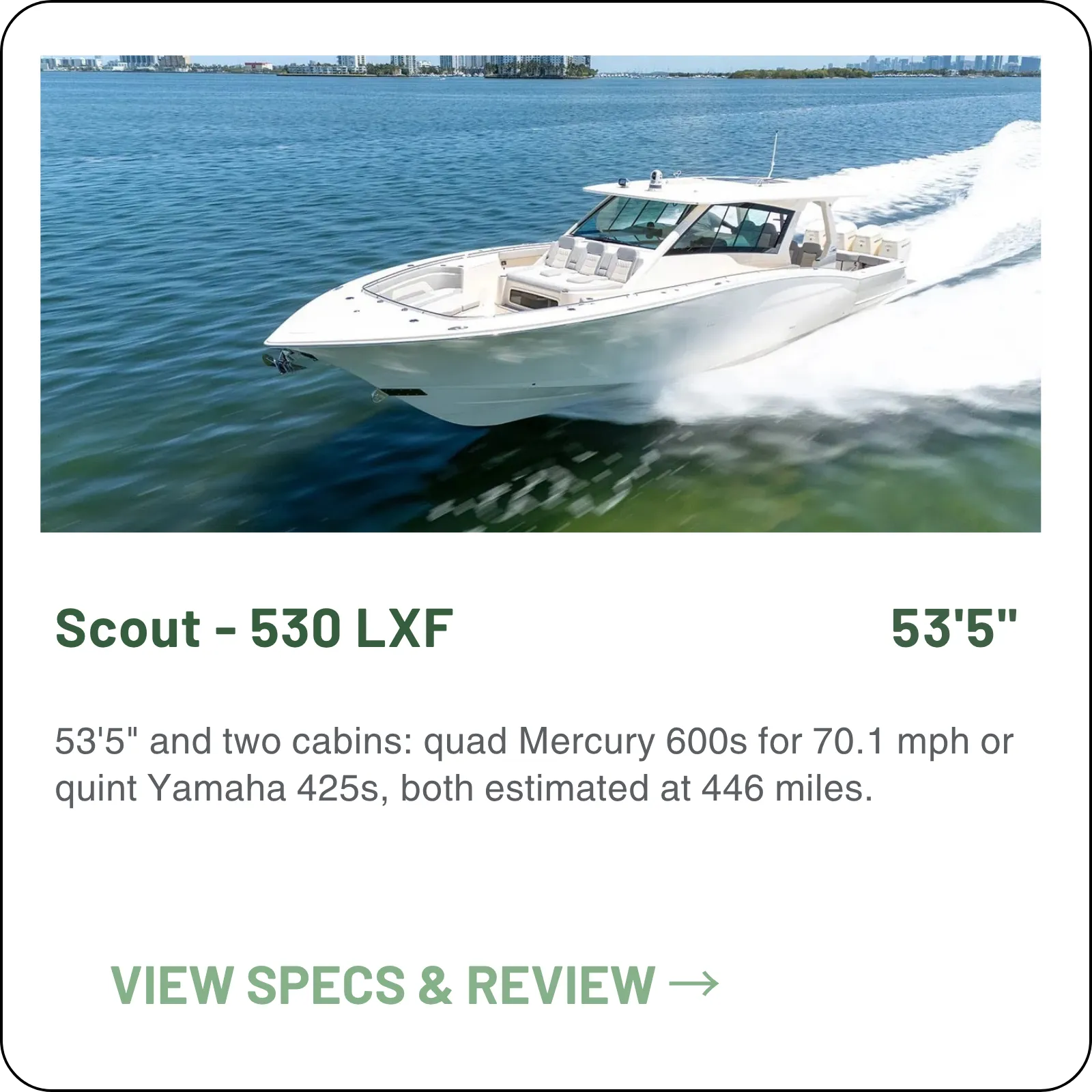
53'5" and two cabins: quad Mercury 600s for 70.1 mph or quint Yamaha 425s, both estimated at 446 miles.

Don't see the LXF model you're after — or a brand-new launch? Request specs through Yacht Specs Direct.
The 305 LXF at 30'1" is the entry point and the only hull here outside Scout's epoxy-infusion programme — Scout applies that process from 33 feet up. It carries 212 gallons, 20 degrees of transom deadrise and a fully cushioned berth with an electric marine head inside the console. Scout's twin Yamaha 300 bulletin records 60.5 mph at 5,800 rpm and best economy at 28.8 mph. Rated to 800 hp against a 500 hp cruising recommendation.
The 330 LXF at 32'9" is the first S-Class hull and the first epoxy-infused one. The deadrise jumps to 24 degrees — four more than the 305 — on 9,545 lbs of dry hull, and the stepped bottom is what keeps that weight from costing at the fuel dock. 265 gallons; twin Mercury Verado 300s run 55.2 mph at 6,000 rpm with best efficiency at 39.4 mph. Rated to 900 hp, though the largest package Scout actually bulletins is twin Yamaha 425s.
The 357 LXF at 35'3" is where the engine decision starts to define the boat. Twin Yamaha 450 XTOs top 62.1 mph and hold 1.21 mpg at a 35.0 mph cruise; triple Mercury 400 V10s top 72.2 mph and cut nought-to-thirty from 11.95 to 7.37 seconds. Same epoxy-infused, dual-stepped hull, 22 degrees of deadrise, 319 gallons, and genuine fishing capacity — 43-gallon fish boxes each side, a 60-gallon transom box, a 47-gallon aerated baitwell. Air conditioning is an option, tied to the Garmin helm package.
The 377 LXF at 37'7" is the carbon boat and the quiet one. A 5,500-watt, 400-amp-hour lithium bank runs 120V air conditioning and heat with no generator aboard. Its two published packages finish 0.1 mph apart at the top — 68.0 mph on triple Mercury 400 V10s, 67.9 on twin 600 V12s — and separate on cruise character instead, 39.6 mph against 44.4. Note the deadrise: 19.5 degrees, deliberately flatter than the 357 and the 400.
The 400 LXF at 39'7" is the one with a cabin you stand up in — 6'4" of headroom, a convertible queen, an enclosed shower, a galley. An 8 kW diesel generator and 12,000 BTU of air conditioning come as delivered. The two engine packages are genuinely different boats: quad Mercury 400 V10s at 71.5 mph, twin Mercury 600 V12s at 62.6. Optional saddle tanks take fuel from 395 to 509 gallons. Scout's older bulletins and its current flyer disagree on the tank figure and the horsepower ceiling — worth confirming against your own build sheet.
The 400 LXF Li-Ion is that same 39'7" boat with the generator taken out. Scout describes it as an alternative version of the 400 LXF, running a 48-volt lithium-ion bank charged by the Mercury engines in place of the 8 kW diesel, with the same 12,000 BTU air conditioner, the same 6'4" cabin and 6'3" head, 395 gallons standard and 509 with the saddle tanks, and 22 degrees of deadrise on a 14,940 lb carbon-epoxy hull. One bulletin belongs to this boat: triple Mercury 400 V10s with a Seakeeper and the Fathom system, tested March 2025 — 62.7 mph at 6,400 rpm, 0.87 mpg held from 36.6 all the way to 43.4 mph, an estimated 343 miles on the standard tank and 442 with the saddles. Read the spec table carefully: its 355- and 458-mile range rows belong to quad Mercury 400s — match any quoted figure to the engines actually on the transom. Scout publishes identical length, beam, draft, deadrise, dry and rigged weights, tanks and cabin dimensions for the two boats, so deleting the generator buys no documented weight saving — it buys one fewer system.
The 425 LXF at 42'2" is where the line stops feeling like a large center console and starts feeling like a small express. 545 gallons, an enclosed head with a shower, a standard 8 kW generator, and 17,064 lbs of carbon-epoxy hull before engines. Two packages, both bulletined with a Seakeeper aboard: triple Mercury 600 V12s at 72.5 mph top with a 41.6 mph cruise returning 0.75 mpg, or quad Mercury 400 V10s at 69.6 mph and 38.8 mph at 0.78. Three miles an hour and one fewer engine — read that as a maintenance decision rather than a performance one.
The 435 LXF Li-Ion at 43'4" is the 377's idea grown up: a Fathom 48-volt lithium-ion house system and no generator aboard, on a hull carrying 605 gallons, 22 degrees of deadrise, 6'6" of cabin headroom and 6'3" of standing room in the head. Triple Mercury 600 V12s run 70.2 mph at 6,400 rpm and cruise 43.8 mph at 0.73 mpg. It is fourteen inches longer than the 425 and carries sixty more gallons, but the difference that matters is the diesel generator that is not there.
The 530 LXF at 53'5" is the largest boat in this hub — two cabins, a queen master stateroom, 875 gallons and 27,980 lbs of carbon-epoxy structure, with Scout extending the infusion past the hull to the deck, hardtop and flybridge. Scout's own flyer calls it "our flagship". Two packages: quad Mercury 600 V12s at 70.1 mph with a 42.6 mph best-efficiency cruise, or quint Yamaha 425 XTOs at 66.2 mph and 40.9 mph. Both return 0.51 mpg at that cruise, so this choice is about engine count, service network and feel rather than economy. It is not the largest boat Scout builds — the 670 LXF and 670 LXS sit above it at 66'9" in Scout's 67 LX Series.

The LXF line is the clearest example I can point at of a builder spending money where the buyer cannot see it. Epoxy infusion and carbon laminate cost Scout more per hull and photograph exactly the same as a wet layup. What you get for it is a boat that carries serious horsepower and serious deadrise without the heavy, soft ride that usually comes with a big center console.
The step that matters most in this line is from the 305 to the 330. That is where the infusion starts, where the deadrise goes from 20 to 24 degrees, and where the boat stops being a very good day boat and starts being an offshore boat. If your run involves crossing something on a bad afternoon, start at the 330.
The three biggest boats here move the line somewhere new, and it is worth naming what changed. At 42, 43 and 53 feet you are buying a center console with an enclosed head, a real berth and — on the 435 Li-Ion — no diesel generator at all, because the lithium bank does that work. The 435 LXF Li-Ion is the one I find most interesting. Taking the generator out of a 43-foot boat removes a fuel system, an exhaust, a service schedule and a noise you stop noticing only because you got used to it, and Scout has now done it three times — the 377 LXF, the 400 LXF Li-Ion and the 435 LXF Li-Ion. Ask hard about battery life and replacement before you decide it comes free, because that is the part no brochure in this segment covers.
The other decision I would slow down on is engines, especially on the 357, the 400 and the 530. Scout publishes separate performance sheets per package and they are not small differences — nine miles an hour and two whole engines apart on the 400, and four miles an hour between quad V12s and quint XTOs on the 530 for identical fuel economy at cruise. Get the bulletin for the exact package you intend to order, and read the cruise row rather than the top-speed row. That is the number you will actually live with.
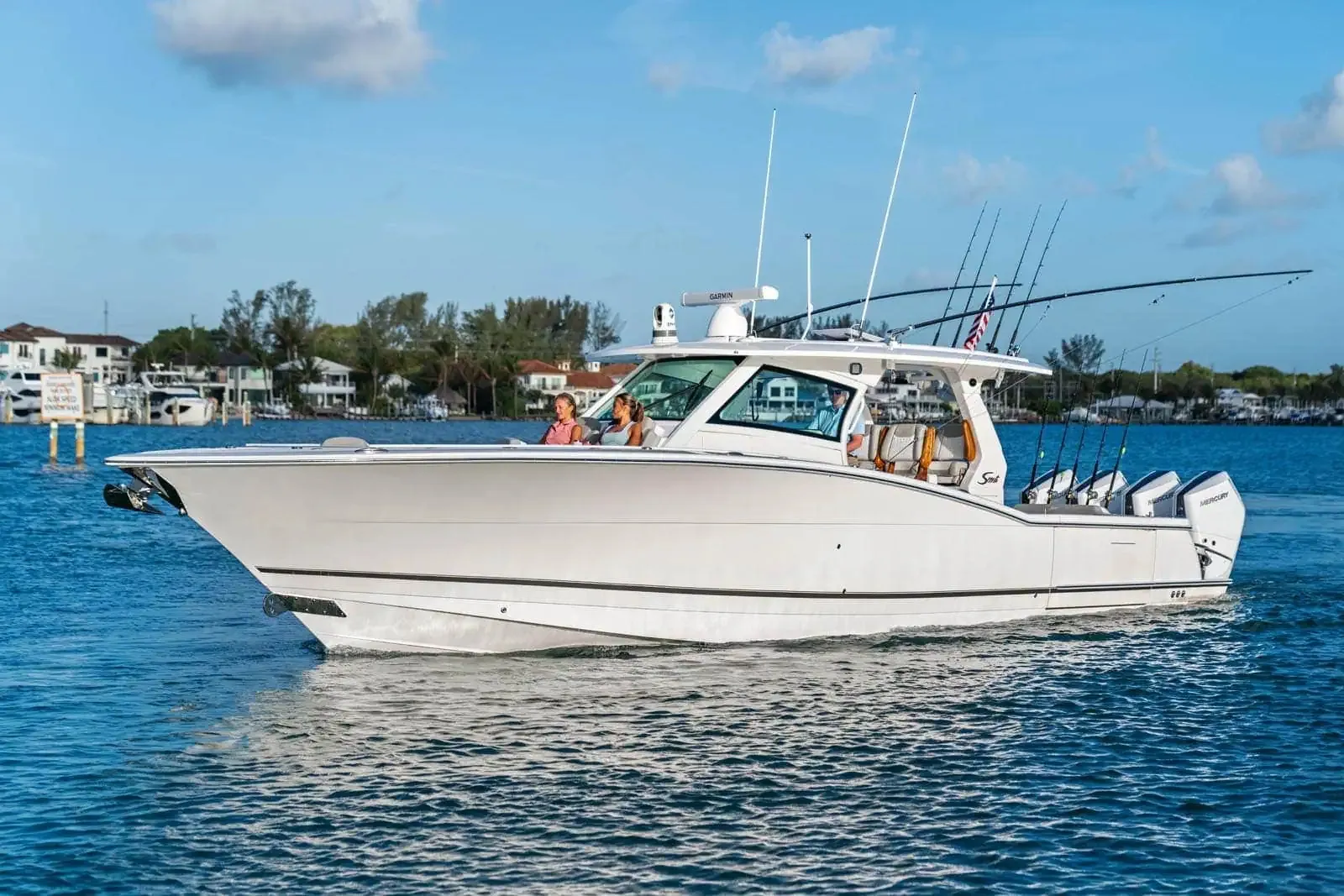
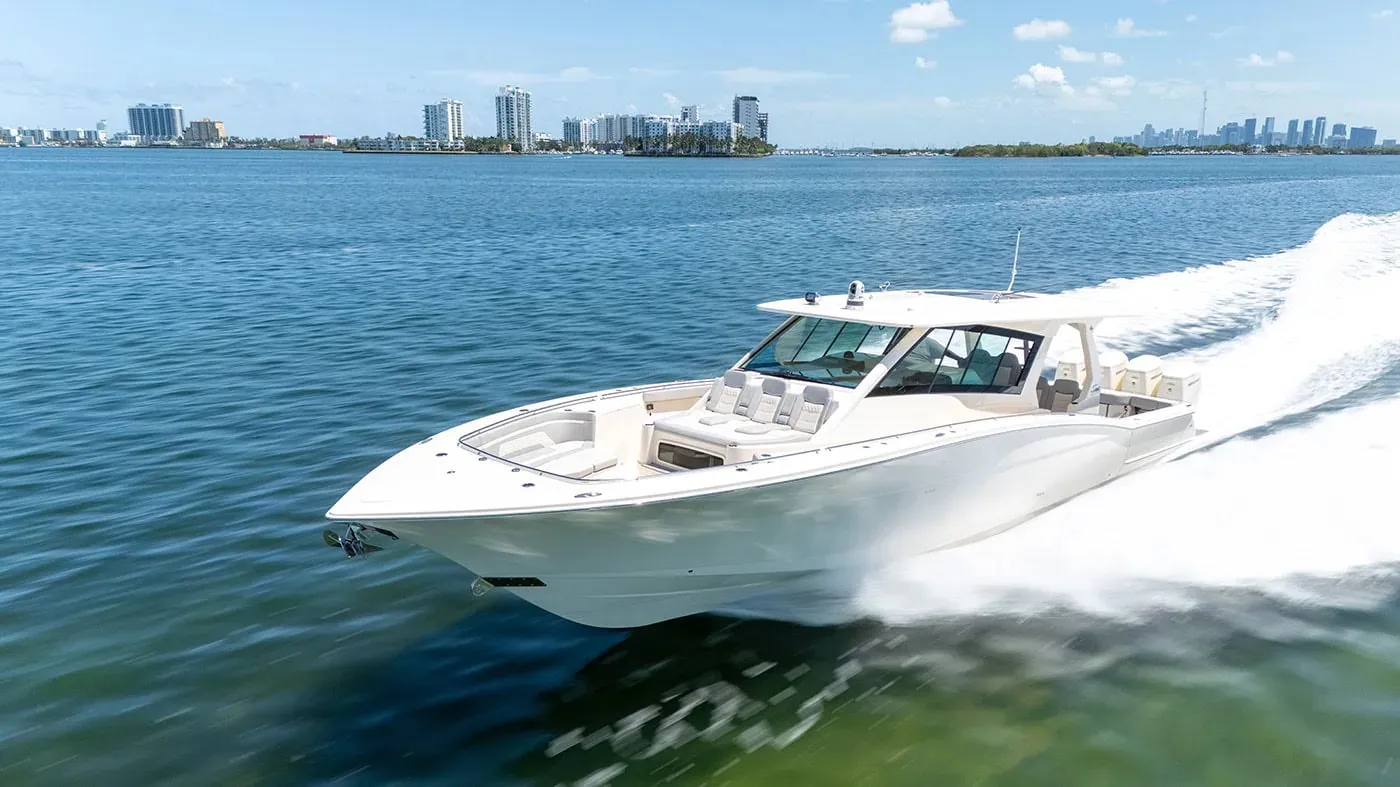
Videos courtesy of Scout Boats.
From Scout's own tested performance bulletins, issued per engine package. Each bulletin gives a top speed at a stated rpm, acceleration times, a best-economy row in mpg and an estimated range that Scout footnotes as dependent on cruising speed and sea conditions — so every figure belongs to a specific package, and the first thing to check on any quoted number is which engines it was tested with.
How much tested data comes with a hull varies: six bulletins exist for the 425 LXF and five for the 530 LXF, while the 435 LXF Li-Ion has one, for triple Mercury 600s. Count the 400 LXF Li-Ion's carefully: three sheets are listed on its page, and only the triple Mercury 400 V10 bulletin was run on the Li-Ion boat itself. Recommended cruising horsepower is published for the 305 LXF at 500, the 330 LXF at 600 and the 425 LXF at 1,200. Match every quoted figure to its package — on the 357 LXF the two published packages are ten mph apart.
LXF is Scout's luxury center console range, and the nine models here run from 30'1" to 53'5": the 305 LXF, 330 LXF, 357 LXF, 377 LXF, 400 LXF, 400 LXF Li-Ion, 425 LXF, 435 LXF Li-Ion and 530 LXF.
From the 330 up, Scout also files them as S-Class — its own designation for luxury models 33 feet and over — and that is where the construction and the standard-equipment lists step up together. Every one of them is NMMA and Yacht Certified. Scout is family owned and has built at Summerville, South Carolina since 1989. LXF is not the top of the range: above it Scout runs a separate 67 LX Series, the 670 LXF and 670 LXS, both 66'9".
Three bands, and the boundary is length. Scout's epoxy-infusion programme applies from 33 feet up, so the 305 LXF below that line is built to Scout's brand-level standard — 100% hand-laid construction, with carbon fiber and epoxy on select models.
The 330 LXF and 357 LXF use epoxy-infused E-glass over a dual stepped bottom, which Scout's published laminate comparison puts at approximately 2.4 pounds per square foot. From 37 feet up — the 377 LXF, 400 LXF, 400 LXF Li-Ion, 425 LXF, 435 LXF Li-Ion and 530 LXF — Scout switches to a carbon fiber and E-glass hybrid in the epoxy infusion at approximately 1.7 pounds per square foot, and on the 530 the stringer grid is carbon-infused as well. Its stated figure for a traditional chopper-gun layup is approximately 4.2. The band now has a new top end outside this hub: the 67 LX Series flyer specifies a carbon-fiber epoxy-infused hull for the 670 LXF and 670 LXS, with carbon and fiberglass infused stringers and deck and a carbon-fiber epoxy-infused hardtop frame support.
Tell us how you plan to use the boat — guests, range, crew or no crew — and we'll give you the straight story on where in the LXF series you belong, new or brokerage.
Explore All Scout Boats ModelsOr reach Tony directly: TS@MintedYachts.com · +1 (404) 805-9819