
August 21, 2026
Scout 425 LXF - Triple 600s Win the Top End, Quad 400s Win the Launch
Scout's 425 LXF is a 42'2" S-Class center console on an epoxy-infused carbon hull with 545 gallons of fuel, 22 degrees of transom deadrise, …
Read the articleExpert Review, Technical Specifications & Market Analysis
| Feature | Specifications |
|---|---|
| Overall Length | 42'2" |
| Beam | 13'1" |
| Draft | 2'4" |
| Displacement | 17,064 lbs |
| Engines | Triple Mercury 600 (3 x 600 HP) or Quad Mercury 400 V10 (4 x 400 HP) |
| Fuel Capacity | 545 gal |
| Water Capacity | 66 gal |
| Cabins / Heads | 1 Cabin / 1 Head |
| Max Speed | 72.5 mph @ 6,403 RPM (triple Mercury 600 V12s); 69.6 mph @ 6,400 RPM (quad Mercury 400 V10s) |
| Cruise Speed | 41.6 mph @ 4,000 RPM at 0.75 mpg (triple Mercury 600 V12s); 38.8 mph @ 4,000 RPM at 0.78 mpg (quad Mercury 400 V10s) |
Source: Spec & Photos courtesy of Scout. Specs verified by Tony Smith, USCG 100 Ton Master, on August 20, 2026.
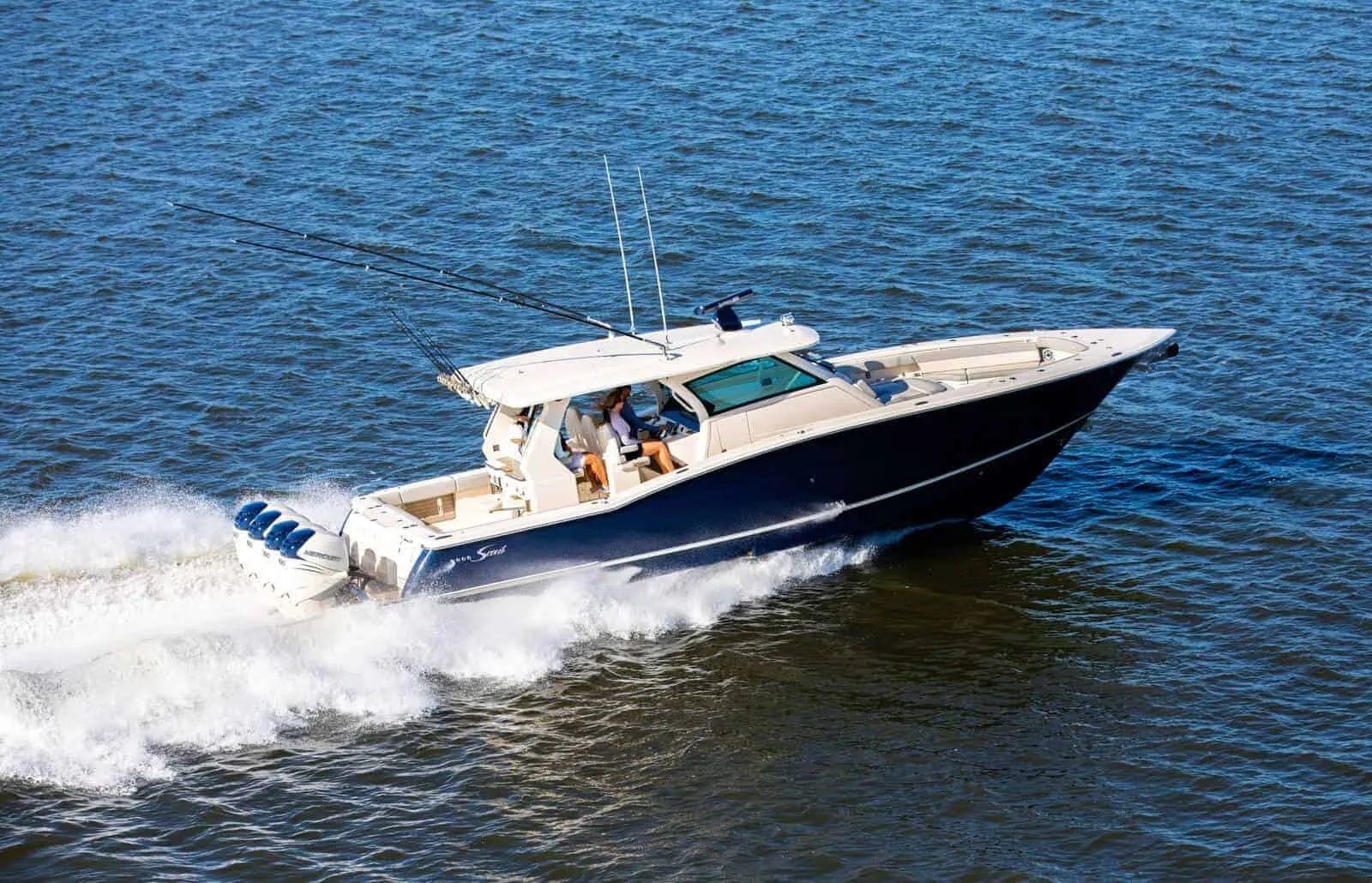
One 42'2" hull, two published bulletins: triple Mercury 600s for 72.5 mph, or quad Mercury 400 V10s that reach 30 mph 0.72 seconds sooner.
Part of the Scout LXF series — see how owners step up through the lineup.

Nearly every time a buyer sits down with two engine packages, the ranking is obvious within a minute - one is faster everywhere and costs more, and the conversation is really about budget. The 425 LXF does not work like that, and it is the most interesting thing about the boat. Triple Mercury 600 V12s run 72.5 mph. Quad Mercury 400 V10s run 69.6. But the quads hit 30 mph in 7.16 seconds against 7.88 for the triples, and they post the better economy number in Scout's own table at 0.79 mpg. You cannot rank these two. You have to actually know how you use the boat.
Here is how I would decide it. If your day is a long run offshore and a long run home, take the triples: 2.9 more mph over an hour is real, and three engines instead of four is one fewer set of props, one fewer service interval and a transom you can fish around. If your day is shorter hops with a loaded boat and people aboard, take the quads - the launch is where you will actually feel the difference, and the rigged dry weight is about a thousand pounds lighter, which your lift will notice. What I would not do is let anyone tell you the four-engine boat is automatically the fast one, because on this hull it is not.
The part I would push you on is the cabin, and not because it is bad. It is genuinely good - a full-size toilet, a separate enclosed shower with its own door, a galley with a cooktop and a microwave, and 12,000 BTU of air conditioning running off a generator that is already aboard. But whether it fits you standing up is the one question you can only answer by standing in the boat. Do that before you sign, along with confirming the fuel capacity on the build sheet for your model year.
Video courtesy of Scout.
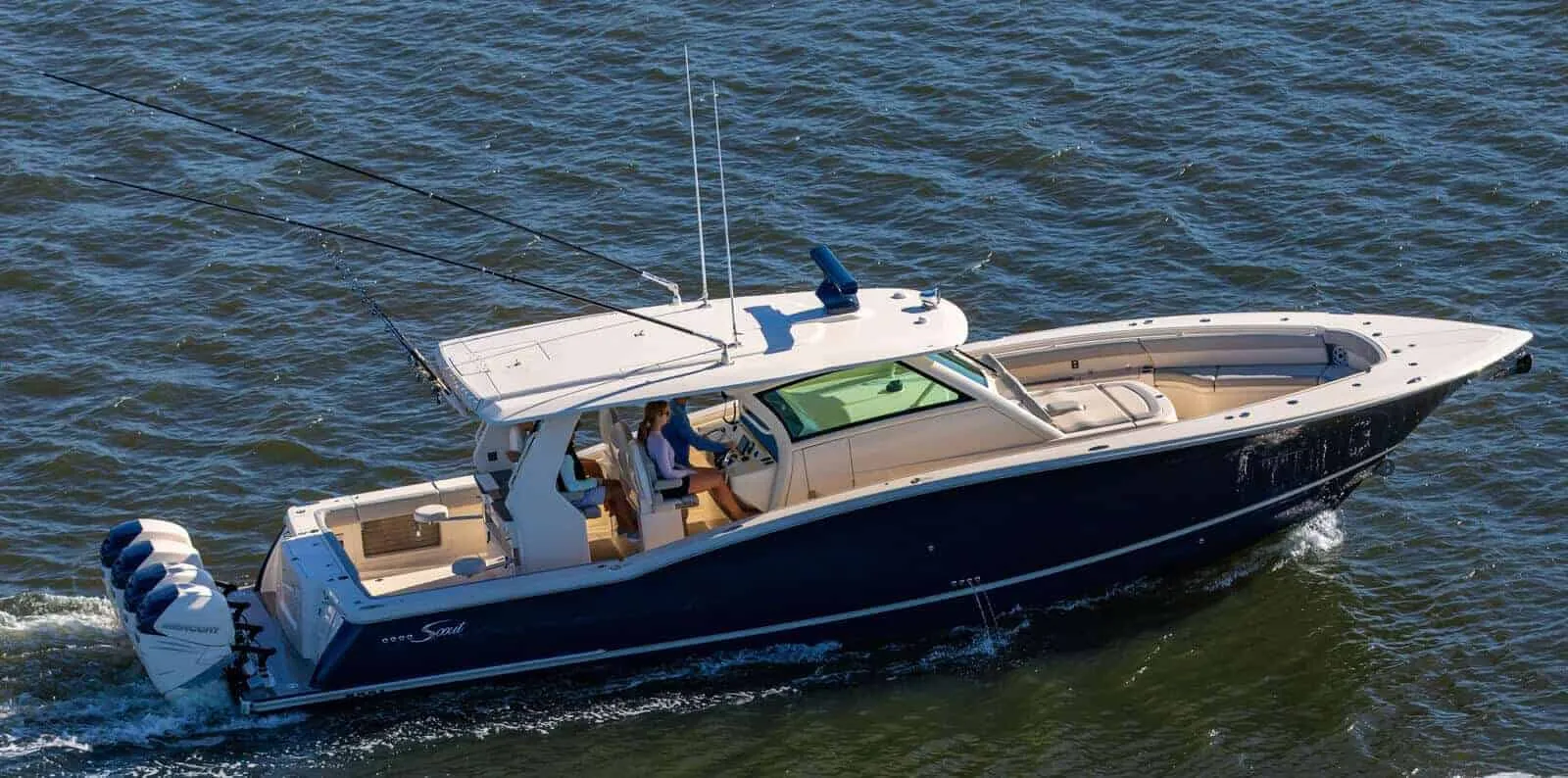
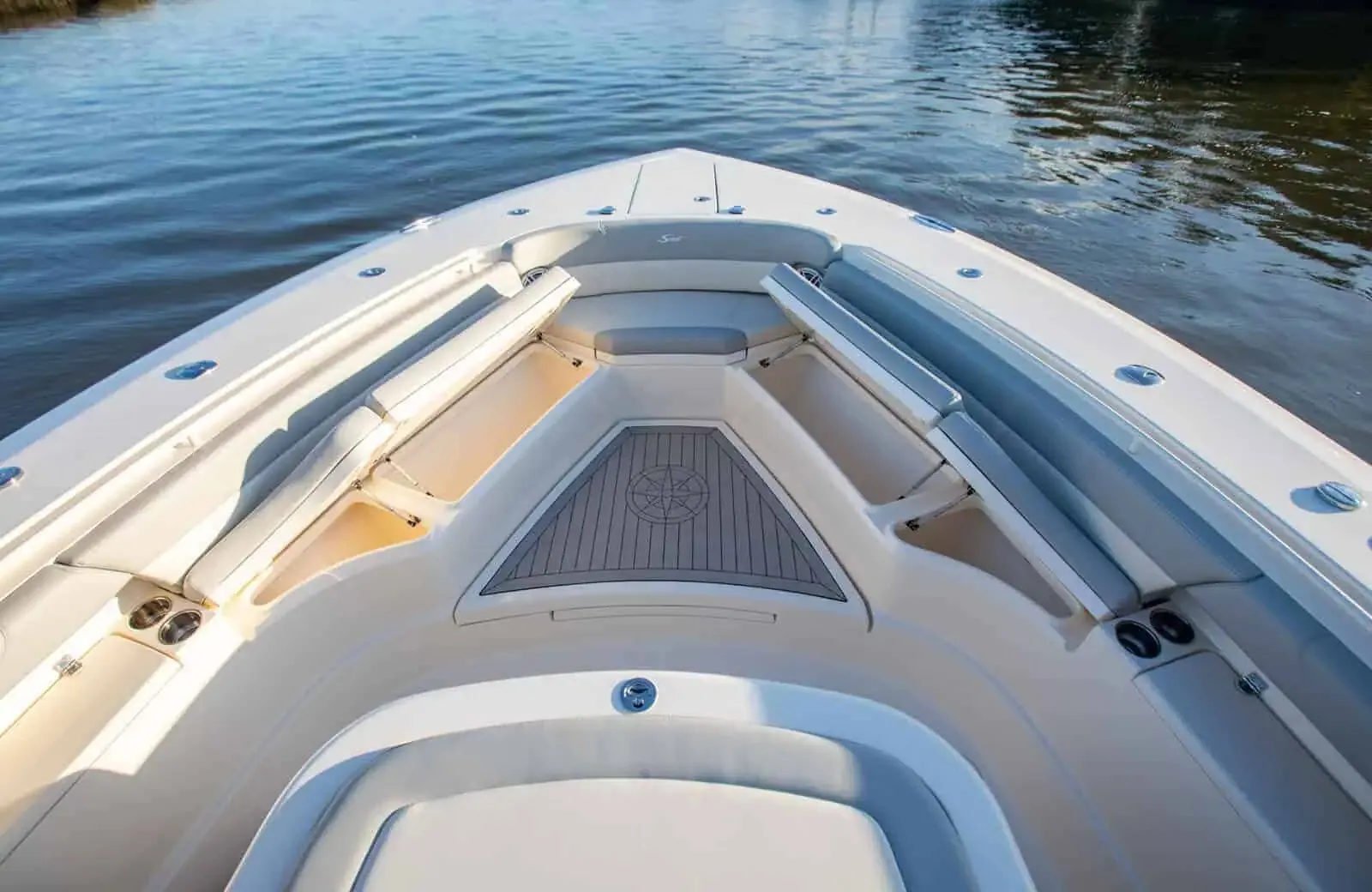
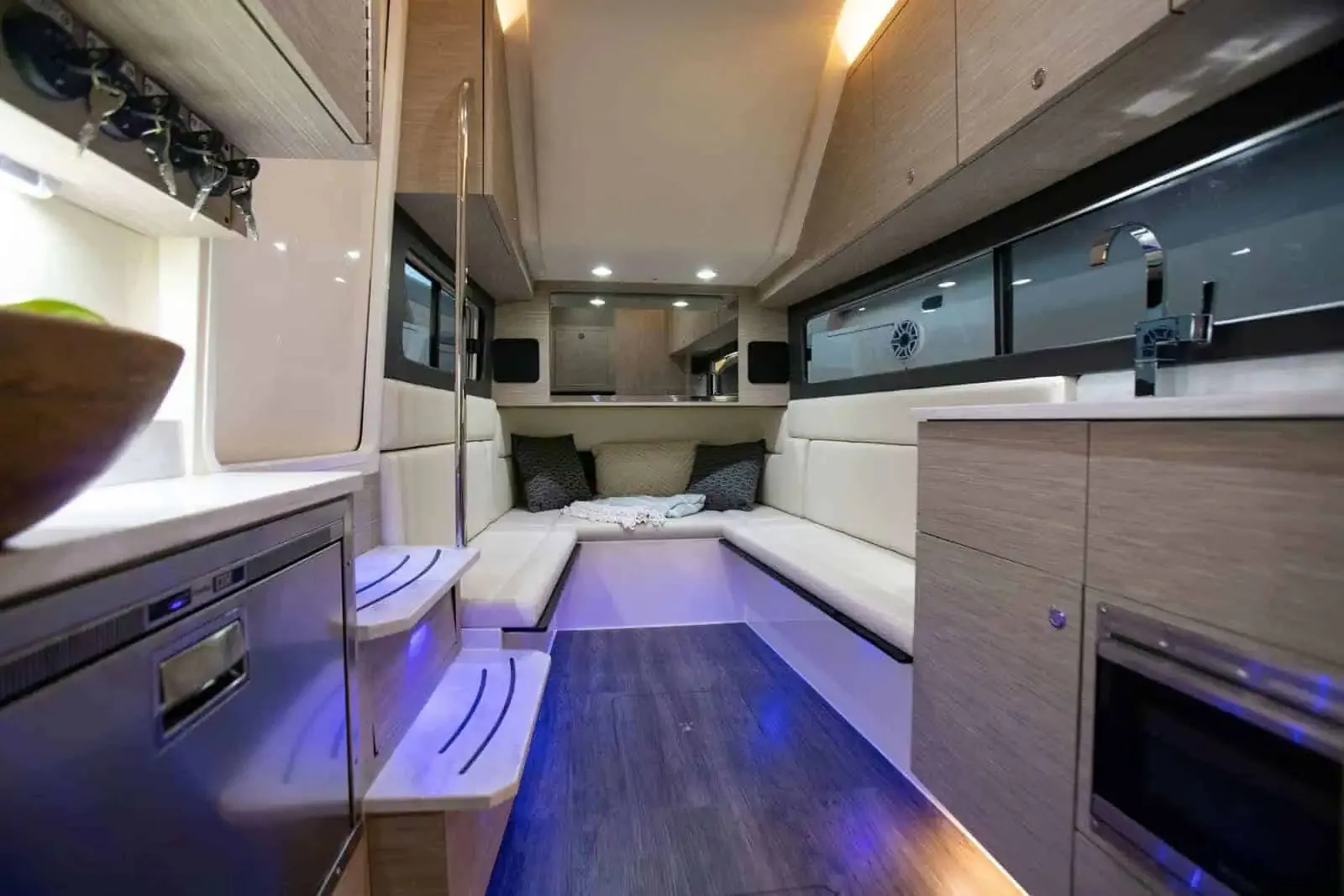
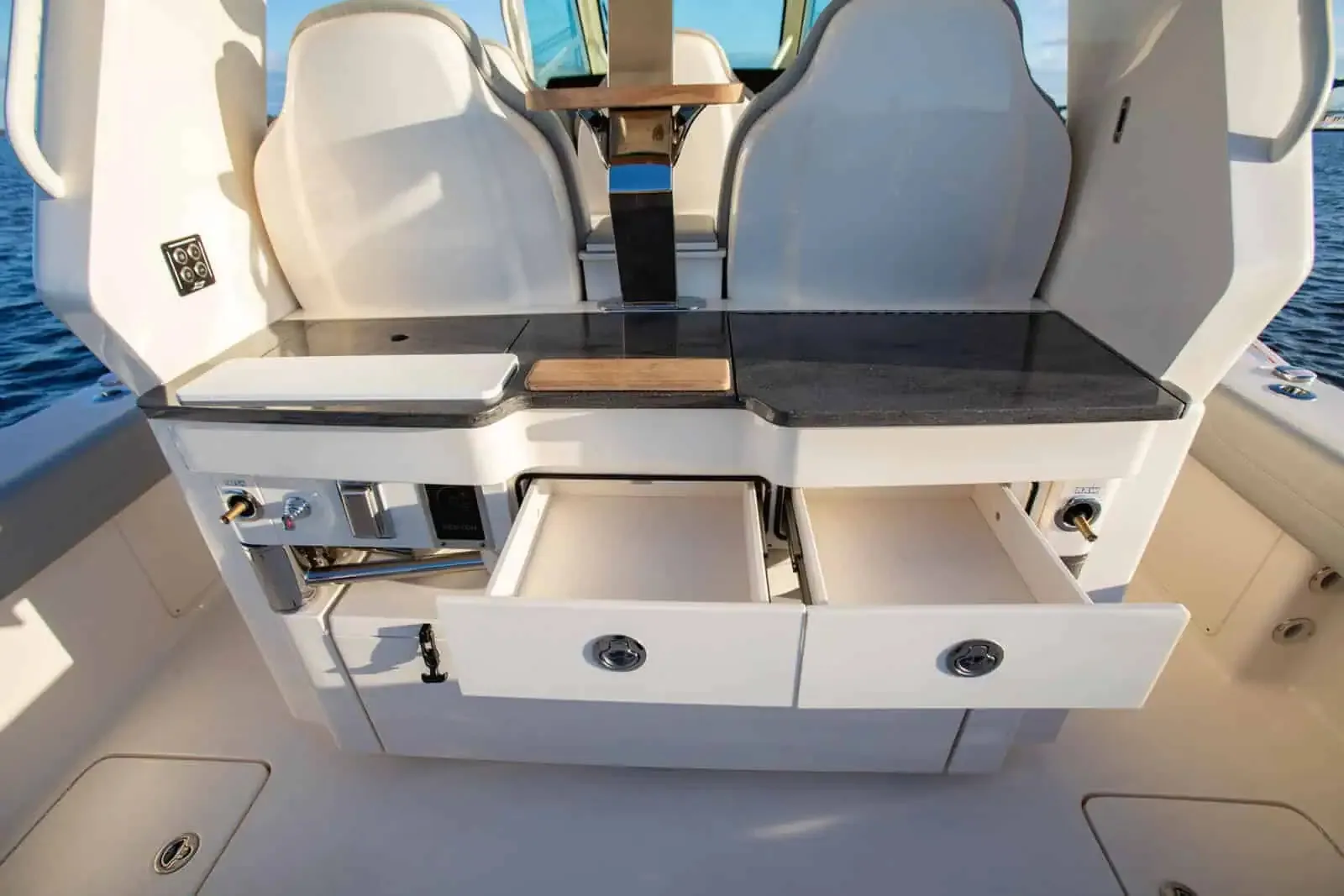
Photos courtesy of Scout.
The Scout 425 LXF is a 42'2" S-Class center console - Scout's designation for its luxury models 33 feet and up - built in Carbon Epoxy Construction, with carbon fiber and E-glass as the primary reinforcements in the epoxy infusion, over Scout's double stepped bottom. It carries 22 degrees of transom deadrise on a 13'1" beam at 17,064 lbs dry without engines, draws approximately 28", and is rated to 1,800 hp. Fuel is 545 gallons and fresh water 66.
The standard sheet is unusually complete. An 8 kW generator on its own 26-gallon diesel tank, a 12,000 BTU air conditioner, C-Zone digital switching, a Seakeeper 4.5, three Garmin 8616 screens, 50-amp Glendinning shore power, three captain's helm chairs plus second-row seating, and heated seats in both rows all arrive as delivered. The dynamic leaning post is the piece people remember: an electrically actuated fiberglass drawer cooler, a summer kitchen with grill, sink and cutting board, and swivel barstools that stow away when the fishing starts.
Deck capacity matches the length: port and starboard floor fish boxes at 92 gallons each with overboard diaphragm discharge, an 80-gallon cockpit baitwell, ten stainless flush-mount gunnel rod holders, eight pull-up flush-mount cleats, a full transom walk-thru platform with an Armstrong dive ladder, a synthetic teak swim platform, a port-side hydraulic beach platform and an aft under-deck systems room. Scout builds the 425 LXF in Summerville, South Carolina and the boat is NMMA and Yacht Certified.
Scout rates the 425 LXF to 1,800 hp and publishes a recommended cruising horsepower of 1,200 - a manufacturer number to plan the engine decision against.
Six tested bulletins exist for the 425 LXF. Two cover the engine packages on the current menu, and they split the honors rather than stacking them. Triple Mercury 600 V12 Verados (Verado 12 stainless props, 37p/33p/37p) top out at 72.5 mph at 6,403 rpm, reach 20 mph in 5.26 seconds and 30 mph in 7.88, and peak at 0.75 mpg at 41.6 mph (4,000 rpm).
Quad Mercury 400 V10s (Revolution 4 stainless, 25p) top out lower at 69.6 mph at 6,400 rpm, but get moving faster: 4.61 seconds to 20 mph and 7.16 seconds to 30. Best economy in Scout's own table is 0.79 mpg at 44.9 mph (4,500 rpm), with 0.78 mpg at 38.8 mph. So the triples win the top end by 2.9 mph while the quads win 0-30 by 0.72 seconds and post the higher peak mpg. That is the reverse of how the two packages usually rank on a Scout hull, and it is the whole argument at the order desk.
One caution on the paperwork. Both bulletins predate the current spec sheet and carry older figures - 16,800 lbs dry without engines, and 500 gallons of fuel on the triple-600 sheet - where the current model page and flyer list 17,064 lbs and 545 gallons. Confirm both against the build sheet for your model year.
The console cabin is a genuine cabin rather than a berth with a curtain. Scout fits an enclosed head area with a full-size toilet and a hot/cold sink, a separate enclosed shower area with a door and sump, a sitting area with a convertible berth, a galley sink, a single-burner glass cooktop, a microwave and a drawer refrigerator. A 32" LED TV, port and starboard windows with privacy shades, LED accent lighting, stainless accents and AC outlets in both the head and the berth finish it. The 12,000 BTU air conditioner runs off the standard 8 kW generator, so the cabin stays cold at anchor without a refit. If standing room below decides your purchase, stand in the cabin before you order rather than after.
Fresh water is 66 gallons and the holding tank is 16 - the practical limit on how long the boat stays comfortable between pump-outs. On deck, the forward sun lounge has dry box storage, the forward bench carries port and starboard gear storage boxes, and forward glove boxes include a charging station.
The 425 LXF sits above the 400 LXF and immediately below the 435 LXF Li-Ion in Scout's LXF line, inside the yard's carbon band - the epoxy-infused carbon fiber and E-glass laminate Scout reserves for its 37-foot and larger models rather than the epoxy-infused E-glass it uses from 33 to 35 feet.
Its closest relative is the boat directly above it, and the comparison is unusually clean. The 435 LXF Li-Ion is 14 inches longer on the same 13'1" beam, the same 22-degree bottom and the same 1,800 hp ceiling. What separates them is systems: the 425 carries an 8 kW diesel generator and a 26-gallon diesel tank, the 435 replaces both with a Fathom 48V lithium house system and carries 60 more gallons of fuel. Buyers cross-shopping 42-foot offshore center consoles are usually weighing deadrise, how much of the boat is standard before options, and whether they want a genset aboard at all.
Two practical notes. Scout lists an upper helm flybridge and a 12 kW generator upgrade on the 425's option sheet, along with a hardtop deletion credit. And Scout's own model page currently flags limited availability for this model, which is worth knowing before you build a shortlist around it.
Scout is family owned, has built in Summerville, South Carolina since 1989, and the 425 LXF is NMMA and Yacht Certified.
The 425 LXF suits the owner who wants a fishing boat that does not make the family pay for it. You get 92-gallon floor fish boxes, an 80-gallon baitwell and ten gunnel rod holders on one side of the ledger, and an enclosed head, a separate shower, a galley and 12,000 BTU of air conditioning on the other - with a generator aboard as standard rather than as a line item.
It is a strong fit if your slip and lift take a 13'1" beam and 17,064 lbs before engines, if 22 degrees of deadrise matches your water, and if 545 gallons covers the way you actually run. It is also the hull to pick if you want a manufacturer cruising rating to plan around: 1,200 hp recommended against an 1,800 hp ceiling is a real number.
Settle the engines before anything else, because the two packages are genuinely different boats. Triple Mercury 600 V12s give you 72.5 mph and three engines to service. Quad Mercury 400 V10s give you 69.6 mph, 7.16 seconds to 30 mph instead of 7.88, and the higher peak economy at 0.79 mpg - at the cost of a fourth set of props and a busier transom to fish around.
It is the wrong boat if you want the simplest possible systems package - there is a diesel generator aboard with its own tank and service interval - or if guaranteed standing headroom below is non-negotiable and you cannot get aboard to stand in the cabin first. The 435 LXF Li-Ion answers the first objection and the 400 LXF, with its published 6'4" of cabin headroom, answers the second.
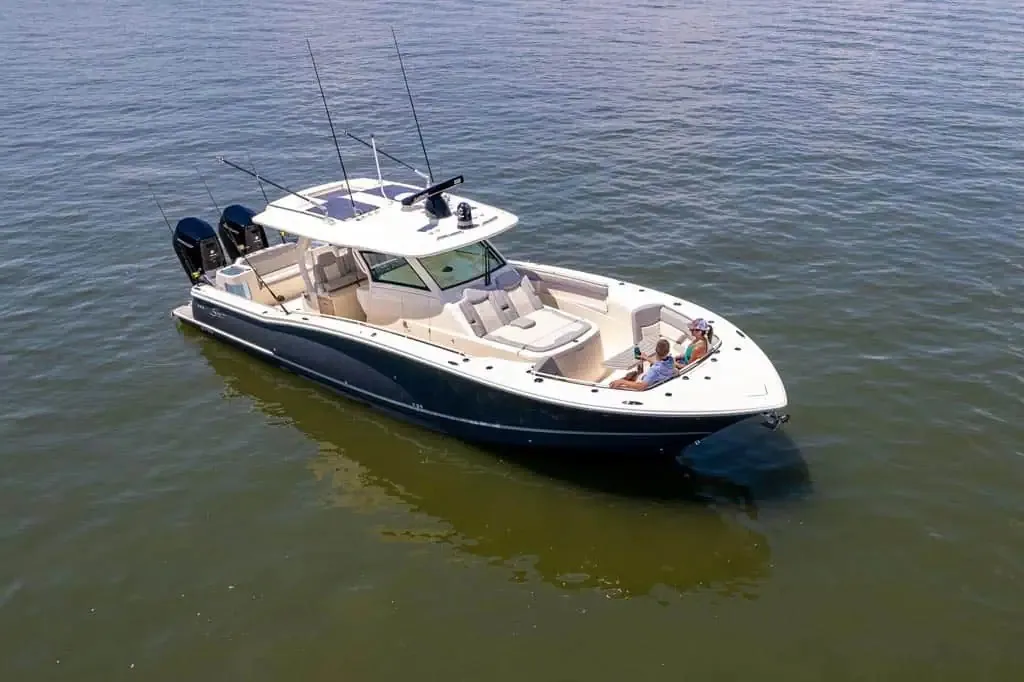
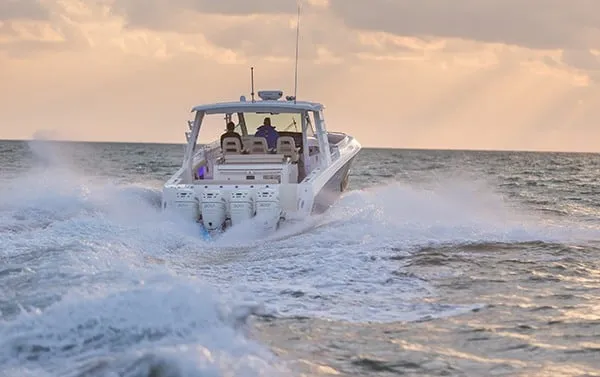
The generator decides it. The 425 LXF carries an 8 kW diesel generator on its own 26-gallon tank, running a 12,000 BTU air conditioner. The 435 LXF Li-Ion deletes the genset entirely and runs the same 12,000 BTU unit off a Fathom 48V lithium-ion system charged by the Mercury engines and from shore power.
Everything else is close. Both are 13'1" in the beam with 22 degrees of deadrise, rated to 1,800 hp. The 435 is 14 inches longer, carries 60 more gallons, and publishes its cabin dimensions — 6'6" headroom, 6'3" in the head, a 7'2" berth — where on the 425 you should stand in the cabin and check for yourself. Against that, the 425 gives you two tested engine packages to choose between and the 435 has only one.
Yes — a separately enclosed shower area with its own door and a sump, alongside an enclosed head with a full-size toilet and a hot and cold sink. That is a real bathroom rather than a hose in a berth, and it is a large part of why the 425 LXF works as a family boat as well as a fishing one.
The rest of the console cabin: a sitting area with a convertible berth, a galley sink, a single-burner glass cooktop, a microwave, a drawer refrigerator, a 32" LED TV, privacy shades and AC outlets in both the head and the berth. The 12,000 BTU air conditioner runs off the standard 8 kW generator. Fresh water is 66 gallons against a 16-gallon holding tank. Stand in the cabin before you order, so you know the headroom fits you.
Best economy per package, from its tested bulletins: 0.75 mpg at 41.6 mph on the triple Mercury 600s, and 0.79 mpg at 44.9 mph on the quad Mercury 400 V10s, with 0.78 mpg at 38.8 mph. Fuel is 545 gallons — work your own passage planning off those figures and the tank, with a reserve held back.
Scout also publishes a recommended cruising horsepower of 1,200 against the 1,800 hp ceiling, a planning figure worth having when you spec the transom. One paperwork note: both bulletins predate the current spec sheet, so confirm dry weight and tank size on the build sheet for your model year.
Two, and each belongs to a named package. Triple Mercury 600 V12 Verados on Verado 12 stainless props (37p/33p/37p) reach 72.5 mph at 6,403 rpm. Quad Mercury 400 V10s on Revolution 4 stainless (25p) reach 69.6 mph at 6,400 rpm. Both figures come from Scout's own tested bulletins.
Acceleration reverses the ranking. The quads hit 20 mph in 4.61 seconds and 30 mph in 7.16; the triples take 5.26 and 7.88. So the triples win the top end by 2.9 mph while the quads win the sprint to 30 mph by almost three quarters of a second — and post the higher peak economy at 0.79 mpg. That is the reverse of how the two usually rank on a Scout hull, and it is the whole argument when you spec the boat.