
August 21, 2026
Scout 530 LXF - Two Cabins, Eighteen Degrees, and Four Engines or Five
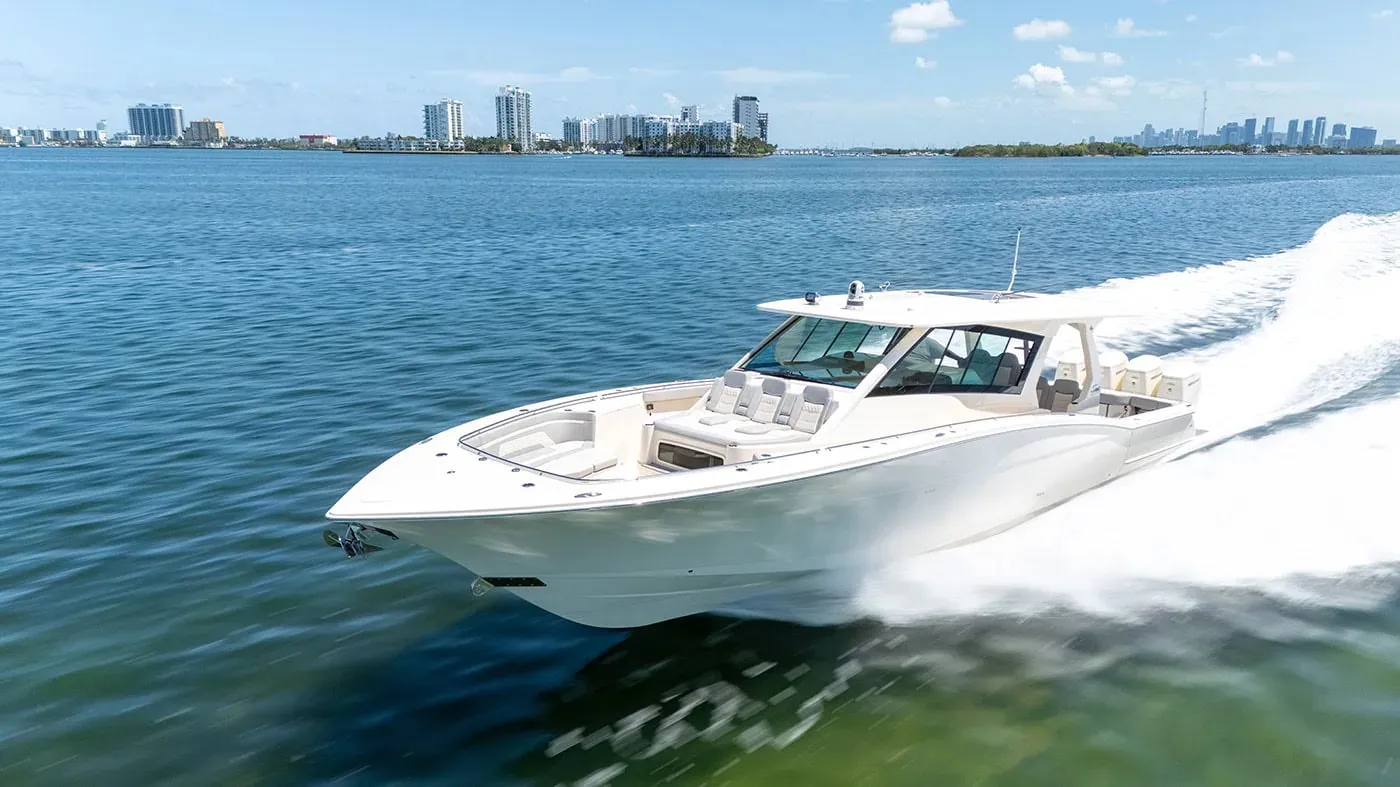
Scout's 530 LXF is a 53'5" carbon-epoxy center console with two cabins, a queen master stateroom, separately enclosed head and shower rooms …
Read the articleExpert Review, Technical Specifications & Market Analysis
| Feature | Specifications |
|---|---|
| Overall Length | 53'5" |
| Beam | 14'8" |
| Draft | 2'7" |
| Displacement | 27,980 lbs |
| Engines | Quad Mercury 600 V12 (4 x 600 HP) or Quint Yamaha 425 XTO (5 x 425 HP) |
| Fuel Capacity | 875 gal |
| Water Capacity | 100 gal |
| Cabins / Heads | 2 Cabins / 1 Head |
| Max Speed | 70.1 mph @ 6,400 RPM (quad Mercury 600 V12s); 66.2 mph @ 6,000 RPM (quint Yamaha 425 XTOs) |
| Cruise Speed | 42.6 mph @ 4,000 RPM at 0.51 mpg best fuel efficiency (quad Mercury 600 V12s); 40.9 mph @ 4,000 RPM at 0.51 mpg (quint Yamaha 425 XTOs) |
Source: Spec & Photos courtesy of Scout. Specs verified by Tony Smith, USCG 100 Ton Master, on August 20, 2026.
Two cabins, a queen stateroom and a separate enclosed shower in 53'5" - with 875 gallons under the deck and a choice of four Mercury 600s or five Yamaha 425s.
Part of the Scout LXF series — see how owners step up through the lineup.

I get a version of the same question every year: I want the accommodation of a cruiser, but I am not ready to give up the deck. The 530 LXF is the most complete answer I have seen to it in a center console. Two cabins. A queen master with rod storage under the bed. An aft double berth behind its own door. A head and a shower as two separate enclosed rooms, each with a skylight. A galley with a two-burner cooktop, a drawer freezer and an ice maker. And 32,000 BTU of air conditioning across two dedicated zones off a 15 kW generator, which is a different order of comfort from the single unit you get further down the range. None of that costs you the walkaround deck, the beach platforms or the baitwells.
Two numbers I would make sure nobody glosses over. The first is deadrise: 18 degrees, where the 425 and the 435 both run 22. That is not a downgrade, it is a different setup - this hull is 27,980 pounds dry before engines and it uses weight where the smaller boats use vee - but it does mean you should not assume the bigger boat is automatically the softer ride. Trial it in your own water. The second is the engine comparison, and here I want to be straight with you: the quad Mercury 600s post 70.1 mph and 7.8 seconds to 30, the quint Yamaha 425s post 66.2 mph and 10.90 seconds. Those two tests were run two years apart and, critically, the Yamaha boat was carrying 450 gallons of fuel while the Mercury boat had half a tank. The quads are the quicker package. Anyone who tells you the exact margin is making it up.
So what does the fifth engine actually buy? Not speed - 2,125 horsepower across five Yamaha 425s against 2,400 across four Mercury 600s, with the same 0.51 mpg best-cruise figure and the same 446-mile published estimate on both sheets. What it buys is one more engine than you need to get home, and thrust spread wider across the transom. That is a real thing to want, and it is a perfectly good reason to choose it. Just choose it for that reason rather than for a performance advantage that the bulletins do not support. And go in clear-eyed about ownership: a diesel genset with an 80-gallon tank, two air conditioning zones, a bow thruster and up to five outboards is a lot of boat to keep right. If that list is the part that worries you, the 435 LXF Li-Ion ten feet down the range deletes the generator entirely.
Video courtesy of Scout.
Photos courtesy of Scout.
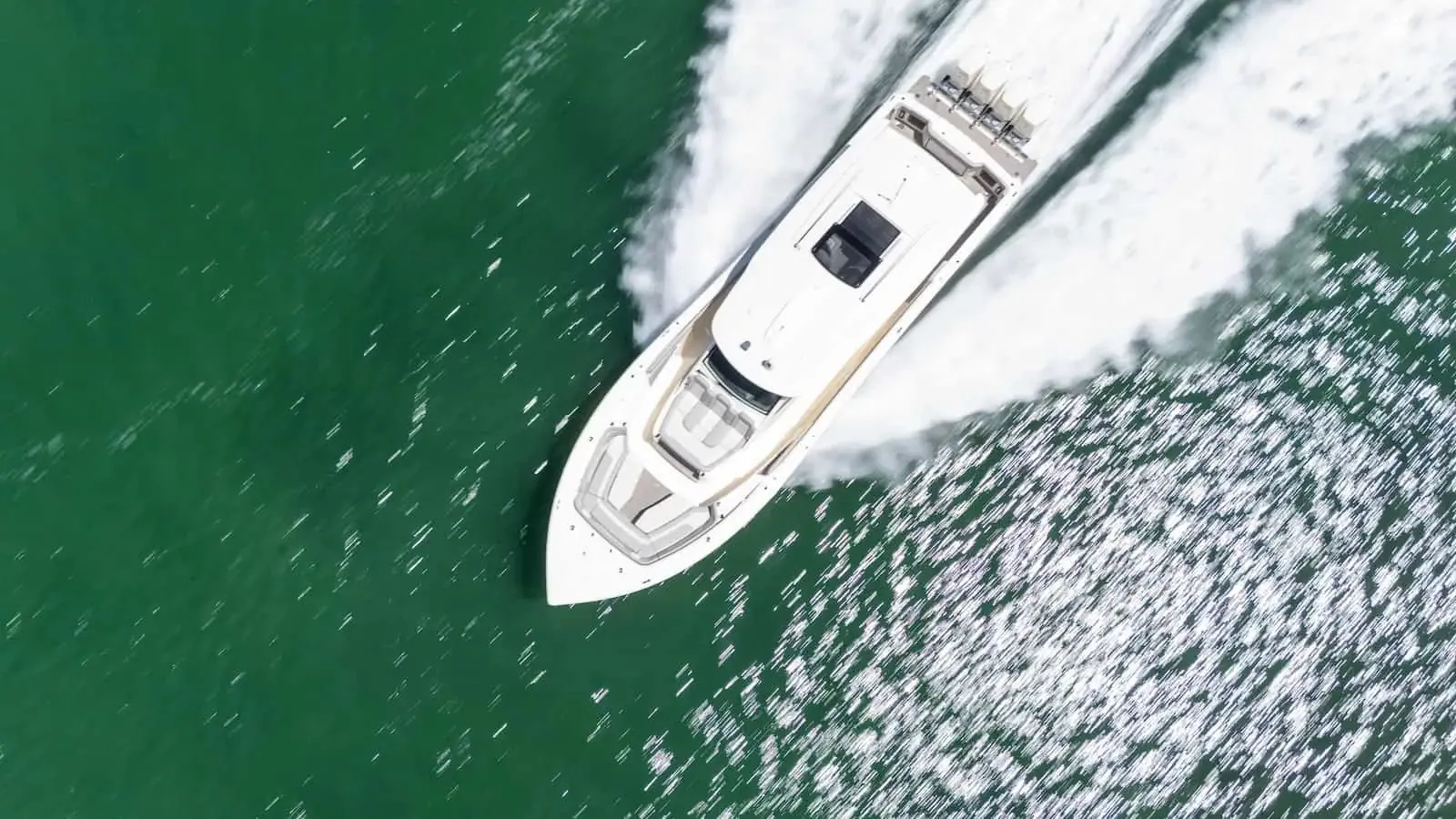
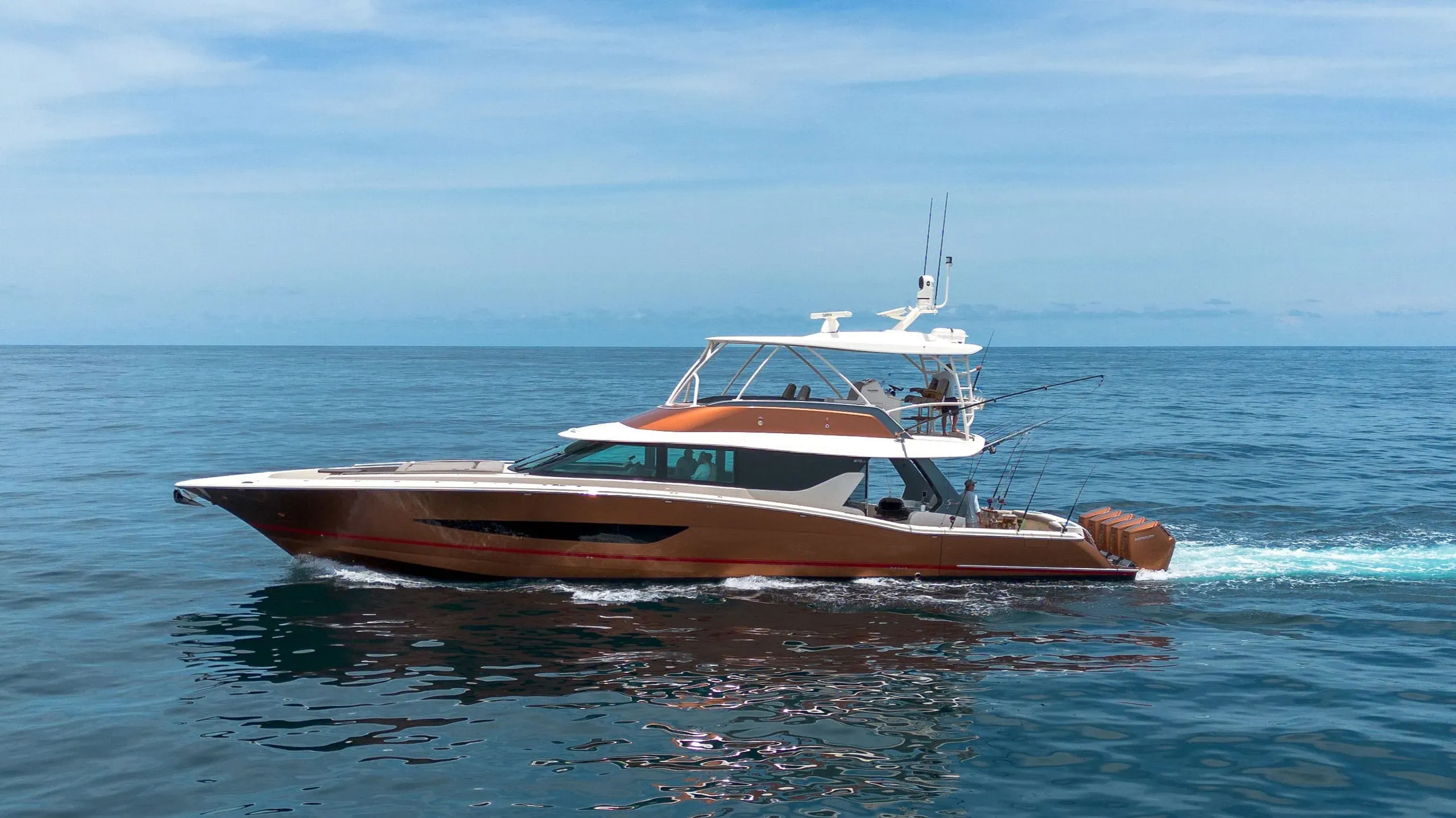
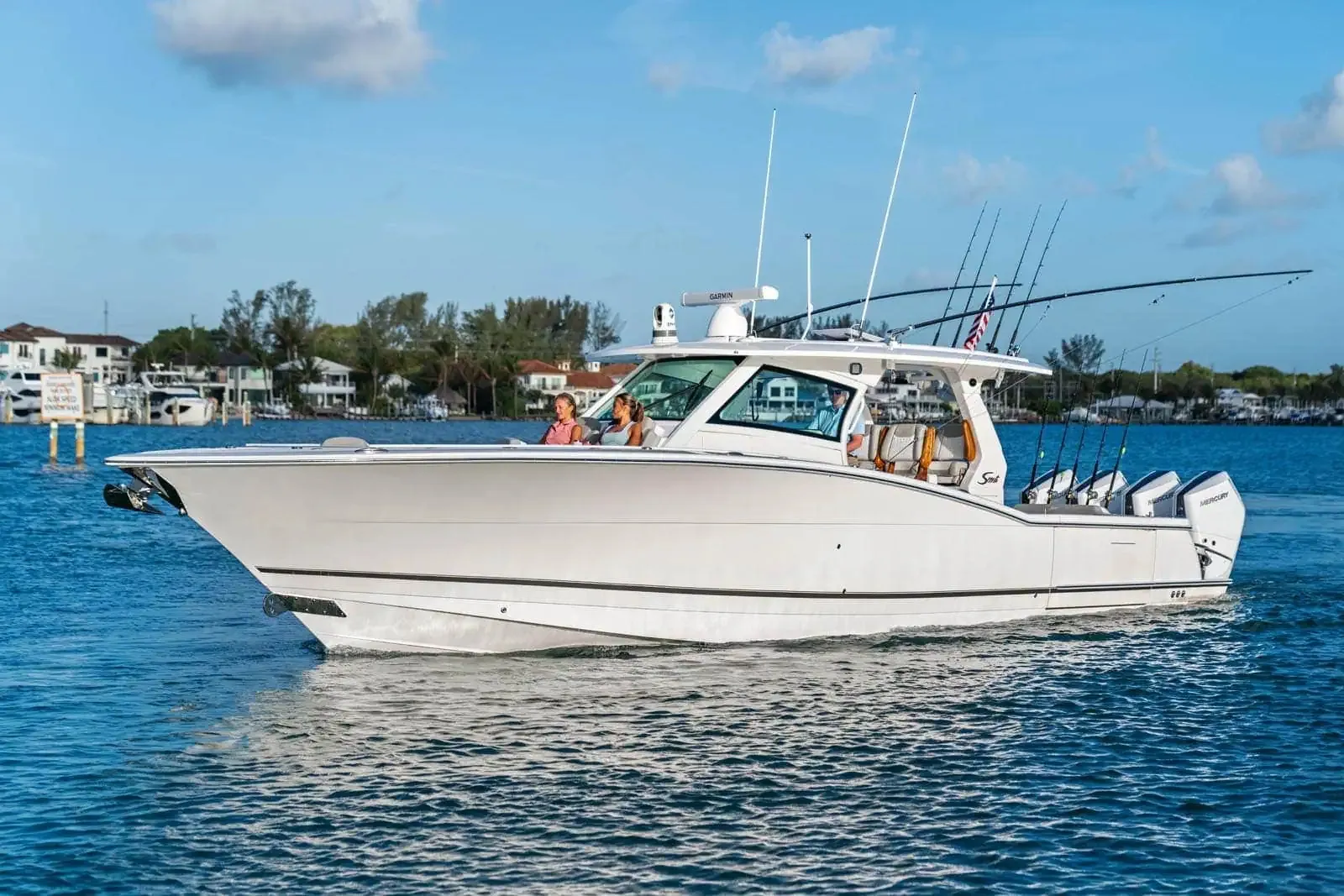
The Scout 530 LXF is a 53'5" S-Class center console and the model Scout's own flyer calls its flagship. It is built in Carbon Epoxy Construction - carbon fiber and E-glass as the primary reinforcements in the epoxy infusion, over a carbon-infused stringer grid - on Scout's double stepped bottom. It carries 18 degrees of transom deadrise on a 14'8" beam at 27,980 lbs dry without engines, draws approximately 31", and is rated between a minimum of 1,700 hp and a maximum of 2,400. Fuel is 875 gallons, fresh water 100, and there are separate 40-gallon black and grey water tanks.
Unlike every LXF below it, the 530 is a two-cabin boat with a genuine hotel system. A Fischer Panda 15 kW generator on an 80-gallon diesel tank feeds two dedicated 16,000 BTU air conditioning and heat units - one for the cabin, one for the helm area - plus an 11-gallon water heater. A Seakeeper 6 is standard, as is C-Zone digital switching, a proportional 24V bow thruster, and two 50-amp shore power cord reels.
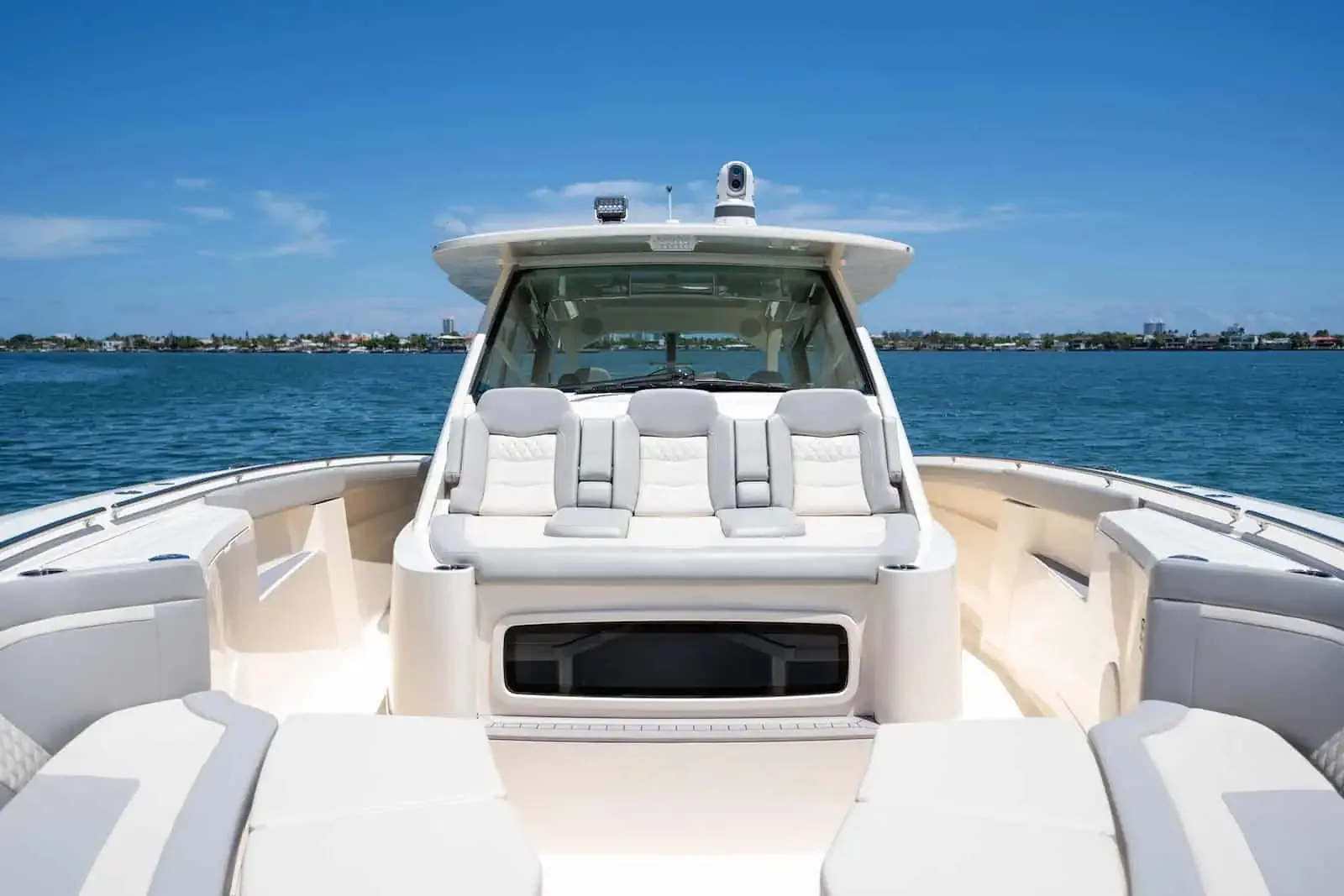
The cockpit is arranged for entertaining as much as fishing. Dual electronically actuated hydraulic beach platforms deploy on both sides, dual aft cockpit transom doors fold out of the way, and a full beam-to-beam transom walk-thru platform runs the width of the stern. A cockpit island carries a cooler, sink, cutting board, electric grill and drawer refrigerator with forward-facing bench seating and aft-facing bar stools, and there is aft-facing stadium seating for three and helm-area seating for seven. Fishing content is standard too: port and starboard aft fish boxes, split aft transom baitwells with aerators, two 30-gallon cockpit baitwells, lockable in-deck rod storage and seven vertical rod holders along the transom. The 530 LXF is NMMA and Yacht Certified.
Scout publishes five tested bulletins for the 530 LXF. Two cover the packages on the current menu, and they are further apart than the specification line suggests.
Quad Mercury 600 V12 Verados on Bravo Three stainless props (33p) top out at 70.1 mph at 6,400 rpm, reach 20 mph in 5.3 seconds and 30 mph in 7.8, and post best fuel efficiency of 0.51 mpg at 42.6 mph. Scout publishes an estimated range of 446 miles for this configuration with the Seakeeper aboard.
Quint Yamaha 425 XTOs on 16-1/8 x 23 propellers top out at 66.2 mph at 6,000 rpm and take 10.90 seconds to reach 30 mph. Best cruise economy in Scout's table is the same 0.51 mpg, at 40.9 mph. Scout publishes the same estimated range - 446 miles - for this package too. Both range figures are footnoted as estimates based on fuel consumption at optimal cruising speeds and sea conditions.
Read those two sheets carefully before you rank them, because they were not run under the same conditions. The quad Mercury test is dated July 2021 with half a tank aboard; the Yamaha quint test is dated September 2019 at a full boat test weight of 35,177 lbs, including 450 gallons of fuel and eight batteries. A 10.90-second run to 30 mph on a boat carrying roughly 3,000 lbs of extra fuel is not directly comparable to a 7.8-second run on a half tank. The honest summary is that the quad 600s are the quicker package on paper and the sheets do not let you say by exactly how much.
On horsepower, the arithmetic is worth stating plainly: four Mercury 600s is 2,400 hp across four engines, five Yamaha 425 XTOs is 2,125 hp across five. The Yamaha bulletin also cites a 2,510 hp Yamaha ceiling against the 2,400 hp maximum on the current specification table.
One paperwork note. Both bulletins carry the older hull dimensions - 53'0" length, 26,500 lbs dry, and 14'6" beam on the Mercury sheet - while the current model page and flyer list 53'5", 27,980 lbs and 14'8" - confirm against the build sheet for your model year. Separately, the model page's headline range row quotes 525 miles for a third package, quint Mercury 400s with the Seakeeper, so the range estimate you are shown depends entirely on which engines are under discussion.
The 530 is where an LXF stops being a boat with a cabin and becomes a boat with an interior. Scout publishes 6'9-1/4" of cabin headroom and 9'8" of bridge clearance to the top of the hardtop with no tower fitted.
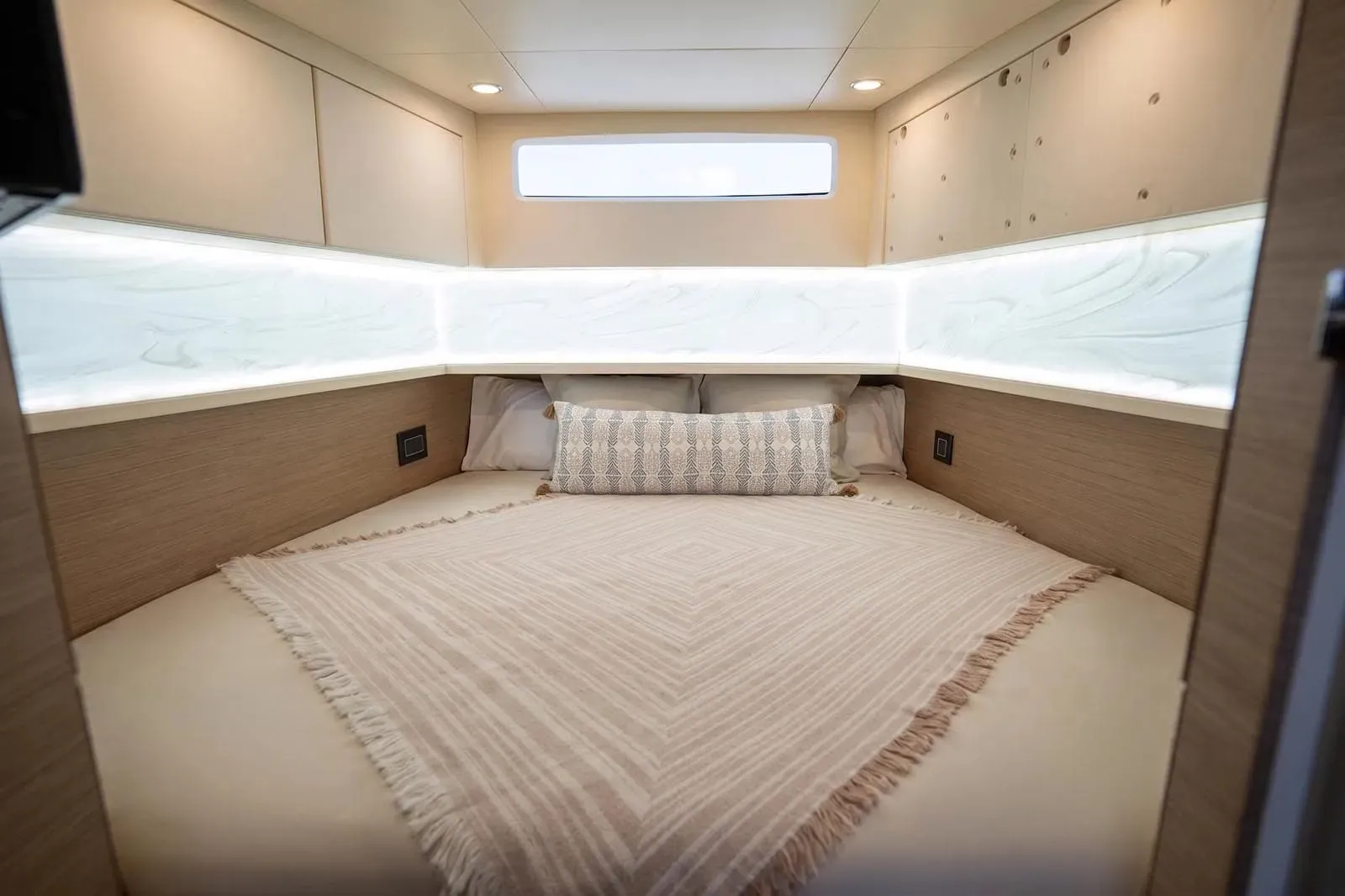
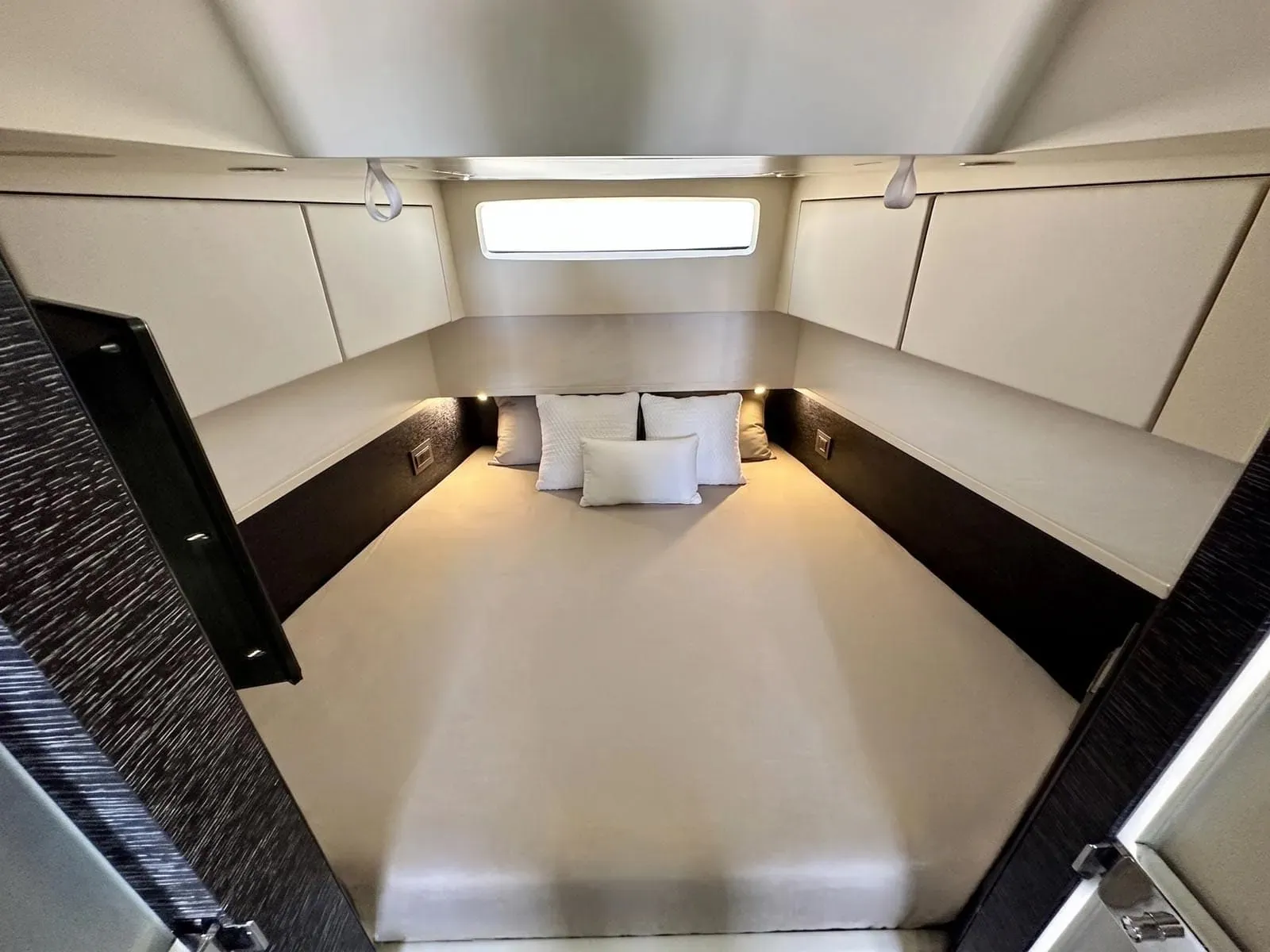
Below decks there is a private queen master stateroom with rod storage under the bed and a forward window with an electric shade, a convertible sofa-to-berth entertainment and sleeping area, and a separate enclosed double berth aft. The head room and the shower room are separately enclosed, each with its own door and skylight, and an overhead salon skylight with an automatic shade brings daylight into the middle of the boat. The galley carries a sink, a microwave oven, a two-burner electric stovetop, a drawer refrigerator and a drawer freezer with an internal ice maker. There is a hanging closet, an electronically actuated pedestal dining table and two 32" LED televisions.
Climate is handled by two dedicated 16,000 BTU air conditioning and heat units - one for the cabin, one for the helm area - off the standard Fischer Panda 15 kW generator, with an 11-gallon water heater. Fresh water is 100 gallons, with 40 gallons of black water and 40 of grey, both discharging overboard.
Scout offers four interior cabinetry and flooring packages, and the option list runs to a retractable glass sunroof in the hardtop, a water maker, a cabin-mounted safe, a dehumidifier for time on the lift and a central vacuum.
The 530 LXF is the top of Scout's LXF center-console line and the boat Scout's own model flyer calls its flagship. It is not the largest boat in the range: the 670 LXF sits above it in the LX Series at 66'9" with 1,500 gallons of fuel. Below it, the 435 LXF Li-Ion and the 425 LXF are the closest siblings, and both are a full ten feet shorter.
The number that separates it most from those siblings is deadrise. The 425 and the 435 both run 22 degrees at the transom; the 530 runs 18. That is a real difference in the way the two ends of the range are set up, and it is worth understanding before you assume the bigger boat is simply the softer one - at 27,980 lbs dry, the 530 is doing with mass what the smaller hulls do with vee.
Its cross-shop is genuinely wide. With two cabins, a queen stateroom, two separately enclosed rooms for head and shower, a 15 kW generator, 32,000 BTU of air conditioning across two zones and a galley with a freezer and ice maker, the 530 competes for buyers who would otherwise be looking at a sportfish or a flybridge cruiser - and Scout now offers it with an upper helm flybridge superstructure, which narrows that gap further. What it keeps that those boats do not is the walkaround deck, the beach platforms and a cockpit that converts between 150 square feet of entertaining space and a fishing platform.
Scout is family owned, has built in Summerville, South Carolina since 1989, and the 530 LXF is NMMA and Yacht Certified.
The 530 LXF is for the owner who wants the accommodation of a cruiser without giving up the deck of a center console. Two cabins, a queen stateroom, an aft berth, a separately enclosed head and a separately enclosed shower, a galley with a two-burner cooktop and a drawer freezer with an ice maker - and outside it, dual beach platforms, a full beam-to-beam transom walk-thru, split transom baitwells and lockable in-deck rod storage.
It is a strong fit if your slip and lift take a 14'8" beam and 27,980 lbs before engines, if 875 gallons and Scout's 446-mile estimate suit the way you run, and if you are comfortable with 18 degrees of transom deadrise rather than the 22 the 425 and 435 carry. It is also the right boat if you want a real hotel system: 32,000 BTU across two dedicated zones off a 15 kW generator is a different order of comfort from a single unit and a small genset.
On engines, be honest about what you are buying. Quad Mercury 600 V12s are the quicker package - 70.1 mph and 7.8 seconds to 30 - and the current specification table's 2,400 hp maximum is built around them. Quint Yamaha 425 XTOs give you five engines and 2,125 hp, land at 66.2 mph, and post the same 0.51 mpg best-cruise figure and the same 446-mile published estimate. The fifth engine is not buying you speed on this hull; it is buying you a fifth engine.
It is the wrong boat if you want the simplest possible ownership. There is a diesel generator with an 80-gallon tank, two air conditioning zones, a bow thruster and up to five outboards to service. Buyers who want the same walkaround layout with a fraction of the systems should look ten feet down the range at the 435 LXF Li-Ion, which deletes the generator entirely.
446 miles — and it publishes the same figure for both current packages, quad Mercury 600 V12s and quint Yamaha 425 XTOs, each with the Seakeeper aboard. Both are footnoted as estimates based on fuel consumption at optimal cruising speeds and sea conditions. Fuel capacity is 875 gallons.
A third figure exists and is worth knowing about: the model page's headline range row quotes 525 miles for quint Mercury 400s with the Seakeeper. So the range you are shown depends entirely on which engines are under discussion. Best fuel efficiency is that same 0.51 mpg on both current packages — at 42.6 mph on the Mercurys and 40.9 mph on the Yamahas.
Two, which is what separates it from every LXF below it. There is a private queen master stateroom with rod storage under the bed and a forward window with an electric shade, a separate enclosed double berth aft, and a convertible sofa-to-berth area between them. The head room and the shower room are separately enclosed, each with its own door and skylight.
Cabin headroom is 6'9-1/4". The galley carries a sink, a microwave, a two-burner electric stovetop, a drawer refrigerator and a drawer freezer with an internal ice maker, and there are two 32" televisions and a hanging closet. Fresh water is 100 gallons with separate 40-gallon black and grey tanks. Note that the 530 LXF tops the LXF center-console line rather than Scout's whole range — the 670 LXF and 670 LXS, both 66'9", sit above it in Scout's 67 LX Series, and both carry three staterooms.
Not directly, and the difference matters. Quad Mercury 600 V12s on Bravo Three stainless (33p) were tested in July 2021 with half a tank aboard: 70.1 mph at 6,400 rpm, 20 mph in 5.3 seconds, 30 mph in 7.8. Quint Yamaha 425 XTOs on 16-1/8 x 23 props were tested in September 2019 at a full boat test weight of 35,177 lbs including 450 gallons of fuel and eight batteries: 66.2 mph at 6,000 rpm, 30 mph in 10.90 seconds.
A 10.90-second run carrying roughly 3,000 lbs of extra fuel is not the same test as a 7.8-second run on a half tank. The fair summary is that the quad 600s are the quicker package on paper and the sheets do not let you say by how much. Best economy is identical at 0.51 mpg.
It is if you want two cabins and a real hotel system; it is not if you want simpler ownership. The 530 LXF is 53'5" on a 14'8" beam at 27,980 lbs dry, with a private queen master stateroom, a separate enclosed aft double berth, separately enclosed head and shower rooms, and 32,000 BTU across two air-conditioning zones off a Fischer Panda 15 kW generator.
The trade-offs are real. Deadrise drops to 18 degrees from the 22 the 425 LXF and 435 LXF Li-Ion carry, and you take on a generator with an 80-gallon diesel tank, a bow thruster, two AC zones and up to five outboards to service. If you want the same walkaround deck with a fraction of the systems, the 435 LXF Li-Ion is the honest alternative.