
August 20, 2026
Scout 357 LXF — Twin 450s or Triple 400s on the Same Stepped Hull
Scout's 357 LXF is a 35'3" S-Class center console on an epoxy-infused, dual-stepped hull with 319 gallons of fuel, 22 degrees of transom dea…
Read the articleExpert Review, Technical Specifications & Market Analysis
| Feature | Specifications |
|---|---|
| Overall Length | 35'3" |
| Beam | 10'9" |
| Draft | 2'0" |
| Displacement | 10,120 lbs |
| Engines | Twin Yamaha 450 (2 x 450 HP) |
| Fuel Capacity | 319 gal |
| Water Capacity | 23 gal |
| Cabins / Heads | 1 Cabin / 1 Head |
| Max Speed | 62.1 mph @ 6,100 RPM (twin Yamaha 450 XTOs); 72.2 mph @ 6,412 RPM (triple Mercury 400 V10s) |
| Cruise Speed | 35.0 mph at 1.21 mpg (twin Yamaha 450 XTOs); 43.7 mph @ 4,000 RPM best efficiency (triple Mercury 400 V10s) |
Source: Spec & Photos courtesy of Scout. Specs verified by Tony Smith, USCG 100 Ton Master, on August 20, 2026.
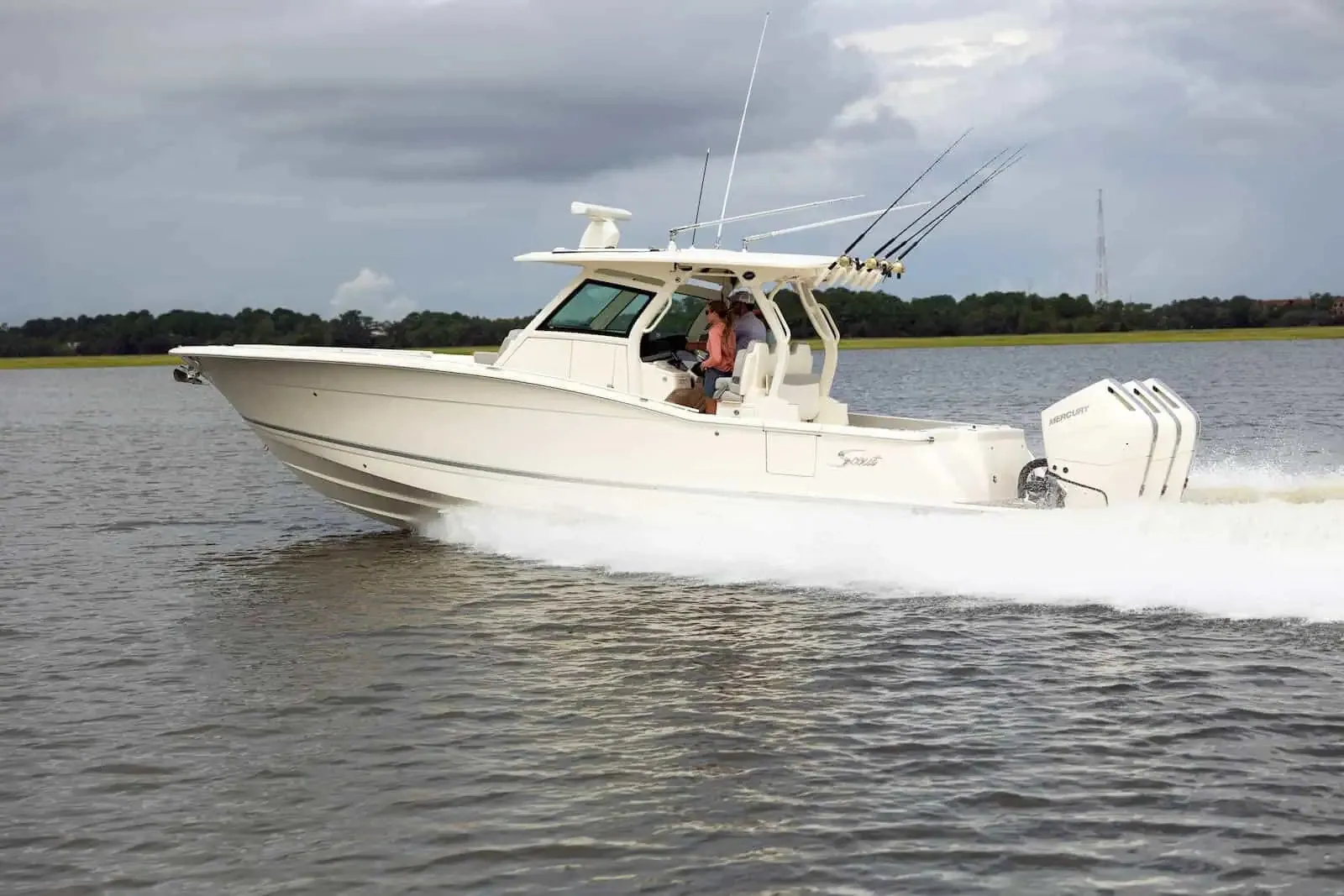
One hull, two boats: twin Yamaha 450s for 62.1 mph and a published 385-mile estimate, or triple Mercury 400 V10s for 72.2 mph.
Part of the Scout LXF series — see how owners step up through the lineup.

I get asked constantly whether the money for an epoxy-infused hull is real or marketing. On the 357 it is real, and the way you notice is not in a brochure line — it is that a 35-footer with a 10,120-pound dry hull runs 62.1 mph on two engines and still puts 1.21 mpg on the board at a 35 mph cruise. Scout infuses this laminate with epoxy instead of the polyester most of this class uses, and pairs it with their dual stepped bottom. That combination is why the twin-450 boat is not the slow choice. It is the sensible one.
Which brings me to the only decision that actually matters on this hull. Scout publishes performance bulletins for both packages and they describe two different boats. Twin Yamaha 450 XTOs: 62.1 mph flat out, 11.95 seconds to 30, and an estimated 385 miles of range with the Seakeeper spinning. Triple Mercury 400 V10s: 72.2 mph, 7.37 seconds to 30, and 366 miles. If you run long and you run with a small crew, take the twins — two engines to service, two sets of props, more fuel in the tank at the end of the day. If the run to the fish is what decides your day, the triples pay you back in minutes rather than gallons.
Here is what I would check on the sea trial. The inner console berth is genuinely useful — 6'1" of headroom, a double berth, a marine head with electric overboard discharge, a refrigerator — and it is genuinely not a cabin. Go down there before you sign anything and decide whether it does what you need it to do. And settle air conditioning at the order desk. It is on Scout’s option list for this model rather than the standard sheet, and it is not the sort of thing you add cheaply once the boat is built. Everything else on the standard list — Seakeeper 3, three heated captain's chairs, the bow anchor camera, the walkable Esthec swim platform — is already aboard.
Video courtesy of Scout.
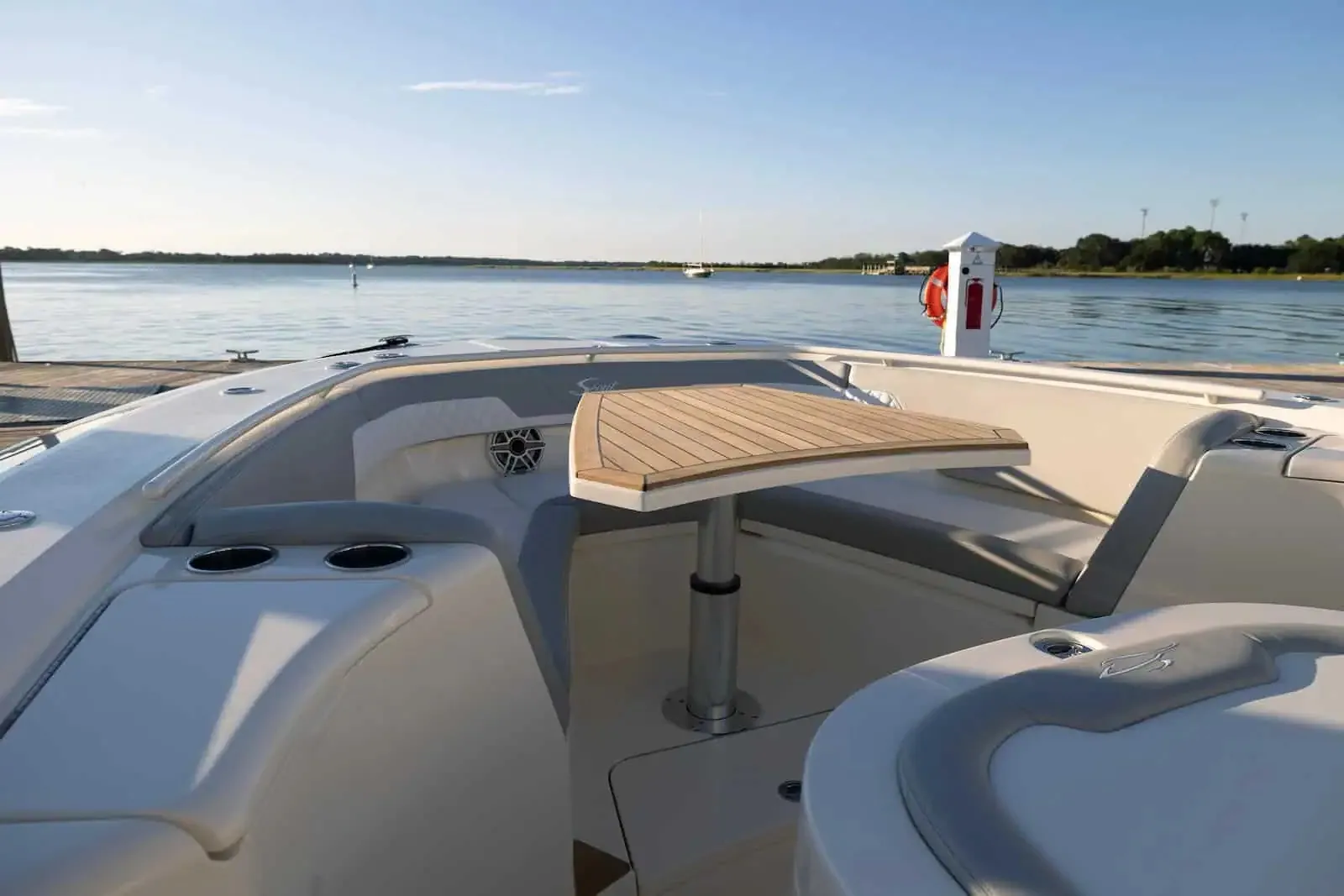
Photos courtesy of Scout.
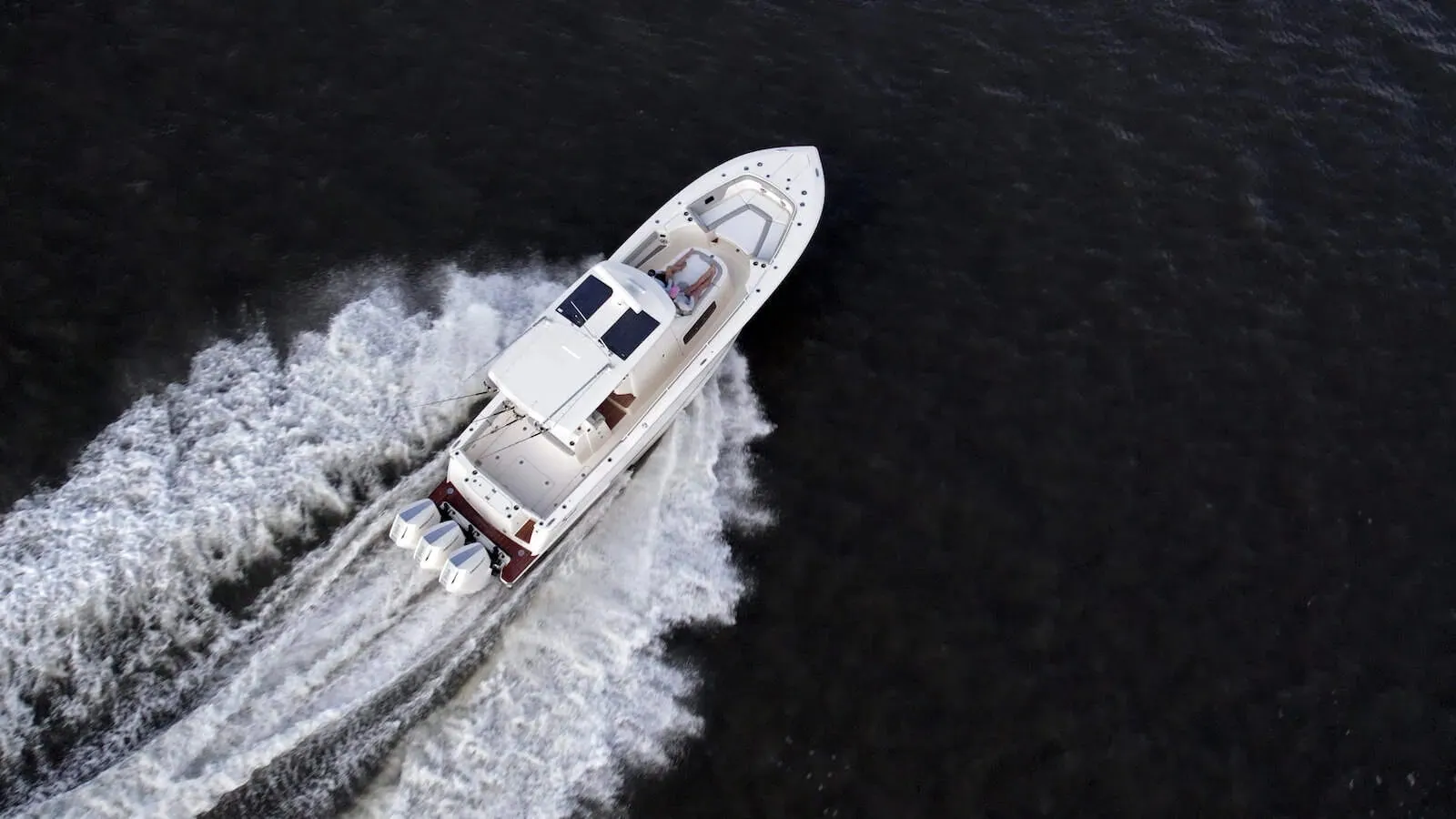
The Scout 357 LXF is a 35'3" S-Class center console - Scout's designation for its luxury models 33 feet and up. It is built with epoxy infusion construction and dual Scout Stepped Hull Technology, carries 22 degrees of transom deadrise on a 10'9" beam, and weighs 10,120 lbs dry without engines. Fuel capacity is 319 gallons, fresh water 23 gallons and black water 11 gallons, and Scout rates the hull to 1,200 hp.
The standard boat arrives more complete than the length suggests: a fully walkable swim platform with a starboard walk-thru and Esthec, an Armstrong swim platform ladder, a 60-gallon transom fishbox, raw and fresh water washdown on a 25-gallon tank, key-fob remote lights, three captain's helm chairs with heated seats and flip-up bolsters, an aft-facing bench for two that converts to a raised prep table, and Scout's bow anchor camera. The advertised starting configuration includes a Seakeeper 3, and the order sheet carries a deletion credit for owners who do not want it.
Fishing capacity is real for the size: 43-gallon fish boxes port and starboard, a 47-gallon aerated cockpit baitwell and ten flush-mount gunnel rod holders. Scout builds the 357 LXF in Summerville, South Carolina and the boat is NMMA and Yacht Certified.
Scout rates the 357 LXF to a maximum of 1,200 hp and publishes tested performance bulletins for two packages.
On the twin Yamaha 450 XTO bulletin (16-1/8 x 22p props, tested at 14,005 lbs with a Seakeeper 3 aboard), Scout records a top speed of 62.1 mph at 6,100 rpm, best cruise economy of 1.21 mpg at 35.0 mph (3,500 rpm), 0-30 mph in 11.95 seconds, and an estimated range of 385 miles - footnoted as an estimate based on fuel consumption at optimal cruising speeds and sea conditions.
The triple Mercury 400 V10 bulletin (27p Rev X props) describes a different boat: 72.2 mph at 6,412 rpm, 0-20 mph in 4.91 seconds, 0-30 mph in 7.37 seconds, best cruise economy of 1.15 mpg at 43.7 mph, and an estimated range of 366 miles. The running surface carries 22 degrees of transom deadrise, draft is approximately 24" and bridge clearance to the T-top is approximately 8'5".
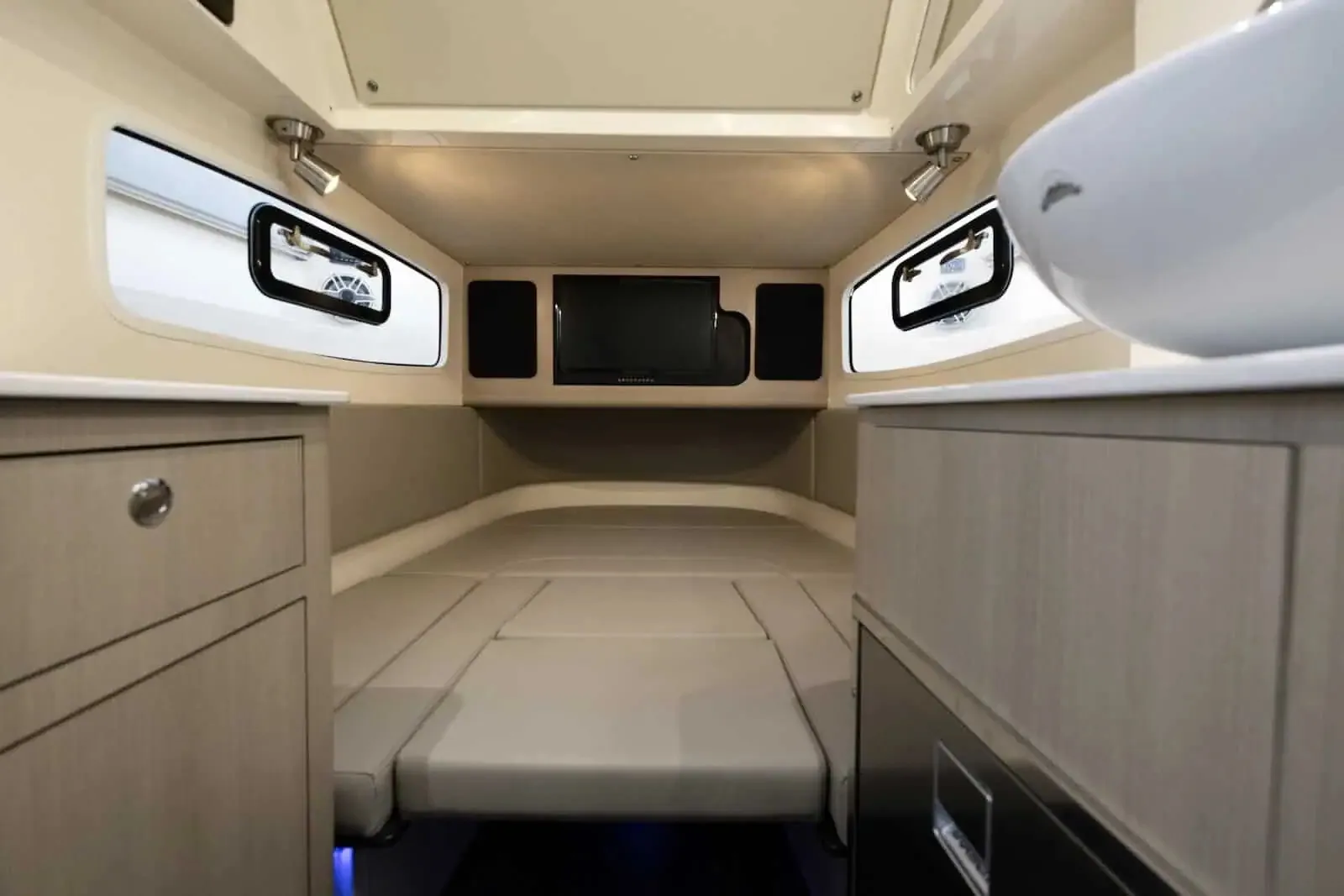
The inner console berth is what separates the 357 LXF from a day boat. Scout finishes it with a double berth, 6'1" of console headroom, port and starboard windows, overhead lights, a porcelain vessel sink on a Corian vanity with mirror, a marine head with electric overboard discharge on an 11-gallon holding tank, a refrigerator, a 19" TV and a starboard closet for brushes, gaffs and lines. Air conditioning sits on Scout's option list rather than the standard sheet.
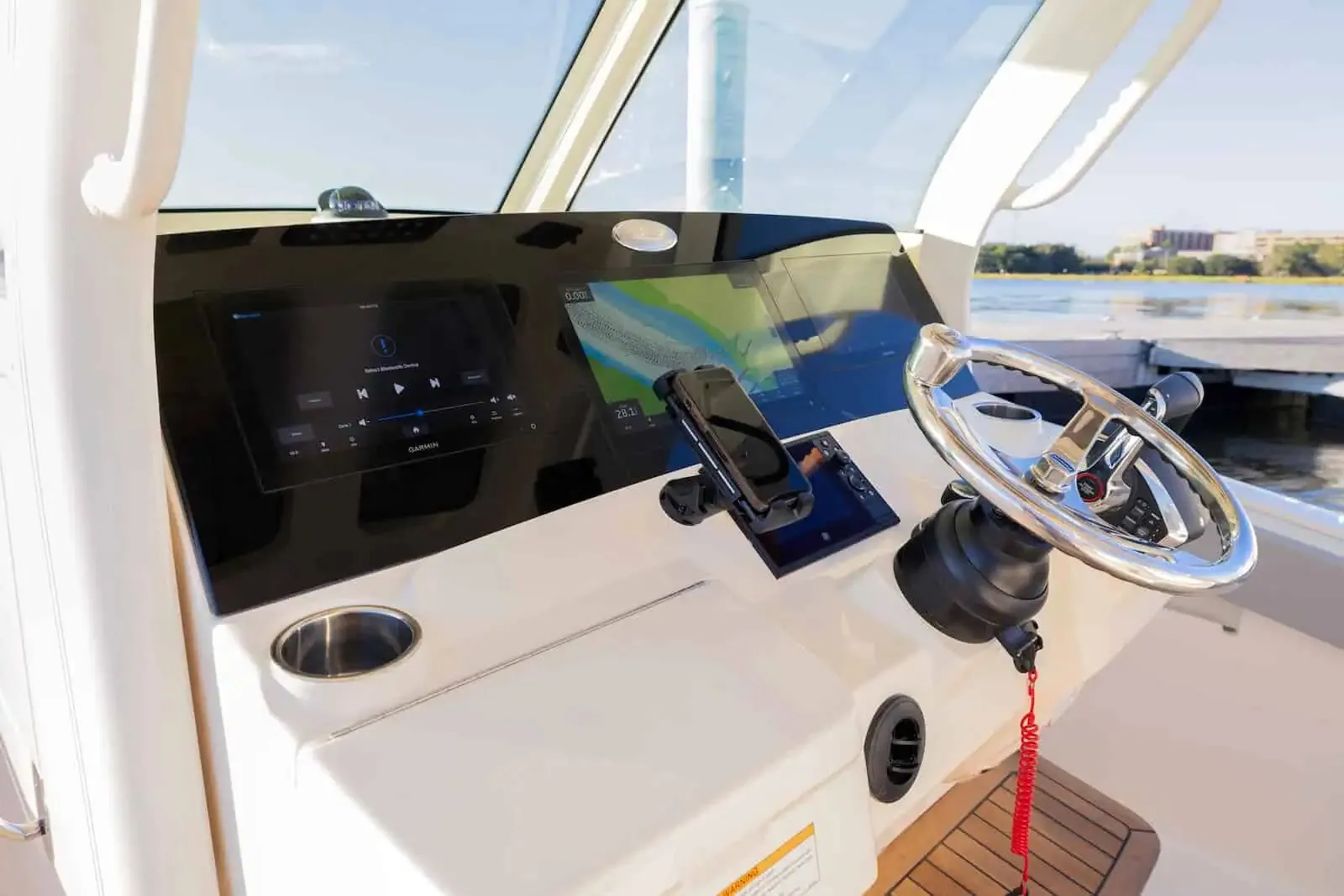
On deck, the forward console double sun deck lounge has cushions, armrests and underside storage, and the bow table is electrically actuated and converts to a sun lounge in Esthec. Three heated captain's chairs face a Garmin 9213 display, and the aft-facing bench for two has a cooler underneath.
Fresh water is 23 gallons and the holding tank is 11 - the honest limit on how long the boat stays comfortable.
The 357 LXF sits between the 330 LXF and the 377 LXF in Scout's LXF line, and it is the largest hull Scout builds in its epoxy-infused E-glass laminate. Scout's own published construction comparison puts that laminate at approximately 2.4 lbs per square foot against approximately 4.2 for a traditional chopper-gun layup, and reserves the carbon fiber/E-glass hybrid at approximately 1.7 lbs per square foot for its 37-foot and larger models. That is the line the 357 sits on - the top of one construction band rather than the bottom of the next.
Buyers looking at this hull are generally comparing 35-to-37-foot offshore center consoles, weighing deadrise, fuel capacity, how much of the boat is standard before options, and whether a console berth matters to their crew.
Scout is family owned, has built in Summerville, South Carolina since 1989, and the 357 LXF is NMMA and Yacht Certified.
The 357 LXF suits the owner-operator who runs offshore with a small crew and wants a boat that handles a long day rather than a long weekend. If you already run a 33-footer and what you keep wanting is more fuel, more deck and a head your family will actually use, this is the size where those three arrive together.
It is a strong fit if 22 degrees of deadrise matches your water, if 319 gallons covers a normal day, and if you have a firm view on engines - the two published packages are genuinely different boats. Twin Yamaha 450s give you 62.1 mph and two engines to service. Triple Mercury 400 V10s give you 72.2 mph and cut 0-30 mph from 11.95 seconds to 7.37.
It is the wrong boat if you want to stand up below deck or shower aboard - the console berth is a berth, and the 400 LXF is where a stand-up cabin, an enclosed shower and a generator become standard. One number to get in writing at the order desk: the rigged weight for your configuration — the published 10,120 lbs is without engines.
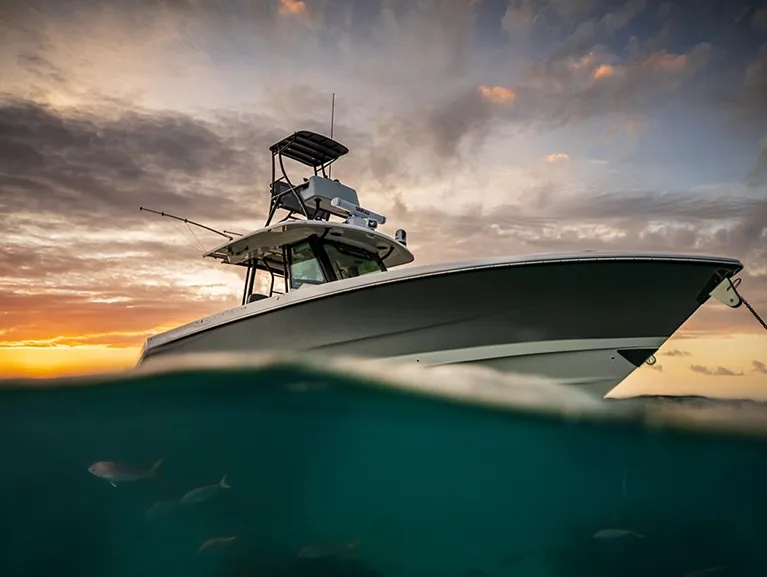
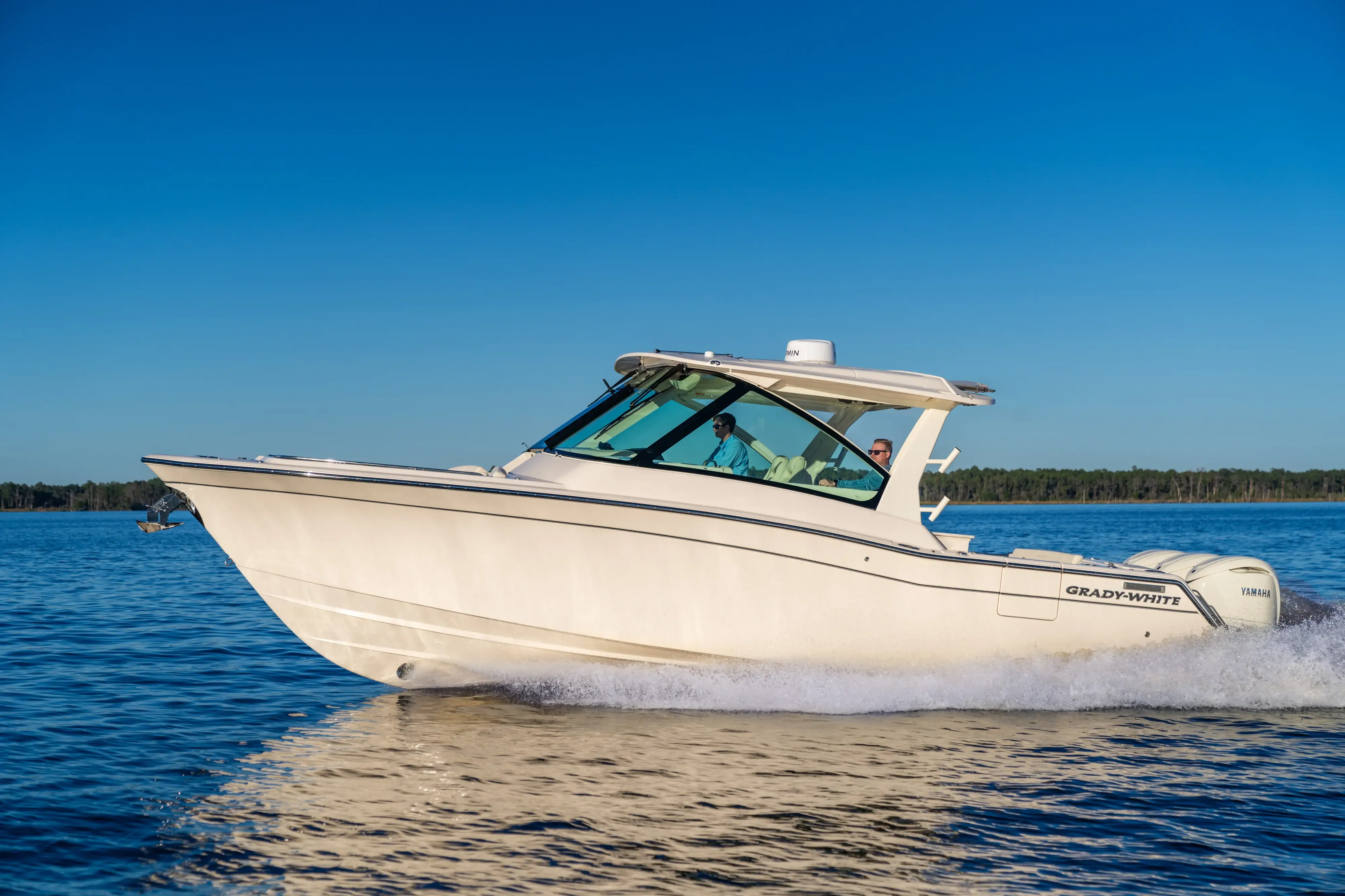
It depends entirely on which engine package the figure belongs to, and the two Scout publishes are ten miles an hour apart. On twin Yamaha 450 XTOs with 16-1/8 x 22p props, tested at 14,005 pounds with a Seakeeper 3 aboard, Scout records 62.1 mph at 6,100 rpm. On triple Mercury 400 V10s with 27p Rev X props, Scout records 72.2 mph at 6,412 rpm.
Acceleration splits them further: 0-30 mph takes 11.95 seconds on the twins and 7.37 seconds on the triples. Any speed quoted for this hull without naming the package behind it tells you nothing.
Scout publishes a best-cruise-economy row rather than a cruising speed. On twin Yamaha 450s that is 1.21 mpg at 35.0 mph, with an estimated range of 385 miles from 319 gallons. On triple Mercury 400 V10s it is 1.15 mpg at 43.7 mph, with an estimated 366 miles. Scout footnotes both ranges as estimates tied to cruising speed and sea conditions.
Treat both as planning figures, and work from the bulletin for the package you order — the two sit almost nine miles an hour apart at their best-economy points.
It comes down to whether the run to the fish decides your day. The twins give 62.1 mph, a published estimated range of 385 miles and two engines to service. The triples give 72.2 mph, 366 miles, and cut 0-30 mph from 11.95 seconds to 7.37. Scout publishes a tested bulletin for both, so you are choosing between two documented boats rather than guessing.
If you run long with a small crew, the twins leave more fuel in the tank at the end of the day. If your grounds are an hour out and the weather window is short, the triples buy those minutes back. Run both if a dealer can arrange it.
Scout's own flyer heading reads inner console berth, not cabin, and that is the fairest description. Below the console there is a double berth with 6'1" of console headroom, port and starboard windows, overhead lights, a porcelain vessel sink on a Corian vanity with mirror, a marine head with electric overboard discharge on an 11-gallon holding tank, a refrigerator, a 19-inch TV and a starboard closet for brushes, gaffs and lines.
Air conditioning sits on Scout's option list for this model rather than the standard sheet — settle it at the order desk, not after delivery. Fresh water is 23 gallons.