
August 22, 2026
Scout 400 LXF Li-Ion - Same Hull, Same Dry Weight, No Diesel Tank
The Scout 400 LXF Li-Ion is the 39'7" 400 LXF with the diesel generator taken out and a 48V lithium-ion system put in its place. Scout publi…
Read the articleExpert Review, Technical Specifications & Market Analysis
| Feature | Specifications |
|---|---|
| Overall Length | 39'7" |
| Beam | 12'1" |
| Draft | 2'3" |
| Displacement | 14,940 lbs |
| Engines | Triple Mercury V10 Verado 400 (3 x 400 HP) or Twin Mercury 600 (2 x 600 HP) |
| Fuel Capacity | 395 gal |
| Water Capacity | 51 gal |
| Cabins / Heads | 1 Cabin / 1 Head |
| Max Speed | 62.7 mph @ 6,400 RPM (triple Mercury 400 V10s w/ Seakeeper & Fathom, Scout performance bulletin) |
| Cruise Speed | 43.4 mph @ 4,500 RPM at 0.87 mpg best cruise (triple Mercury 400 V10s) |
Source: Spec & Photos courtesy of Scout. Specs verified by Tony Smith, USCG 100 Ton Master, on August 21, 2026.
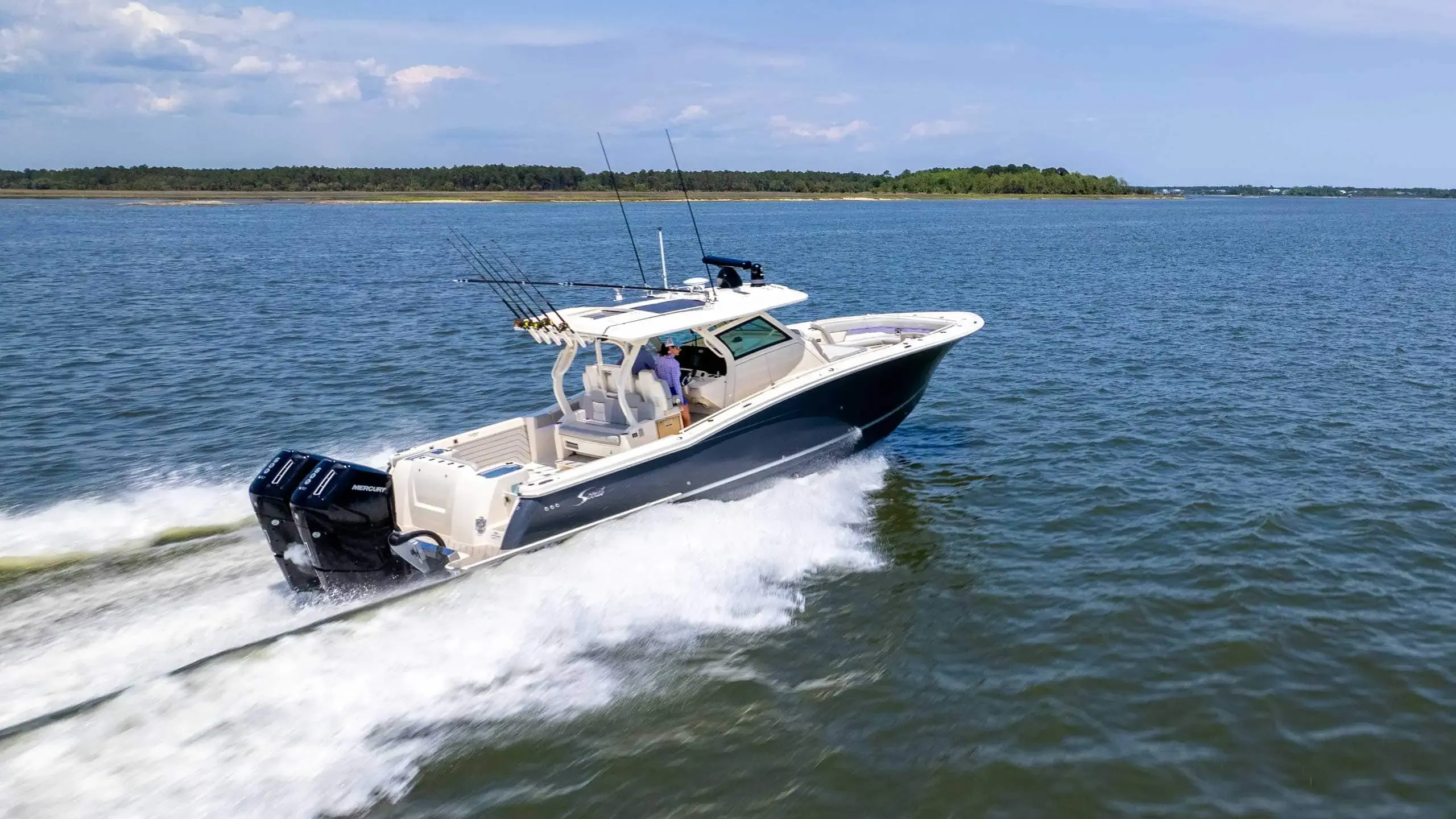
Scout's 39'7" carbon-epoxy hull with the generator deleted: a 48V lithium bank carries the house load and runs the 12,000 BTU air conditioner, charged by the Mercurys and from shore power.
Part of the Scout LXF series — see how owners step up through the lineup.

Put this boat next to the 400 LXF and there is almost nothing to compare. Same 39 feet 7 inches, same 12-foot-1 beam, same 22-degree bottom, same 14,940 pounds dry, same cabin down to the inch. Scout does not pretend otherwise - it calls the Li-Ion an alternative version of the current 400 LXF. So the only honest way to talk about it is to talk about the one thing that changed, and the cleanest way to show you is to open both specification tables side by side. The 400 LXF has a row that says Diesel Tank, 18 gallons. This one does not, because there is no generator to feed. That is the boat.
I want to be careful about what I claim for the lithium, because this is the sort of feature that gets oversold. Scout documents more here than on most of its Li-Ion material: the safety statement linked from the model page names Mastervolt MLI Ultra lithium iron phosphate cells with a built-in battery management system, an automatic safety disconnect, UL 1973 certification and the ABYC E-13 marine standard. That is real provenance. The two numbers to get confirmed on your build sheet are the bank's size, in kilowatt-hours or amp-hours, and how long it runs 12,000 BTU of air conditioning at anchor. If you are buying this boat to sit on the hook in silence with the cabin cold, settle both in writing before you order.
Two things I would not let anyone blur. First, the weight: Scout publishes the identical dry figure for both 400s, so this is not the lighter boat, whatever you hear about deleting a generator. Second, the performance sheet. One bulletin exists with the lithium aboard, on triple Mercury 400 V10s, and it reads 62.7 mph flat out and 9.89 seconds to 30. The 400 LXF on quad 400s does 71.5 and 7.31. If the last nine miles per hour matter, take the generator and be happy. If they do not, this is the quieter boat, and it is the same hull underneath.
Video courtesy of Scout.
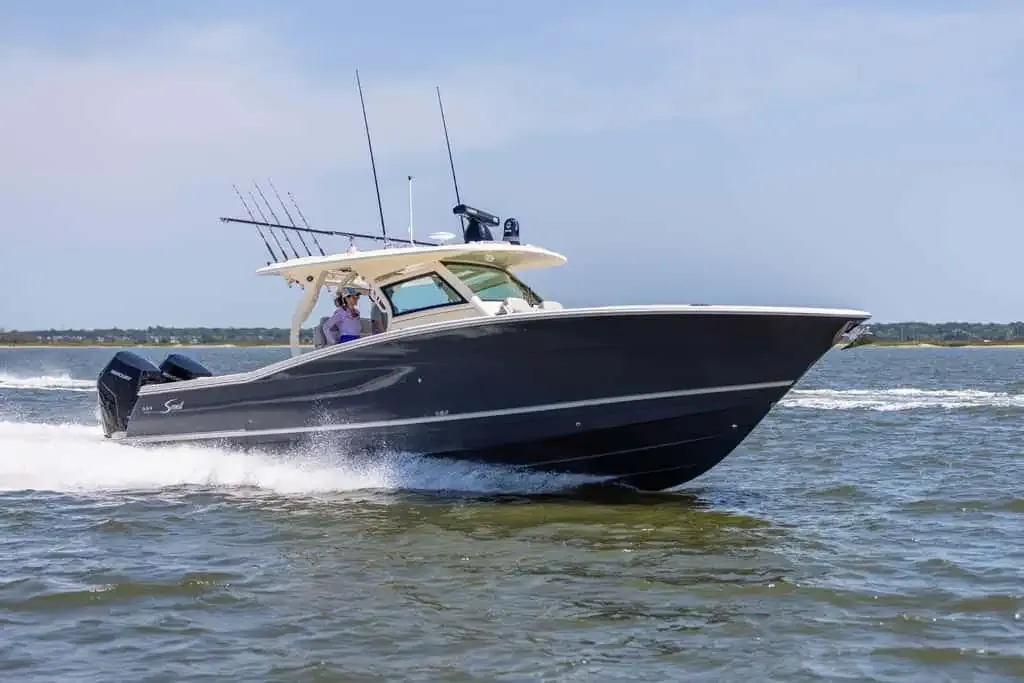
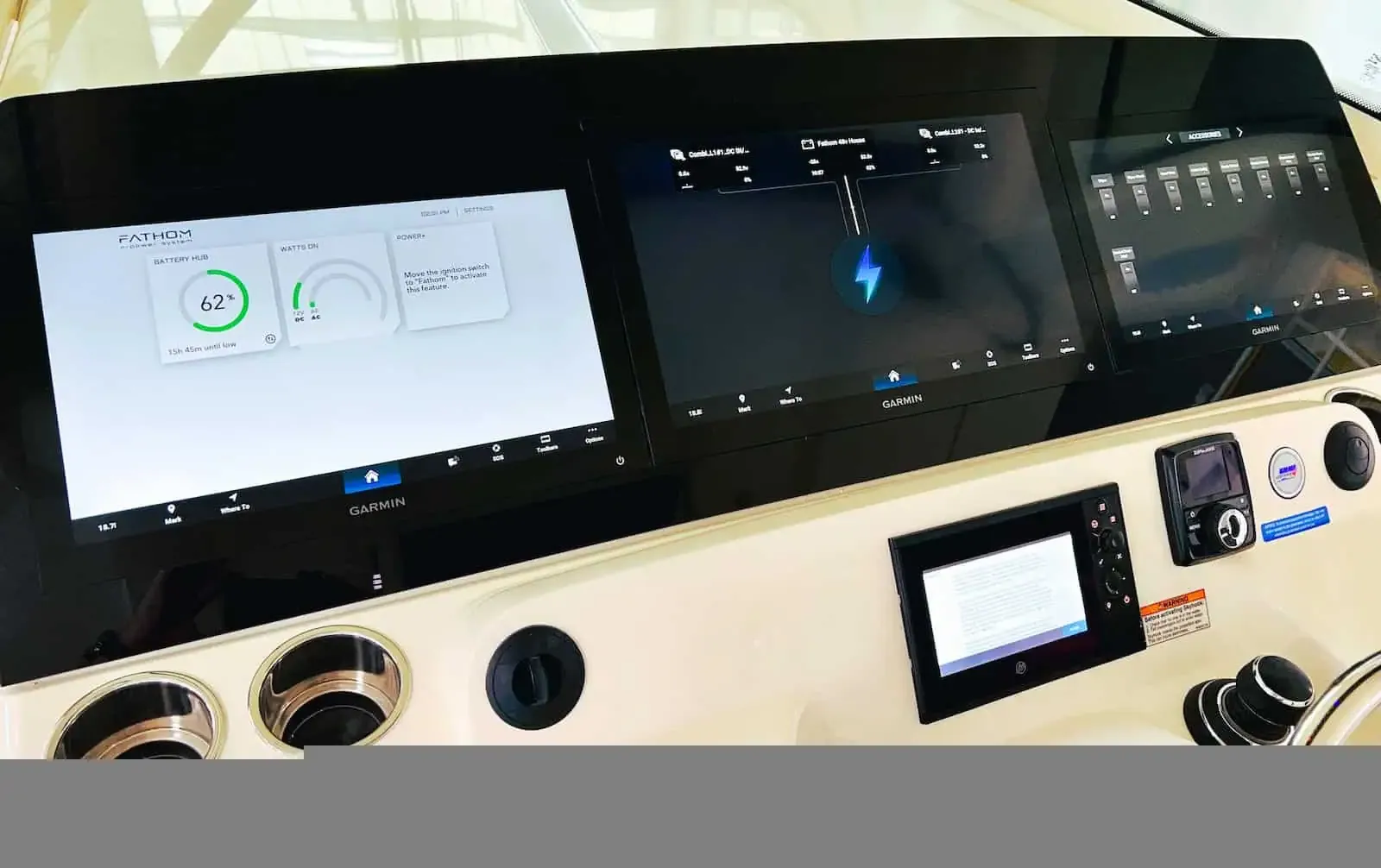
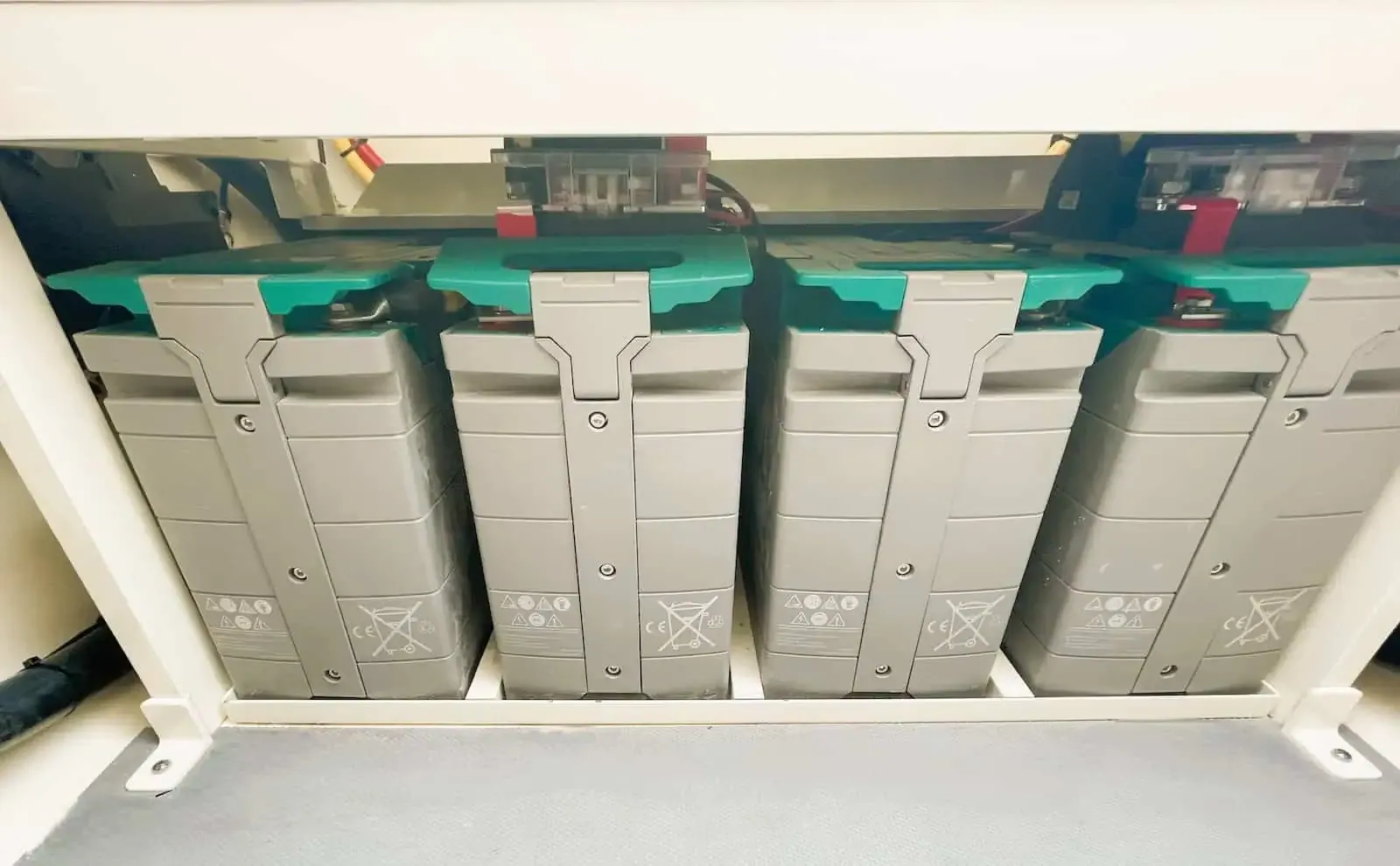
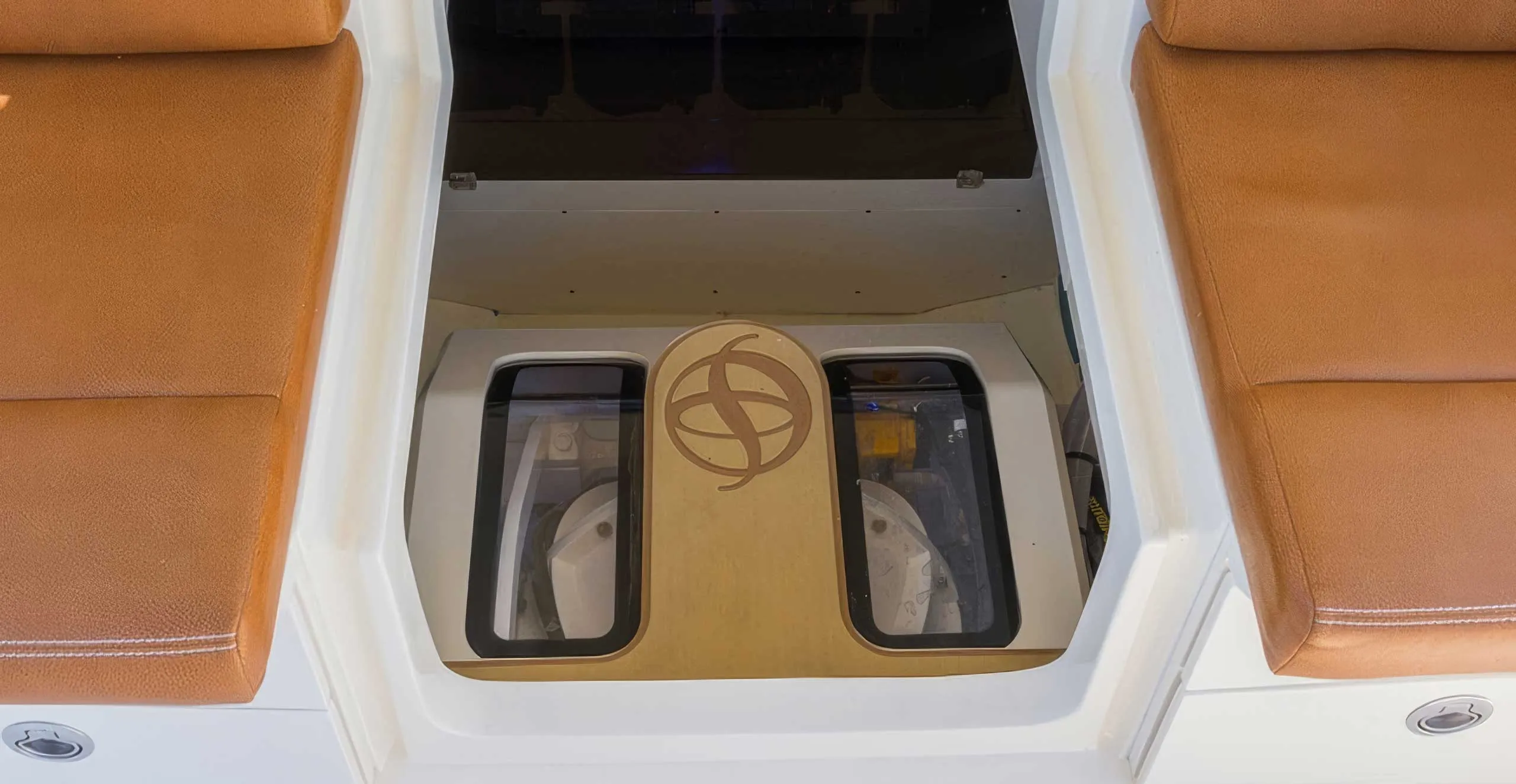
Photos courtesy of Scout.
The Scout 400 LXF Li-Ion is a 39'7" S-Class center console - Scout's designation for its luxury models 33 feet and up - and Scout describes it as an alternative version of the current 400 LXF rather than a separate hull. It is built in Carbon Epoxy Construction, with carbon fiber and E-glass as the primary reinforcements in the epoxy infusion, over Scout's double stepped bottom. It carries 22 degrees of transom deadrise on a 12'1" beam at 14,940 lbs dry without engines, draws approximately 27" and is rated to 1,700 hp. Fuel is 395 gallons, or 509 with optional saddle tanks, fresh water 51 gallons and waste 16.
The Li-Ion is the electrical package. Where the 400 LXF carries an 8 kW diesel generator on an 18-gallon day tank, Scout fits a 48V lithium-ion system and states that no generator is necessary, with the batteries charged by the Mercury engines as well as from shore power. A Xantrex Truecharge 3 battery charger, a 50-amp shore power plug, C-Zone digital switching, two Garmin 9217 displays, a DC Seakeeper gyro, heated helm seats and a 12,000 BTU air conditioner are all standard.
Deck content is the 400 LXF's: 92.5-gallon floor fish boxes port and starboard with overboard diaphragm discharge, 66 gallons of baitwell in two aerated wells in the stern seat, ten flush-mount gunnel rod holders and five in the transom, a full transom walk-thru with an Armstrong dive ladder, a port-side beach platform and a midships mechanical room. Scout builds it in Summerville, South Carolina and the boat is NMMA and Yacht Certified.
Scout publishes one bulletin run with the lithium system aboard, and the title says what was on the boat: 400 LXF Li-Ion w/ Seakeeper & Fathom. The package is triple V10 Verado 400s on Rev X stainless props in 25p/23p/25p, tested 24 March 2025 at an approximate full-boat weight of 18,640 lbs with four aboard, a quarter tank of fuel, the Seakeeper, the hardtop and the lithium battery management system.
Top speed is 62.7 mph at 6,400 rpm. Zero to 20 mph takes 6.34 seconds, zero to 30 takes 9.89. Economy reaches 0.87 mpg at 4,000 rpm and 36.6 mph and holds the same 0.87 at Scout's marked best-cruise point of 4,500 rpm and 43.4 mph, so the efficiency band is roughly seven mph wide rather than a single peak. Scout's estimated range on this sheet is 343 miles, or 442 with the optional saddle tanks, footnoted as an estimate based on fuel consumption at optimal cruising speeds and sea conditions.
One caution when reading the model page: its spec table credits an estimated range of 355 and 458 miles to quad Mercury 400s, figures that belong to the standard 400 LXF's bulletins and were worked on a 430-gallon tank. The Li-Ion's own bulletin, on 395 gallons, is the source of the 343 and 442 above. The quad-400 and twin-600 bulletins linked alongside it are the 400 LXF's as well, run without the lithium system aboard - the triple-400 sheet is the only tested description of this boat.
The cabin numbers are published and they are the 400 LXF's: 6'4" of standing room in the cabin, 6'3" in the head and a 6'5" sleeping length on a convertible queen berth. The head and shower area is enclosed, with a toilet, a glass vessel sink and a mirrored vanity cabinet. The galley carries a sink, a single-burner glass cooktop, a microwave and a drawer refrigerator, and Scout adds a Corian berth table, a 32" LED TV with two speakers, port and starboard windows with privacy shades, five vertical rod holders inside the cabin, AC outlets in both the head and the berth, and a 16-gallon waste tank with overboard discharge.
What changes below decks is what the air conditioning runs on. The 12,000 BTU unit is standard on both 400s; on this one it draws from the 48V lithium bank rather than from an 8 kW diesel generator. That removes the day tank, the genset service interval and the noise at anchor. If you plan to lie at anchor with the cabin cold, get the bank's capacity and its air-conditioning run-time confirmed on the build sheet for your configuration.
Charging comes from three places Scout does document: the Mercury engines, the standard 50-amp shore power plug through a Xantrex Truecharge 3 charger, and hardtop solar panels, which sit on the option list. Fresh water is 51 gallons, with a water heater standard.
The 400 LXF Li-Ion sits between the 377 LXF and the 425 LXF on length, inside Scout's carbon band - the epoxy-infused carbon fiber and E-glass laminate the yard reserves for its larger models. But its real position is alongside the 400 LXF, because on paper the two are the same boat: identical published length, beam, draft, deadrise, dry weight, rigged weight with twin Mercury 600s, fuel, water, waste, baitwell, fish box and cabin dimensions.
The whole decision is the electrical architecture. The 400 LXF carries an 8 kW diesel generator on an 18-gallon diesel tank, three AGM house batteries, two 50-amp chargers and a Seakeeper 3 DC as standard, with 5 kW and 12 kW generators on the option sheet. The Li-Ion carries a 48V lithium system and a Xantrex Truecharge 3 charger, and a generator is not offered on it at all - not as standard, not as an option. It also gets the larger DC gyro of the two as standard, with a Seakeeper 6 available above it on both boats.
This is not Scout's only generator-free model. The 377 LXF and the 435 LXF Li-Ion take the same approach at 37 and 43 feet, so the question here is not whether lithium house power exists in the range but whether 39'7" is the size at which you want it.
Scout is family owned, has built in Summerville, South Carolina since 1989, and the 400 LXF Li-Ion is NMMA and Yacht Certified.
The 400 LXF Li-Ion is for the buyer who has decided the diesel generator is the part of the boat they least want to own, and who does not need to move up to 43 feet to be rid of it. You get the same walkaround deck, the same 6'4" stand-up cabin and the same 12,000 BTU of air conditioning as the 400 LXF, running off a 48V lithium bank instead of a genset with a day tank and a service interval.
It is a strong fit if your slip and lift take a 12'1" beam and 17,460 lbs rigged with twin Mercury 600s, if 22 degrees of deadrise matches your water, and if 395 gallons - or 509 with the saddle tanks - covers the way you actually run. It is also the better of the two if you want the battery provenance documented: the safety statement Scout links from this model's page names Mastervolt MLI Ultra lithium iron phosphate cells with an integrated battery management system and an automatic safety disconnect, certified to UL 1973 and built to the ABYC E-13 marine standard.
Three things should stop you. First, acceleration: the only Fathom-tested package reaches 30 mph in 9.89 seconds, against 7.31 for the 400 LXF on quad Mercury 400 V10s. Second, choice: one bulletin exists for this boat, so there is no second set of verified numbers to weigh. Third, weight - Scout publishes 14,940 lbs dry for both 400s, so the generator deletion does not make this the lighter boat.
And if the answer you need is how many hours of air conditioning the bank holds at anchor, get it in writing on the build sheet - or take the 400 LXF and its generator.
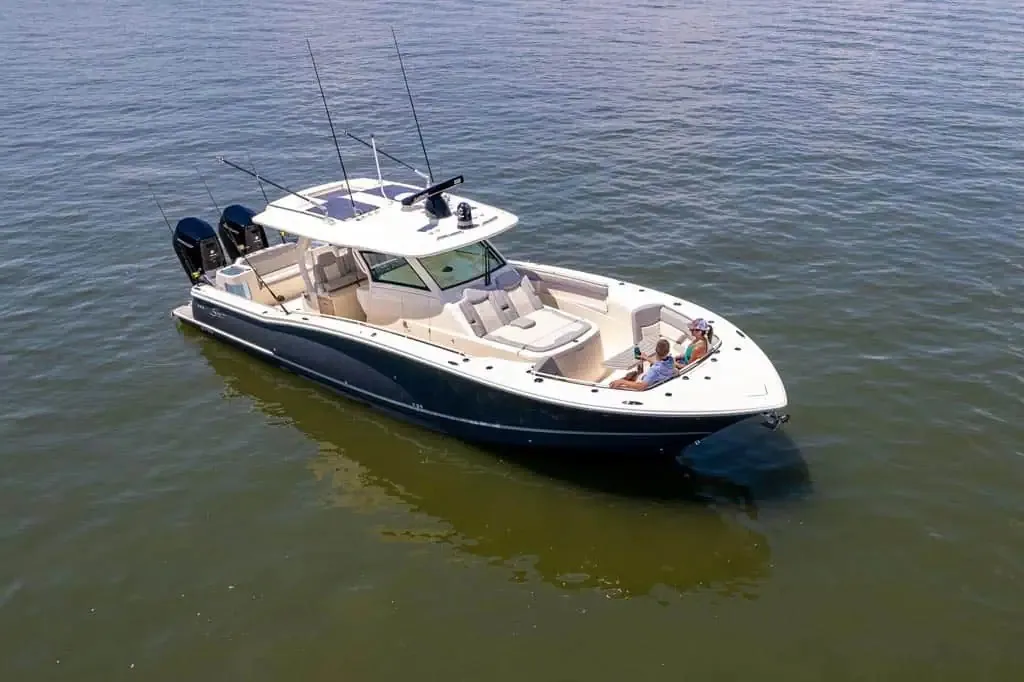
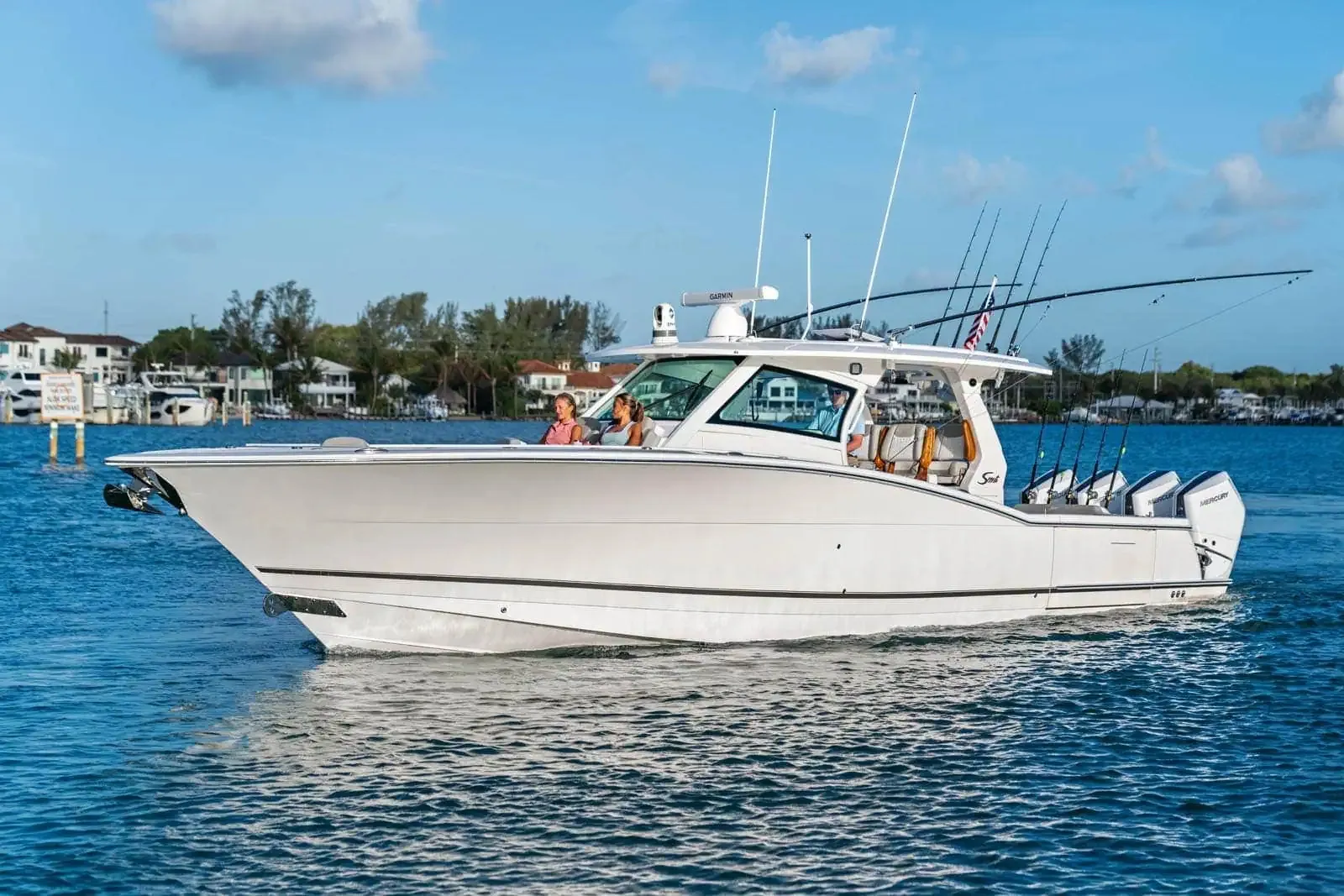
One bulletin belongs to this hull: triple Mercury V10 Verado 400s on Rev X stainless props (25p/23p/25p), run with a Seakeeper and the Fathom system aboard and dated 24 March 2025. Top speed 62.7 mph at 6,400 rpm, 0-20 mph in 6.34 seconds and 0-30 mph in 9.89. Best economy is 0.87 mpg and it holds across a wide band — 36.6 mph at 4,000 rpm and 43.4 mph at 4,500 return the same figure. Estimated range is 343 miles on the standard tank and 442 with the saddle tanks, footnoted by Scout as an estimate tied to cruising speed and sea conditions.
Two other bulletins linked from the model page — twin Mercury 600 V12s and quad Mercury 400 V10s — belong to the standard 400 LXF, run with a generator aboard and no Fathom system; only the triple-400 sheet was run on this boat. The same goes for the page's range rows of 355 and 458 miles, credited to quad Mercury 400s — the Li-Ion's own bulletin reads 343 and 442.
The generator, and nothing else that Scout publishes. The 400 LXF carries a standard 8 kW diesel generator; the Li-Ion deletes it and runs the same 12,000 BTU air conditioner off a 48-volt lithium-ion bank that charges from the Mercury engines as well as from shore power. Scout's own wording is exactly that — a new model and alternative version to the current 400 LXF, complete with a lithium ion battery management system, no generator necessary.
Every other number on the two spec sheets is identical: 39'7" length, 12'1" beam, 27" draft, 22 degrees of deadrise, 14,940 lbs dry without engines and 17,460 lbs with twin Mercury 600s, 395 gallons standard and 509 with the optional saddle tanks, 51 gallons of fresh water, a 16-gallon waste tank, 6'4" of cabin standing room and 6'3" in the head. Deleting the generator buys you one fewer system, not a lighter boat.
Yes. Scout publishes 6 feet 4 inches of standing room in the cabin and 6 feet 3 inches in the head, with a convertible queen berth at a 6-foot-5-inch sleeping length. The head and shower area is enclosed, with a toilet, a glass vessel sink and a mirrored vanity cabinet, and the galley carries a sink, a single-burner glass cooktop, a microwave and a drawer refrigerator. There is a 32" LED TV, port and starboard windows with privacy shades, five vertical cabin rod holders and AC outlets in both the head and the berth.
The 12,000 BTU air conditioner is standard, and on this boat it runs off the lithium bank rather than a genset — which is the whole point of the model. Fresh water is 51 gallons against a 16-gallon holding tank, the same tankage as the 400 LXF, and that is what sets how long two couples stay comfortable aboard rather than the cabin dimensions.
The model page and the model flyer both state 1,700 horsepower maximum, while the spec block on the performance bulletin states 1,600 — settle that on your build sheet before you order a package anywhere near the ceiling.
The only package Scout has actually tested here is triple Mercury 400 V10s — 1,200 horsepower, well below either figure. The lithium system is listed as standard equipment on select engine packages, so confirm that your chosen rig is one of them.