
August 18, 2026
The Pershing 6X: What 48 Knots Buys You at 62 Feet
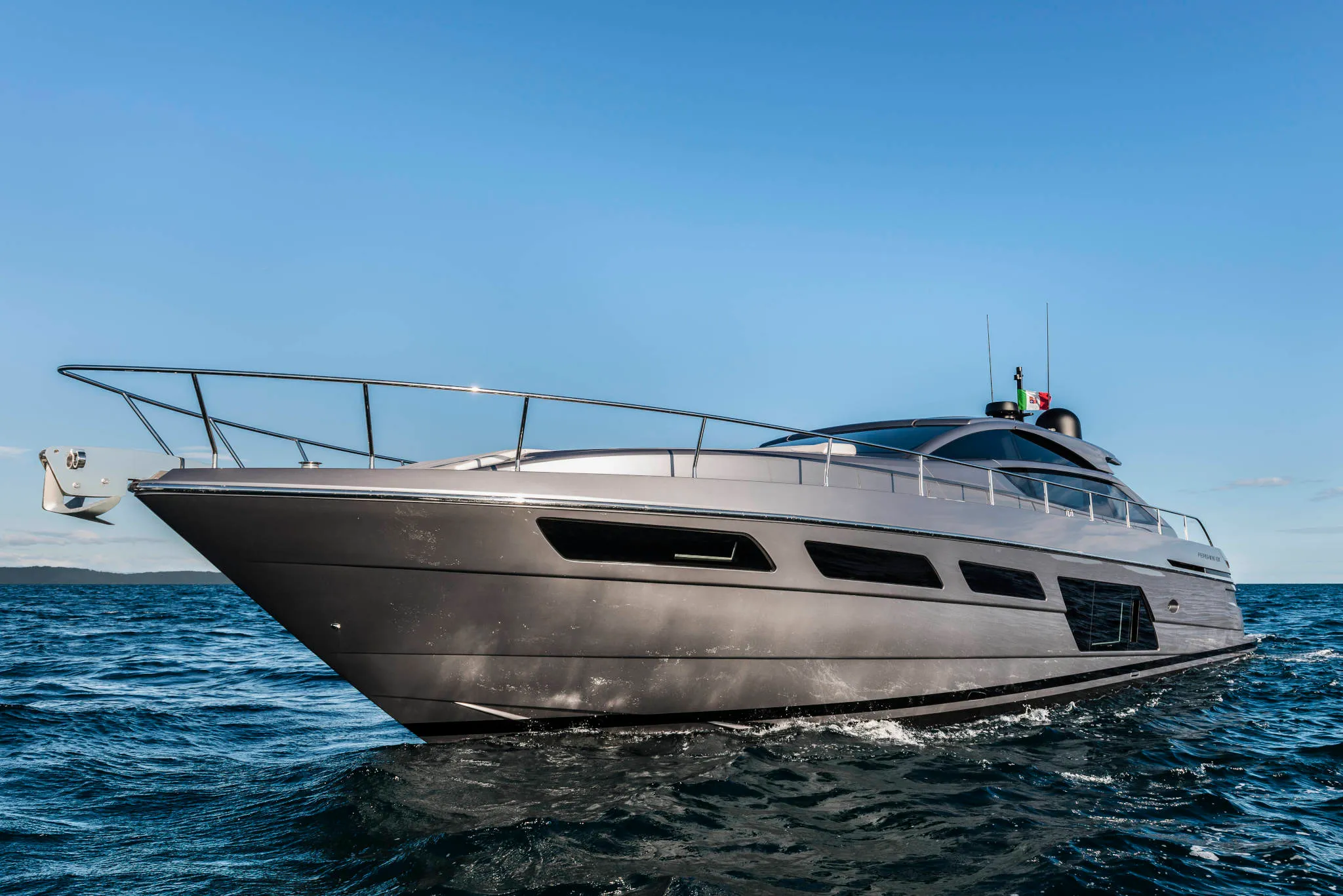
The Pershing 6X is the smallest boat in the range that will sleep a full party and still run to a published 48 knots: 62 feet, twin MAN V12-…
Read the article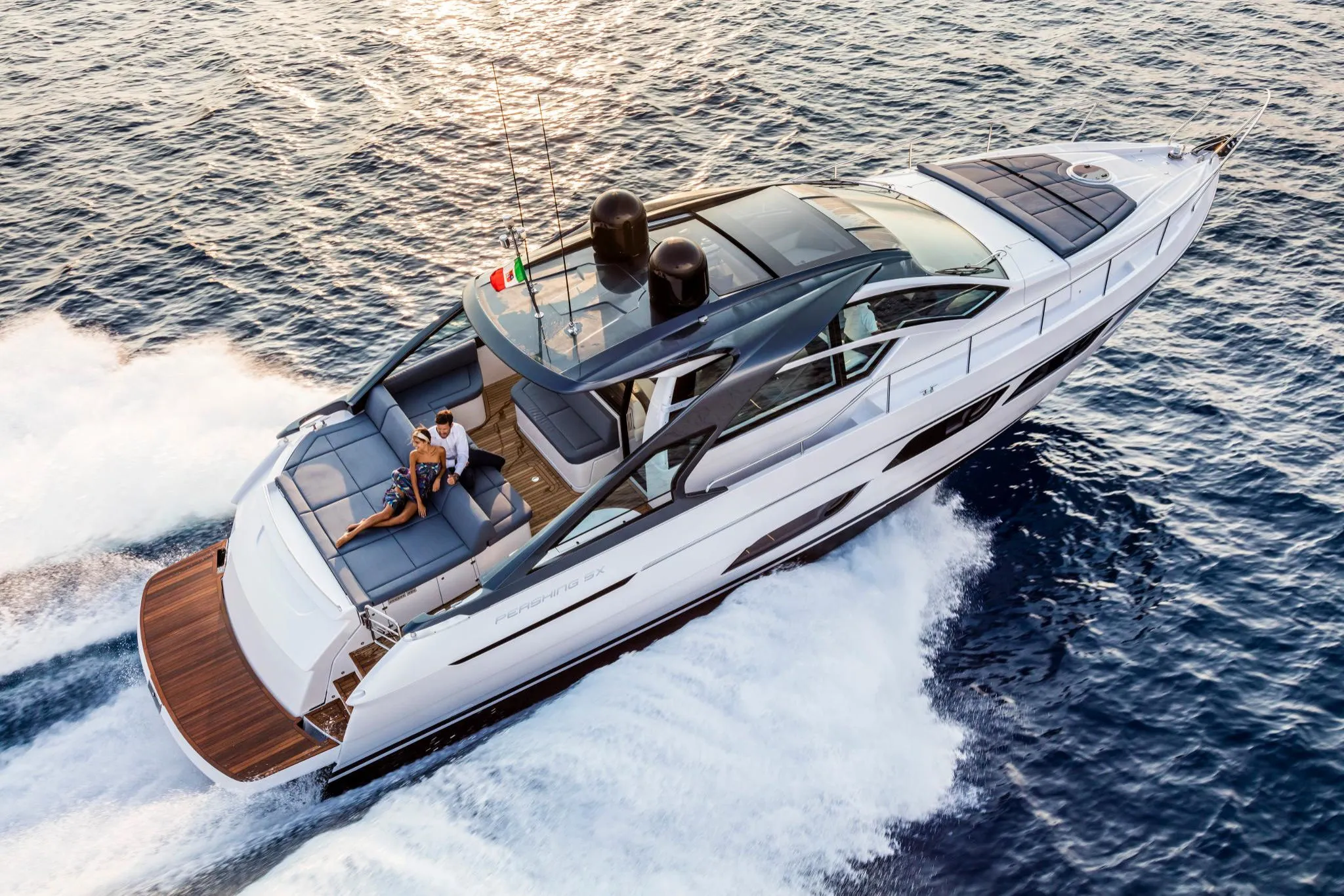
You want to be the boat that is already there while everyone else is still running. Since the Pershing 45 landed in 1985, that has been the entire point of this yard. Here is our expert assessment of the brand.

— Tony Smith
Founder, Minted Yachts
Here is what people get wrong about Pershing. They think it is a speed brand, buy one, and discover it is a distance brand. Fifty knots is a headline; what actually changes your weekend is a 41-knot cruise you can hold for three hours, because that is what turns a two-day passage into an afternoon.
The argument against me is real and it is about drivetrains. Surface drives cost more to maintain than shafts, they want attention to trim, and deferred service shows up immediately in a sea trial. If you run twenty hours a year you will be paying for capability you never use, and there are slower boats with more interior volume for the same money. Pershing is not trying to sell you one of those, and neither am I.
Where to start depends on whether you want the pace or the space. The X Generation — 7X, 8X, 9X — is the pace: carbon hulls, surface drives, 42 to 50 knots. The GTX Series is the space: pods or waterjets, beach clubs, terraces that fold out over the water, and a cruise in the high twenties or low thirties instead. The GTX80 is the one I point most American buyers at, because triple-pod redundancy and 300 miles at a 28-knot cruise is a genuinely different ownership proposition from a surface-drive boat.
Deep-dive specs and expert opinions on current Pershing Yachts models. Don't see the Pershing Yachts you're looking for? Reach out for new and pre-owned brokerage options.
Photo credit Pershing Yachts.
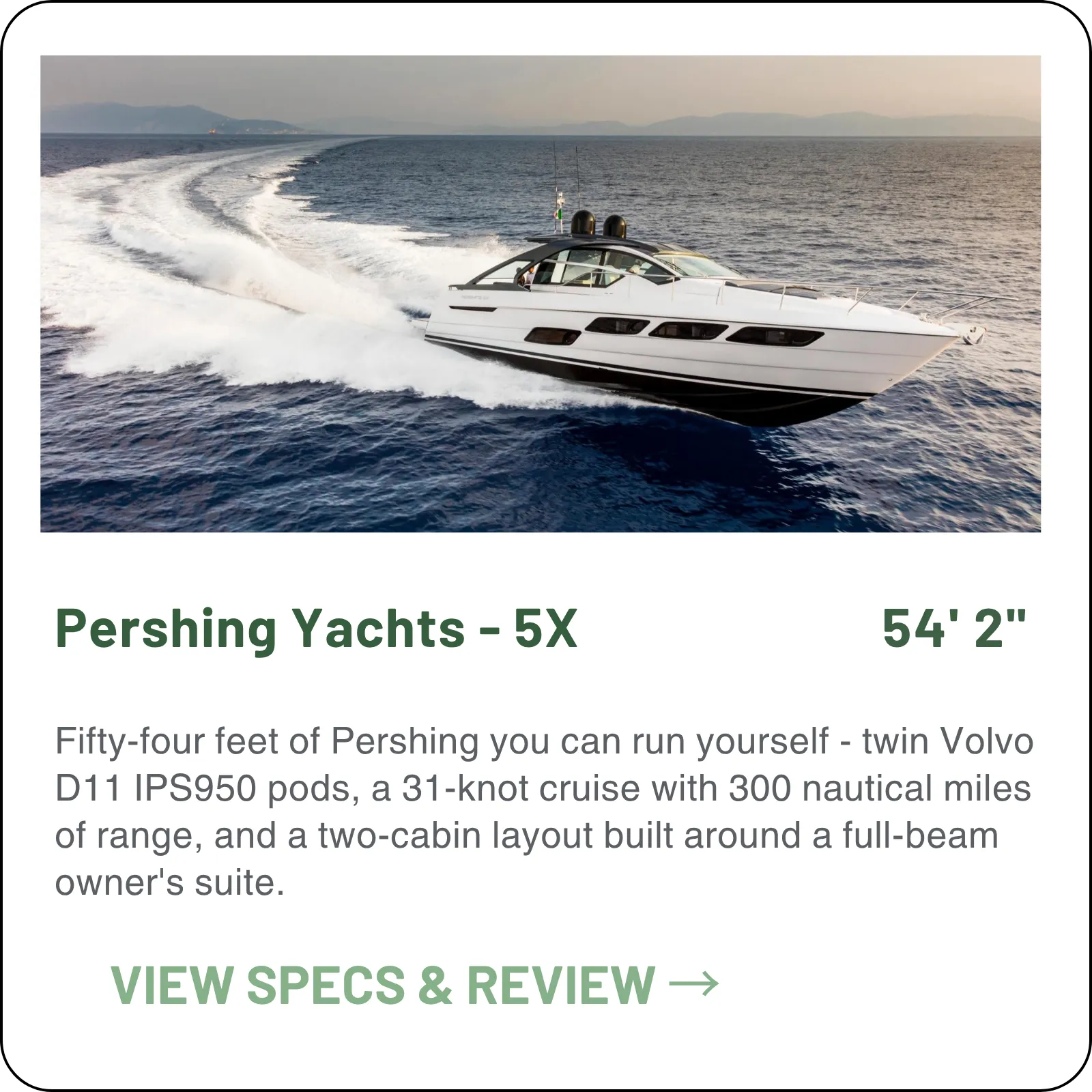
Fifty-four feet of Pershing you can run yourself - twin Volvo D11 IPS950 pods, a 31-knot cruise with 300 nautical miles of range, and a two-cabin layout built around a full-beam owner's suite.
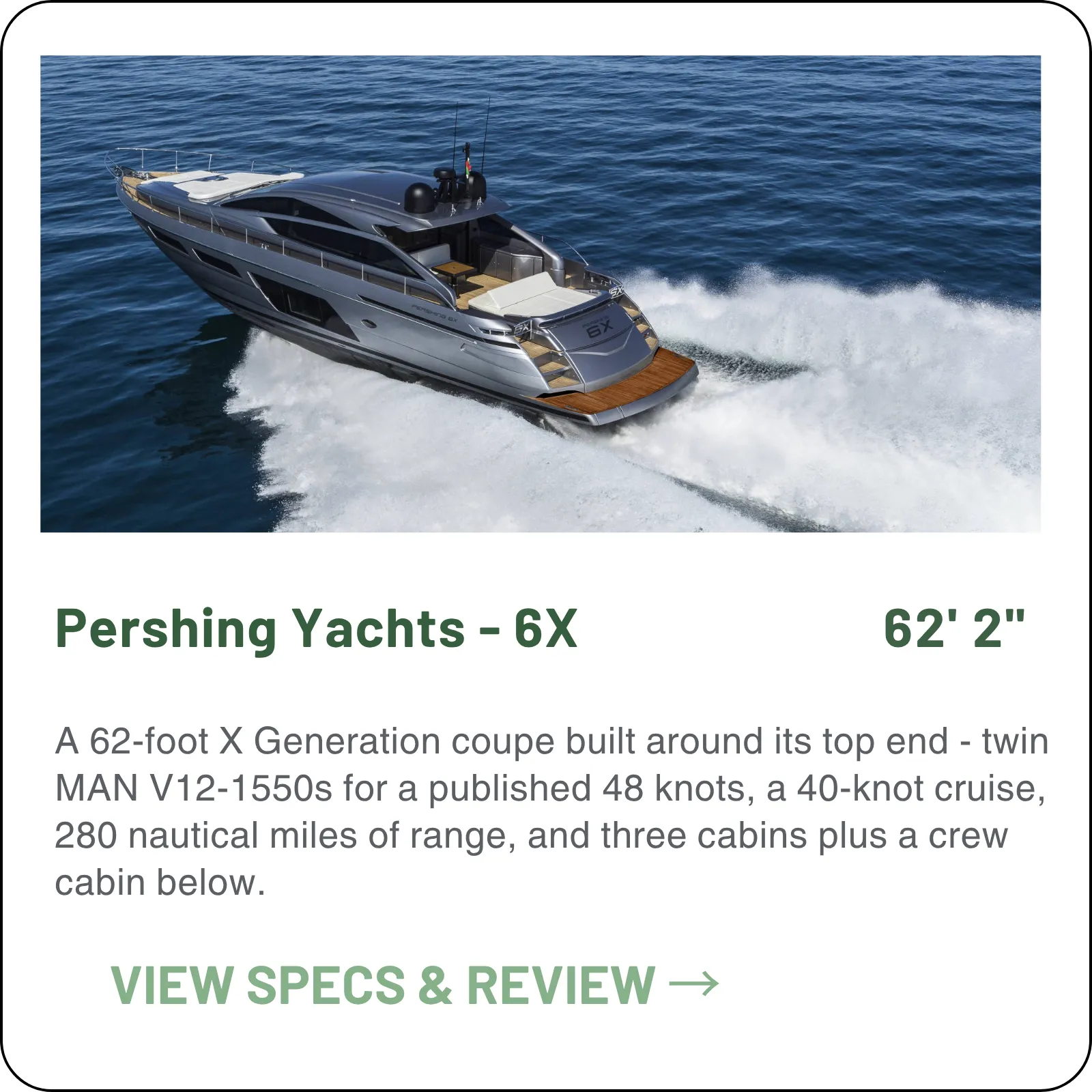
A 62-foot X Generation coupe built around its top end - twin MAN V12-1550s for a published 48 knots, a 40-knot cruise, 280 nautical miles of range, and three cabins plus a crew cabin below.
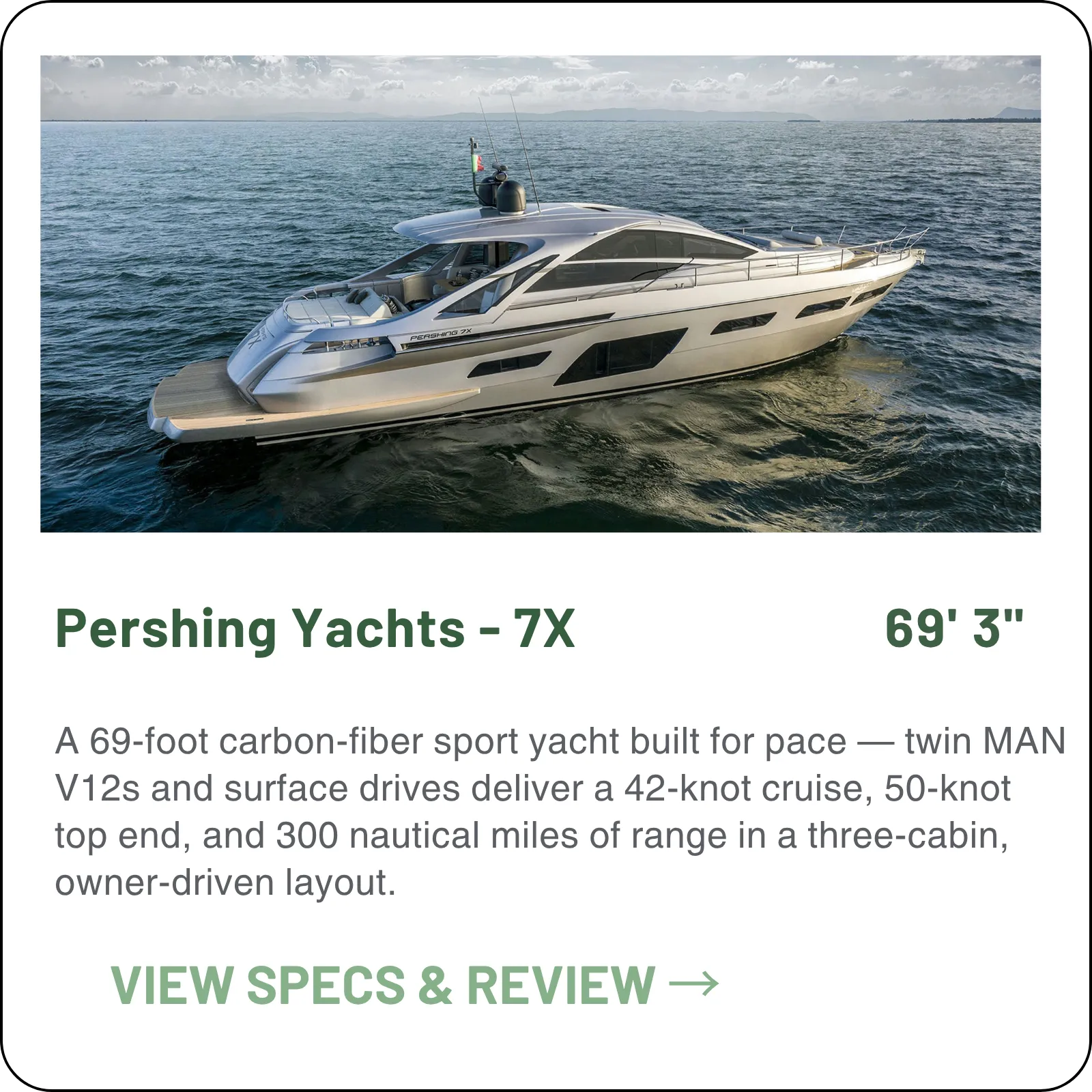
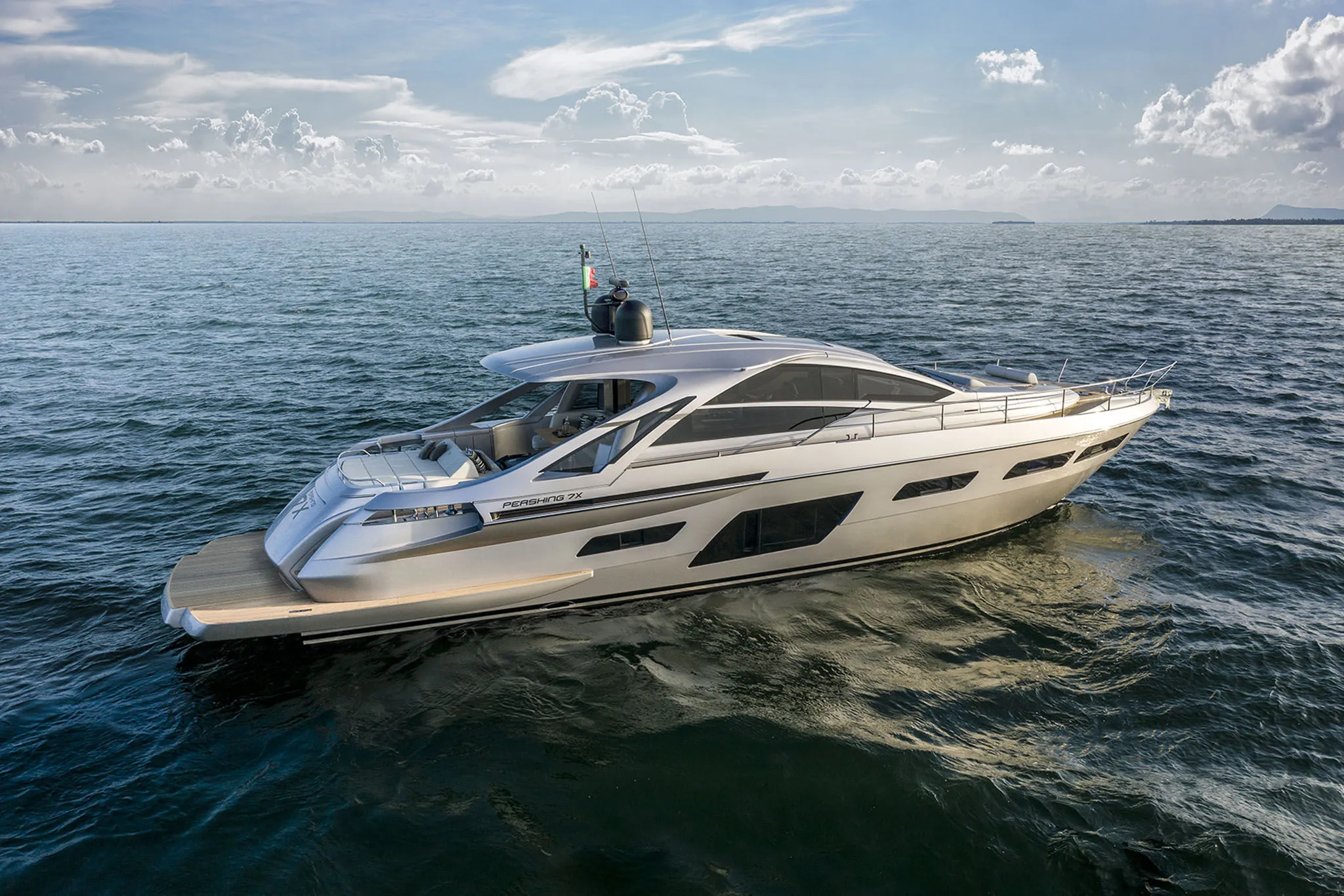
A 69-foot carbon-fiber sport yacht built for pace — twin MAN V12s and surface drives deliver a 42-knot cruise, 50-knot top end, and 300 nautical miles of range in a three-cabin, owner-driven layout.
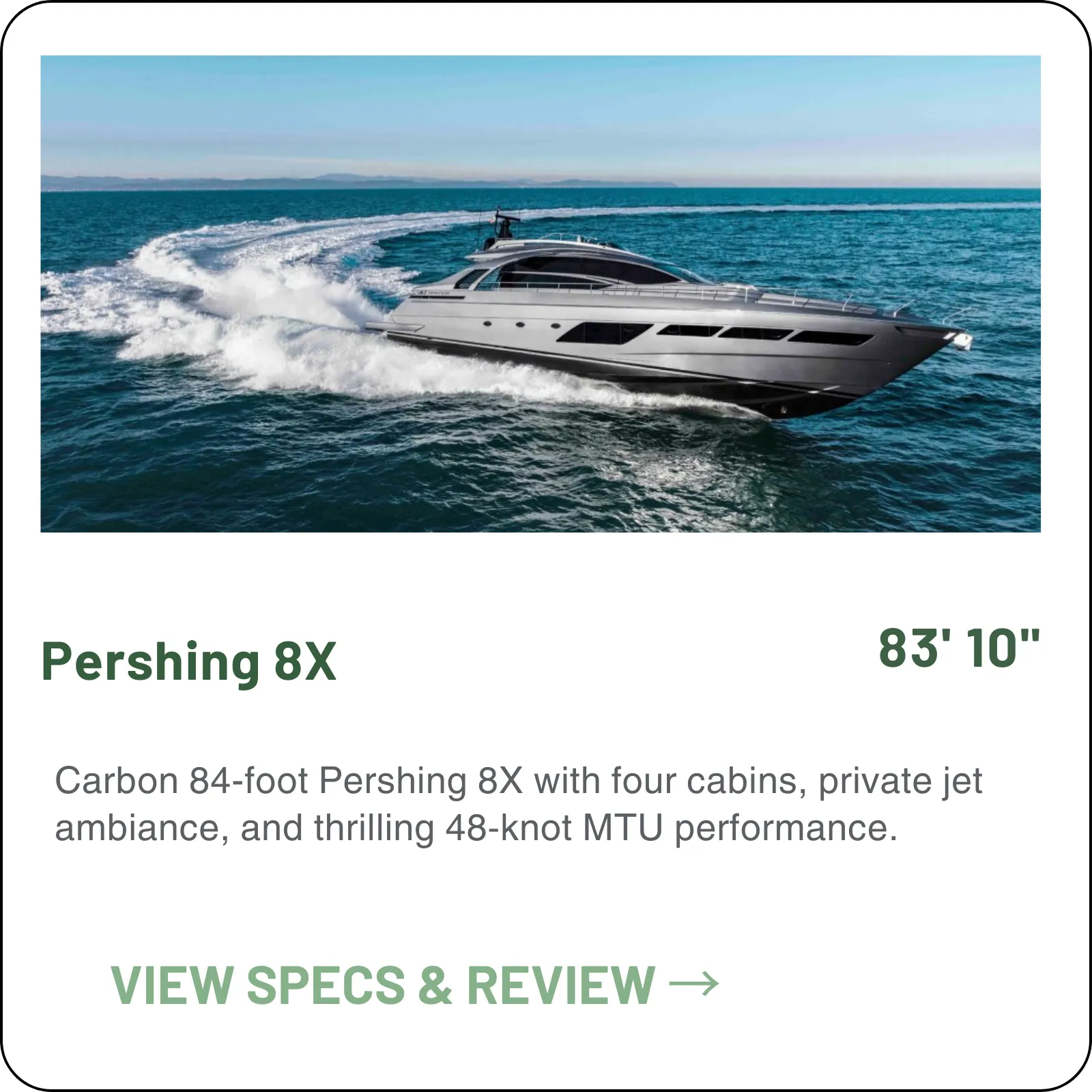
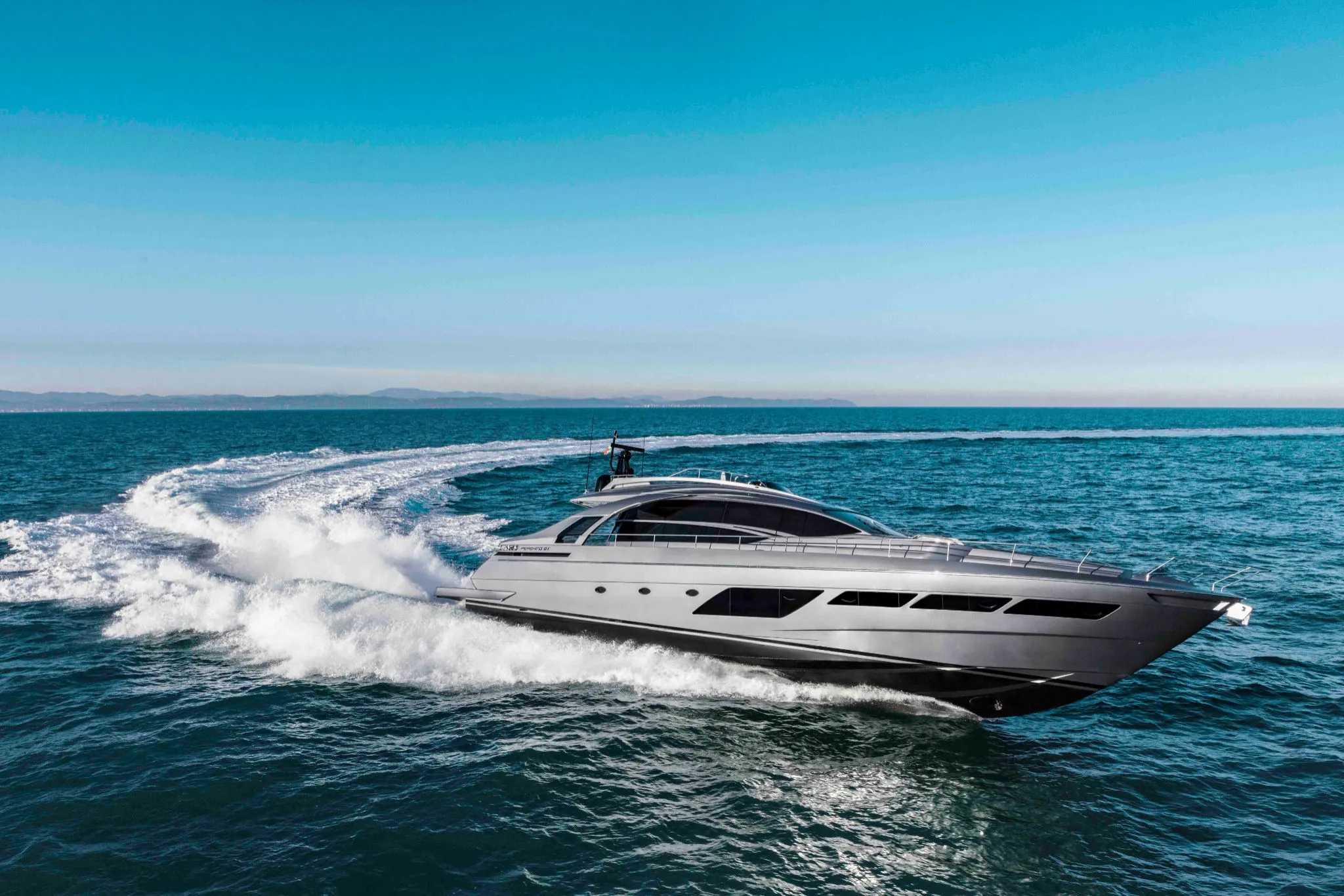
Carbon fibre and surface drives in an 83'10" package — 48 knots flat out, a 41-knot cruise, and four cabins for owners who want the pace without giving up the accommodation.
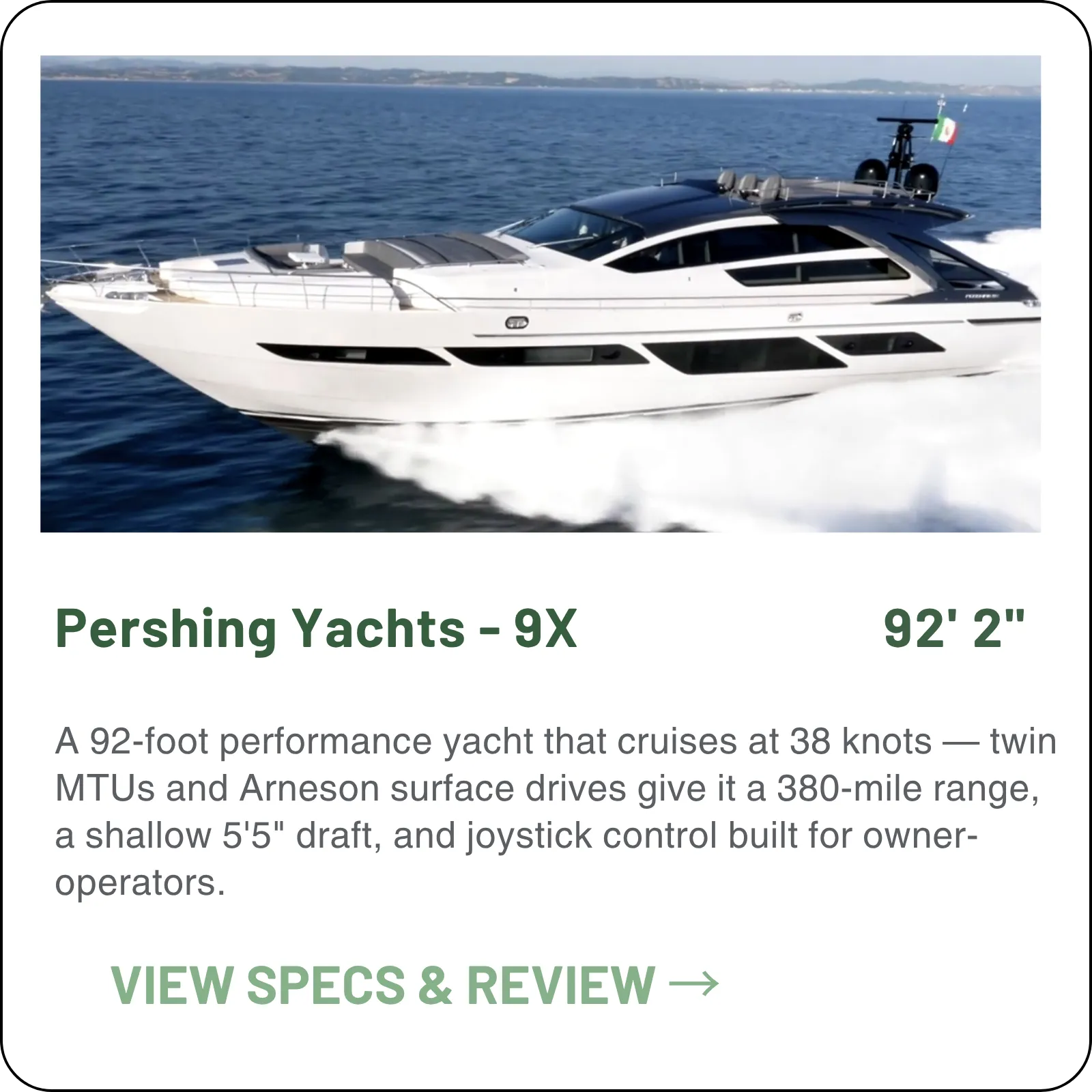
A 92-foot performance yacht that cruises at 38 knots — twin MTUs on surface drives give it 380 miles of range, a shallow 5'5" draft, and joystick control built for owner-operators.
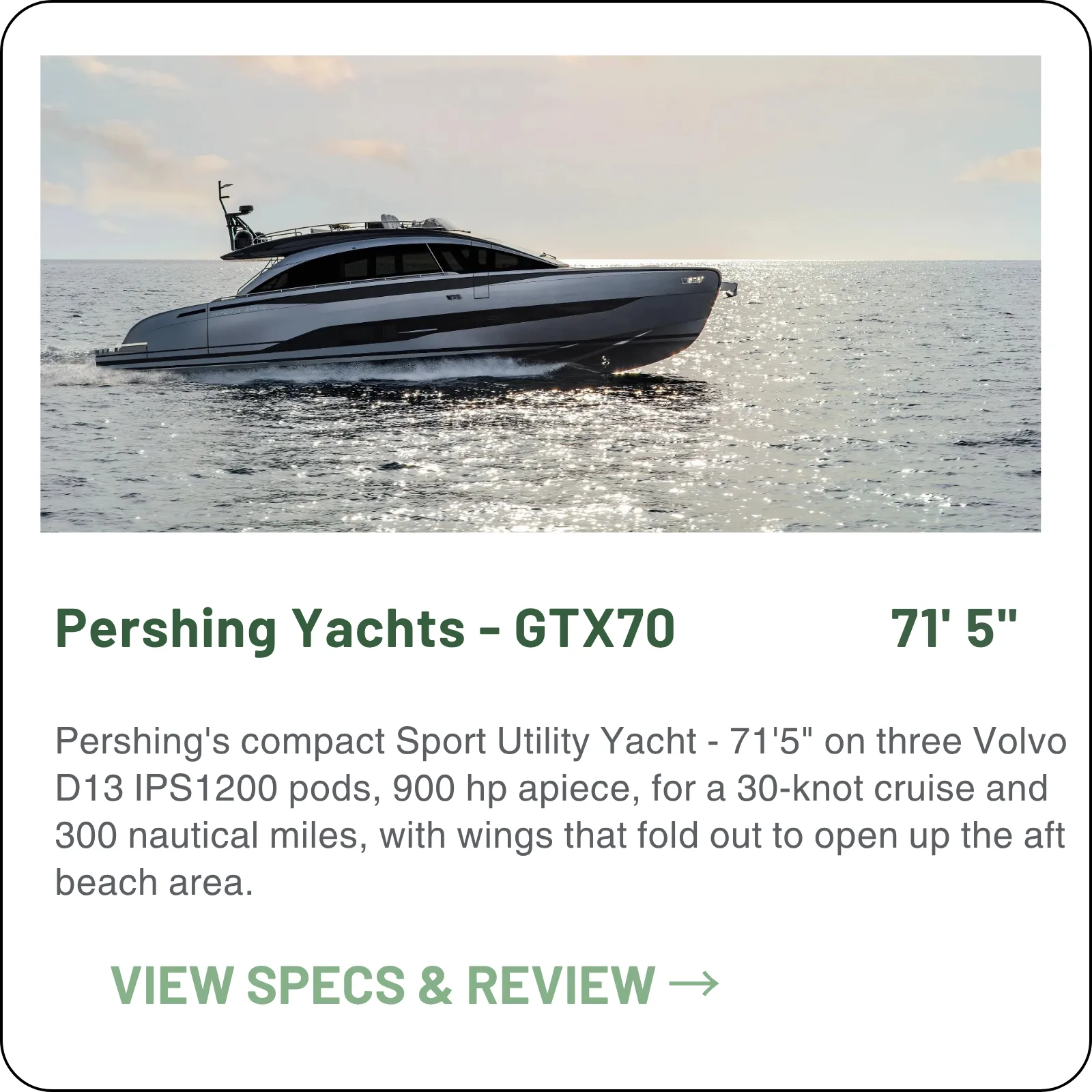
Pershing's compact Sport Utility Yacht - 71'5" on three Volvo D13 IPS1200 pods, 900 hp apiece, for a 30-knot cruise and 300 nautical miles, with wings that fold out to open up the aft beach area.
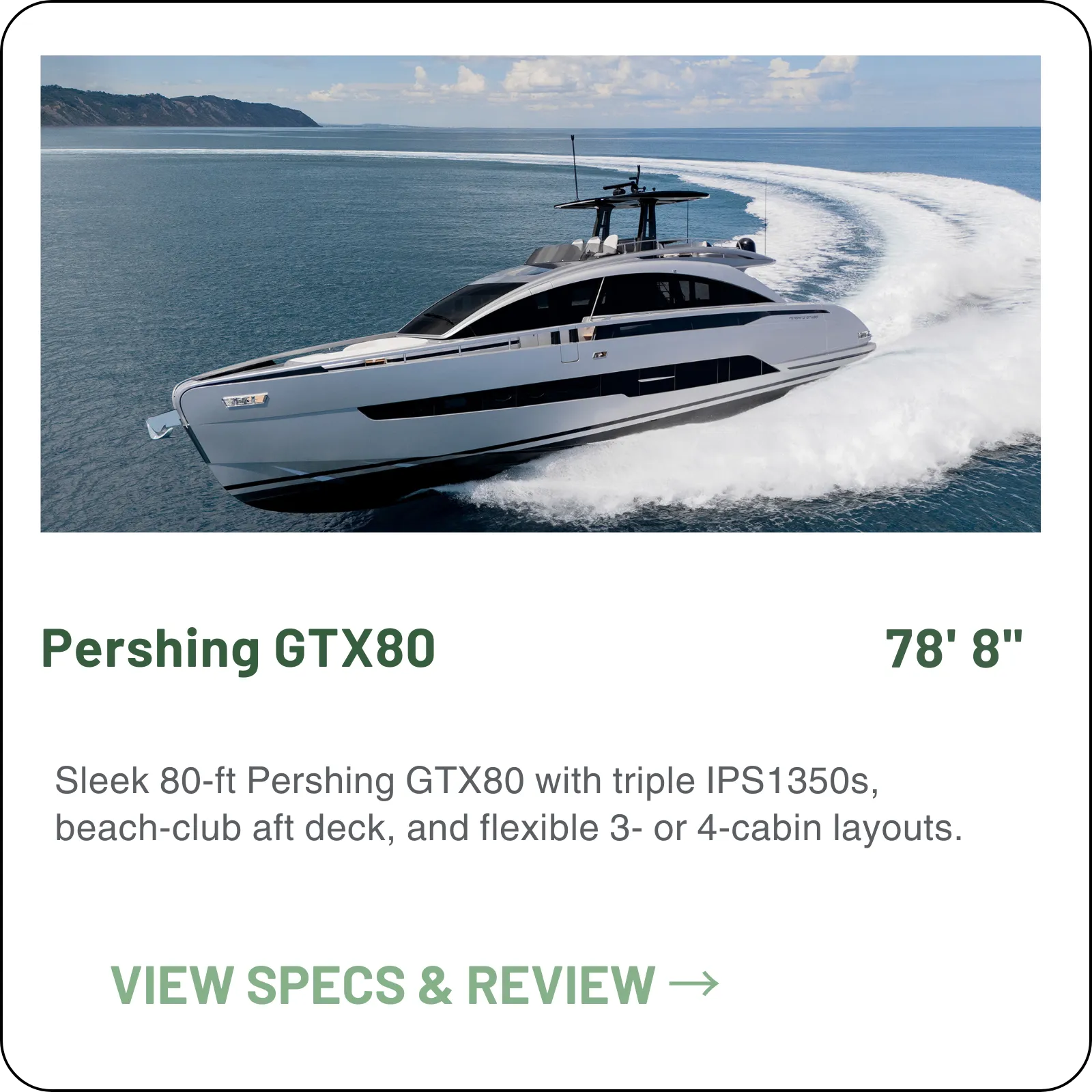
The Pershing built for how Americans actually cruise — 78'8" on triple Volvo IPS pods, a 28-knot cruise with 300 miles of range, galley-up living and a 23-square-metre carbon sundeck.
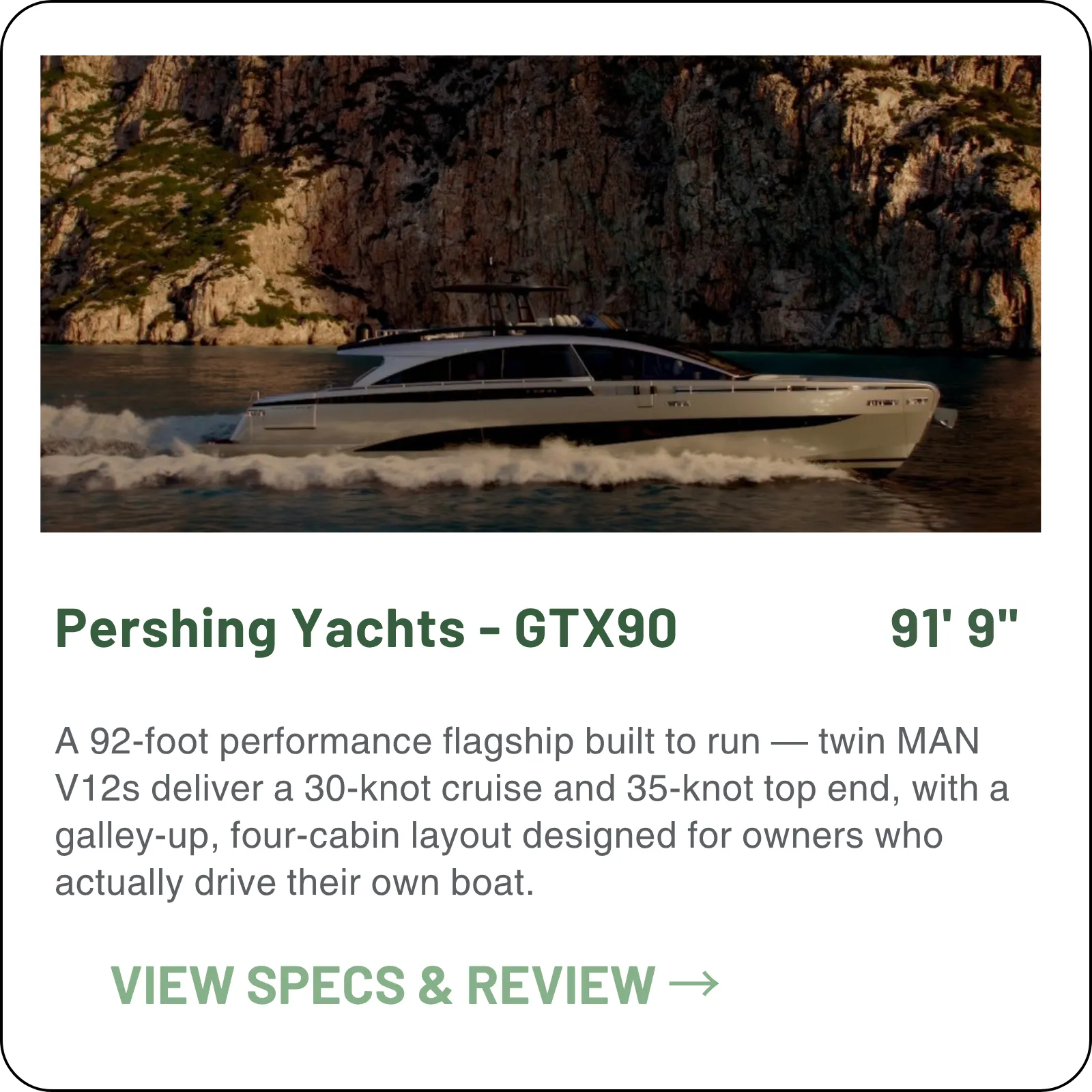
The newest Sport Utility Yacht in the GTX range — 91'9" on twin MAN V12 2200s and Castoldi waterjets, a 30-knot cruise, four cabins and a 355-square-foot sportsbridge.
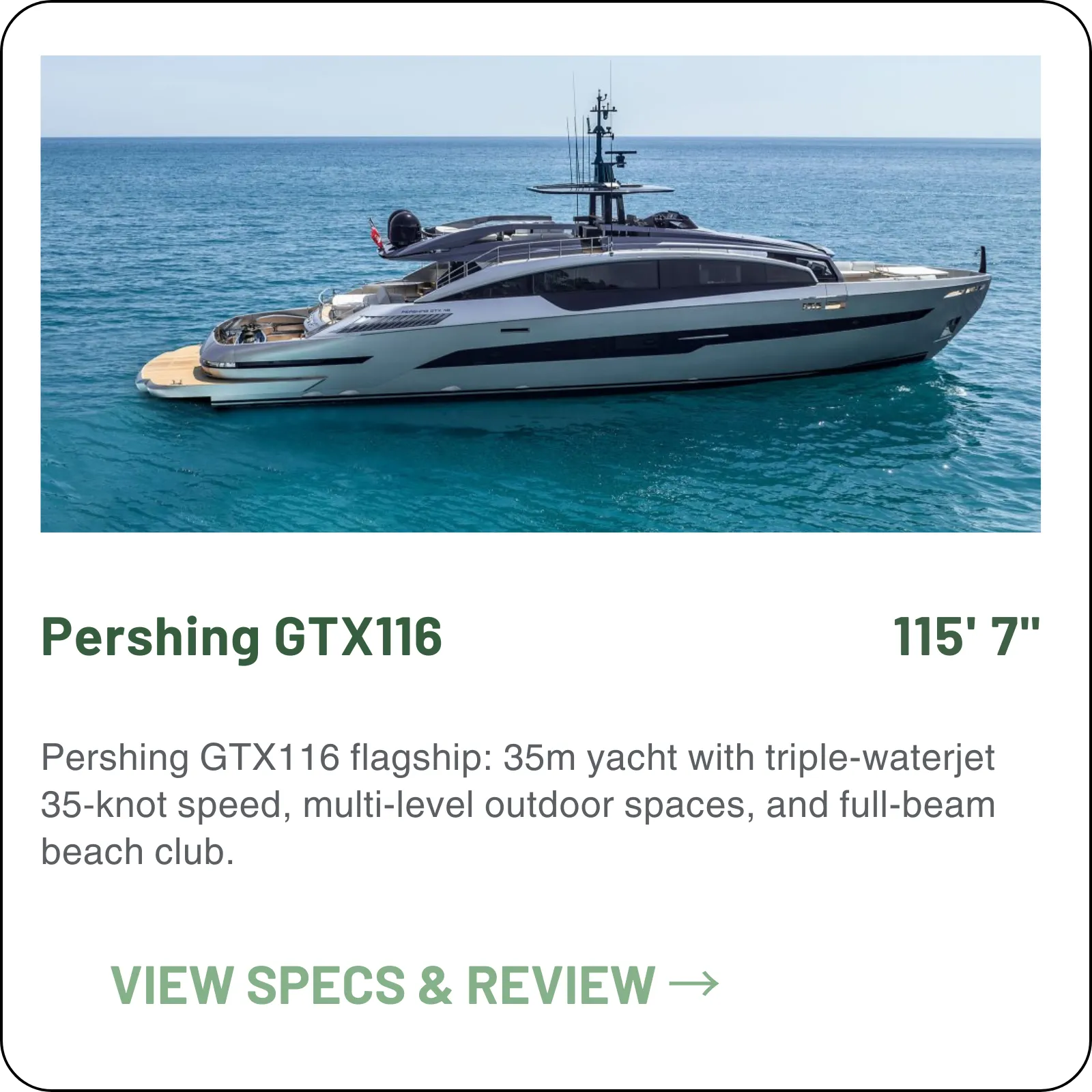
Pershing's flagship for owners who refuse to trade speed for space — 115'11" on triple MAN V12s and Kamewa waterjets, 34 knots flat out, five cabins, and 165 square metres of connected outdoor deck.

Request other Brand or Model Information, with our Yacht Specs Direct, offer.
Videos courtesy of Pershing Yachts.
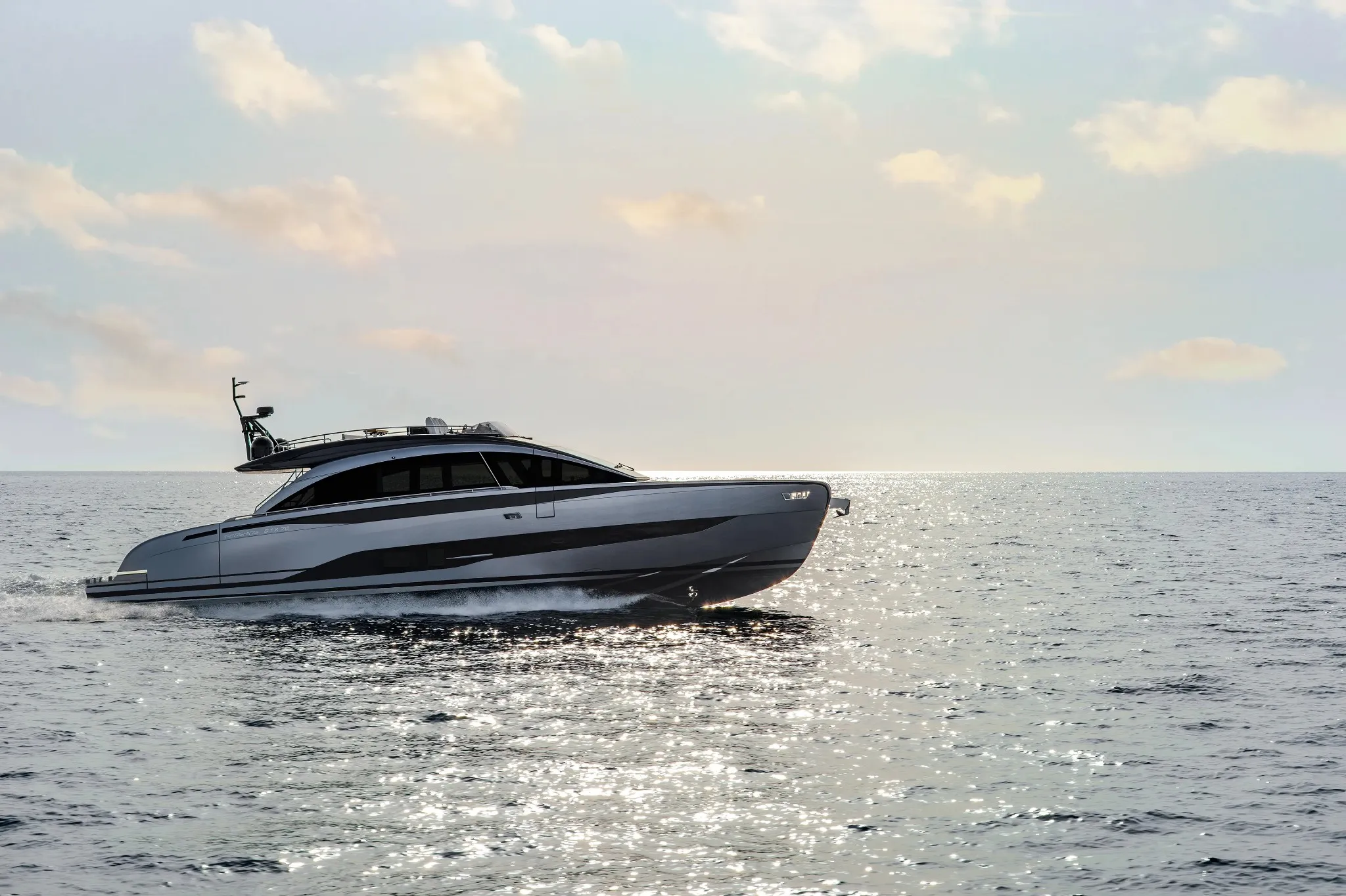
Pershing builds at Mondolfo, on Italy's Adriatic coast — the yard it calls the home of its "seaborne missiles" — with the registered office at Cattolica. The GTX range is built in a newer production area on the same site.
Pershing has been part of the Ferretti Group since 1998, alongside Riva, Ferretti Yachts, Custom Line and Wally.
Pershing dates itself from 1985, when the Pershing 45 arrived as a yacht built around speed at a time when cruising boats were built around everything else. The company marked forty years of that history in July 2025.
Surface drives are the through-line: Pershing adopted them early and built its identity on them. The brand joined the Ferretti Group in 1998, and today splits its fleet into the X Generation, the GTX Series and a Superyachts collection holding the 140.
Start with a single question: do you want the pace or the space? If it is pace, the X Generation — 7X, 8X, 9X — gives you carbon hulls, surface drives and 42 to 50 knots. If it is space, the GTX Series trades that for beach clubs, fold-out terraces and far more volume.
For most American owner-operators we would start with the GTX80: triple-pod redundancy and 300 nautical miles at 28 knots is a very different ownership proposition from a surface-drive boat. If you are set on speed, the 8X is the best balance of pace and accommodation in the range.
Across the six models we review, Pershing publishes top speeds from 34 to 50 knots. The X Generation sport yachts run 42 to 50 knots on surface drives; the GTX Series runs 34 to 35 knots on pods and waterjets.
The fastest is the 7X at 50 knots. More useful than the top speeds are the cruise figures, which range from 28 knots on the GTX80 to 42 knots on the 7X — those are the speeds you actually travel at.
Every buyer's mission is different. Tell us how you plan to use your vessel, and we'll give you the straight story on which models fit your life—and which don't.
Specific Model Details & Advice