
August 25, 2026
Galeon 450 HTC: The Flybridge Boat for People Who Don't Want a Flybridge
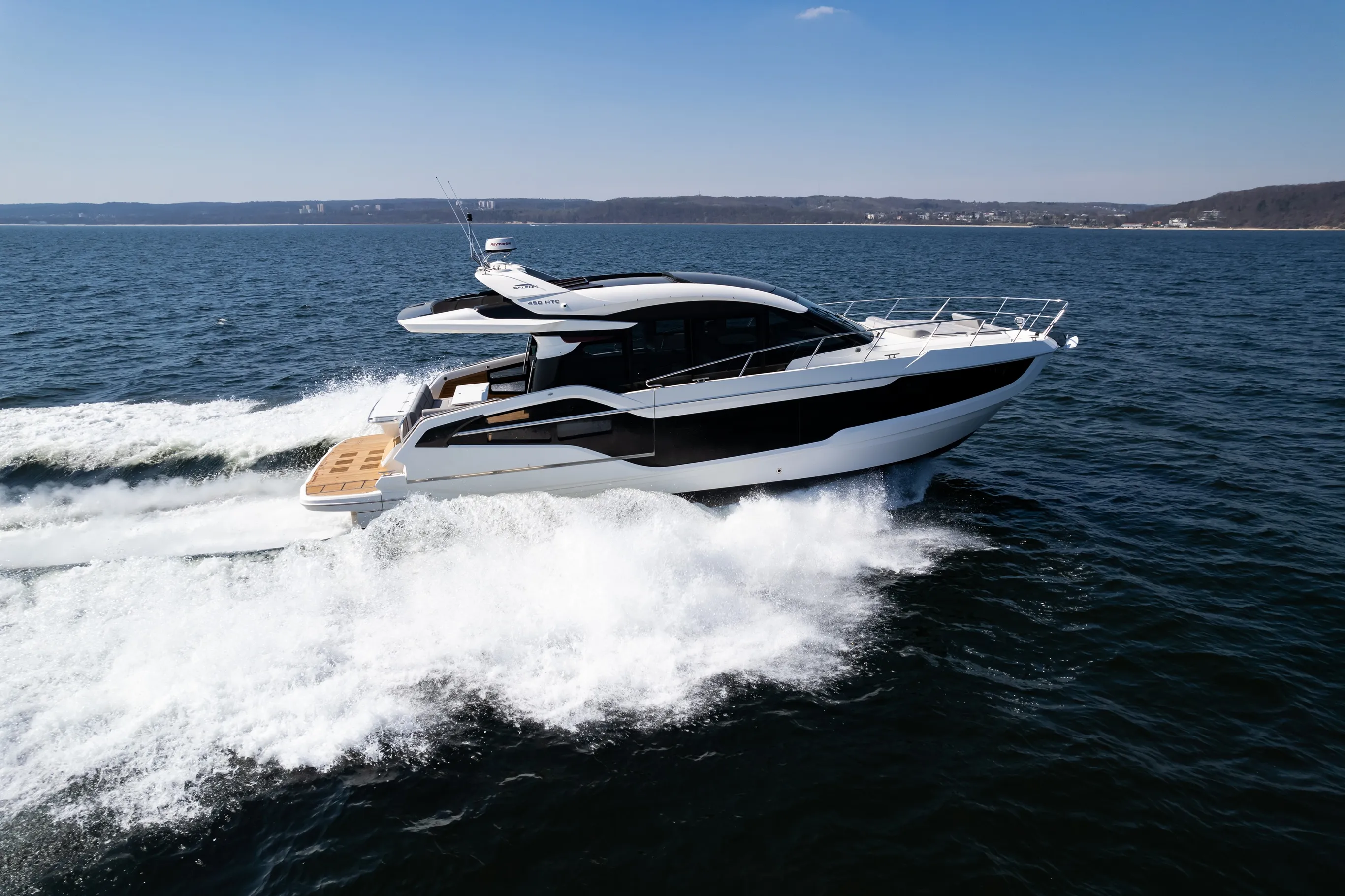
Galeon builds one 45' 10" hull and sells it two ways. The 450 HTC is the hardtop version - a sweeping full-length glass roof with a retracta…
Read the articleExpert Review, Technical Specifications & Market Analysis
| Feature | Specifications |
|---|---|
| Overall Length | 45' 10" |
| Beam | 14' 2" |
| Draft | 2' 8" |
| Displacement | 38,960 lbs |
| Engines | 2 x 440 hp (minimum); up to 2 x 600 hp |
| Fuel Capacity | 423 gal |
| Water Capacity | 119 gal |
| Cabins / Heads | 2/3 Cabins / 2 Heads |
| Max Speed | 29 knots |
Source: Spec & Photos courtesy of Galeon. Specs verified by Tony Smith, USCG 100 Ton Master, on August 24, 2026.
Galeon aims the 450 HTC at flybridge buyers looking for an upgrade - and it is built on exactly the same 45' 10" hull as the 440 FLY, with a full-length glass roof where the upper deck would be.
Part of the Galeon HTC series — see how owners step up through the lineup.

Galeon does something on this boat that I wish more builders did: it tells you who it is trying to take the sale from. It aims the 450 HTC at flybridge enthusiasts looking for a substantial upgrade in the segment. That is a hardtop pitched at flybridge shoppers, and the reason it can make that pitch is the part most buyers never notice - the 450 HTC and the 440 FLY are the same hull. Not similar. The same. Identical figures on both: 45' 10" overall, 14' 2" beam, 2' 8" draft, 423 gallons of fuel, 38,960 lbs light craft, the same 2 x 440 to 2 x 600 hp band, CE category B, crew limit 14. When you see two Galeons in the same catalogue at an identical 45' 10", that is not a mix-up. It means the length has been settled for you and the only real question is what goes on top.
Here that is a sweeping full-length glass roof with a retractable targa panel, and Galeon's own line for it is the right one: it brings the open-air feeling of a flybridge into the form of a coupe at the touch of a button. What you get in exchange for giving up the upper deck is a lower profile, better handling and one very good main deck instead of two adequate ones. What you give up is real and I will not soften it: no second helm, no upstairs seating, nowhere to put six people away from the saloon. If entertaining on two levels is why you started looking at flybridges, the sunroof does not replace that.
Two things to be straight about before you sign. First, the speed. Galeon quotes up to 29 knots here against 31 for the 440 FLY on the same hull. I read both figures as current maxima, not as a tested head-to-head, and I would want observed speed and consumption from your own sea trial on the exact engine specification you order. Second, the layout: this boat is sold as two cabins or three, and the third is bunk berths rather than a third double. Confirm which layout the specific boat in front of you was built to before you count where everybody sleeps.
Video courtesy of Galeon.
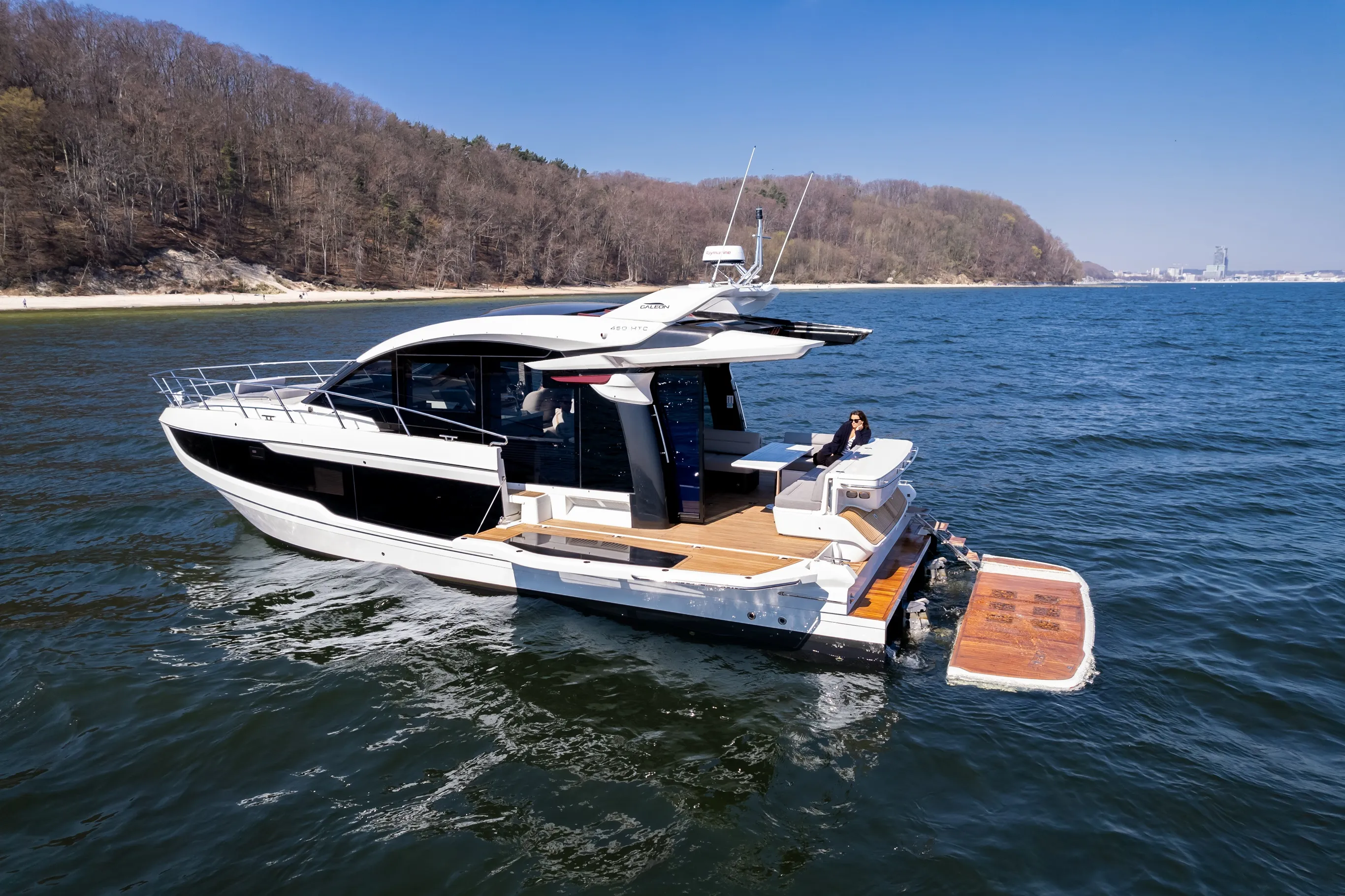
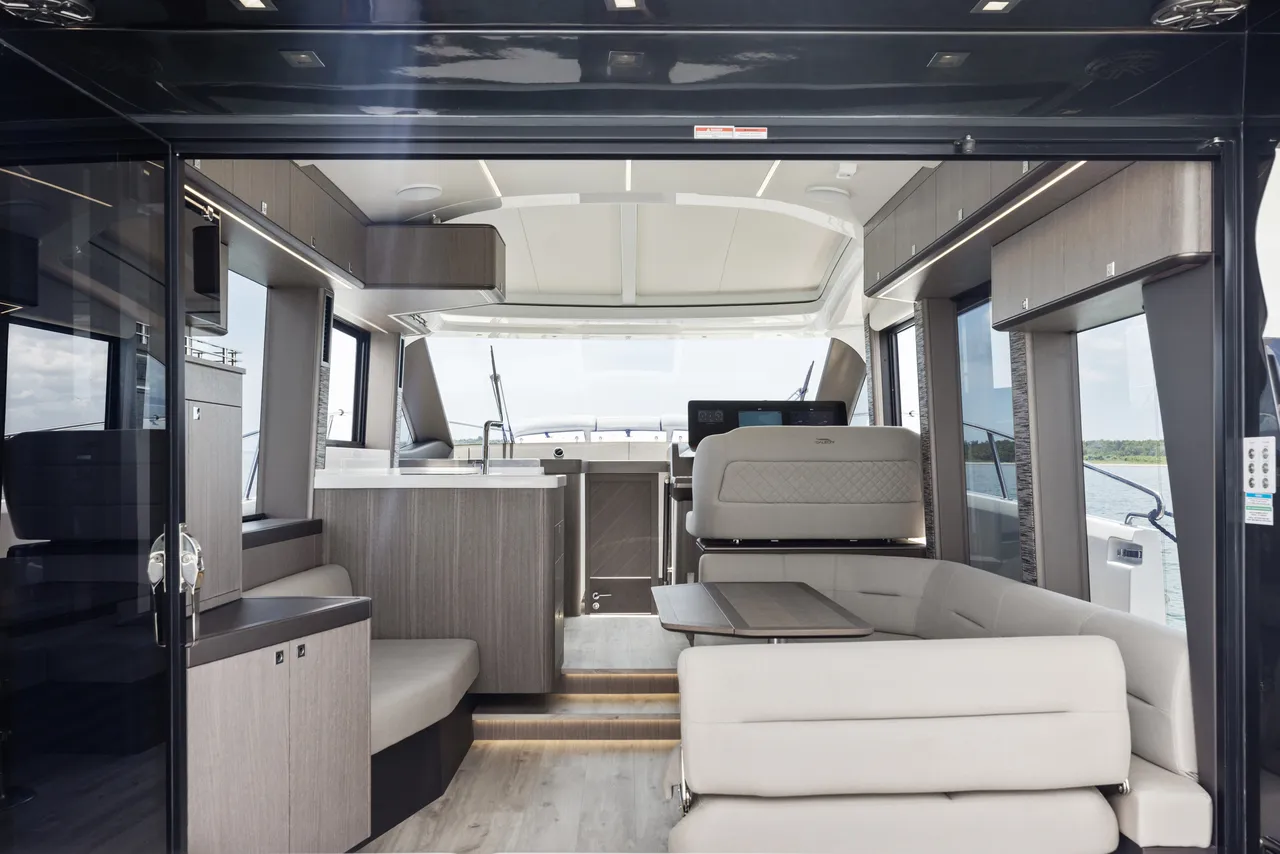
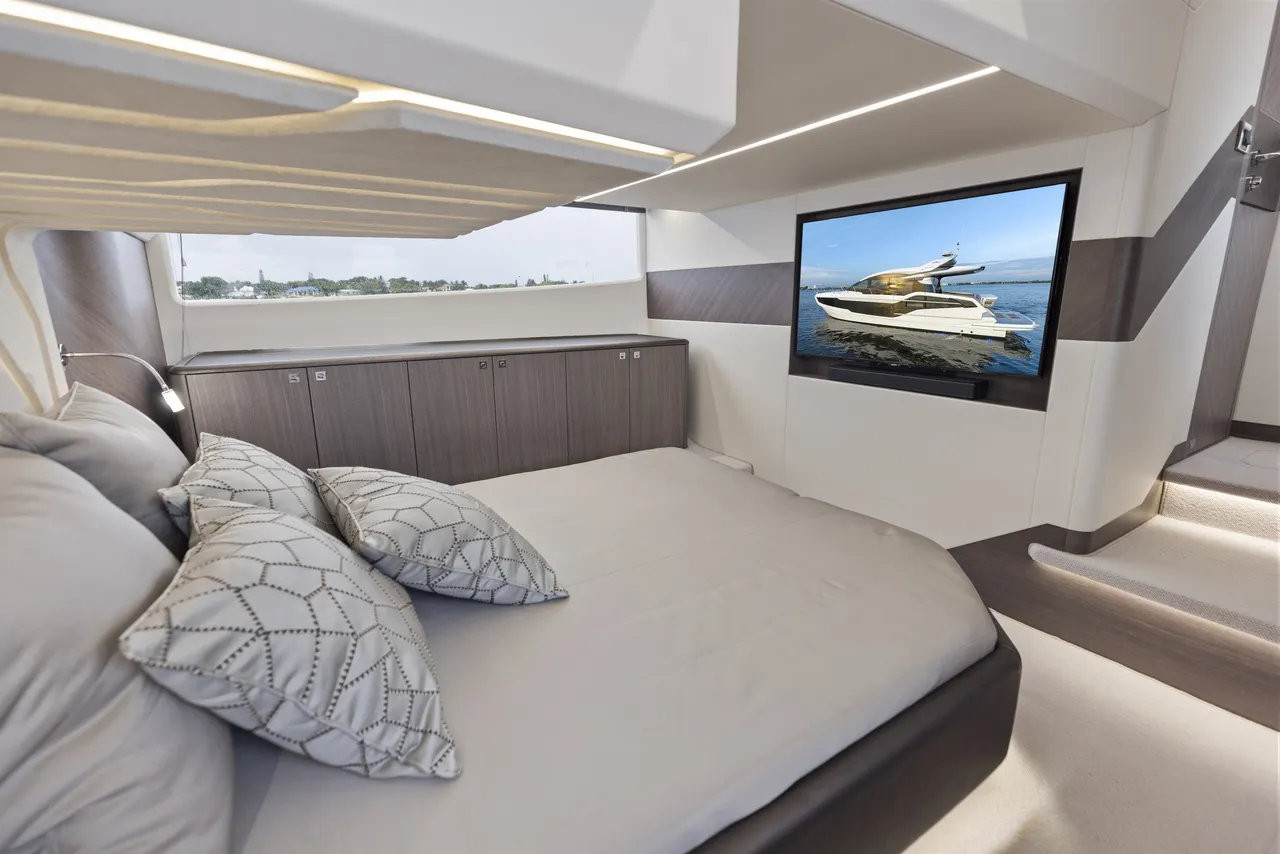
Photos courtesy of Galeon.
The Galeon 450 HTC is a 45' 10" hardtop coupe on a 42' 5" hull with 14' 2" of beam - and it is the same hull as the Galeon 440 FLY. Not a related hull, the same one, down to the 2' 8" draft, the 423 gallons of fuel and the 38,960 lb light-craft mass. Identical length overall between the two models is how Galeon builds its range, because it shares hulls across its classes. What separates them is the roof. The 440 FLY has a flybridge and a second helm; the 450 HTC has a fixed hardtop with a sweeping full-length glass roof and no upper station.
Galeon is unusually direct about who that is for. It pitches the 450 HTC at flybridge enthusiasts seeking a substantial upgrade within this segment - in other words, at the buyer who has been shopping flybridges and wants the space without the top deck. The large electric sunroof is how it makes that case: it brings the open-air feeling of a flybridge into the sleek form of a coupe, at the touch of a button.
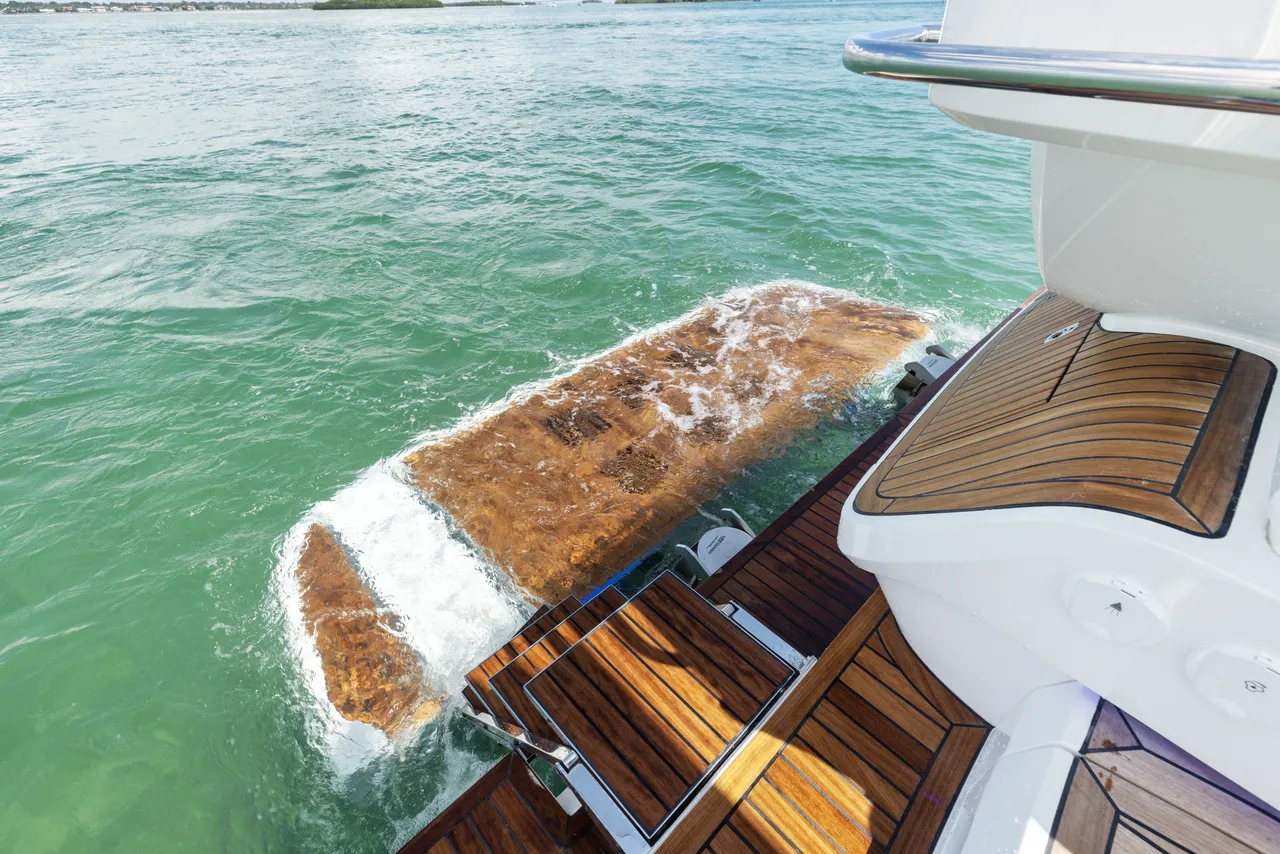
The main deck is where the whole boat happens. A bright open-plan saloon sits under panoramic windows and the retractable roof panel, with a well-equipped galley, a convertible dining area and a helm station with strong visibility. Full-height sliding doors at the aft end open the saloon straight into the cockpit, so at anchor it is one continuous space. Outside, Beach Mode drops semi-glazed panels on both sides of the cockpit and takes the beam from 14' 2" to 20' 10", while a full-sized hydraulic stern platform doubles as a lift for water toys and opens onto a stern-facing grill area.
Galeon quotes a maximum speed of up to 29 knots for the 450 HTC, and sells the boat as an engine power band rather than one named package: minimum 2 x 440 hp, maximum 2 x 600 hp. A listing that names a specific engine is describing that individual boat's build rather than the model specification. Ask for observed speed and consumption at your intended cruise rpm at sea trial, on the engine package you are actually ordering.
Light-craft mass is 38,960 lbs, and that is the minimum weight with base engines, so a boat built to 2 x 600 hp weighs more than that. Maximum load is 8,532 lbs. Draft is 2' 8", measured without propellers, with a bare-hull-with-appendage figure of 4' 3" - size a lift and a berth off the deeper one. CE category is B, with a crew limit of 14.
One figure worth a note: the 440 FLY shares this hull, this mass and this engine band, and Galeon quotes 31 knots for it against 29 here. Treat both numbers as the builder's current maxima rather than a tested comparison, and plan around the figures you observe yourself on the engine specification you actually order.
The standard arrangement below accommodates four: a mid-ship master and a forward VIP, both with substantial volume and storage. Galeon offers a three-cabin layout with bunk berths for larger groups, so the boat is sold as two or three cabins and you will see it described both ways - confirm which layout a given boat was built to before you count berths. The full-beam master suite sits amidships with large hull windows, generous storage and a private en-suite. The lower-deck bathrooms have heads and showers with standing headroom.
Above, the saloon is the argument for the model. Panoramic glazing runs down both sides and a sweeping full-length glass roof runs overhead, with an electric sunroof panel that opens the main deck to the sky. The galley is well equipped and positioned to serve both the saloon and the cockpit; the seating area converts for dining; the helm sits forward with clear sightlines. Because the aft division is full-height sliding glass rather than a bulkhead, the saloon and cockpit function as one room whenever the doors are open - which on a hardtop, with the roof panel back, is most of the time.
The tank plan is the practical limit. Fresh water is 119 gallons, against a 58-gallon grey tank and a 32-gallon black tank. Fuel is 423 gallons total, split between two tanks, and maximum load is 8,532 lbs once you have added people, water, fuel and gear.
The 450 HTC's closest relation is the 440 FLY, and they are the same hull. Both are 45' 10" overall on a 42' 5" hull with a 14' 2" beam that opens to 20' 10" in Beach Mode, both carry 423 gallons of fuel and 119 gallons of water, both list a 38,960 lb light-craft mass and an 8,532 lb maximum load, both run an engine band from 2 x 440 hp to 2 x 600 hp, and both are CE category B with a crew limit of 14. Every one of those figures is identical on the two boats. Galeon shares hulls across its classes, so identical length between them is how the range is built rather than an error.
So the choice is a class choice. The 450 HTC gives you one large protected main deck under a sweeping full-length glass roof with a retractable targa panel, no upper station and lower windage. The 440 FLY gives you a third deck - an upper helm with a companion settee, an L-shaped sofa and table seating six, and a wet bar - and it is quoted at 31 knots against the 450's 29. Galeon aims the 450 HTC squarely at the buyer who has been looking at flybridges and wants a substantial upgrade without the top deck, and the electric sunroof is the feature built to close that argument.
Within Galeon's hardtop line the 450 HTC sits above the 410 HTC at 40' 11". That step buys the larger hull, the two-or-three-cabin option and the 423-gallon fuel plan. Across to the flybridge range, the 420 FLY at 44' 11" is the other way to spend similar money on similar length - a different hull with 264 gallons of fuel and two cabins.
Two practical notes. If your home run includes a fixed bridge, get the as-built air draft of the specific boat in writing before you plan around it. And the three-cabin layout uses bunk berths rather than a third double - know that before you count sleeping capacity, and confirm which layout the specific boat in front of you was built to.
The 450 HTC fits the buyer who wants flybridge-scale living space in a boat that behaves like a sport cruiser. Galeon says as much - it aims the model at flybridge enthusiasts seeking a substantial upgrade in this segment - and the boat is built to make that trade painless. The full-length glass roof and the large electric sunroof are Galeon's answer to what you give up by deleting the upper deck: open sky over the saloon at the touch of a button, without the windage or the climb. Downstairs, Beach Mode drops semi-glazed panels on both sides and takes the cockpit from 14' 2" to 20' 10" of beam, with a hydraulic stern platform that doubles as a toy lift and opens onto a stern-facing grill.
It fits a family of four comfortably and a larger group conditionally: the standard plan is a mid-ship master and a forward VIP, with the third cabin available as a bunk cabin rather than a third double. Both lower-deck bathrooms have a head and shower with standing height. It fits particularly well if you run in weather - a fixed hardtop with full-height sliding glass doors gives you a genuinely protected main deck that an open express does not, while the roof panel keeps it from feeling closed in. It fits less well if what you actually want is a second helm and a place to put six people upstairs; that is the same hull with a flybridge on it, sold as the 440 FLY.
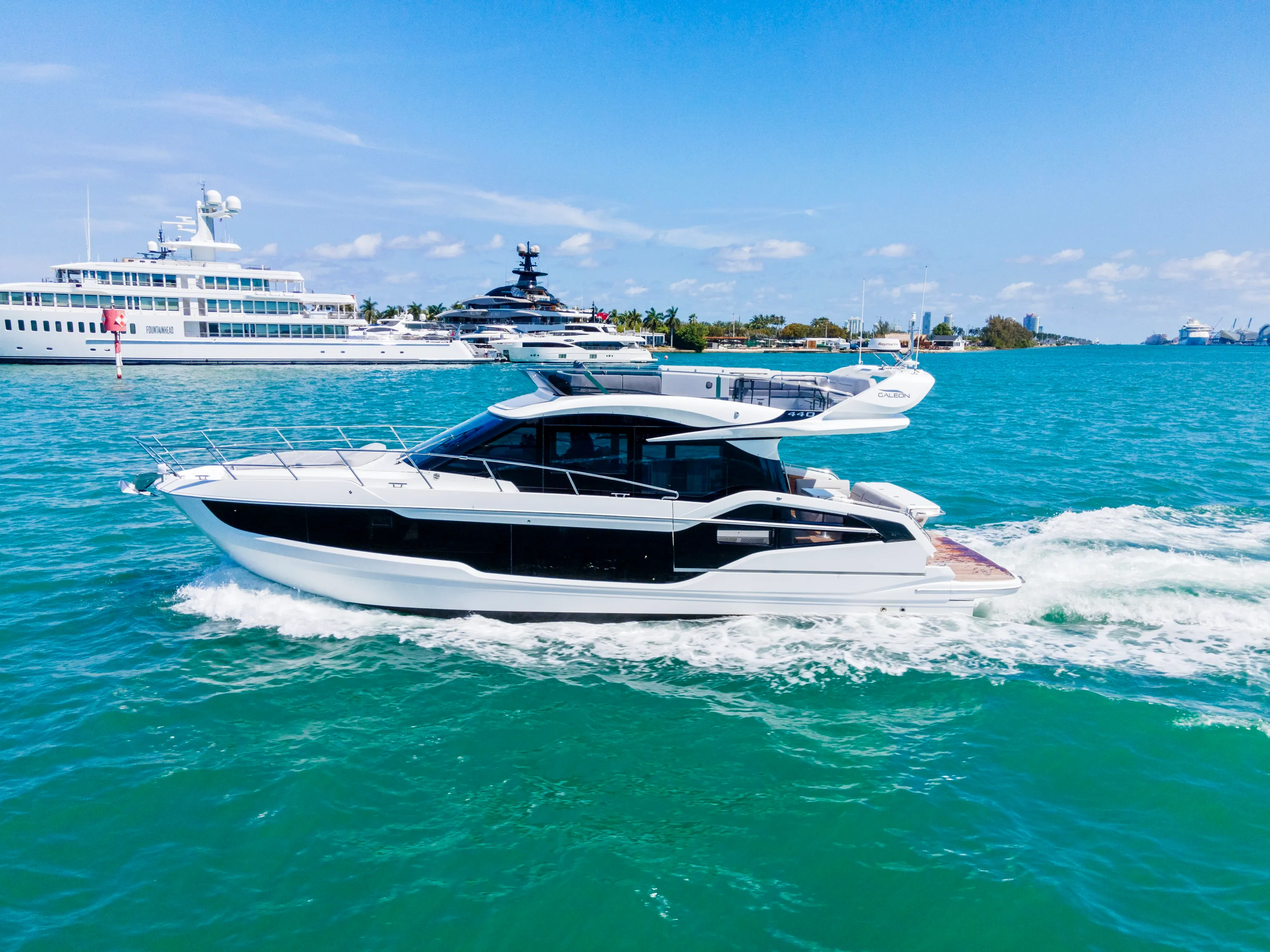
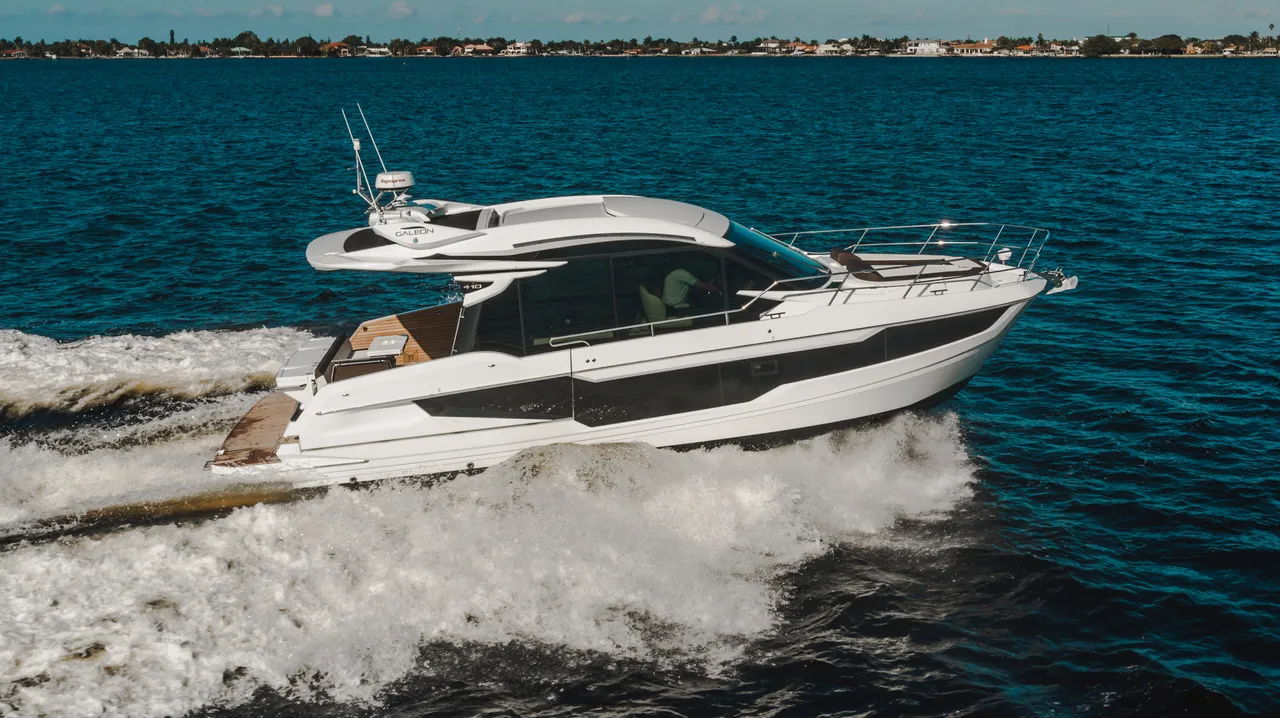
A fixed hardtop, glazed for most of its length, with a retractable targa roof over the cockpit and a large electric sunroof over the saloon. Galeon's argument for the configuration is that it puts open sky over the main deck at the touch of a button without the climb to a second helm, and it aims the model at flybridge owners looking for an upgrade in the segment. The main deck stays one room: full-height sliding doors join the saloon to the cockpit, and the galley and helm sit forward.
On Galeon's published figures the 450 HTC carries the same 16' 7" bridge clearance and the same 38,960 lb light-craft mass as the 440 FLY, so if you are choosing the coupe to clear a bridge, confirm the as-built air draft of the specific boat in writing.
Decide whether you want an upper deck, because underneath these are the same boat. Every figure Galeon gives is identical across the two: a 42' 5" hull under a 45' 10" length overall, 13' 10" of hull beam, 14' 2" beam overall opening to 20' 10" with the Beach Mode balconies down, 2' 8" of draft without propellers, 423 gallons of fuel, 119 gallons of water, a 38,960 lb light-craft mass, an 8,532 lb maximum load, the same 2 x 440 to 2 x 600 hp band, a crew limit of 14 and CE category B. Identical length between the two models is how Galeon builds the range, not an error.
So the choice is the roof. The 450 HTC has a fixed hardtop with a full-length glass roof, a retractable targa over the cockpit and a large electric sunroof over the saloon; the 440 FLY has a flybridge with a second helm, a wet bar and an L-shaped sofa seating six. Galeon pitches the HTC squarely at flybridge owners looking to move up rather than at people who have never had one. Two figures to settle before you sign: the FLY is quoted at up to 31 knots against the HTC's 29 - read both as builder maxima and sea-trial the boat you are buying - and both models list the same 16' 7" bridge clearance, so if clearing a fixed bridge is the reason for the coupe, get the as-built air draft in writing.
Two doubles as standard, with an optional bunk cabin — so both numbers you have seen are right, and neither on its own tells you what you are buying. The standard arrangement is four berths: a mid-ship master and a forward VIP. The three-cabin layout adds bunk beds for larger groups and takes the boat to six guests. The third cabin is bunk berths rather than a third double, so any six-guest figure depends on ordering it — confirm which layout the boat in front of you was built to.
Everything else is the same either way. Two bathrooms, both with a head and a shower with standing headroom. The full-beam master sits amidships with large hull windows, generous storage and a private en-suite; the VIP is forward. And treat the 14 guests Galeon lists as a separate number entirely: it matches the crew limit of 14 under CE category B, which is day capacity, not berths.
Up to 29 knots, Galeon's published maximum. Engine power is sold as a band rather than a single package — 2 x 440 hp minimum, 2 x 600 hp maximum.
The 440 FLY, the same hull with the same 38,960 lb light-craft mass and the same engine band, is quoted at up to 31 knots. Read both figures as the builder's ceiling rather than a tested comparison, and ask for observed speed and consumption at your intended cruise rpm, in writing, before you plan around them.