
August 25, 2026
Galeon 440 FLY vs 450 HTC: One 45' 10" Hull, and the Roof Decides
Galeon builds one 45' 10" hull and sells it two ways. The 440 FLY is the flybridge version - an upper helm with a companion settee, a six-se…
Read the articleExpert Review, Technical Specifications & Market Analysis
| Feature | Specifications |
|---|---|
| Overall Length | 45' 10" |
| Beam | 14' 2" |
| Draft | 2' 8" |
| Displacement | 38,960 lbs |
| Engines | 2 x Diesel (up to 600 hp) |
| Fuel Capacity | 423 gal |
| Water Capacity | 119 gal |
| Cabins / Heads | 2/3 Cabins / 2 Heads |
| Max Speed | 31 knots |
Source: Spec & Photos courtesy of Galeon. Specs verified by Tony Smith, USCG 100 Ton Master, on August 24, 2026.
The 440 FLY and the 450 HTC are the same 45' 10" Galeon hull - identical down to the 38,960 lb light-craft mass. What you are actually choosing is a flybridge.
Part of the Galeon FLY series — see how owners step up through the lineup.

The first thing you need to know about the 440 FLY is something Galeon does not put in a headline: it is the same hull as the 450 HTC. I do not mean similar, I mean identical - 45' 10" overall, 14' 2" beam, 2' 8" draft, 423 gallons of fuel, 38,960 lbs light craft, the same 2 x 440 to 2 x 600 hp band, the same CE category B and the same crew limit of 14. Galeon shares hulls across its classes and this is one of them. So when you see two boats in the same catalogue at an identical 45' 10", that is not a mix-up. It means the length has already been decided for you, and the real question is what sits on top of it.
On this boat, what sits on top is a properly planned flybridge: a helm station with a portside settee so the driver has company, the main rest area set further aft around an L-shaped sofa and an elongated table that seats six, and a well-equipped wet bar. That is a third place to put people, on a boat that still fits a 46-foot slip - and downstairs Beach Mode drops the cockpit panels and takes you from 14' 2" of beam to 20' 10" at anchor. If you entertain, that combination is the argument, and it is the reason to pay for this version rather than the hardtop.
Two things I would settle before you sign, and one of them can end the conversation early. Bridge clearance on this hull is 16' 7", with a lower published figure of 14' 11" - if your home run has a fixed bridge, measure it before you do anything else, because that is the price of the deck you came for. And on speed: I read Galeon's quoted maxima as ceilings rather than test results, and I would want observed speed and consumption from your own sea trial on the exact engine specification you order. Also worth knowing before you count berths: the third cabin is a bunk cabin, not a third double.
Video courtesy of Galeon.
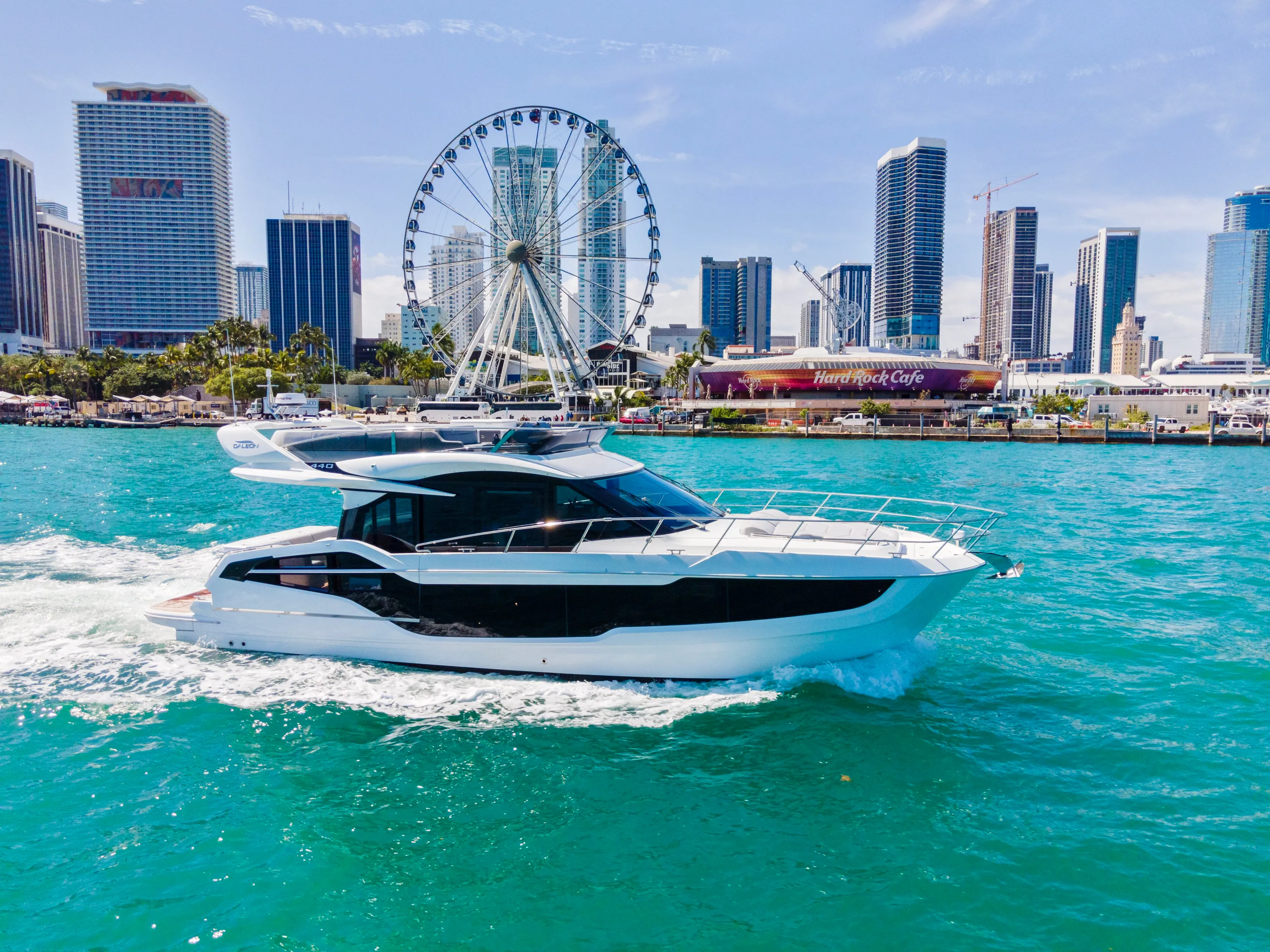
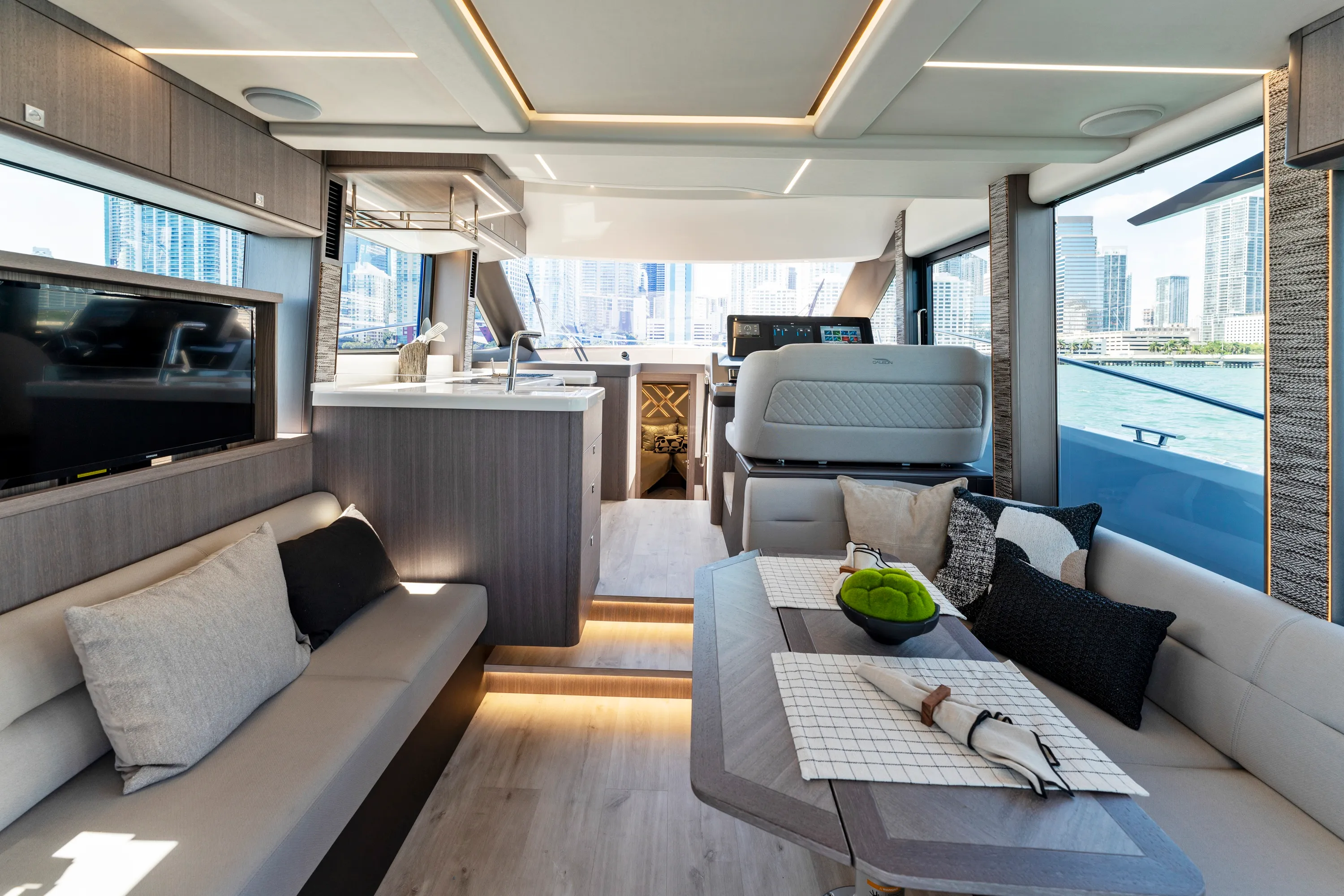
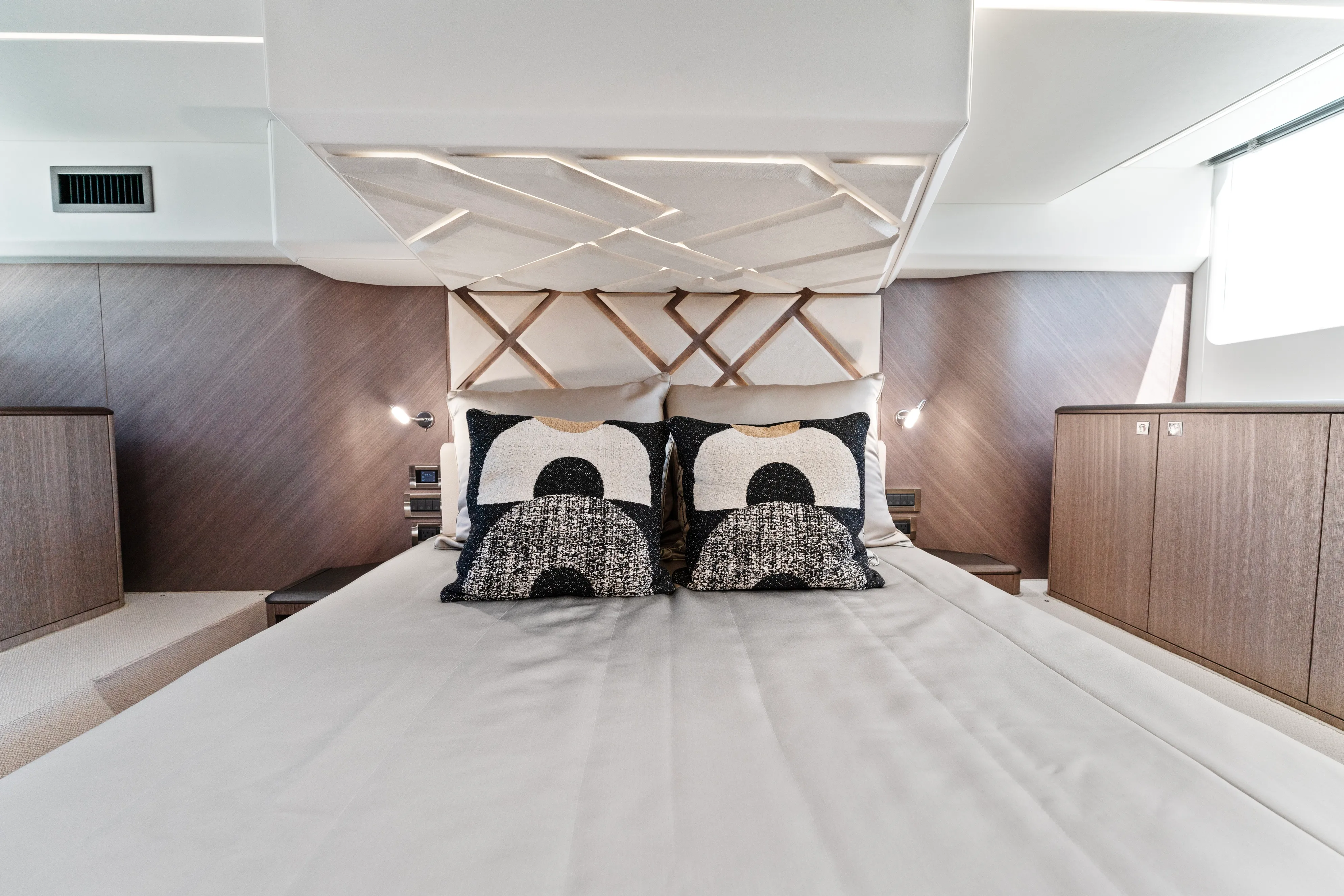
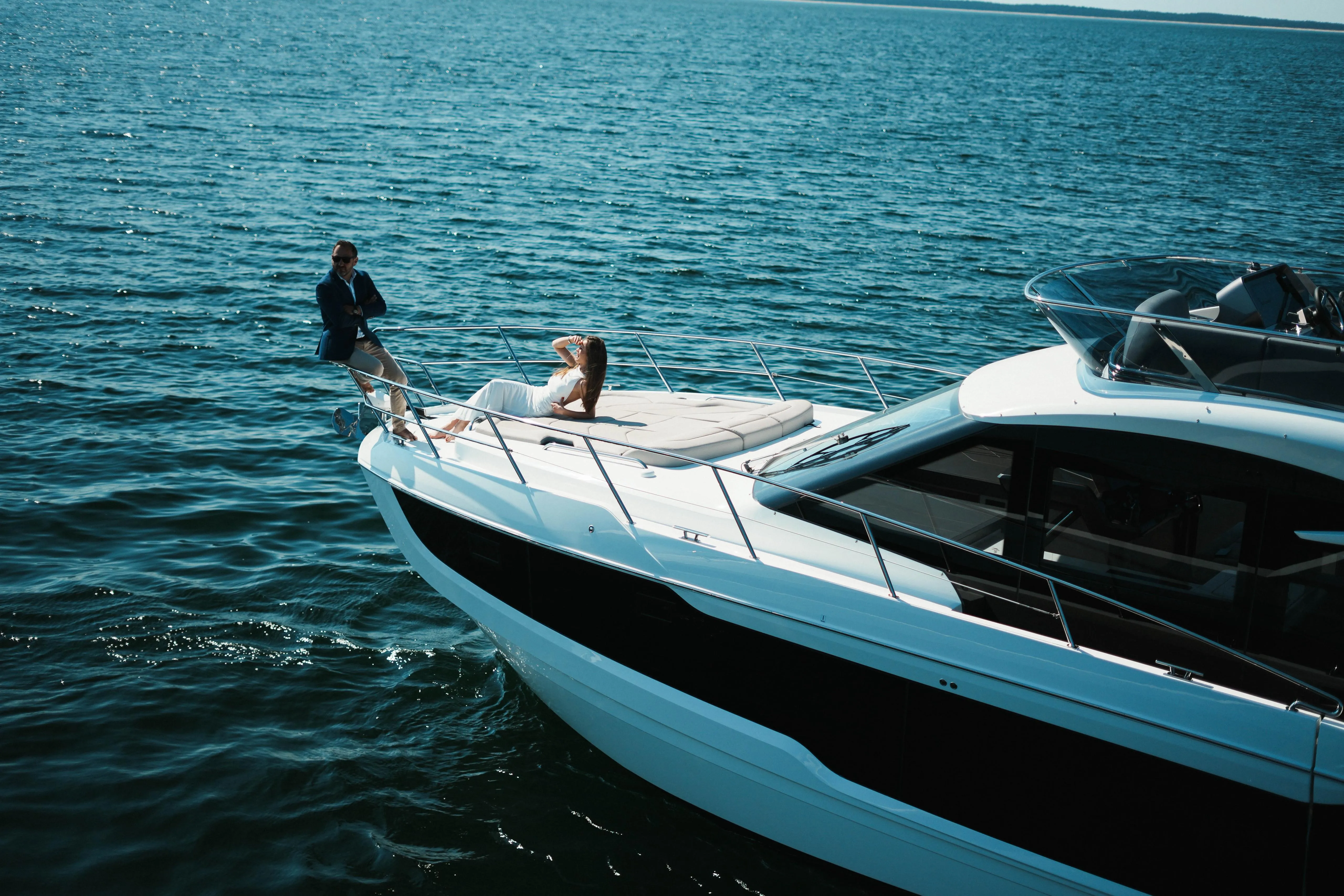
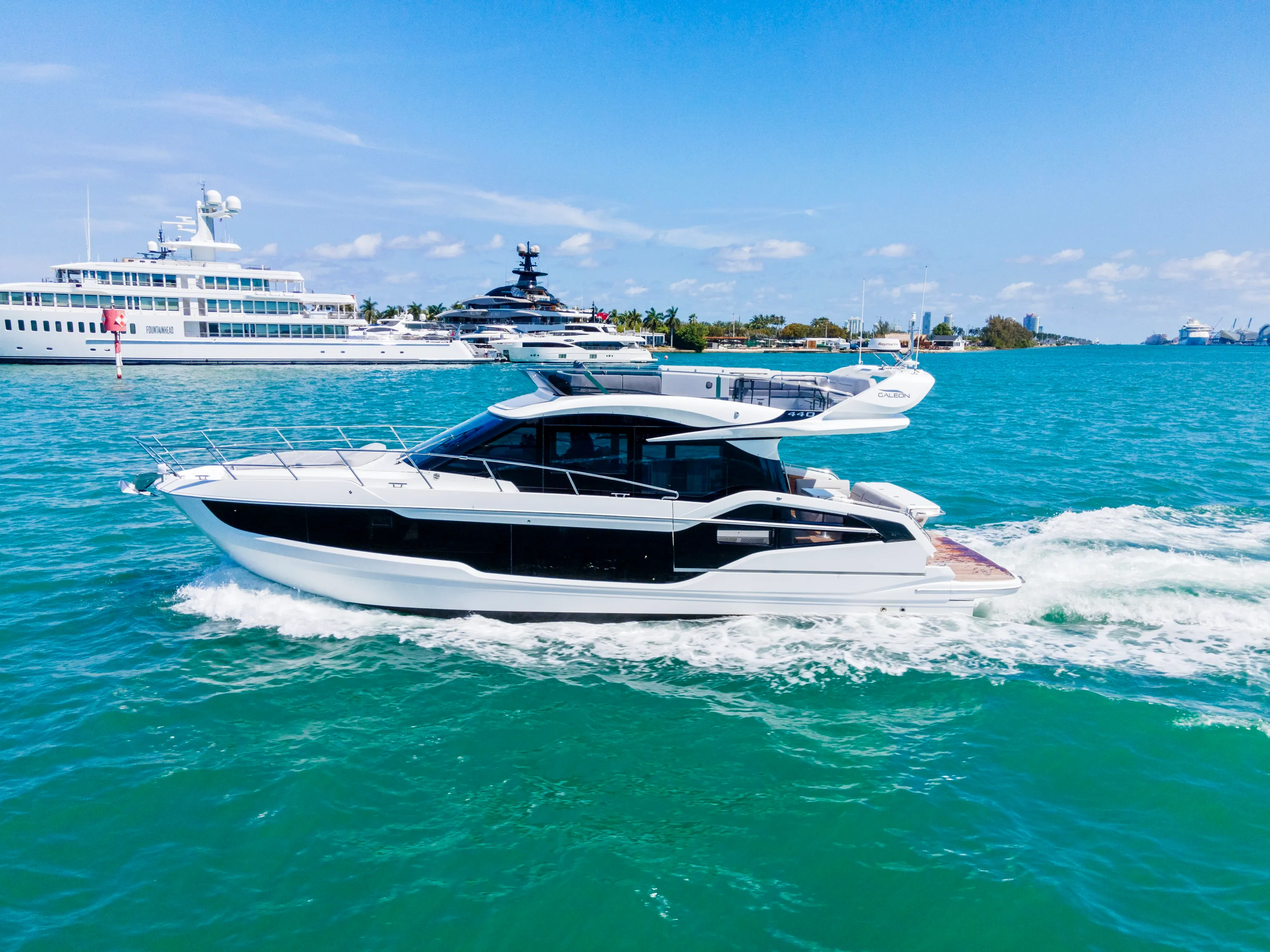
Photos courtesy of Galeon.
The Galeon 440 FLY is a 45' 10" flybridge yacht on a 42' 5" hull with 14' 2" of beam, and it shares that hull with the Galeon 450 HTC. Same length, same beam, same 2' 8" draft, same 423 gallons of fuel, same 38,960 lb light-craft mass, same engine ceiling. Two Galeons at an identical 45' 10" is how the range is built rather than a mix-up - what separates these two is the top deck. The 440 FLY has a flybridge; the 450 HTC has a hardtop coupe roof and no upper station.
The flybridge is what you are buying, and it is planned as a room rather than left as an afterthought. The helm station has a portside settee for a companion, with the main rest area set further back around an L-shaped sofa and an elongated table that comfortably seats six, plus a well-equipped wet bar. That is a genuine third living level with its own social plan, not a sunpad with a wheel on it.
The main deck runs a classic layout: the saloon aft, separated from the cockpit only by sliding glass doors, with the galley and helm station forward and the cabins below. Two leisure zones sit outside, the bow reached through starboard sliding doors next to the helm, with a foldable bimini and a front-facing seat for shelter. Aft, a full-sized hydraulic stern platform doubles as a lift for water toys and gives access to a stern-facing grill area. Galeon's signature Beach Mode drops semi-glazed panels on both sides of the cockpit, taking the beam from 14' 2" to 20' 10" at anchor.
Galeon quotes a maximum speed of up to 31 knots for the 440 FLY, and sells the boat as an engine power band rather than one specific package: minimum 2 x 440 hp, maximum 2 x 600 hp. No engine manufacturer is named for this model, so any brand attached to a 440 FLY's power figures did not come from the builder.
Cruise numbers on this boat are sea-trial numbers: ask for observed speed and consumption at your intended cruise rpm, on the engine package you are actually ordering.
Light-craft mass is 38,960 lbs, and that is the minimum weight with base engines, so a boat specified to 2 x 600 hp weighs more than that. Maximum load is 8,532 lbs. Draft is 2' 8", measured without propellers, with a bare-hull-with-appendage figure of 4' 3" - size a lift and a berth off the deeper one. Bridge clearance is 16' 7", falling to 14' 11"; measure the lower figure against any fixed bridge on your home run. CE category is B, with a crew limit of 14.
One note on the top speed. The 450 HTC shares this hull, this mass, this fuel capacity and this same engine band, and Galeon quotes 29 knots for it against 31 here. Treat both as the builder's current maxima rather than a tested comparison between two boats, and get observed figures on the hull and the engine specification you actually order.
Below deck the standard arrangement accommodates four in two cabins: a mid-ship master and a forward VIP, both with substantial storage. For larger groups Galeon offers a three-cabin layout with bunk berths, so the boat is sold as two or three cabins - the third is a bunk cabin rather than a third double. Both lower-deck bathrooms have a head and a shower with standing headroom, which on a 46-foot boat is worth having.
The saloon is arranged around panoramic glazing, with the seating area aft and the galley positioned aft-adjacent so it connects to both the saloon and the cockpit. Full-height sliding glass doors are the only division between inside and outside, so at anchor the saloon and cockpit read as one room. The dining space converts, and the seating arrangements are designed to be reconfigured between a family cruise and an evening with guests.
The tank plan is where a weekend gets planned. Fresh water is 119 gallons, against a 58-gallon grey tank and a 32-gallon black tank. Fuel is 423 gallons total, split between two tanks. Maximum load is 8,532 lbs, which is the figure to work against once you have added people, water, fuel and gear.
The 440 FLY's nearest relation is not a competitor's boat, it is the 450 HTC - and they are the same hull. Both are 45' 10" overall on a 42' 5" hull with a 14' 2" beam that opens to 20' 10" in Beach Mode, both carry 423 gallons of fuel and 119 gallons of water, both list a 38,960 lb light-craft mass and 8,532 lb maximum load, both run an engine band from 2 x 440 hp to 2 x 600 hp, and both are CE category B with a crew limit of 14. Every one of those figures is identical on the two boats. Galeon shares hulls across its classes, so identical length between them is how the range is built rather than a mistake.
So the decision is a class decision, not a size decision. The 440 FLY gives you a third deck: an upper helm with a companion settee, an L-shaped sofa and table seating six, and a wet bar, with the panoramic views and open-air cruising that come with driving from up there. The 450 HTC gives you a hardtop coupe with a full-length glass roof and a retractable targa panel, lower windage, and a sportier profile - and Galeon quotes it at 29 knots against the 440's 31. If you want to entertain on three levels, this is the boat. If you want one big protected main deck with the sky above it, that is the other one.
Inside the FLY range itself, the 440 sits above the 420 FLY and below the 480 FLY. The step down to the 420 FLY is bigger than the eleven inches of length implies - it is a different hull with 264 gallons of fuel against 423 and a firm two-cabin plan. The step up to the 480 FLY buys length and a three-cabin standard layout.
Two practical notes. Galeon's flybridge advantage carries an air-draft cost: 16' 7" of bridge clearance, or 14' 11" in the lower measurement, which is a number worth measuring your home run against before anything else. And the three-cabin layout uses bunk berths rather than a third double - that is a children's or crew arrangement, and it is the right thing to know before you count sleeping capacity.
The 440 FLY fits the owner who entertains and wants somewhere to do it that is not the cockpit. The flybridge is laid out deliberately: helm station with a portside settee so whoever is driving has company, then the main rest area further aft with an L-shaped sofa around an elongated table seating six, and a well-equipped wet bar. Downstairs, Beach Mode drops semi-glazed panels on both sides and takes the cockpit from 14' 2" to 20' 10" of beam, with a full-sized hydraulic stern platform that doubles as a toy lift and opens onto a stern-facing grill. That is three separate places to put people, on a boat that still fits a 46-foot slip.
It fits a family of four comfortably and a larger group conditionally. The standard arrangement is a mid-ship master and a forward VIP - four berths - and the third cabin is an option with bunk berths, not a third double. Both bathrooms have a head and a shower with standing height. It fits less well if your home water has a low fixed bridge: bridge clearance is 16' 7", or 14' 11" on the lower published measurement, and that is the cost of the deck you came for. If that number is a problem, the same hull is available as the 450 HTC without the upper station.
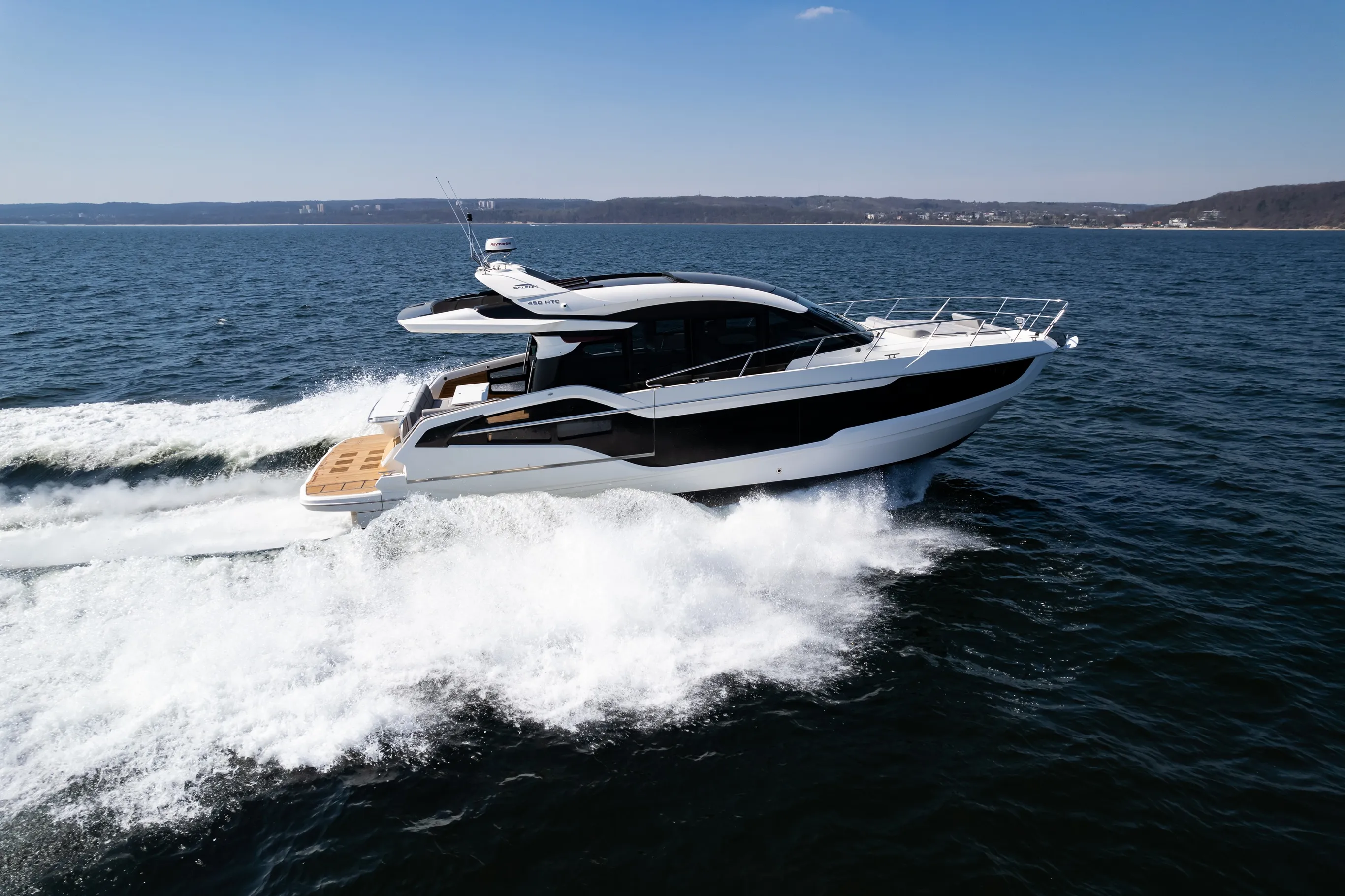
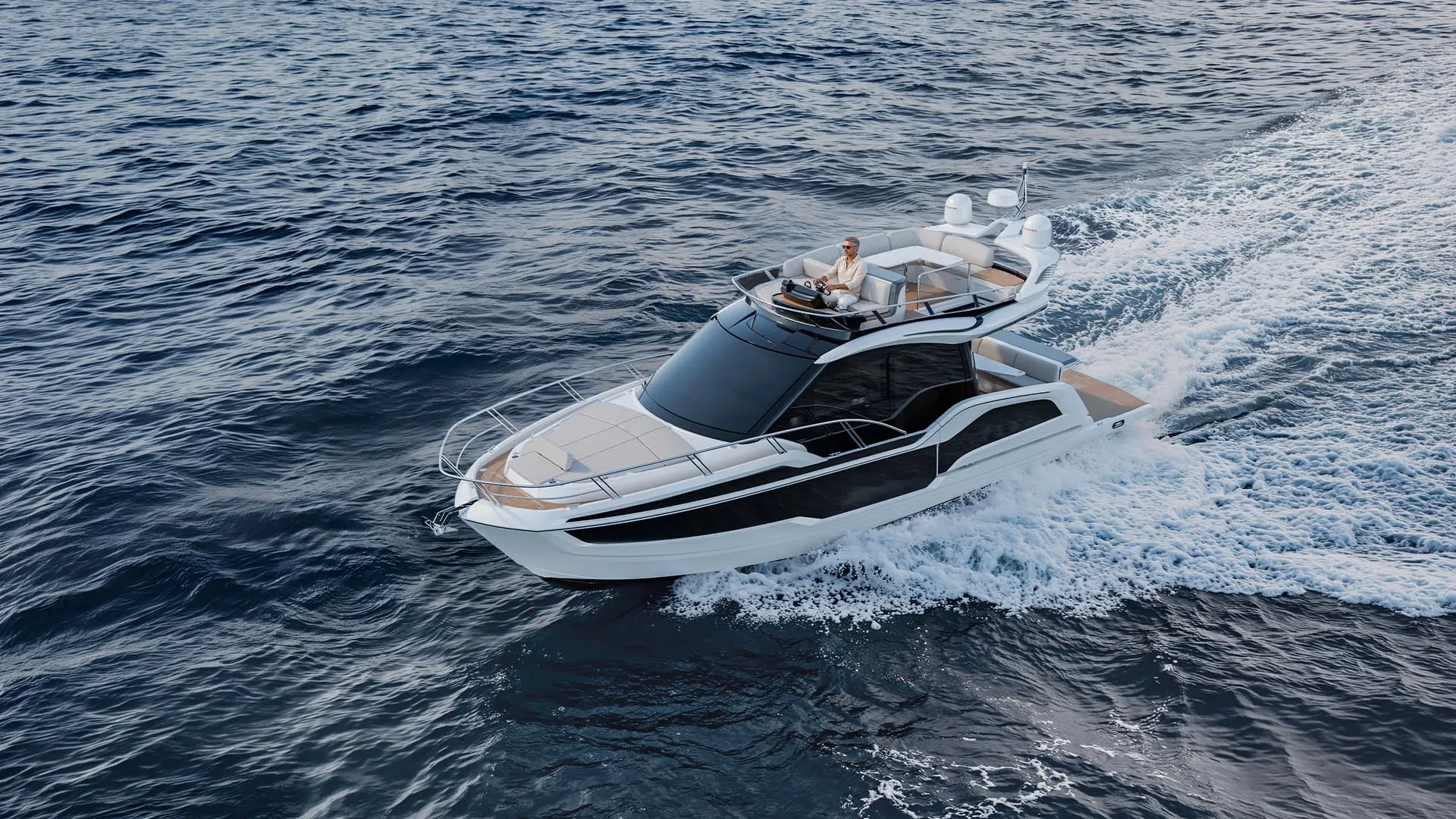
Book it on 45' 10", and check the width twice. That is the length overall, and it is the number a marina bills on. The hull itself measures 42' 5", so more than three feet of what you are paying for is platform and pulpit. Beam is 14' 2" underway — but Beach Mode drops semi-glazed panels on both sides and takes the boat to 20' 10" across, so a berth that fits the yacht will not necessarily let you open it at the dock.
Draft is 2' 8" without propellers, with 4' 3" for the bare hull with its appendage; plan on the deeper one. Bridge clearance is 16' 7", with a lower figure of 14' 11" — and the 450 HTC, which has no flybridge at all, carries the same pair of figures. If there is a fixed bridge between the boat and open water, get the air draft of your specific hull confirmed in writing.
Up to 31 knots. That is Galeon's published maximum and the only speed figure it gives for this boat. Engine power is sold as a band rather than a single package — 2 x 440 hp minimum, 2 x 600 hp maximum — with no one manufacturer tied to the model, so a make attached to a 440 FLY's numbers describes an individual boat's build.
One figure to hold alongside the 31: the 450 HTC, which shares this hull, this 38,960 lb light-craft mass and this engine band, is quoted at up to 29 knots. Treat both maxima as the builder's ceiling rather than a test result, and ask for observed speed and consumption at your intended cruise rpm in writing.
Four, in two cabins, as the boat is normally arranged: a mid-ship master and a forward VIP, both with substantial storage. A three-cabin layout with bunk beds is available for larger groups, which is why the boat is sold as two or three cabins — the third is bunk berths, not a third double. Order it and you are at six berths.
Both lower-deck bathrooms have a head and a shower with standing headroom. One number to read carefully: the 14 guests Galeon lists is the boat's carrying capacity under CE category B, and it matches the crew limit of 14. Fourteen aboard for the day; four overnight, or six with the bunk cabin ordered.
The top deck, and nothing else. Galeon builds one 45' 10" hull and sells it two ways, and underneath the two boats are identical: a 42' 5" hull under a 45' 10" length overall, 13' 10" of hull beam, 14' 2" beam overall opening to 20' 10" with the Beach Mode balconies down, 2' 8" of draft without propellers, 423 gallons of fuel in two tanks, 119 gallons of water, a 38,960 lb light-craft mass, an 8,532 lb maximum load, an engine band running from 2 x 440 hp to 2 x 600 hp, a crew limit of 14 and CE category B. Two Galeons at the same length is how the range is built, not a mix-up.
The 440 FLY gets a flybridge with its own helm station; the 450 HTC gets a fixed hardtop with a full-length glass roof and no upper station. Two figures are worth a close look before you pick. The FLY is quoted at up to 31 knots and the HTC at up to 29, on the same mass and the same engine ceiling - and both carry the same 16' 7" bridge clearance despite the different superstructures. If air draft or top speed is what decides this for you, get the figure for the specific boat in writing.