
August 27, 2026
Galeon 485 HTS: A 49-Footer That Draws 2' 8"
Most 49-foot diesel cruisers make you choose between a proper full-beam master and getting into shallow water. The Galeon 485 HTS refuses: 2…
Read the articleExpert Review, Technical Specifications & Market Analysis
| Feature | Specifications |
|---|---|
| Overall Length | 49' 2" |
| Beam | 13' 11" |
| Draft | 2' 8" |
| Displacement | 29,983 lbs |
| Engines | 2 x Diesel (up to 440 hp) |
| Fuel Capacity | 317 gal |
| Water Capacity | 119 gal |
| Cabins / Heads | 2 Cabins / 2 Heads |
| Max Speed | 35 knots |
Source: Spec & Photos courtesy of Galeon. Specs verified by Tony Smith, USCG 100 Ton Master, on August 26, 2026.
A 49' 2" sport cruiser that draws 2' 8" - the 485 HTS gives you the flybridge view from a low hardtop, and it gets into water most boats this length cannot.
Part of the Galeon HTS series — see how owners step up through the lineup.

The first thing I do with a 49-footer is look at the draft, and the 485 HTS is the reason. Two foot eight. On a boat this long that is not a footnote, that is a different set of destinations. I have watched clients fall in love with a fifty-foot boat and then quietly discover that half the places they actually wanted to take it are closed to them. This one is not going to do that to you. If you run skinny water - the Bahamas, the Keys, the Gulf, a home basin that silts - start your shortlist here and work outwards.
The second thing I like is structural, and it is the trade Galeon made below deck. They put the full-beam master amidships, which is normally a flybridge boat's move, because a flybridge boat has the volume to spare. Doing it under a low hardtop costs something, and what it costs is the forward cabin's private bathroom - the second head on this boat is a day head the VIP has direct access to. I think that is the right way round for most owners, because you get a genuinely good master in the most stable part of the hull and a main deck that opens front to back with the sunroof and the sliding aft glass. But it is a real trade and I would rather you hear it from me than find it on the boat. If you put adult guests in the bow regularly, walk that route yourself before you decide.
Two things to settle before you sign. Get the cruise speed and the observed burn off your own sea trial - hold the boat at the rpm you would really run at, write down what you see, and get it in writing. And put the engine rating on the build contract; the maximum for this model is 2 x 440 hp, and a maximum is a ceiling, not a description of the boat in the slip. Then take the sea trial somewhere with actual sea in it. Thirty-five knots and a low hardtop is a combination you judge in a chop, not on flat water inside the breakwater.
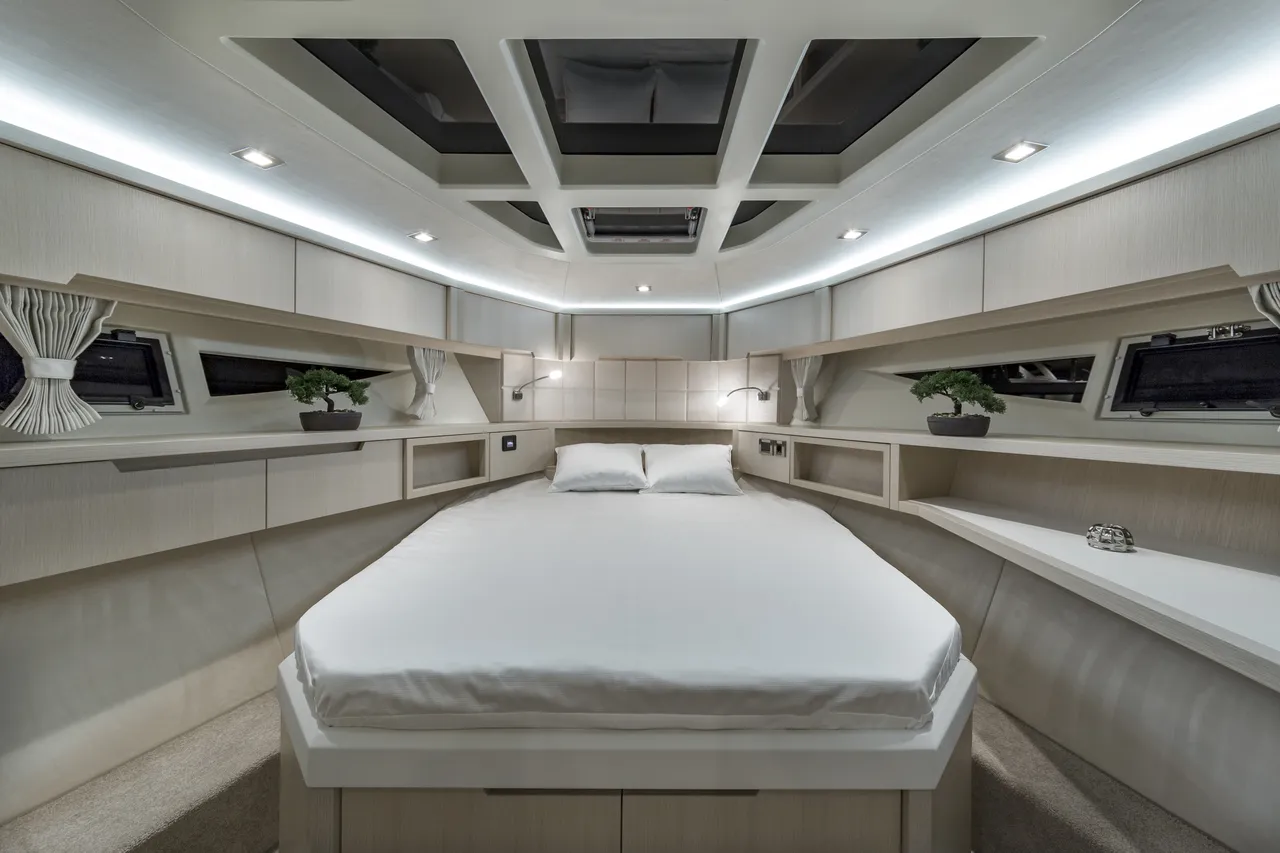
Photos courtesy of Galeon.
The Galeon 485 HTS is a 49' 2" hardtop sport cruiser on a 13' 11" beam, and the number that ought to stop you is the draft: 2' 8". That is shallow for a 49-footer, and it is the kind of figure that decides which bays, flats and back-channel anchorages are open to you rather than which ones you look at from outside. If you run the Bahamas, the Keys, the Gulf shallows or a skinny home channel, that one dimension changes the map.
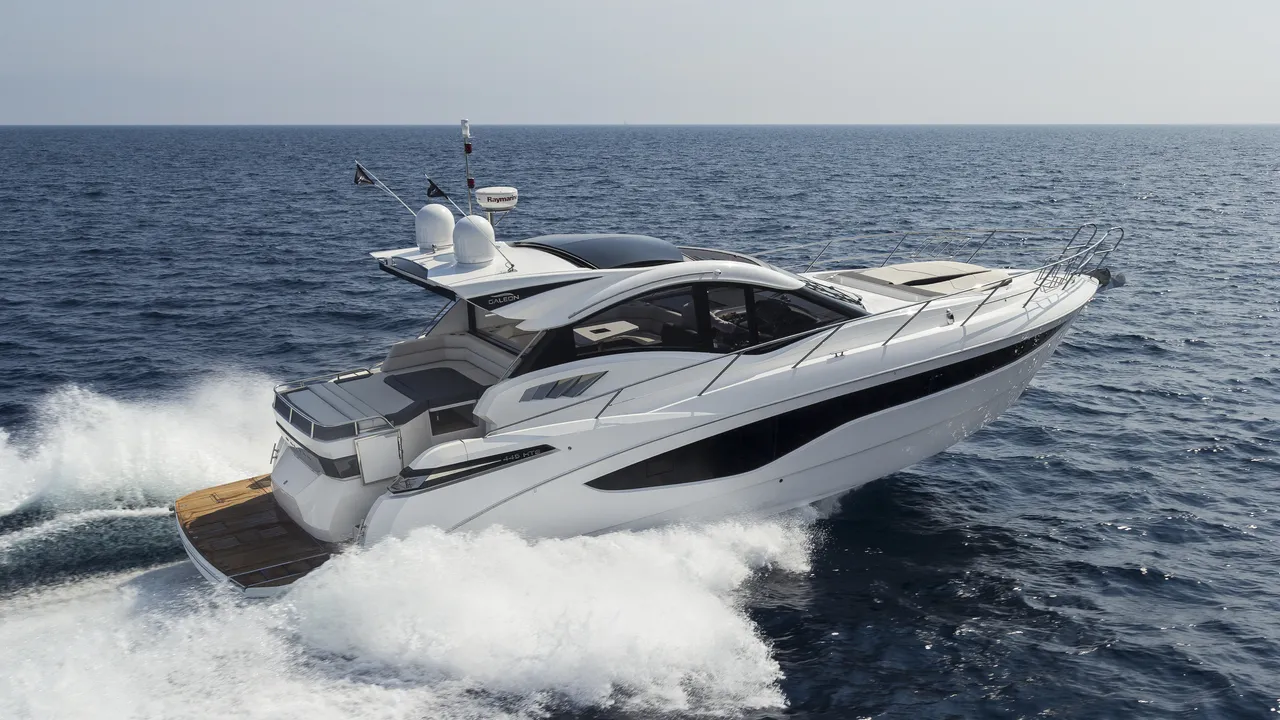
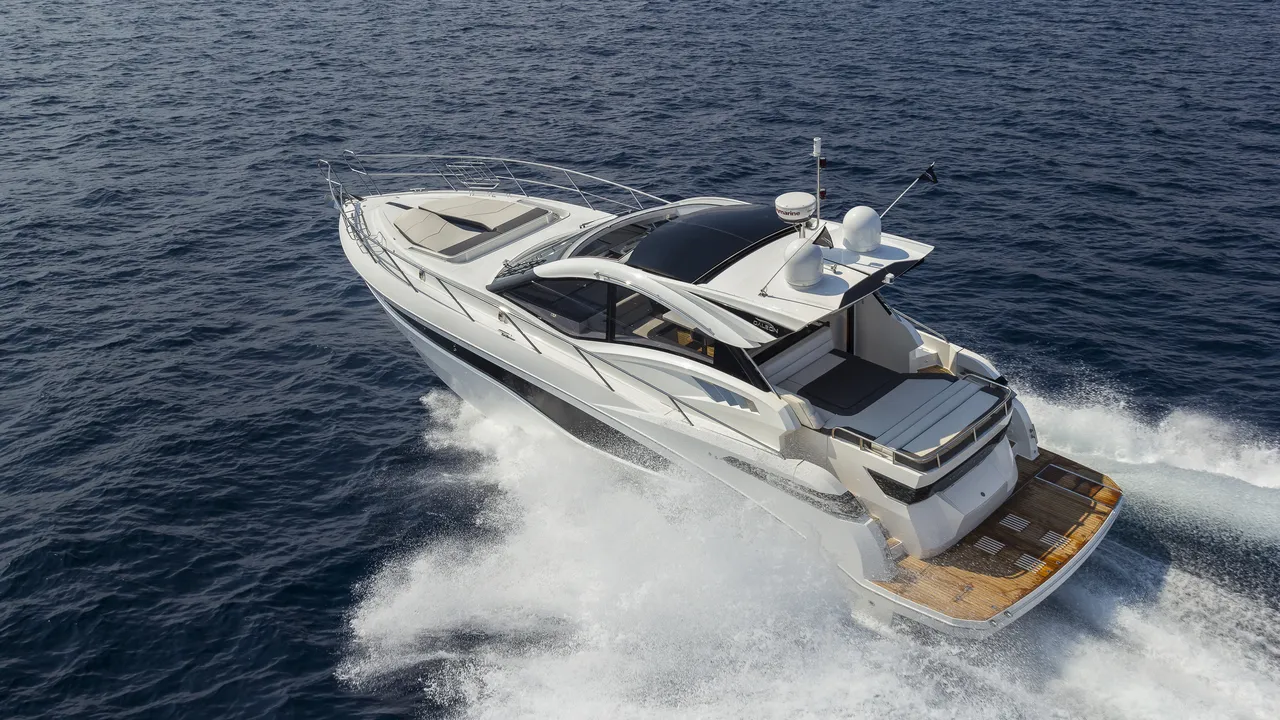
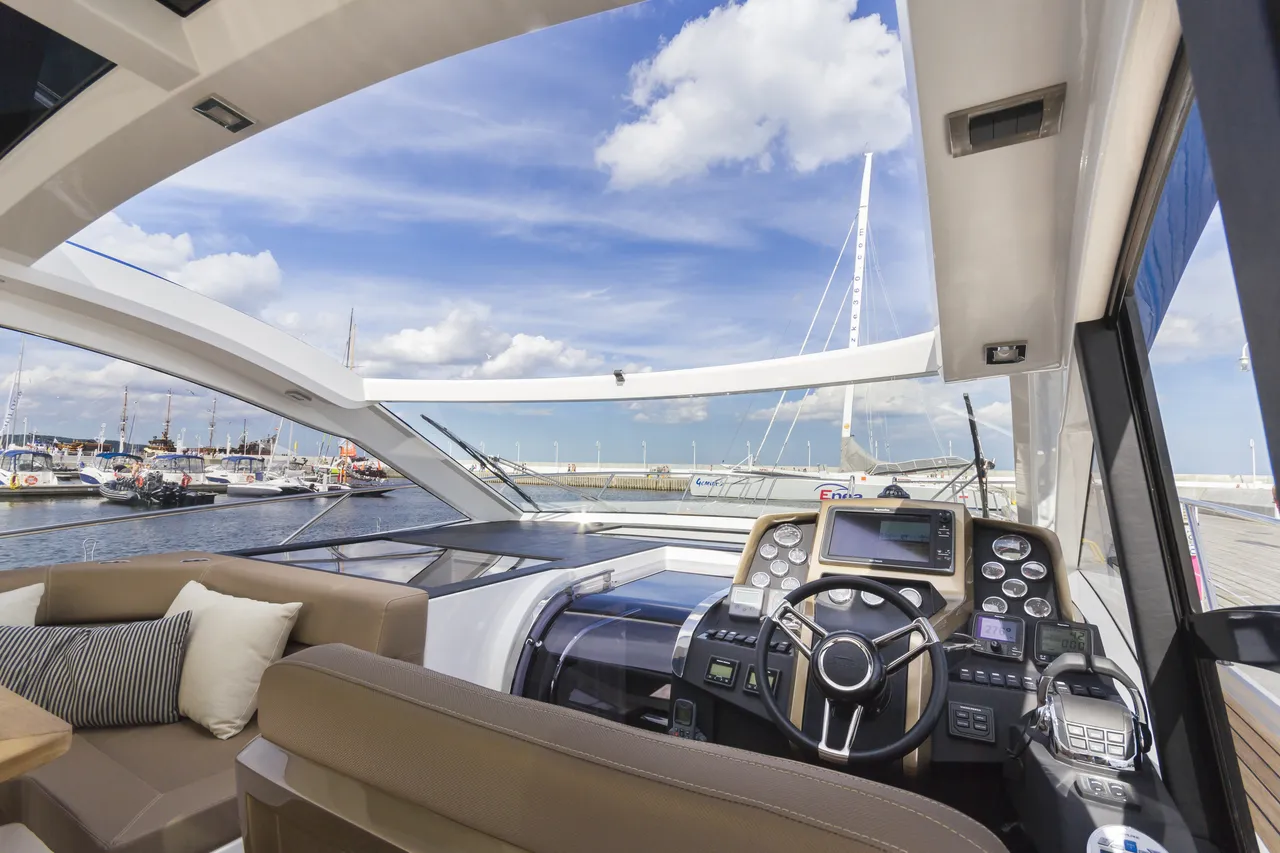
The design brief here is the flybridge feeling without the height, and the deck plan delivers it in two moves. A retractable electric sunroof opens the hardtop above the helm, so the driver gets light and sea air without an upper station. A sliding glass panel opens the whole aft face of the saloon into the cockpit, so the two spaces work as one. Wide side decks lead forward to a bow lounge with adjustable backrests that can be covered or stowed when the weather turns, and an extended hydraulic swim platform handles the tender and water access aft.
Below there are two cabins and two bathrooms. The master is full-beam and amidships - the most stable position on the boat and the one that gives you real headroom and real storage - with a private en-suite. The bow VIP takes a convertible V-berth with direct access to the day head. The galley is set up for extended cruising rather than for a day out. Fuel is 317 gallons, fresh water is 119 gallons, unladen displacement is 29,983 lbs, and the boat is rated for twelve guests. Power is twin diesels rated to a maximum of 2 x 440 hp, and top speed is 35 knots.
Top speed is 35 knots, on twin diesels rated to a maximum of 2 x 440 hp. The number you will actually run at is one to bring back from the sea trial: hold the boat at the rpm you would genuinely cruise at, note the speed, and get the observed burn in writing before anyone works out a range for you.
The power rating is a ceiling rather than a description of any particular boat, and it is worth writing onto your build contract instead of reading off a listing. Unladen displacement is 29,983 lbs, with 317 gallons of fuel and 119 gallons of fresh water still to go aboard on top of it - do that arithmetic before you size a lift or a sling.
The 2' 8" draft is the performance figure most likely to change how you use the boat, even though it has nothing to do with speed. On a 49-footer it buys access: anchorages, cuts and channels that a deeper hull of the same length has to run around. It also means the boat sits low in the water relative to its length, which is worth feeling for yourself in a following sea rather than reading about.
The other half of the design case is the low hardtop. No upper station means weight and windage stay down, which shows up as manners in a crosswind at the dock and composure at speed. That is a handling argument, and handling arguments are settled on the water in the conditions you actually boat in.
The main deck is the reason to buy this boat, and it is built to feel like a flybridge boat without being one. An electric sunroof retracts above the helm, so the person driving gets natural light and moving air rather than a sealed cockpit. At the back of the saloon, a sliding glass panel opens the whole aft face into the cockpit - open it and the saloon, the dinette and the cockpit lounge become one continuous room running most of the length of the boat.
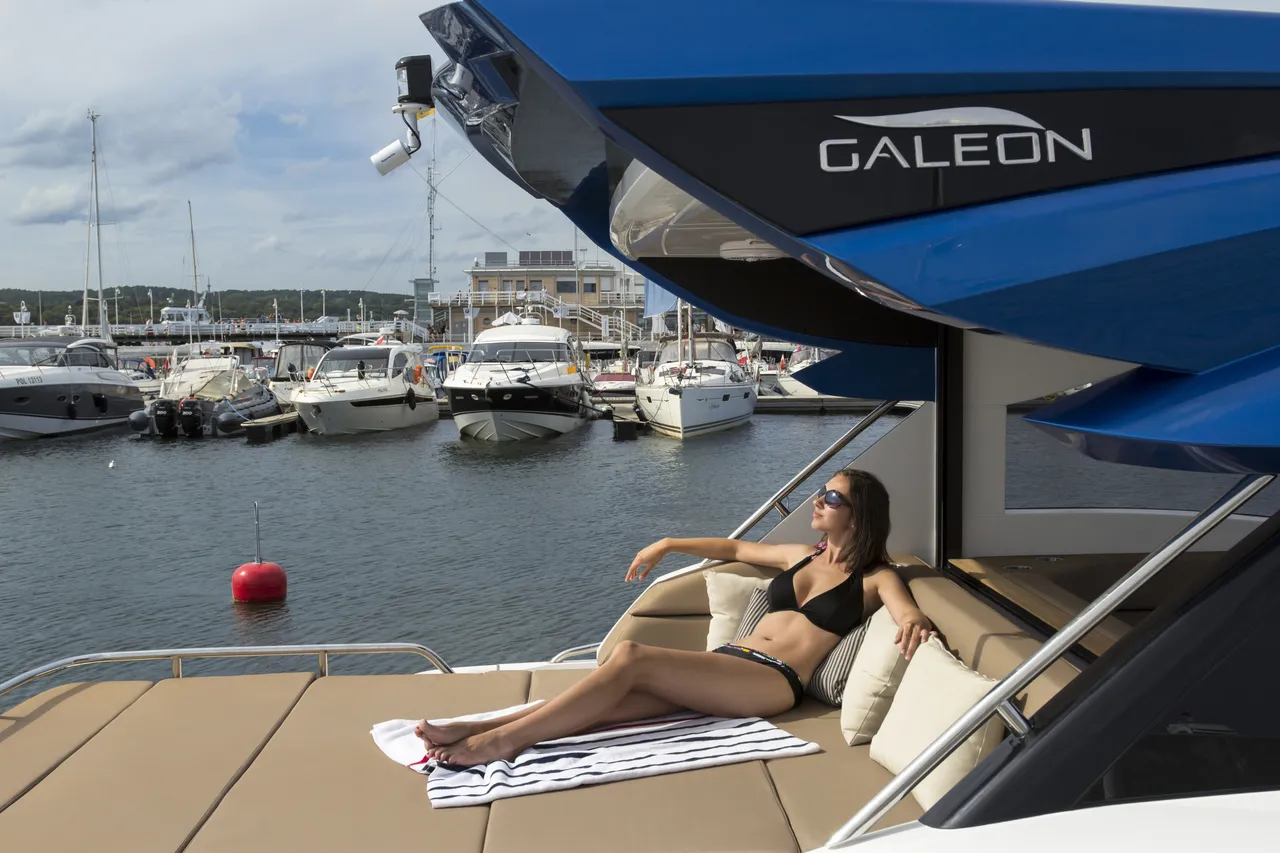
Outside, the cockpit carries comfortable aft seating with a convertible sunpad, so it works for dining, lounging or lying in the sun without rearranging furniture. Wide side decks lead forward to a bow lounge with adjustable backrests, a genuinely private spot under way - and one that can be covered or stowed away when the weather turns, which is the detail that keeps a forward sunpad from becoming a wet cushion in October.
Below, the full-beam master sits amidships. That position matters: it is the most stable part of the hull, and it is what makes the generous headroom, the central bed and the worked-in storage possible on a 49-footer without stealing the whole lower deck. It has its own private en-suite.
Forward, the VIP takes a convertible V-berth with direct access to the day head. Read that carefully if it matters to you: the second bathroom on this boat is a day head the forward cabin uses, rather than a private en-suite of its own. On the smaller 405 HTS and 425 HTS, the bow cabin gets its own bathroom. On the 485 the trade buys you the midship master and a bigger main deck instead, and for most owners that is the right way round - but it is a choice, not an oversight, and it is worth understanding before you put guests forward.
The galley is fully equipped and laid out for extended cruising, with modern appliances, premium finishes and ambient lighting through the saloon. Twelve guests is the rated day capacity; four berths is the overnight number.
Inside Galeon's own range, the 485 HTS is the hardtop line's answer at just under fifty feet. The 450 HTC sits below it at 45' 10", and the 425 HTS below that at 44' 2". If you want a flybridge at roughly this length instead, the 480 FLY is 48' 5". The 485's case against its own siblings is the pairing of an amidships full-beam master with a 2' 8" draft, and the top speed - 35 knots - is the highest number in Galeon's current hardtop line.
Against the wider market of 48-to-50-foot diesel cruisers, the 485 competes on two things that do not usually arrive together. The first is that draft. Plenty of boats this length are handsome and quick; not many will follow you into a two-and-a-half-foot anchorage. The second is the layout: a full-beam master amidships is normally the property of a flybridge boat, because the flybridge boat has the volume to give it away. Getting it under a low hardtop, with a retractable sunroof over the helm and a sliding glass panel to the cockpit, is the specific trick this model is performing.
One layout note that will matter to some buyers and not at all to others. Two bathrooms on this boat means the master's en-suite plus a day head the forward cabin uses. If you regularly put adult guests in the bow and privacy is part of the pitch, walk that route on the boat before you decide.
The 485 HTS fits the owner whose cruising ground is shallow. At 49' 2" and drawing 2' 8", this is a boat that gets into water most of its length class has to admire from the channel. If you run the Bahamas, the Keys, the Gulf, a shoal home basin or anywhere the chart is measured in inches rather than fathoms, that single figure is worth more than any option on the sheet.
It fits the owner who wants a flybridge boat's master cabin without the flybridge boat's height. Full-beam, amidships, private en-suite, real headroom and real storage - and a low hardtop above it with an electric sunroof over the helm so the driver is not sealed in. Less windage at the dock, a lower centre of gravity under way, and no ladder.
It fits people who entertain in numbers. Twelve guests is the rated day capacity, and the deck plan is built for it: the sliding glass panel opens the saloon into the cockpit as one room, the cockpit has convertible aft seating and a sunpad, and the bow lounge has adjustable backrests that stow when the season turns. The extended hydraulic swim platform handles the tender and the swimming.
It fits an owner-operator who wants speed. Thirty-five knots is the top figure, on twin diesels rated to a maximum of 2 x 440 hp.
It is the wrong boat if you need three cabins, or if you need the forward cabin to have a private bathroom - the second head here is a day head with direct access from the VIP.
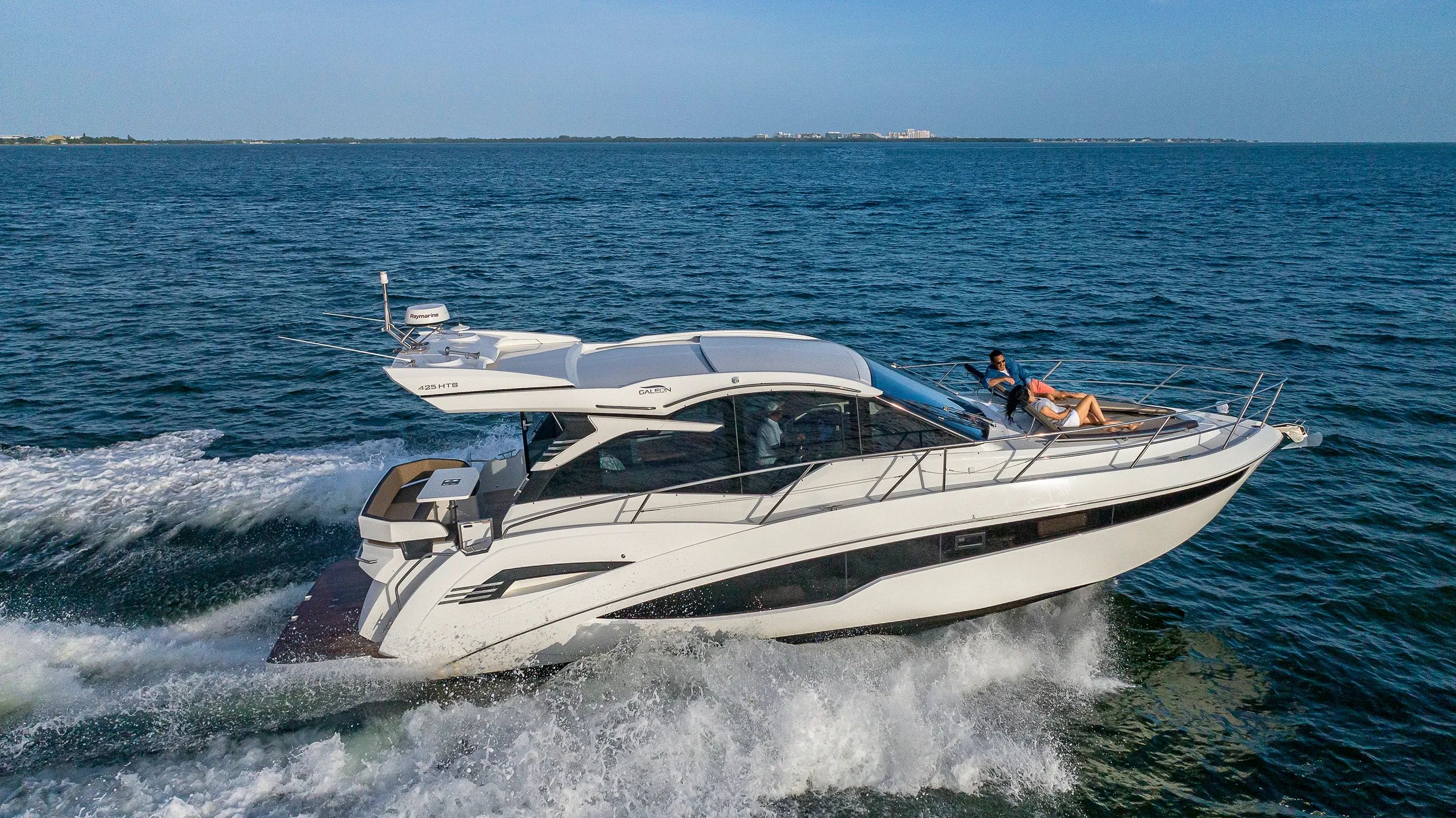
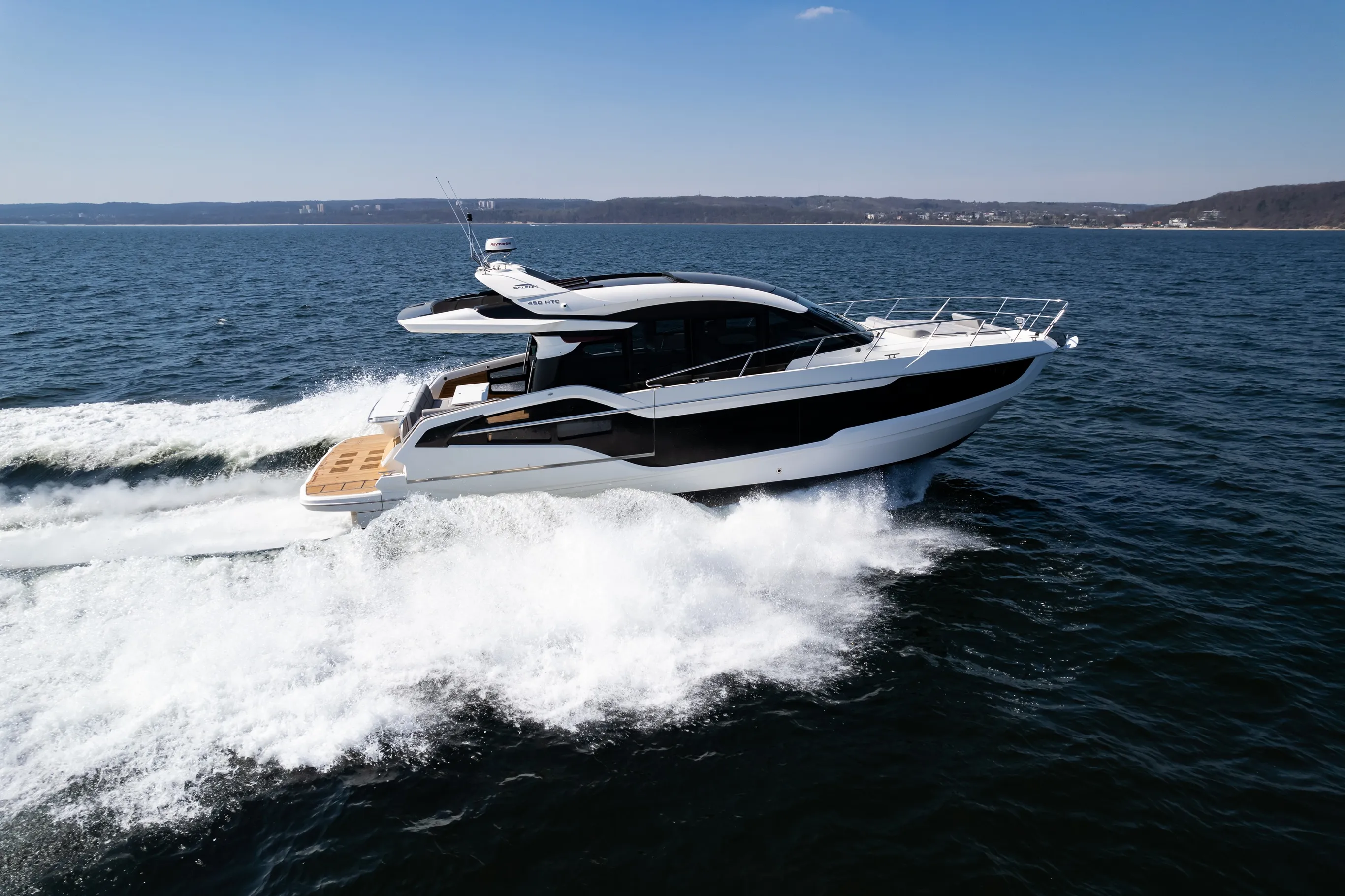
It depends on whether you want the upper station or the shallow draft and the low profile. The 485 HTS is built to give you a flybridge boat's experience without the height: an electric sunroof retracts above the helm, a sliding glass panel opens the saloon into the cockpit as one room, and the full-beam master sits amidships with a private en-suite - a layout usually reserved for flybridge boats. What you give up is a second helm and the upper deck seating. What you gain is 2' 8" of draft, less windage at the dock and a lower centre of gravity under way. Galeon's flybridge answer at a similar length is the 480 FLY at 48' 5".
The Galeon 485 HTS draws 2' 8", which is shallow for a 49' 2" boat and is the single figure most likely to change how you use it. That draft opens anchorages, cuts and back channels that deeper hulls of the same length have to run around - relevant if you cruise the Bahamas, the Keys, the Gulf shallows or a home basin that silts. Because draft moves with the drive package, get the number for your exact configuration in writing before you commit to a slip or a marginal channel.
Not exactly, and it is worth understanding before you put guests aboard. The Galeon 485 HTS has two cabins and two bathrooms: the full-beam master amidships has its own private en-suite, while the bow VIP has a convertible V-berth with direct access to the day head rather than a private bathroom of its own. That trade is what buys the midship master position and the larger main deck. If you regularly put adult guests forward and privacy matters, walk that route on the boat before you decide.
The Galeon 485 HTS has a top speed of up to 35 knots on twin diesels rated to a maximum of 2 x 440 hp. The number you will actually run at is one to establish at sea trial - hold the boat at the rpm you would genuinely cruise at, record the speed, and get the observed fuel burn in writing before anyone calculates a range. The power figure is a maximum rating rather than a description of a particular boat, so confirm what you are buying on the build contract.