
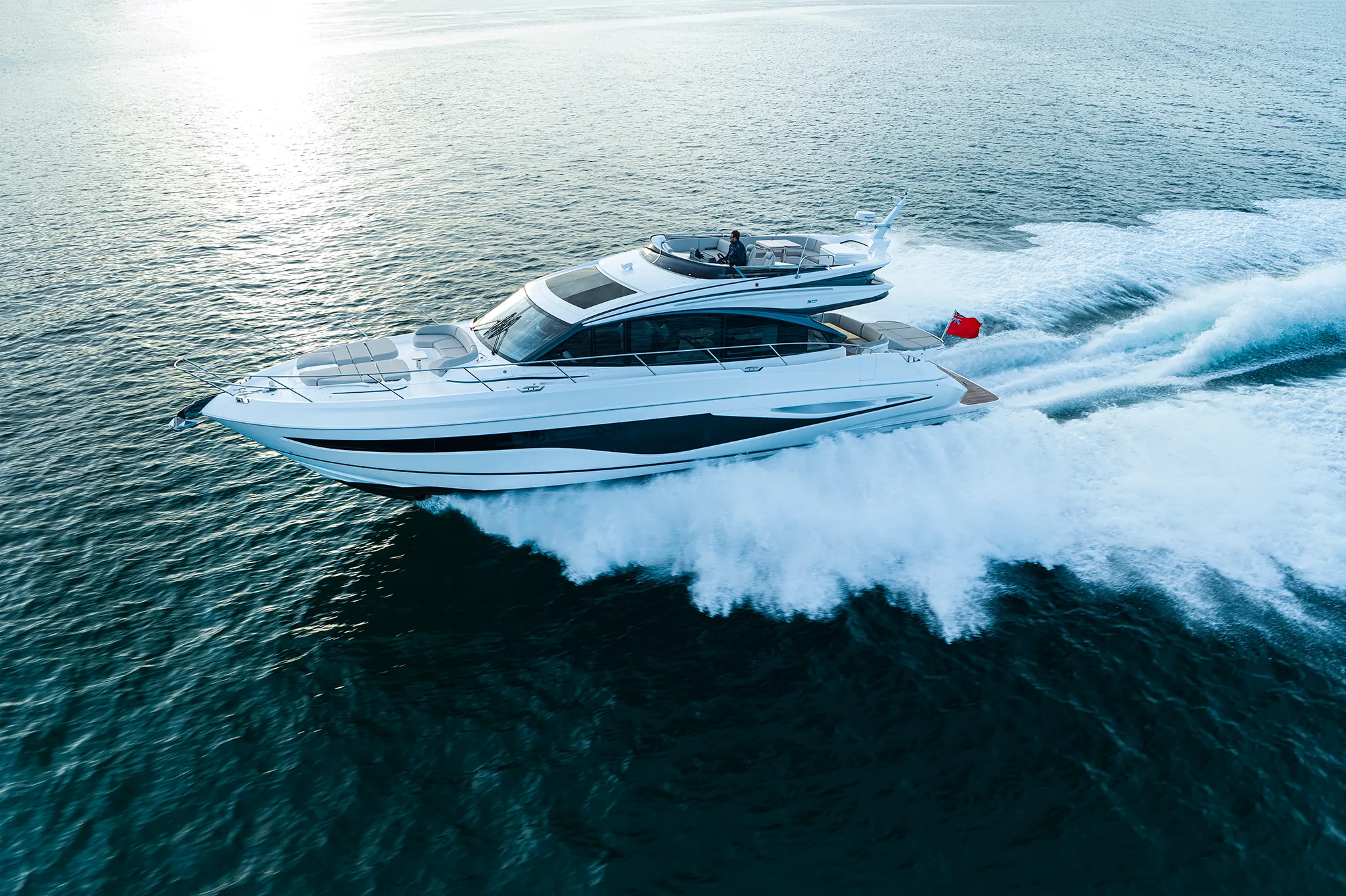
Princess S6567'7"
View Specs & ReviewThe one refuge on this coast — and you cannot book it
Yachting in Monterey
A Minted Location · Monterey, California
Monterey is a place you cruise to, not a place you keep a boat. Get that the right way round and everything else about this harbour makes sense.
It matters because there is nothing else. NOAA Coast Pilot is blunt about the coast to the south: between here and Morro Bay there is no harbour of refuge at all, the 30-fathom curve lies less than a mile offshore in many places, and Carmel Bay "is not recommended for strangers." North, Coast Pilot says that at Santa Cruz "in south weather there is no protection in the harbor; vessels must run for Monterey or Moss Landing Harbor." Monterey is the refuge other harbours run to.
And the protection is real. The breakwater runs about 1,700 feet from the Coast Guard pier and "affords excellent protection in northwest weather." There are more than 20 feet of water in the outer harbour and entrance. One marina publishes guest berthing for vessels up to 200 feet, with a rate card that runs in bands to "150' & UP."
Two things to plan around before you sail.
You cannot reserve a berth at the City marina. Its own words: "Monterey Municipal Marina does not take reservations. Accommodations are on a first come first served basis." Both marinas run wait lists, so arrive with an alternative in mind.
And the yard cannot haul what the marina can berth. Published lift capacity here runs from 60 to 82 tons, and the figure that actually binds is beam — 21 or 22 feet — which caps a haul-out somewhere around 50 to 65 feet for a typical planing motoryacht. The gap between what floats here and what can be lifted here is about 140 feet.
Where to keep a yacht in Monterey
Breakwater Cove Marina is the big-boat answer, and its own rate card is the evidence. It describes itself as "a deep-water marina consisting of 100 slips" with "guest berthing available for vessels up to 200'." Its published guest bands run 80′–99′ at $2.50 per foot per night, 100′–119′ at $3.00, 120′–139′ at $4.00 and 150′ and up at $5.00. A marina does not print bands for boats it cannot take. It has its own fuel dock, and unlike the City it does take reservations: "making a reservation in advance is best as we do fill up fast", cancelling by 15:00 the day before. It has no liveaboard availability, and its largest published permanent berth is 70 feet at $1,200 a month.
Two length figures are published for that marina, and it is worth carrying both. Breakwater Cove publishes guest berthing "up to 200'". California State Parks' Division of Boating and Waterways, facility 75 at the same address, records "Maximum Boat Length: 80." Give the office your length, beam and draft when you book, and take the berth they offer you.
Monterey Municipal Marina is the City's, and it is a sub-60-foot harbour. "413 slips ranging in size from 20 to 50 feet… six end ties accommodate boats from 40 feet to 60 feet." Open 24 hours a day, no fuel — it directs boaters to Breakwater Cove — and the FY27 fee table tops out at a 50-foot berth at $47.00 a day. California State Parks records 408 slips and a 50-foot maximum for the same marina, against the City's own 413 and 60.
Municipal Wharf No. 2 is the overlooked option for something big. The City publishes alongside transient rates in bands: 51′–70′ at $34.50 a day, 71′–90′ at $40.00, and 91′ and over at $45.00 — with no utilities. Coast Pilot describes it as "1,600 feet long and 86 feet wide at the outer end; depths alongside the outer east and west sides are 24 feet." It also hosts four wholesale fish companies and a commercial abalone farm, so it is a working wharf rather than a marina.
Fuel is at Breakwater Cove, and there is a procedure: "All vessels must radio Channel 9 or call the Marina Office… before approaching the service dock." Hours are published both as "open everyday from 8:00 a.m. to 5:00 p.m." and as "Open 8:00 a.m. - Noon and 1 p.m. - 5 p.m. (7-days a week)" — call ahead.
The yard is where the market's real service value sits, and the published capacities vary.
| Source | Capacity | Beam |
|---|---|---|
| Monterey Bay Boatworks (own site) | 82 tons | 21 ft |
| Monterey Boat Haven (own site, same address) | 75 tons | 22 ft |
| NOAA Coast Pilot 7 ¶193 | 70 tons (plus a 3-ton lift) | not stated |
| NOAA Coast Pilot 7 ¶215 | 60 tons | not stated |
Plan against the lowest figure — 60 tons — and against beam, 21 or 22 feet, which is what actually stops a boat. No maximum length is published, so give the yard your length, beam and draft before you book a date. Haul-out runs $13.50–$16.00 per foot at one operator with a $375 minimum, including "two strap haul, high pressure wash, shoring & four free days", and $17–$19 per foot at the other with a $425 minimum, two free lay days and a 4 percent environmental compliance fee. Labour is $110 an hour, $125 for mechanical, electrical and glass, and $250 an hour for the travelift. One rate card is dated "UPDATED 7/1/23", so confirm prices when you book.
Anchoring and moorings. The Open Anchorage east of Wharf II is free and capped at 30 days in any six-month period, in 15 to 30 feet. The City calls the holding "excellent", with one caveat worth respecting: "a sand bottom with some surf grass may cause a light bruce or plow style anchor to skip when setting." The Outer Harbor moorings are about 113 private buoys requiring both owner permission and a City sub-licence, with up to 15 liveaboards permitted. The East Mooring Program is closed this season; when it runs, the season is 1 April to 31 October, and the City's fee schedule carries a November-to-March rate at 1.5 times the regular berth rate.
There is a 3-ton public hoist on Wharf II for trailerable boats at $6.00 per 15 minutes, available 24/7 after certification — and "there are no launch ramp fees in Monterey Harbor."
Marinas
| Name | Where | Max yacht | Slips | Fuel |
|---|---|---|---|---|
| Breakwater Cove Marina"We are a deep-water marina consisting of 100 slips… Guest berthing available for vessels up to 200'." California State Parks DBW facility 75, at this same address, records "Maximum Boat Length: 80" — carry both figures and give the office your length, beam and draft when you book. "We have no live-aboard opportunities at this time." Largest published permanent berth: 70 ft at $1,200 a month. | 32 Cannery Row, inside the breakwater | 200 ft | 100 | Yes — its own fuel dock |
| Monterey Municipal Marina"413 slips ranging in size from 20 to 50 feet… Six end ties accommodate boats from 40 feet to 60 feet." Open 24 hours a day. California State Parks records 408 slips and a 50 ft maximum for the same marina, against the City's own 413 and 60. | 250 Figueroa Street | 60 ft | 413 | No — the City directs boaters to Breakwater Cove |
| Municipal Wharf No. 2The overlooked option for something large. Coast Pilot: "1,600 feet long and 86 feet wide at the outer end; depths alongside the outer east and west sides are 24 feet." A working wharf — it hosts four wholesale fish companies and a commercial abalone farm — rather than a marina. | The easternmost structure in the harbour | — | — | — |
Yacht clubs
| Name | Where | Max yacht | Slips | Fuel |
|---|---|---|---|---|
| Monterey Peninsula Yacht ClubThe City publishes what there is: "The yacht club has a private dock and offers limited reciprocal berthing." Terms are settled on the telephone, so call ahead rather than plan around a berth here. | Municipal Wharf No. 2 | — | — | No |
Fuel docks
| Name | Where | Max yacht | Slips | Fuel |
|---|---|---|---|---|
| Breakwater Cove Fuel DockThe harbour's only fuel. Hours are published both as "open everyday from 8:00 a.m. to 5:00 p.m." and as "Open 8:00 a.m. - Noon and 1 p.m. - 5 p.m. (7-days a week)", so call before you plan a fuel stop around either. | East side of Breakwater Cove | — | — | Yes — confirm grades with the office on Channel 9 |
Figures are as each facility publishes them on its own site; blank cells mean the facility doesn't state a number. Confirm slip availability and current rates directly — or ask us to make the calls.
Cruising from Monterey
Read the exposure first, because Monterey's protection is directional.
Coast Pilot 7, chapter 6, edition 9 August 2026, ¶181: "Monterey Bay, between Point Pinos and Point Santa Cruz, is a broad 20-mile-wide open roadstead." Shelter from northwest winds is at Santa Cruz and Soquel Cove; "from southwest winds at Monterey Harbor." ¶200 on the breakwater: it *"affords excellent protection in northwest weather. However, in heavy weather there may be a strong surge in the harbor."*
⚠️ One entrance hazard is not tidal, and it catches people out. ¶204: "A very strong current is reported to exist at the small-boat basin entrance when swells run following winter storms. The current runs mainly from the breakwater towards Municipal Wharf No. 1; caution is advised." Coast Pilot separately notes that the tidal currents in the bay "are reported to be generally weak" — so this is a swell-driven current, not a tide you can predict from a table.
The harbour speed limit is 3 knots. And a line worth quoting because it tells you what the place is actually like: "Loud-barking sea lions occupy the breakwater during the day and should not unnecessarily be disturbed."
Do not plan a summer visit around clear weather. ¶184–185: "Sea fog is a problem on the bay from about July through September… Poor conditions can be expected over the bay and along exposed coasts on 10 to 15 days per month during July, August, and September." Gales are rare; extreme gusts run 40 to 50 knots from October through May, with a maximum recorded gust of 60 knots from the northeast in January 1989. The worst visibility of the year falls squarely inside the high season.
Pilotage — the step foreign-flag buyers get caught by
Coast Pilot ¶189: "Pilotage in and out of Monterey Bay is compulsory for all vessels of foreign registry" and for US vessels under enrollment without a federal licensed pilot aboard, east of the Territorial Sea line between Point Santa Cruz and Point Pinos. San Francisco Bar Pilots; boarding within a one-mile radius of 36°40′00″N, 121°58′00″W. For an imported or foreign-registered yacht that is a real cost and a real coordination step, so build it into the passage plan.
Anchoring rules, ¶202: a special anchorage sits just south of the breakwater, and a seasonal special anchorage and mooring area just east of Municipal Wharf No. 2, which mariners are asked to avoid transiting. "Mooring or anchoring is restricted based on current weather conditions. Permission to moor or anchor may be obtained through the Office of the Harbormaster."
You are inside a National Marine Sanctuary, and the discharge rule is the one that bites a yacht. Monterey Bay National Marine Sanctuary covers 6,094 square statute miles from the Marin Headlands to Cambria, under 15 CFR § 922.132. Discharging any material into the sanctuary is prohibited except, for a vessel under 300 gross tons, clean effluent from an operable Type I or II marine sanitation device — and "vessel operators must lock all marine sanitation devices in a manner that prevents discharge or deposit of untreated sewage." Clean deck wash-down, engine and generator cooling water, clean bilge water, anchor wash and clean graywater are also permitted under the same tonnage test. Anchoring is expressly permitted. Deserting a vessel aground, at anchor or adrift is prohibited.
Two sanctuary rules catch modern yachts specifically. Flying a motorized aircraft below 1,000 feet over the designated zones is prohibited, and failure to maintain that altitude "is presumed to disturb" marine mammals or seabirds — which covers a yacht-carried drone or helicopter. Personal watercraft are prohibited outside the designated zones, so confirm the current zone boundaries with the sanctuary before you launch one.
Recommended offshore routes for vessels 300 GT and over: northbound 15 miles off Point Sur to 12.7 miles off Pigeon Point; southbound 16 miles off Pigeon Point to 20 miles off Point Sur. Tank vessels transit "well offshore (at least 50 miles)."
Wildlife distances, and note that two different agencies are involved. NOAA Fisheries: whales 100 yards; dolphins, porpoises, seals and sea lions 50 yards; sea turtles 50 yards. Sea otters are not NOAA's — they are US Fish and Wildlife Service jurisdiction, and USFWS guidance from August 2023 is specific: "Keep at least 60 ft. (or five kayak lengths) away, passing by parallel rather than pointing directly at any animals and moving slowly but steadily past rather than stopping." ⚠️ Approaching closely enough to change an animal's behaviour *"may constitute a violation… and could result in penalties, including fines up to $100,000 and potential jail time up to one year."* The sanctuary estimates more than 1,200 otters, and you will meet them inside the harbour as well as outside it.
The canyon. ¶181: "The submarine Monterey Canyon heads near the middle of the bay with a depth of over 50 fathoms about 0.5 mile from the beach near Moss Landing." Sanctuary maximum depth is published as 12,743 feet by NOAA and 10,663 feet by the City.
Tide is modest: NOAA station 9413450, epoch 1983–2001 — MHHW 8.72 · MHW 8.02 · MSL 6.21 · MLW 4.47 · MLLW 3.38. Great Diurnal Range 5.34 feet, mean range 3.54. Currents inside the harbour are not predicted by any station, so read the swell rather than a table.
- Monterey Open Anchorage — East of Wharf II and the East Moorings"Boats may anchor in 15 to 30 feet of water." The City calls the holding ground excellent, with one caveat worth respecting: "a sand bottom with some surf grass may cause a light bruce or plow style anchor to skip when setting." Coast Pilot ¶202 adds that mooring or anchoring is restricted by weather and that permission comes from the Harbormaster.
- Monterey Outer Harbor Moorings — Designated special anchorageAbout 113 buoys, and the only liveaboard route in the harbour: "Up to 15 liveaboard boats are permitted in the Outer Harbor." Breakwater Cove has none.
- East Moorings — East of Municipal Wharf No. 2Limited to 45 feet and under 10 tons when running. The City's fee schedule still carries the off-season rate — "East Mooring Rates from Nov through March = 1.5 times regular berth rate" — which is worth knowing if the programme reopens.
Service, refit & supplies
Shipyards & refit
| Name | Where | Max yacht | Dockage |
|---|---|---|---|
| Monterey Bay Boatworks"Haul outs for both motor and sail vessels up to 82 tons and widths of 21 feet. Catamarans and do it yourself boat owners are welcome." Haul-out $13.50–$16.00/ft, $375 minimum, including "two strap haul, high pressure wash, shoring & four free days"; lay time $1.50/ft/day; labour $110/hr, $125 for mechanical, electrical and glass, $250/hr for the travelift. The rate card is dated "UPDATED 7/1/23", so confirm prices when you book. | 32 Cannery Row | — | — |
| Monterey Boat Haven"Travel weight limit: 75 tons. Maximum beam: 22 feet." $17–$19/ft, $425 minimum, two free lay days, 4% environmental compliance fee. Works on government contracts including the US Coast Guard and harbor authorities. Published capacities for this yard run 60, 70, 75 and 82 tons — Coast Pilot gives 70 tons at ¶193 and 60 tons at ¶215 — and no maximum length is published anywhere, so plan against 60 tons and 22 feet of beam and settle it with the yard before you book. | 32 Cannery Row Suite E — the same address | — | Monday–Friday 08:00–17:00; DIY by two weeks' advance booking; weekends only by prior arrangement |
Chandleries & specialty suppliers
- The Quarterdeck · harbour chandleries — 32 Cannery Row and the harbour areaThe Quarterdeck carries "a large selection of marine and fishing supplies with next day delivery on un-stocked products", Monday to Friday 08:00–17:00. The City adds that "there are several stores and three chandleries within walking distance of the Marina."
- Public hoist and launch ramps, Wharf II — Municipal Wharf No. 2A 3-ton hoist for trailerable boats only. Worth knowing: "There are no launch ramp fees in Monterey Harbor."
On the Monterey calendar
The harbour is year-round; only the amenity layer is seasonal. The marina is open 24/7, with the Harbor Office daily 08:00–17:00 and a 24-hour Harbor Patrol line. The Breakwater Cove fuel dock runs every day with no seasonal closure, and its guest rates are a single flat card with no seasonal tiers — noting only that they "may change for Holidays and Events." The boatyard runs Monday to Friday year-round. The one genuinely seasonal item is the East Moorings, 1 April to 31 October — and they are closed this season.
Note the inversion, because it runs against what most people expect: NOAA puts the worst visibility of the year squarely in the high season, at 10 to 15 poor days per month in July, August and September.
Dated events:
- Monterey Car Week on the wharf — 7 to 16 August 2026
- Racing to Del Monte and Pebble Beach — 7 to 17 August 2026
- Pebble Beach Concours d'Elegance, the 75th — Sunday 16 August 2026
- Monterey Turkish Arts and Cultural Festival, the 26th — 29 to 30 August 2026
- Festa Italia, the 93rd, Custom House Plaza — 11 to 13 September 2026
- Monterey Jazz Festival, the 69th — 25 to 27 September 2026
- Old Fisherman's Wharf 181st Birthday — Sunday 11 October 2026
- Halloween on the Wharf — Saturday 31 October 2026
Local regatta and series dates are set by the organising clubs — confirm them with the organiser. Berthing over Car Week is arranged on the telephone rather than from a rate card, so phone both marinas early if you are planning around that week.
One last thing worth knowing before you arrive: the City states plainly that "rental boats are not available in Monterey Harbor."
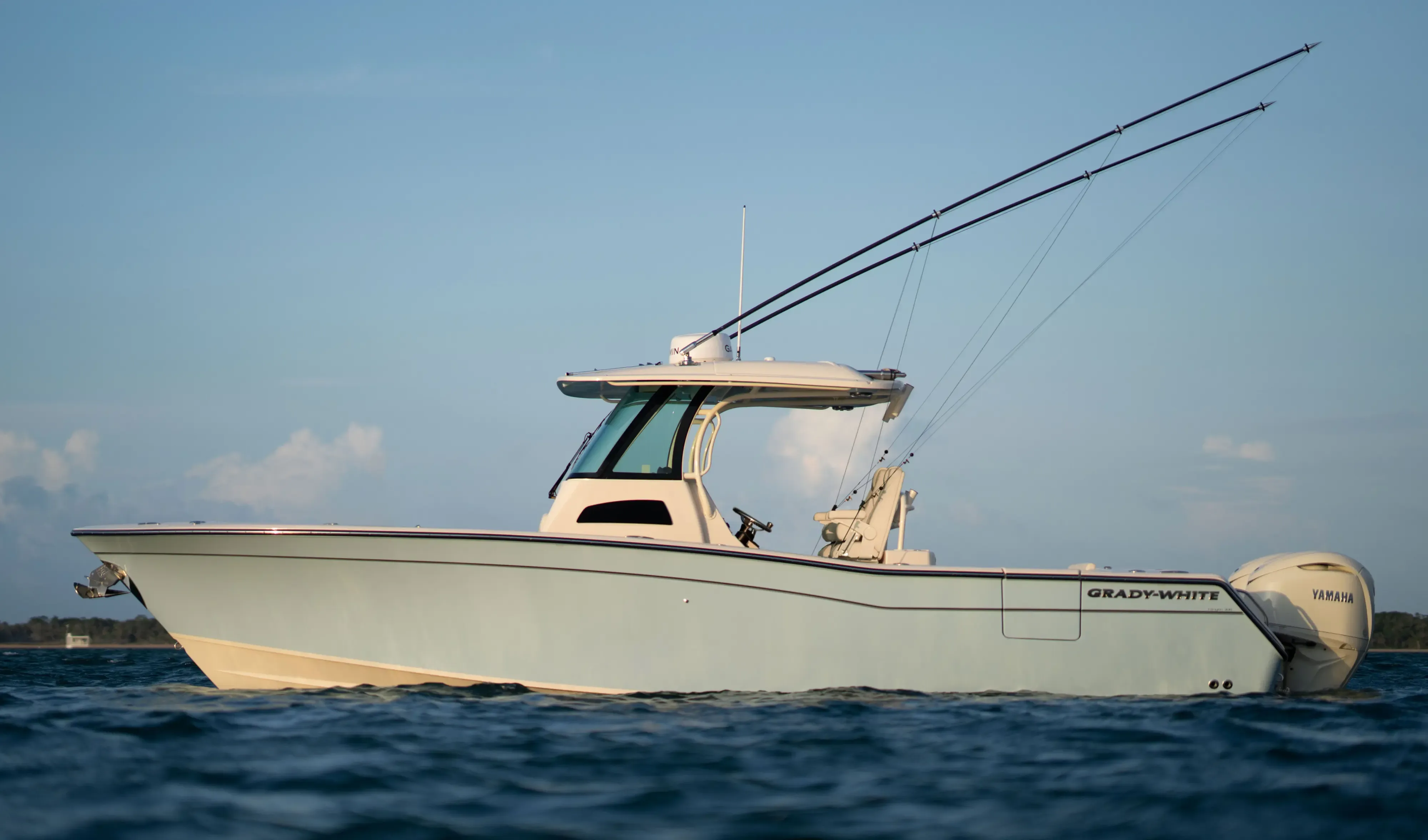
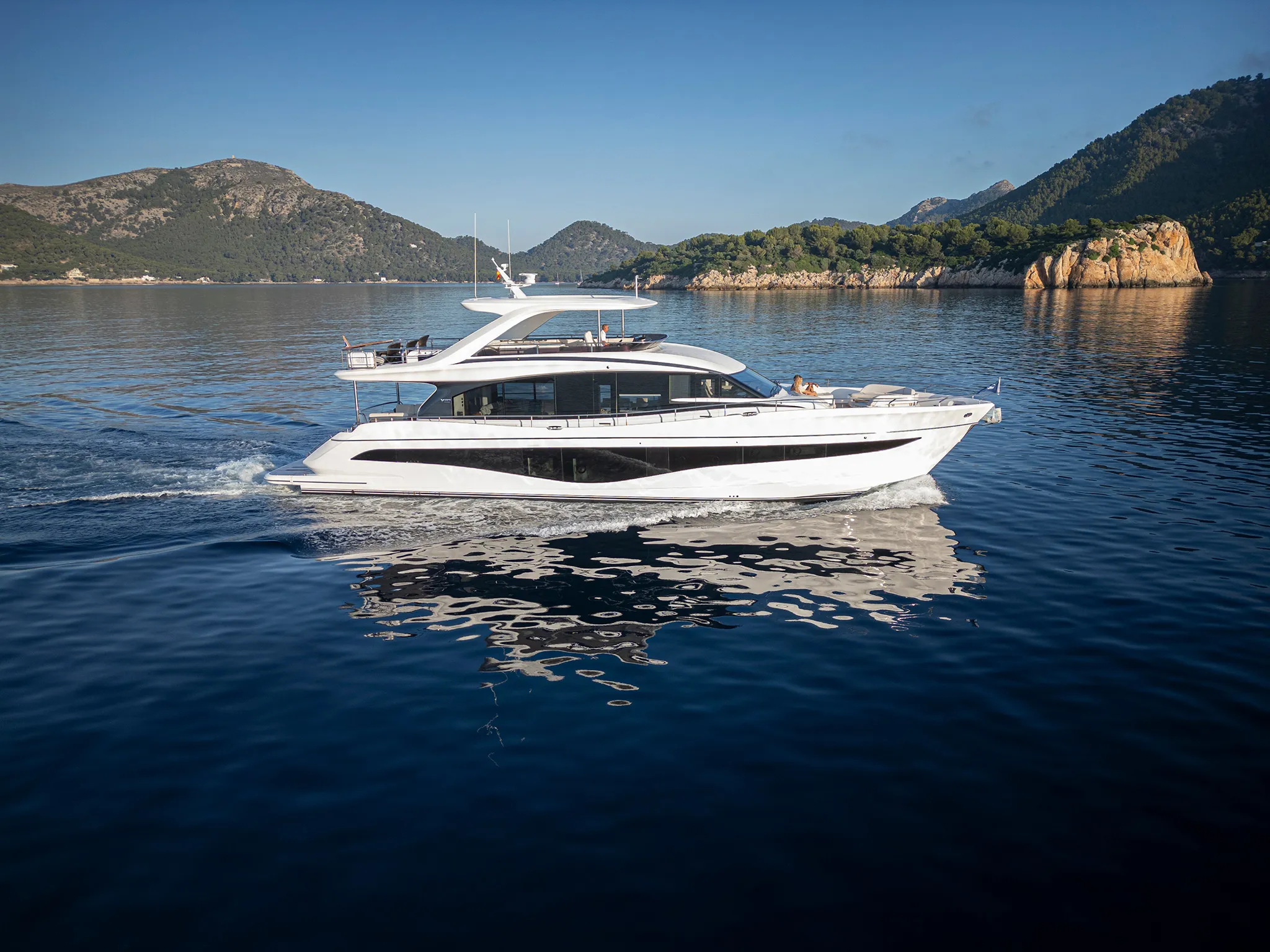
Yachts we'd shortlist for Monterey
Reviewed the same way as everything on this site — specifications verified against the builder's own numbers.
Frequently Asked Questions
Is Monterey a good harbour of refuge?
It is the harbour of refuge for this stretch of coast. NOAA Coast Pilot states that at Santa Cruz, in south weather, there is no protection and vessels must run for Monterey or Moss Landing. South of here there is no harbour of refuge at all before Morro Bay, the 30-fathom curve lies less than a mile offshore in many places, and Carmel Bay is not recommended for strangers. Monterey's breakwater runs about 1,700 feet and affords excellent protection in northwest weather — though Coast Pilot adds that in heavy weather there may be a strong surge in the harbour.
Does a foreign-flagged yacht need a pilot in Monterey Bay?
Yes, and it is an easy step to miss. NOAA Coast Pilot paragraph 189 states that pilotage in and out of Monterey Bay is compulsory for all vessels of foreign registry, and for US vessels under enrollment without a federal licensed pilot aboard, east of the Territorial Sea line between Point Santa Cruz and Point Pinos. Pilots come from the San Francisco Bar Pilots and board within a one-mile radius of 36°40′00″N, 121°58′00″W. For an imported or foreign-registered yacht that is a real cost and coordination step to plan for.
What size boat can be hauled out in Monterey?
No maximum length is published, and the published weights vary: 82 tons and 21 feet of beam on one yard's site, 75 tons and 22 feet on the other's, and NOAA Coast Pilot giving 70 tons at paragraph 193 and 60 tons at paragraph 215. What they agree on is beam: 21 or 22 feet. That caps a haul-out around 50 to 65 feet for a typical planing motoryacht — well short of what the harbour berths afloat. Plan against 60 tons and 21 feet, and settle your length, beam and draft with the yard before you book a date.
What is the largest yacht that can berth in Monterey?
Breakwater Cove Marina publishes guest berthing for vessels up to 200 feet, and backs it with a rate card running in bands to "150' & UP" at $5.00 per foot per night. The City's own fee schedule publishes alongside bands at Municipal Wharf No. 2 to "91' & over". California State Parks' Division of Boating and Waterways records a maximum boat length of 80 feet for the same facility, so carry both figures: what is published is guest berthing up to 200 feet, and the marina office confirms the berth when you book.
Can you reserve a berth in Monterey?
Not at the City marina. Its own words: "Monterey Municipal Marina does not take reservations. Accommodations are on a first come first served basis." Breakwater Cove Marina does take reservations and advises booking in advance because it fills up, with cancellation by 15:00 the day before. Both marinas run wait lists for permanent berths. Municipal Wharf No. 2 offers alongside transient space at $34.50 to $45.00 a day depending on length, with no utilities. Plan a Monterey stop with an alternative in mind rather than on the assumption that a berth will be held.
When is the best weather in Monterey?
Not the summer, which runs against what most people expect. NOAA states that sea fog is a problem on the bay from about July through September, with poor conditions expected on 10 to 15 days per month during July, August and September. Gales are rare, but extreme gusts of 40 to 50 knots occur from October through May. The harbour itself is open year-round: the marina runs 24 hours a day, the fuel dock has no seasonal closure, and guest rates are a single flat card with no seasonal tiers.