
August 29, 2026
The Leopard 46: Cruising Redefined for the Modern Sailor
Quiet, efficient and spacious, the Leopard 46 pairs a smart owner-operator layout with an optional hybrid electric drive - 25 kW pods, solar…
Read the articleExpert Review, Technical Specifications & Market Analysis
| Feature | Specifications |
|---|---|
| Overall Length | 45'7" |
| Beam | 24'1" |
| Draft | 5'5" |
| Displacement | 38,925 lbs |
| Engines | Twin Yanmar (2 x 45 HP) — standard (2 x 57 HP optional) |
| Fuel Capacity | 182 gal |
| Water Capacity | 185 gal |
| Cabins / Heads | 3-5 Cabins |
| Max Speed | - |
| Cruise Speed | - |
Source: Spec & Photos courtesy of Leopard Catamarans.
The question on a 46-foot cruising cat is no longer only how she sails — it is whether you can run the boat's whole electrical life without listening to a generator through dinner. The Leopard 46 offers a hybrid electric drive fed by solar, shore power and regeneration under sail, on a hull with stepped sections and an overlapping genoa.
Part of the Leopard Catamarans Sailing series — see how owners step up through the lineup.

The Leopard 46 is the boat in this range that makes me stop and read the systems page twice. The hybrid electric drive is not a line on an options list: it is a 25 kW pod standing in for a 75 hp thermal engine, a lithium-iron-phosphate battery pack, a solar array and a range extender, managed as one system that carries house loads as well as propulsion. Leopard's own testing puts it over 8 knots, with regeneration up to 1.8 kW per hour per hull and the batteries starting to top up from 4 knots of boat speed. For anyone who cruises where fuel is inconvenient, that changes the shape of the ownership.
The layout change underneath it is quieter and just as consequential. Losing the skipper cabin freed real volume, and Leopard spent it on living space rather than another berth. Of the three arrangements, I steer most private owners to the three cabins plus the utility room. The workspace and the washer/dryer pay you back every week of a long cruise; a fifth double pays you back twice a year. Take the five-cabin version if the boat is going into a fleet, and be honest with yourself about which of those you are.
If you are seriously considering the hybrid, do the arithmetic before the boat show rather than after. Build your real house load, air conditioning included, in the climate you actually cruise, and work out how hard the range extender has to run in your worst week rather than your best one. While you are at it, settle the diesel question the same way: the standard 45 hp Yanmars and the optional 57s behave differently on a loaded boat pushing a foul current, and that is a sea-trial question, not a specification question.
Video courtesy of Leopard Catamarans.
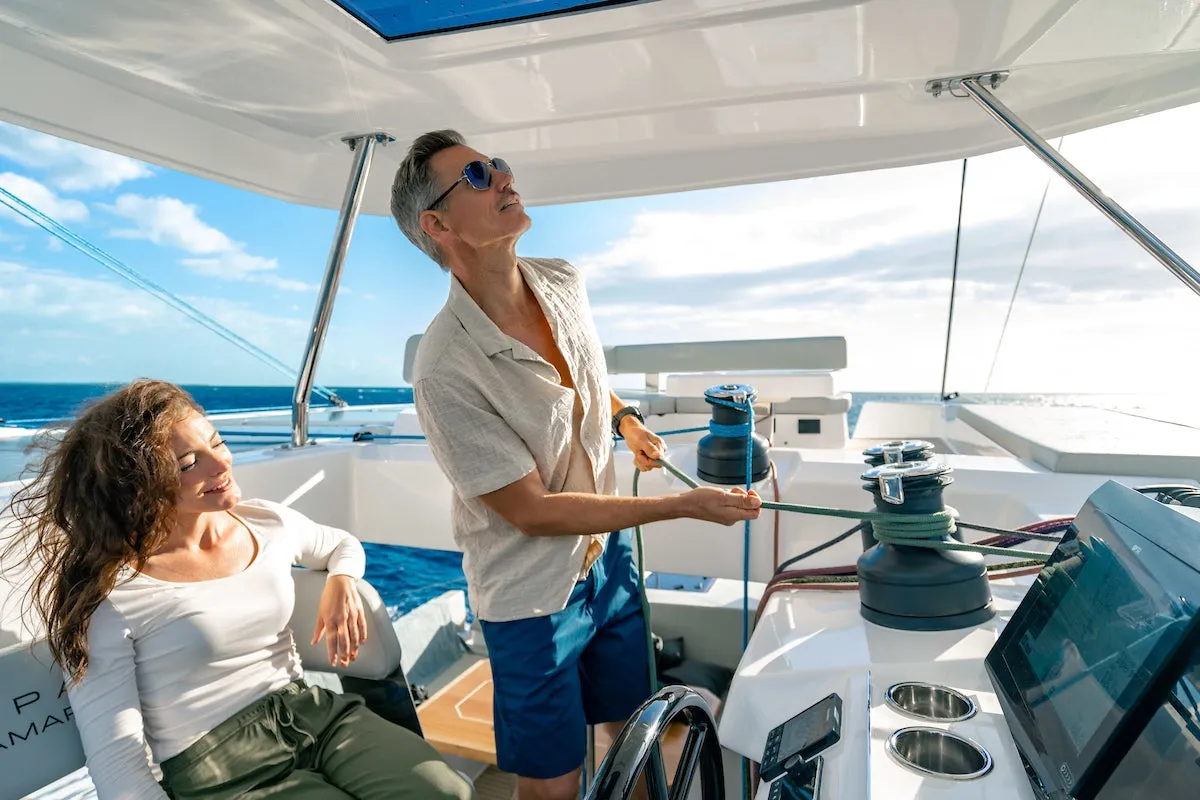
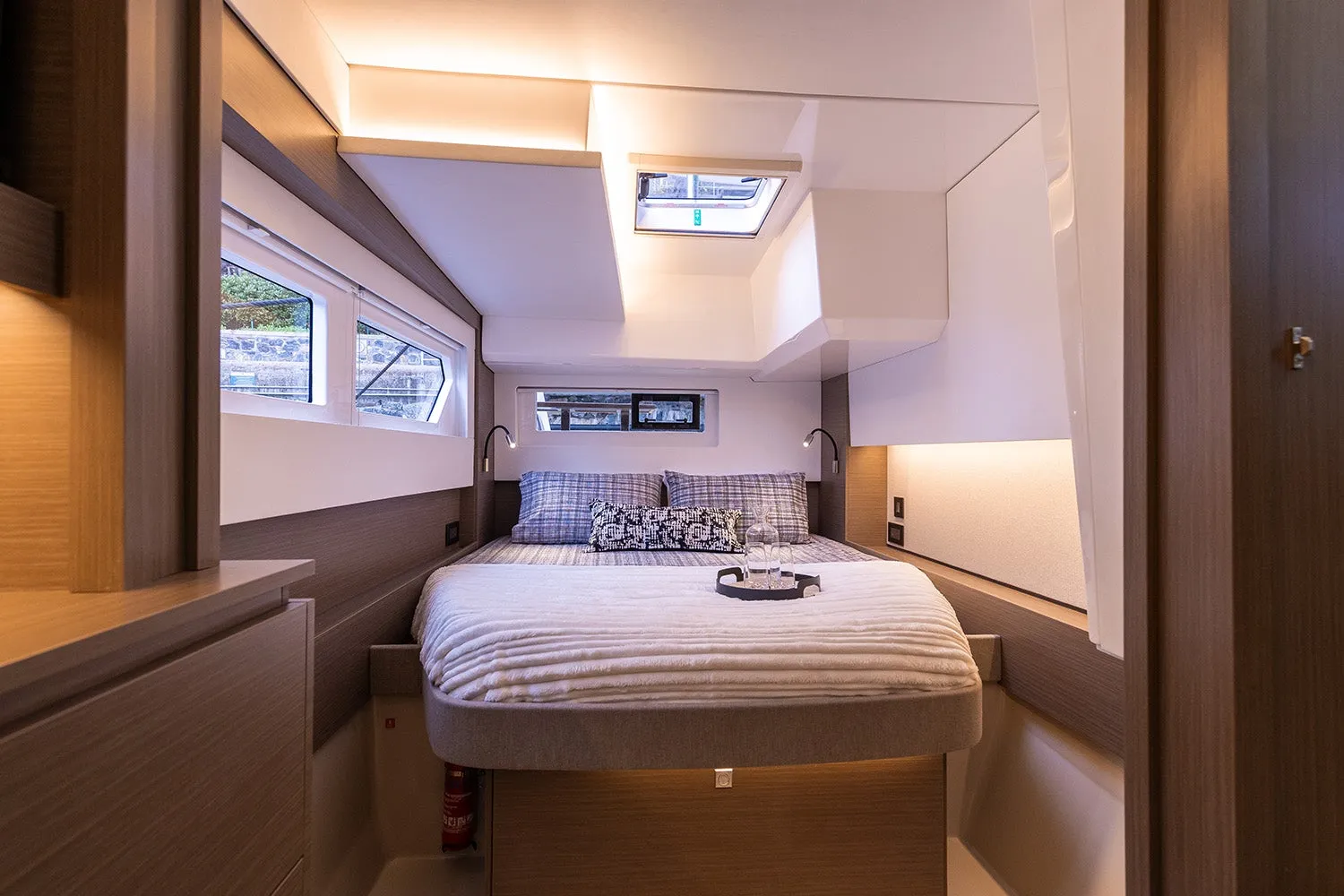
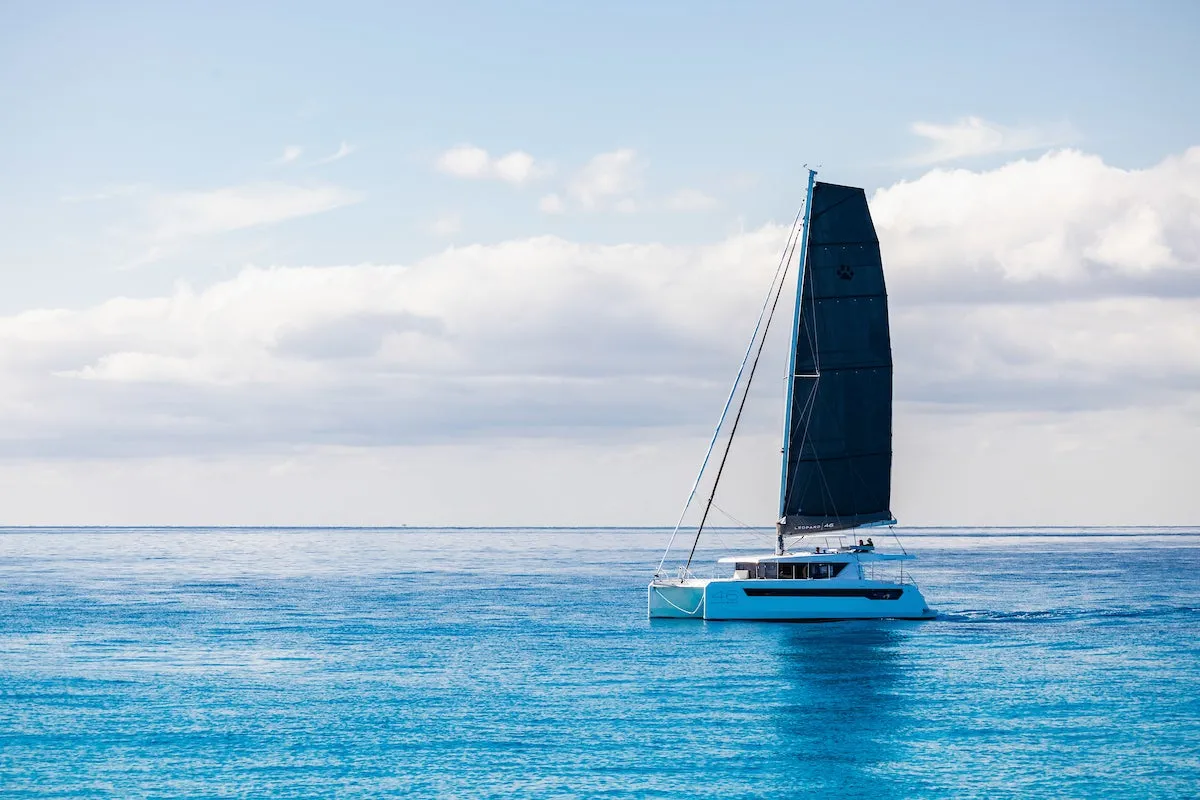
Photos courtesy of Leopard Catamarans.
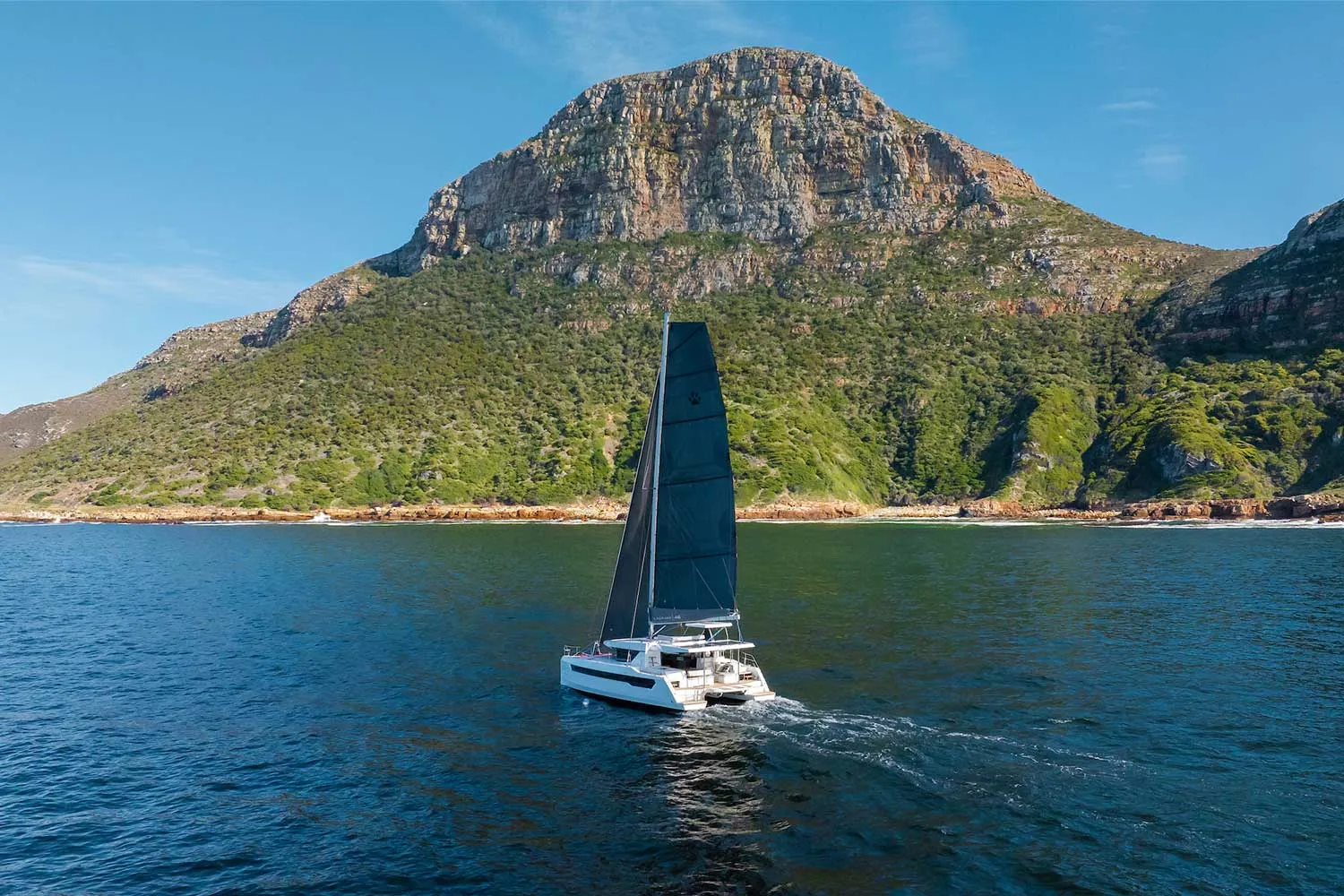
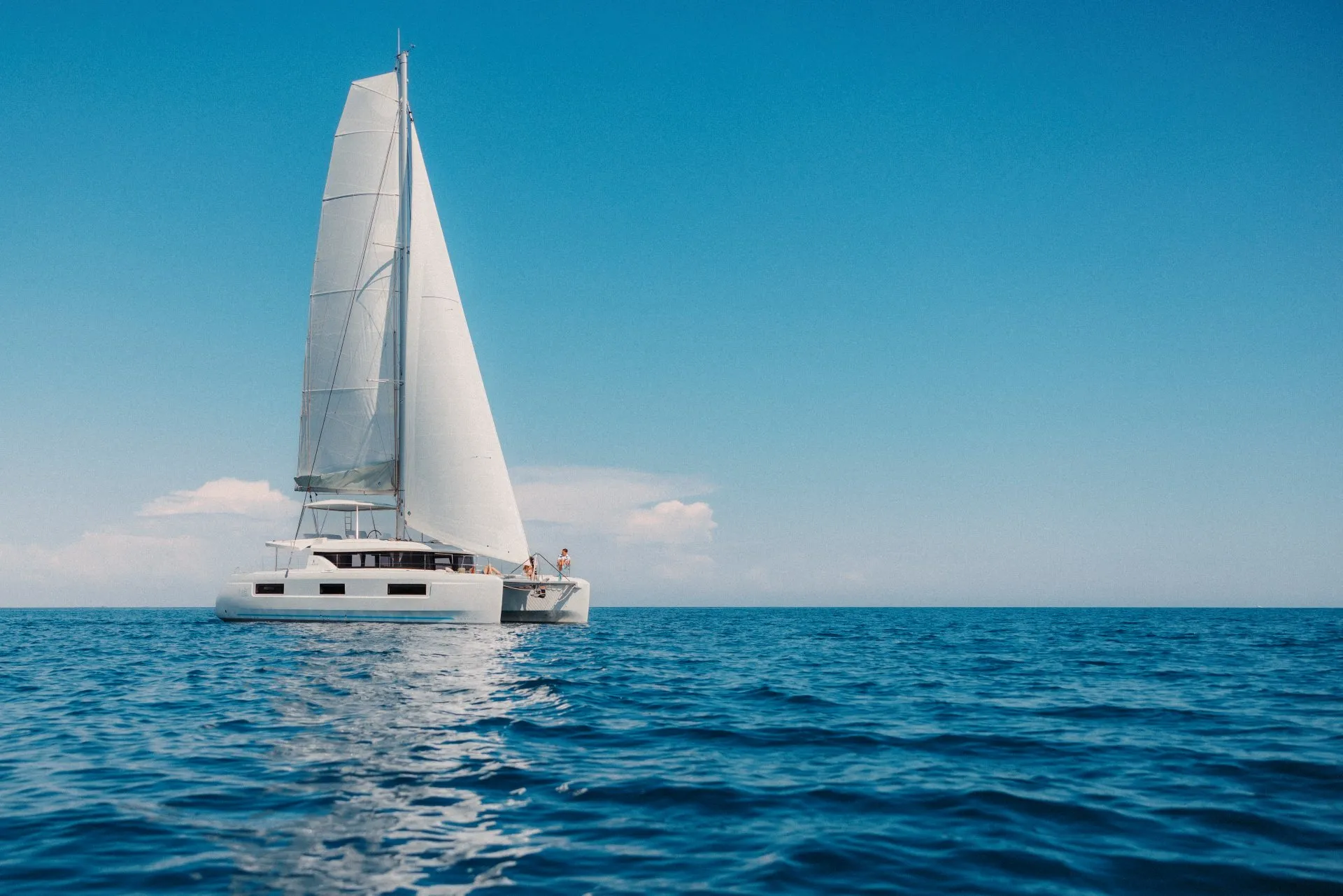
The Leopard 46 is a sailing catamaran of 45'7" (13.9 m) overall — 47'6" with the lifting platform — on a 24'1" (7.35 m) beam, drawing 5'5" (1.65 m), with a waterline length of 44'0" and a displacement of 38,925 lbs. She succeeds the Leopard 45 and keeps what made that boat work, while reorganising the accommodation around one decision: the skipper cabin is gone, and the volume it occupied went into the living space.
That buys three layouts, every cabin with its own head and shower — three cabins plus a utility room, four cabins with a large owner's cabin, or five doubles. Tankage is 182 gal of fuel and 185 gal of water with a 48 gal holding tank, and load carrying capacity is 12,915 lbs. All Leopard catamarans are NMMA and CE certified.
Standard power is twin Yanmar 45 hp diesels, with 57 hp versions optional. The third choice is the one worth studying: an integrated hybrid electric drive built around a power management box, an electric propulsion pod, a high-voltage lithium-iron-phosphate battery bank, a solar array and a range-extending generator. Each pod produces 25 kW of propulsion power in place of a 75 hp thermal engine, energy can come from solar, regeneration under sail, shore power or the range extender, and the system carries house loads as well as propulsion. Leopard's testing shows speeds over 8 knots and regeneration of up to 1.8 kW per hour per hull, with the batteries starting to recharge from 4 knots of boat speed.
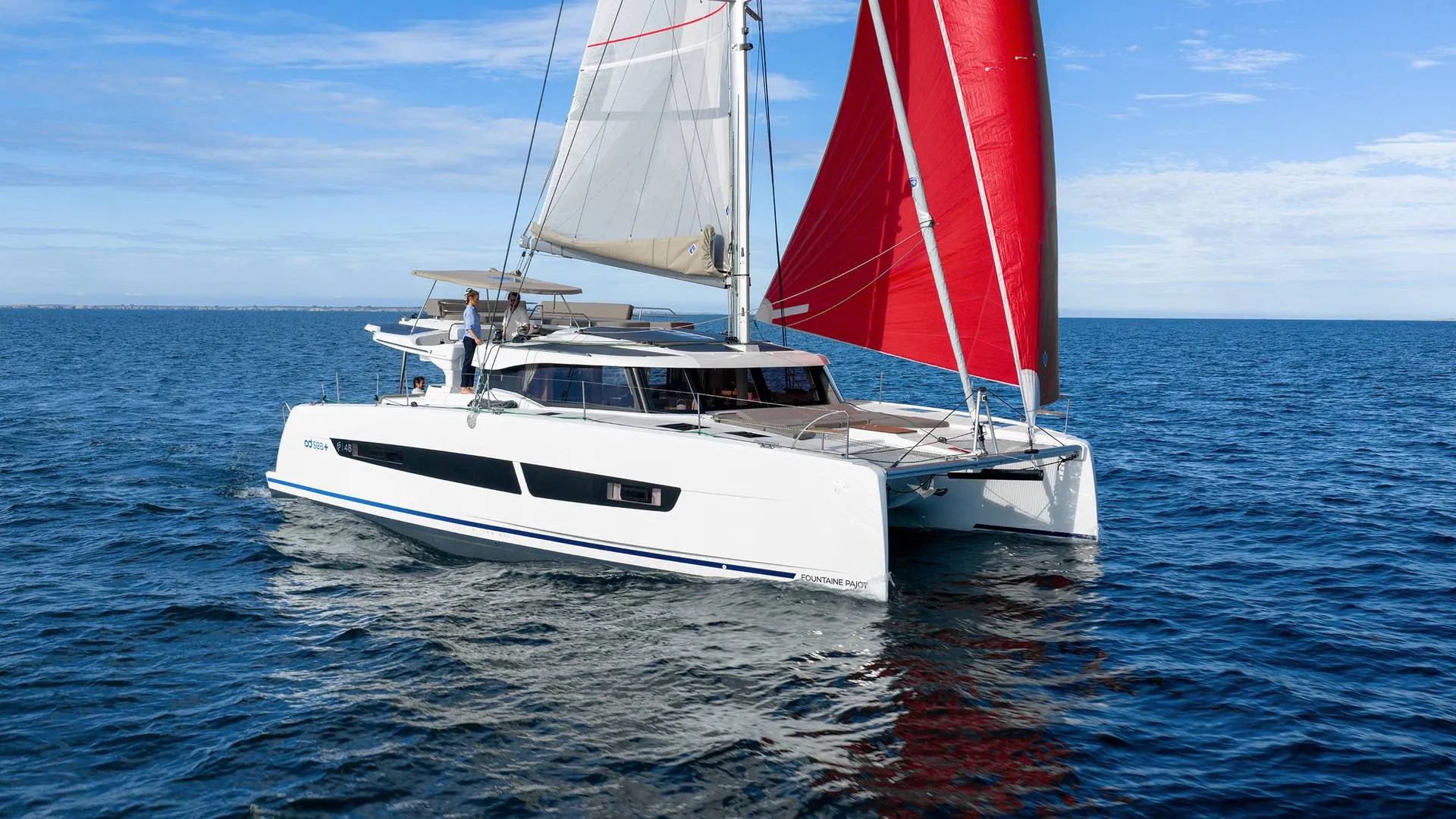
Under sail, total sail area is 1,512 sq ft, and a taller mast with the optional Aramid Sport performance rig adds 15% more sail area along with upgraded running rigging. Stepped hulls and an overlapping genoa are the handling story, and the protected helm station is laid out for offshore singlehanded work — which is the real test of whether a couple can keep the boat moving when the weather turns.
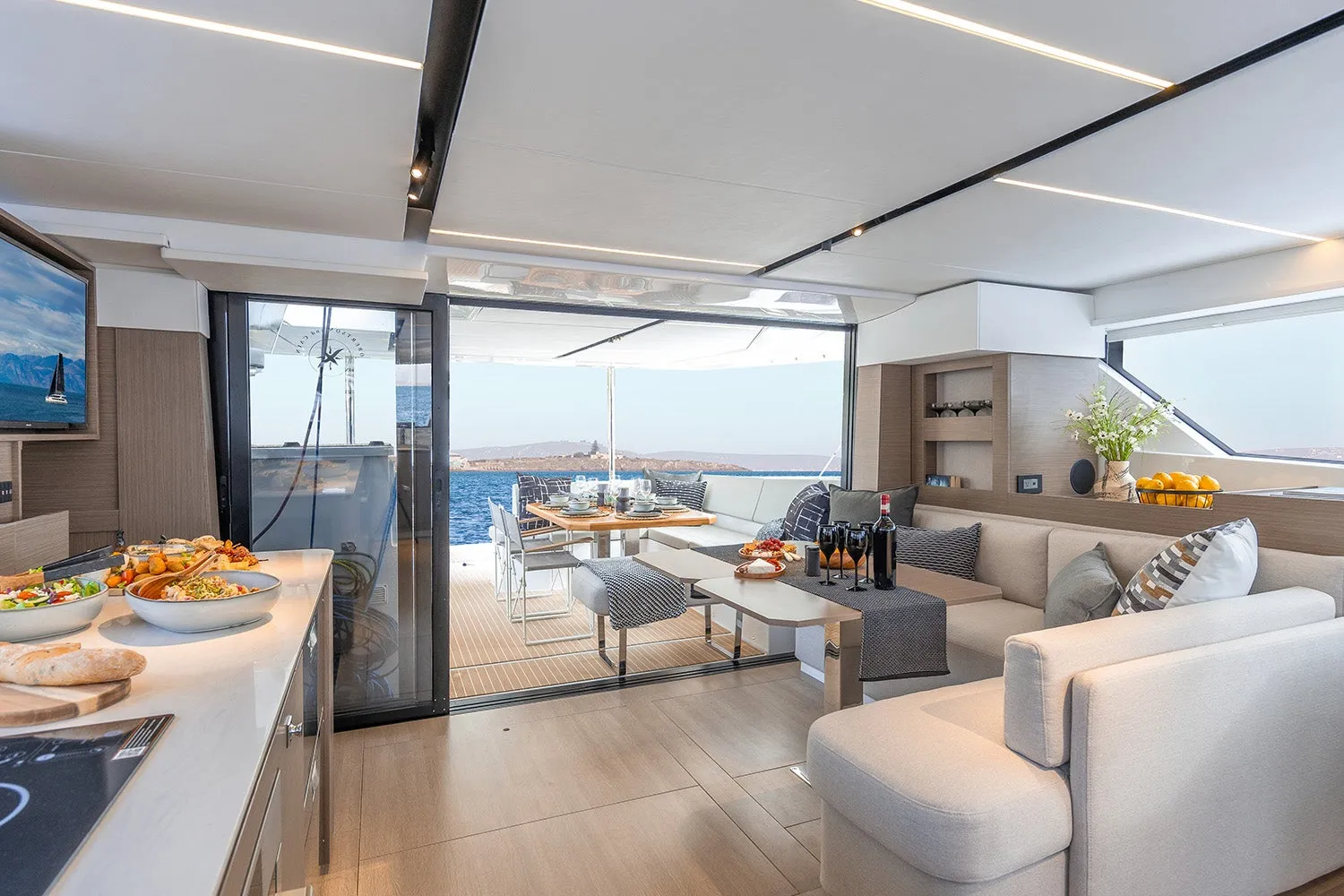
Losing the skipper cabin is what makes this interior feel a size larger than the number on the transom. The aft cockpit and saloon integrate through main saloon doors that open fully or close fully, so the same footprint works as one open room in the trades and as a sealed saloon on a cold passage.
Below, the three-cabin layout trades the forward port cabin for a workspace utility cabin with cabinetry and a washer/dryer — the layout most owner-operators end up wishing they had specified. The four-cabin version gives a whole hull to the owner, and the five-cabin arrangement is the family and charter answer, with every cabin ensuite. Materials and lighting are a step up from the 45, with customisable upholstery, and the options list runs to an electric induction cooktop, a large-capacity inverter, a full lithium house bank and a watermaker.
The 46 sits in the middle of the Leopard sailing range, above the 42'7" Leopard 43 and below the 51'8" Leopard 52, and it is the model that carries the brand's electric argument first. Against the Lagoon 46 Iconic at 47'7" and the Fountaine Pajot FP48 at 47'4" — both close on length and both comfort-led — the Leopard's differentiators are the hybrid drive option and the three-cabin-plus-utility layout.
It remains an owner-operator boat: the protected helm and lines-aft deck are sized for a couple, while the five-cabin configuration keeps it credible for charter fleets. Buyers in this class are usually choosing between interior volume and systems sophistication, and the 46 is the boat arguing you can have the second without giving up the first.
Choose the Leopard 46 if you plan to spend months at a time away from a dock and you would rather solve that with lithium, solar and regeneration than with engine hours. The hybrid drive is a full propulsion and house-power system rather than a marketing option, and it changes the ownership arithmetic most for owners cruising remote areas.
Spec the three-cabin layout with the utility room unless you genuinely need the berths — the workspace and the washer/dryer pay you back every week. If you take the hybrid, work the full energy budget against your real house load, air conditioning included, before you decide how hard the range extender will have to work; the same conversation should settle whether the standard 45 hp diesels or the 57 hp upgrade suits your waters and your displacement when loaded. If you need six cabins or a bigger sail plan, step up to the Leopard 52; if the 46 is more boat than two of you want to handle, the Leopard 43 is the same deck philosophy at a shorter length.
45 ft 7 in overall, or 47 ft 6 in with the lifting platform, on a 24 ft 1 in beam, drawing 5 ft 5 in, with a 44 ft 0 in waterline and a displacement of 38,925 lbs. Tankage is 182 gallons of fuel, 185 gallons of water and a 48 gallon holding tank, and load carrying capacity is 12,915 lbs.
Under sail, total sail area is 1,512 sq ft, and a taller mast with the optional Aramid Sport performance rig adds 15 percent more sail area along with upgraded running rigging. Stepped hulls and an overlapping genoa are the handling story, and the protected helm station is laid out for offshore singlehanded work.
Three, and every cabin has its own head and shower. The three-cabin version trades the forward port cabin for a workspace utility cabin with cabinetry and a washer/dryer; the four-cabin version gives a whole hull to the owner with a large owner's cabin; the five-cabin arrangement is the family and charter answer.
The skipper cabin from the Leopard 45 is gone, and the volume it occupied went into the living space, which is why the interior feels a size larger than the number on the transom. Unless you genuinely need the berths, the three-cabin layout with the utility room is the one most owner-operators end up wishing they had specified.
No. They are two different boats with different hulls that happen to share a number in their names.
The Leopard 46 is a sailing catamaran: 45 ft 7 in overall, 24 ft 1 in beam, 5 ft 5 in draft, 1,512 sq ft of sail area, twin Yanmar 45 hp diesels as standard with 57 hp or a hybrid electric drive optional, and 182 gallons of fuel.
The Leopard 46 Powercat is a motor catamaran: 46 ft 4 in overall, the same 24 ft 1 in beam, 3 ft 1 in draft, 475 gallons of fuel, twin Yanmar 4LV 250 hp diesels as standard, and a specification quoting 23.5 knots maximum and 16 knots cruising. Nothing about one carries across to the other, so compare each on its own sheet.
It is a full propulsion and house-power system rather than a bolt-on option. Each electric pod produces 25 kW of propulsion power in place of a 75 hp thermal engine, managed through a power management box rated at 25 and 50 kW DC and fed by a high-voltage lithium-iron-phosphate battery bank.
Energy comes from four directions: solar, regeneration under sail, shore power and a range-extending generator. Leopard's testing shows speeds over 8 knots, regeneration of up to 1.8 kW per hour per hull, and batteries starting to recharge from 4 knots of boat speed. The system carries house loads as well as propulsion, which is the part that changes the ownership arithmetic if you cruise remote areas. Work your full energy budget against your real house load, air conditioning included, before you decide how hard the range extender will have to work.