
August 29, 2026
Leopard 43: The Catamaran That Proves Evolution Beats Revolution
The Leopard 43 refines a proven platform into a blue-water cruiser that prioritizes comfort and efficiency: wave-piercing hulls, reverse bow…
Read the articleExpert Review, Technical Specifications & Market Analysis
| Feature | Specifications |
|---|---|
| Overall Length | 42'7" |
| Beam | 23'0" |
| Draft | 5'2" |
| Displacement | 32,470 lbs |
| Engines | Twin Yanmar 4JH45 (2 x 45 HP) |
| Fuel Capacity | 158 gal |
| Water Capacity | 174 gal |
| Cabins / Heads | 3-4 Cabins |
| Max Speed | - |
| Cruise Speed | - |
Source: Spec & Photos courtesy of Leopard Catamarans.
You want a cruising catamaran that still rewards you for trimming it — one that lives like an apartment at anchor and does not go dead in ten knots of breeze. The Leopard 43 answers with wave-piercing hulls, reverse bows, a mast three feet taller than the Leopard 42's and 12% more upwind sail area.
Part of the Leopard Catamarans Sailing series — see how owners step up through the lineup.

The interesting thing about the 43 is where Leopard spent the money. This began as a cosmetic update to bring the 42 into line with the 46 and the 52, and it turned into a redesign: wave-piercing hull shapes, reverse bows, and a mast three feet taller carrying 12% more upwind sail area. That last figure is the one I would hold onto. On a cruising catamaran, the margin between sailing in ten knots of breeze and reaching for the ignition key is exactly that kind of number, and it is the difference between a boat you sail and a boat you motor.
The 360-degree saloon glass will divide opinion at a boat show and win most people over on the second day aboard. Older cats feel dark and cut off from the water; this one does not, and the sliding companionway doors mean the saloon and the aft cockpit work as one room whenever the weather allows. Below, I would push most private owners toward the three-cabin layout and keep the volume. Take four cabins only if there are genuinely ever more than four of you aboard, because the stowage you give up is stowage you will want every single week.
Two things to settle before you sign. Get the loaded displacement in writing, because 11,872 lbs of load carrying capacity sounds generous right up until you add a tender, ground tackle, a watermaker and three months of provisions. And spec the sail wardrobe deliberately: the standard 783 sq ft mainsail and the 825 sq ft square-top are two different boats in light air, and that is a much harder decision to revisit later than most of the options list.
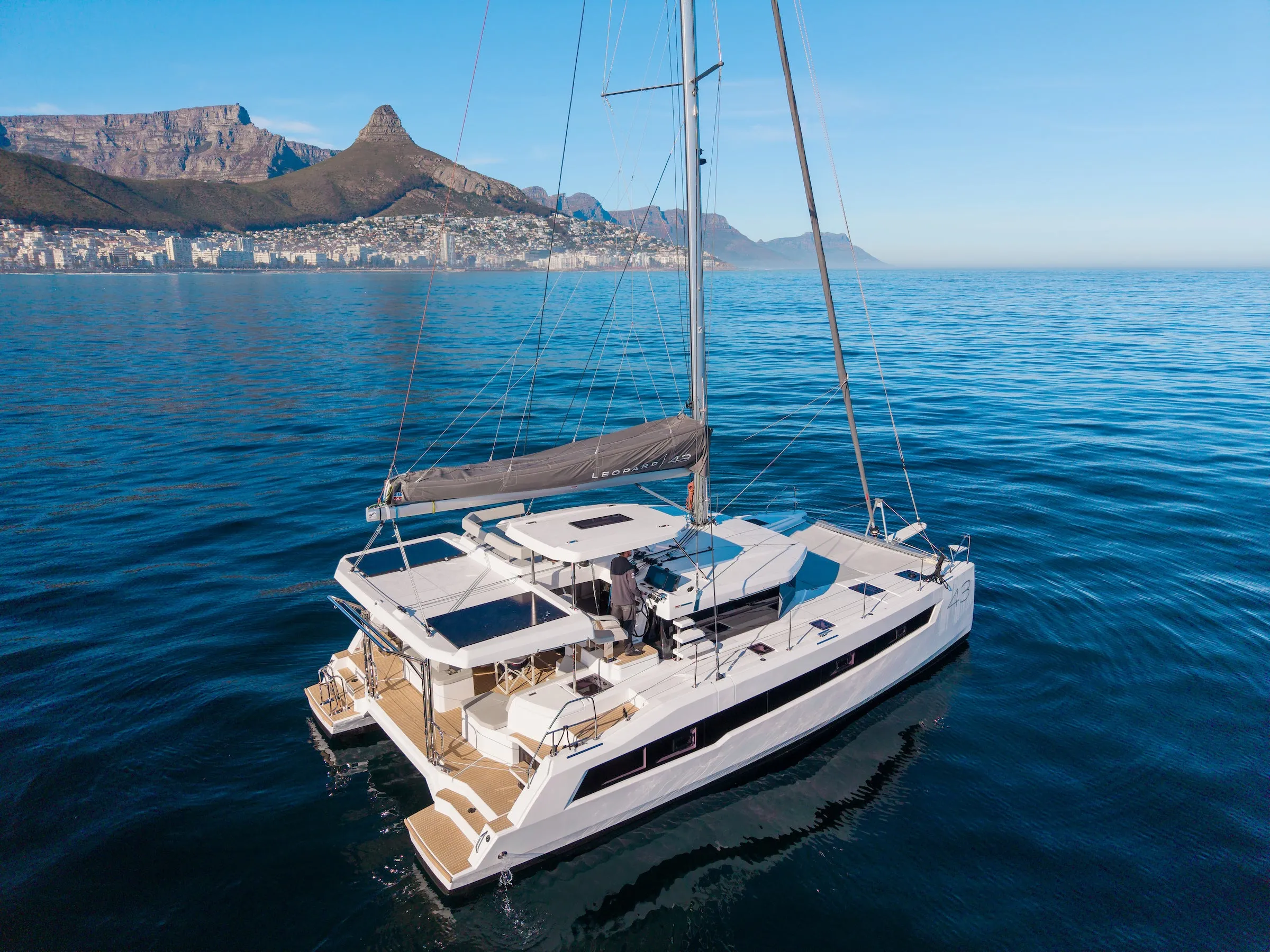
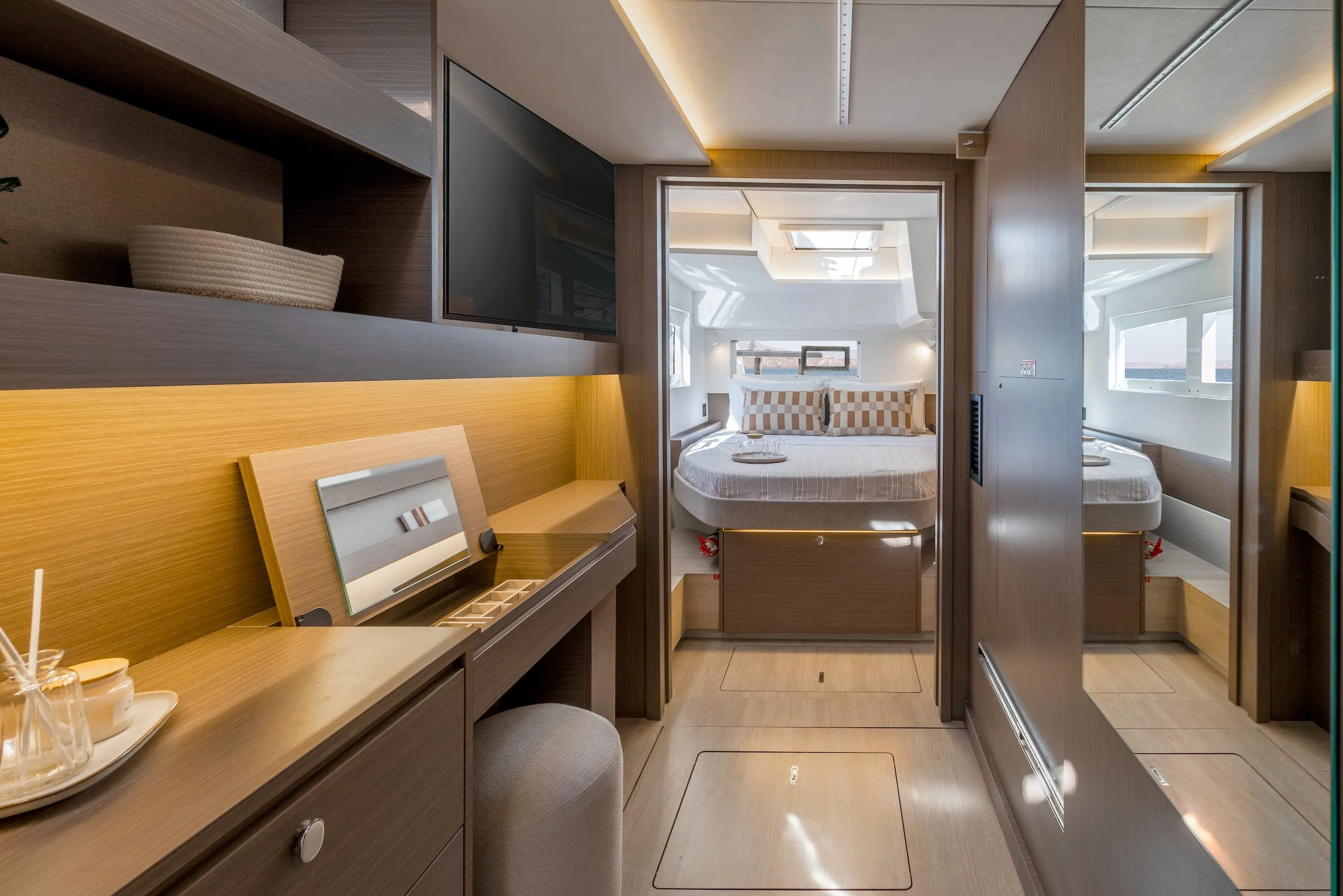
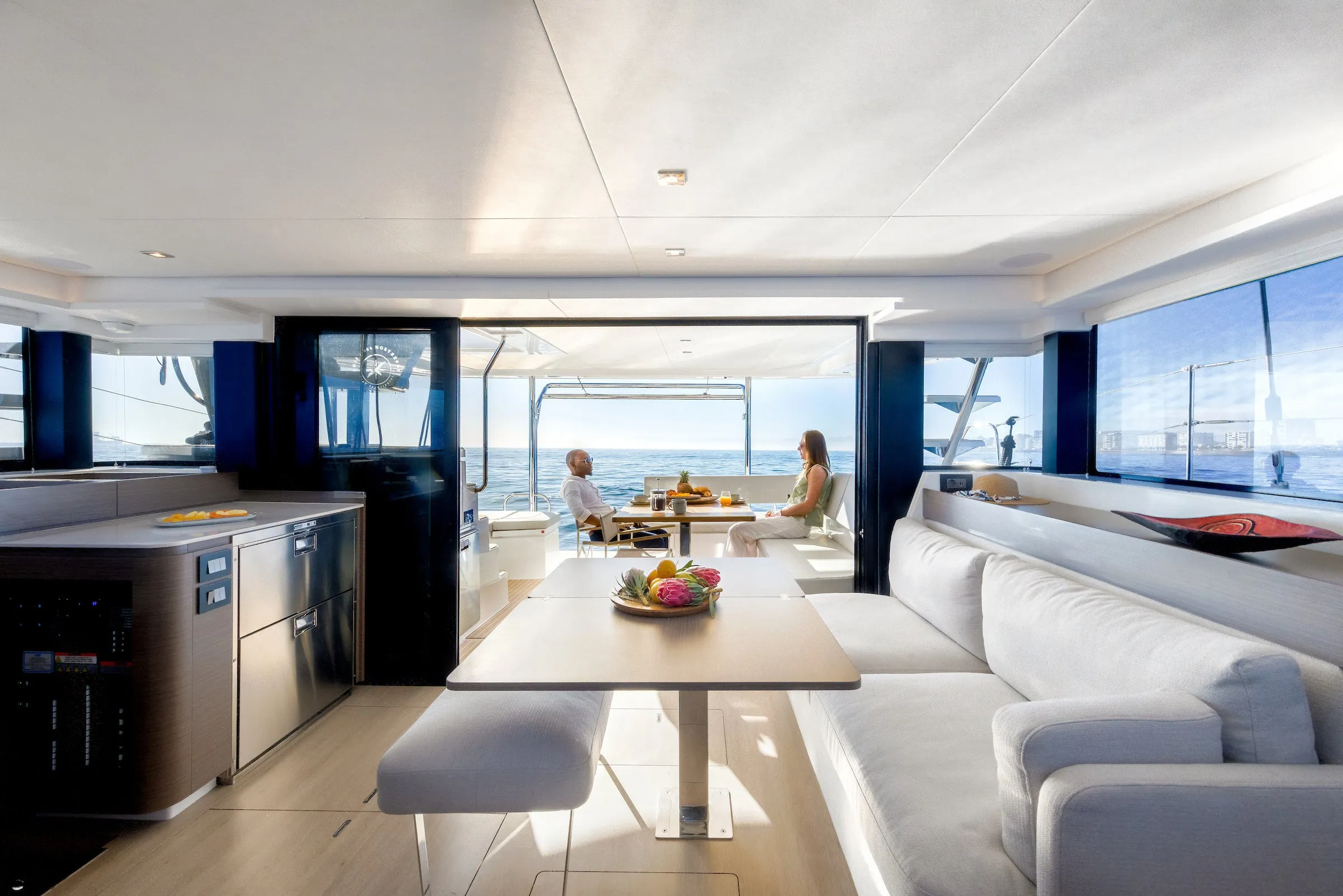
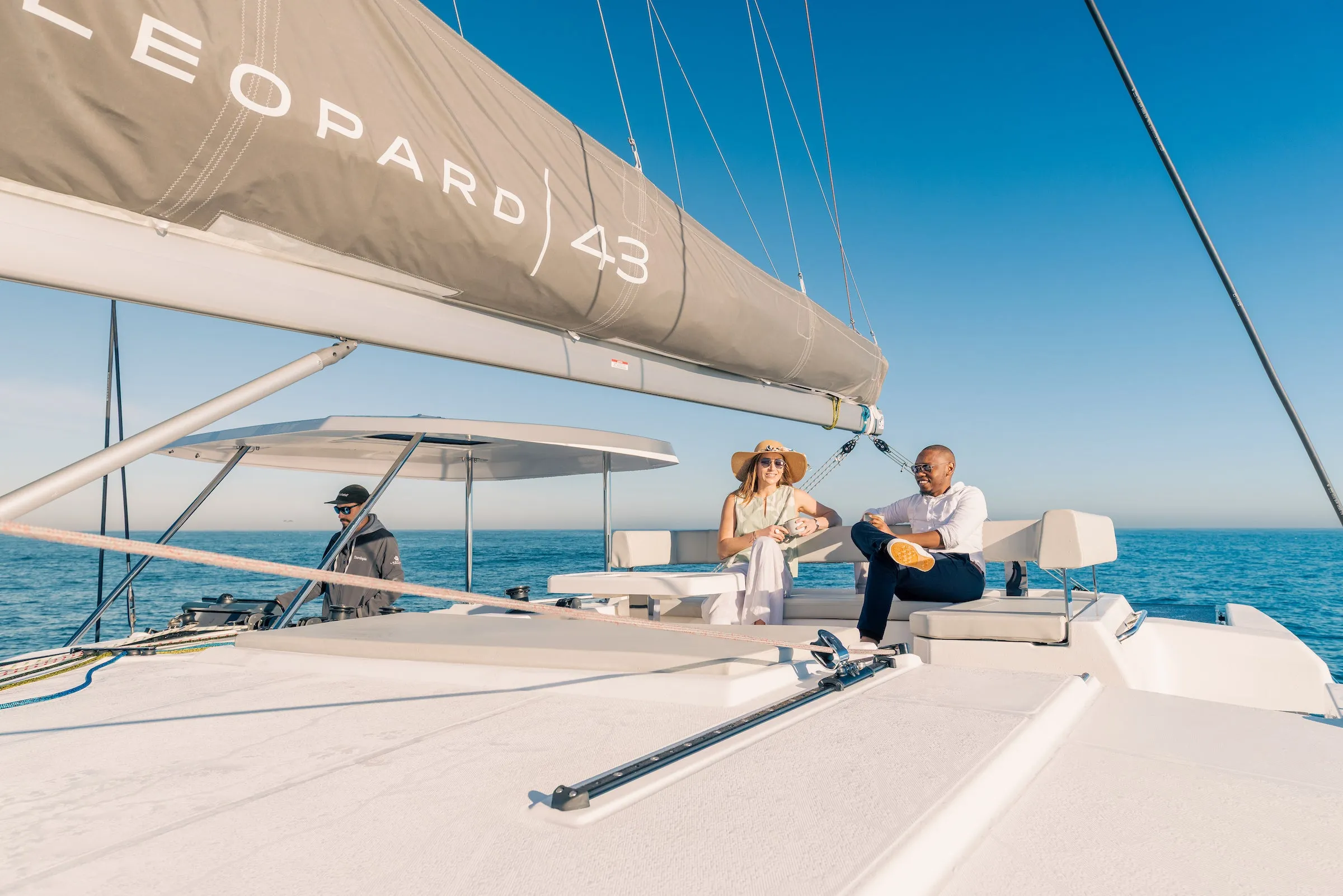
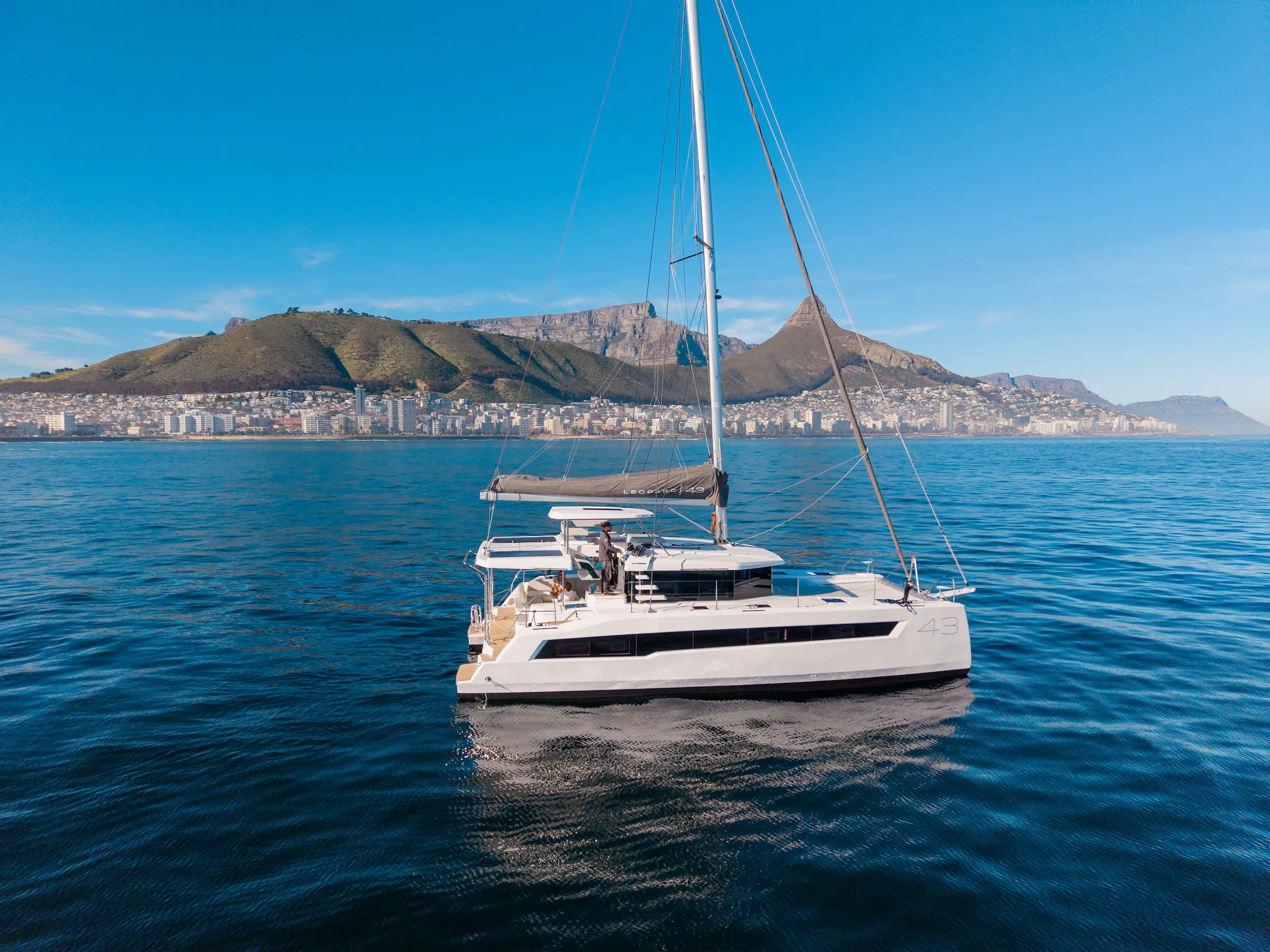
Photos courtesy of Leopard Catamarans.
The Leopard 43 is a sailing catamaran of 42'7" (12.98 m) overall on a 23'0" (7 m) beam, drawing 5'2" (1.57 m), with a waterline length of 41'0" and a displacement of 32,470 lbs. She is the next step on from the Leopard 42, and the redesign went a good deal further than the visual refresh it started as: wave-piercing hull shapes, reverse bows, a taller rig and a saloon wrapped in glass.
Tankage is 158 gal of fuel and 174 gal of water with a 44 gal holding tank, and load carrying capacity is 11,872 lbs — the number that decides how much of your life you can actually put aboard before the boat begins to feel it. Three- and four-cabin layouts are offered, and 1,365W of solar sits on the coachroof aft of the sun lounge. All Leopard catamarans are NMMA and CE certified.
Auxiliary power is twin Yanmar 45 hp diesels, but the sailing case is the more interesting one. Total sail area is 1,354 sq ft, the mast stands three feet taller than the Leopard 42's, and upwind sail area is up 12% on that boat. Wave-piercing hull shapes and reverse bows are there to cut pitching in a seaway, which is what makes a boat this size feel sporty rather than merely stable.
The standard mainsail is 783 sq ft, with a square-top main of 825 sq ft for owners who want more power up high. A composite longeron replaces the traditional bowsprit, which cleans up the foredeck and enlarges it at the same time. Sail handling is laid out for one person — helm layout, rig balance and control placement are all set up for singlehanded operation — and an integrated side step makes stepping off at a dock less of an event than it usually is on a cat this beamy.
The saloon is the headline. Glass now surrounds it completely, with the GRP structures that used to sit beside the companionway removed, so you get a genuine 360-degree view and far more natural light than the 42 delivered. Sliding glass companionway doors open the saloon into the aft cockpit, and the two become one room whenever the weather allows it.
Forward, the cockpit seating has been enlarged and the coachroof lounge redesigned, with an upholstered settee and a sun bed to starboard. Below, the hulls are voluminous enough for island berths you can get into from either side, with continuous panoramic windows at eye level. The owner's hull suite carries a large island berth, a desk with vanity, plentiful hanging and drawer space, and a bathroom with an isolated shower; the four-cabin arrangement puts two guest cabins with island berths and ensuite bathrooms to port. A three-cabin layout is offered as well.
The 43 is the entry point to the Leopard sailing range, below the 45'7" Leopard 46 and the 51'8" Leopard 52, and it inherits the argument that made the Leopard 42 a fleet favorite: enough boat for a couple to run indefinitely, sized so that two people can still handle it when the breeze fills in. What has changed is the emphasis — this is the sportiest hull shape Leopard has drawn at this length, and the rig is sized to use it.
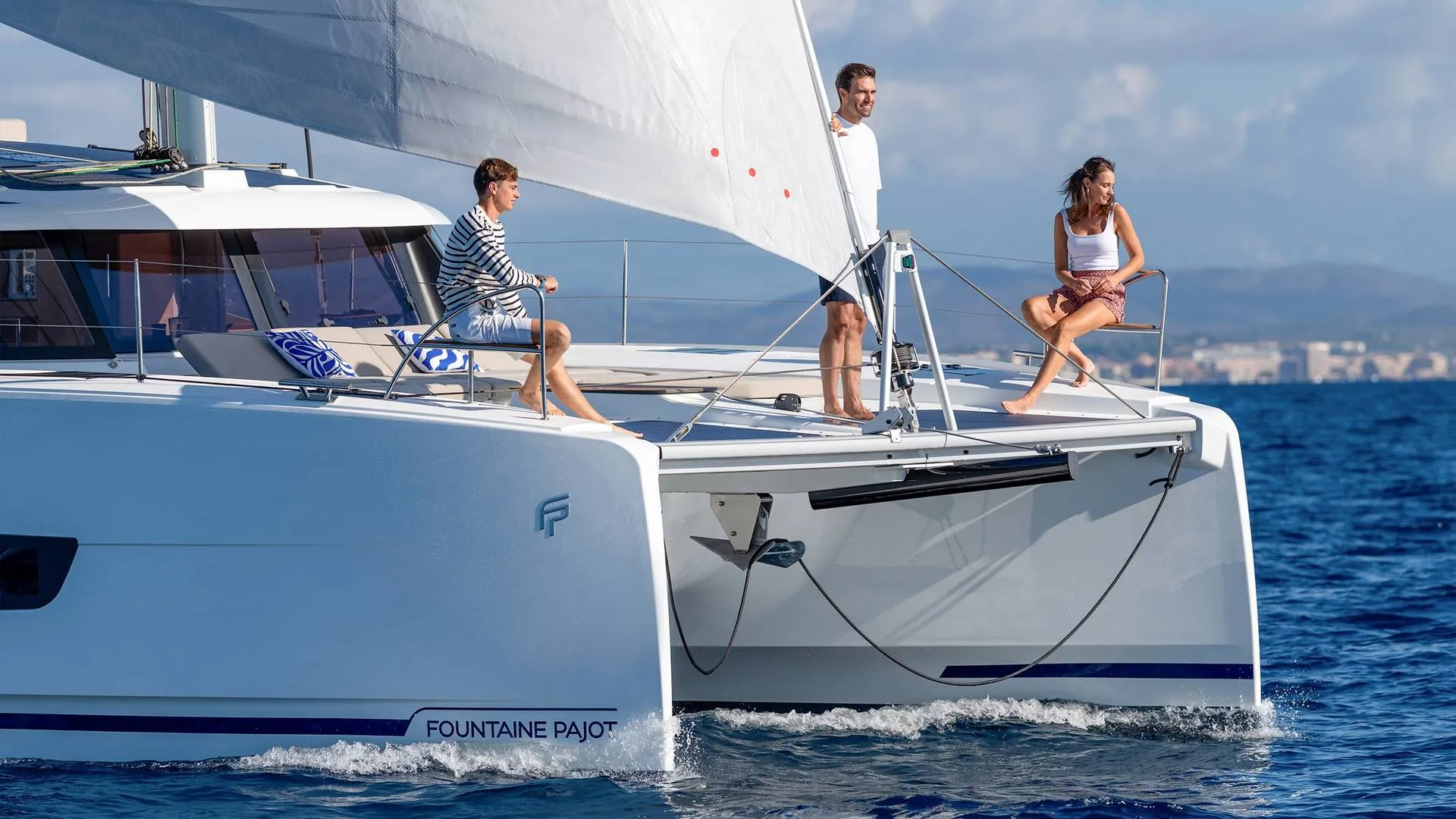
Cross-brand it lands against the Fountaine Pajot FP44 at 43'6" and the Lagoon 43 at 45'5", both of which are longer on paper and both of which lead with comfort. The Leopard's counter-argument is the sail plan and the wave-piercing bows. Against its own sisters it is the shortest way into the current Leopard deck layout.
Buy the 43 if you sail your catamaran rather than motor it, and if the boat's job is long-term cruising for a couple or a family who want space without stepping up to a 46 or a 52. The 12% upwind gain over the Leopard 42 is not a marketing number — it is the difference between sailing in light air and reaching for the key.
Take the four-cabin layout if there are ever more than four of you aboard; take the three-cabin version if it is your boat and you want the volume back. Two things to settle before you sign. Get the loaded displacement in writing so you know what is left of the 11,872 lbs load carrying capacity once tender, ground tackle, watermaker and provisions are aboard. And confirm the draft on the hull you are buying against the cruising ground you have in mind, because the shoal-water margin at this length is measured in inches. If you want more layout choice and the option of electric drive, the Leopard 46 is the next step up.
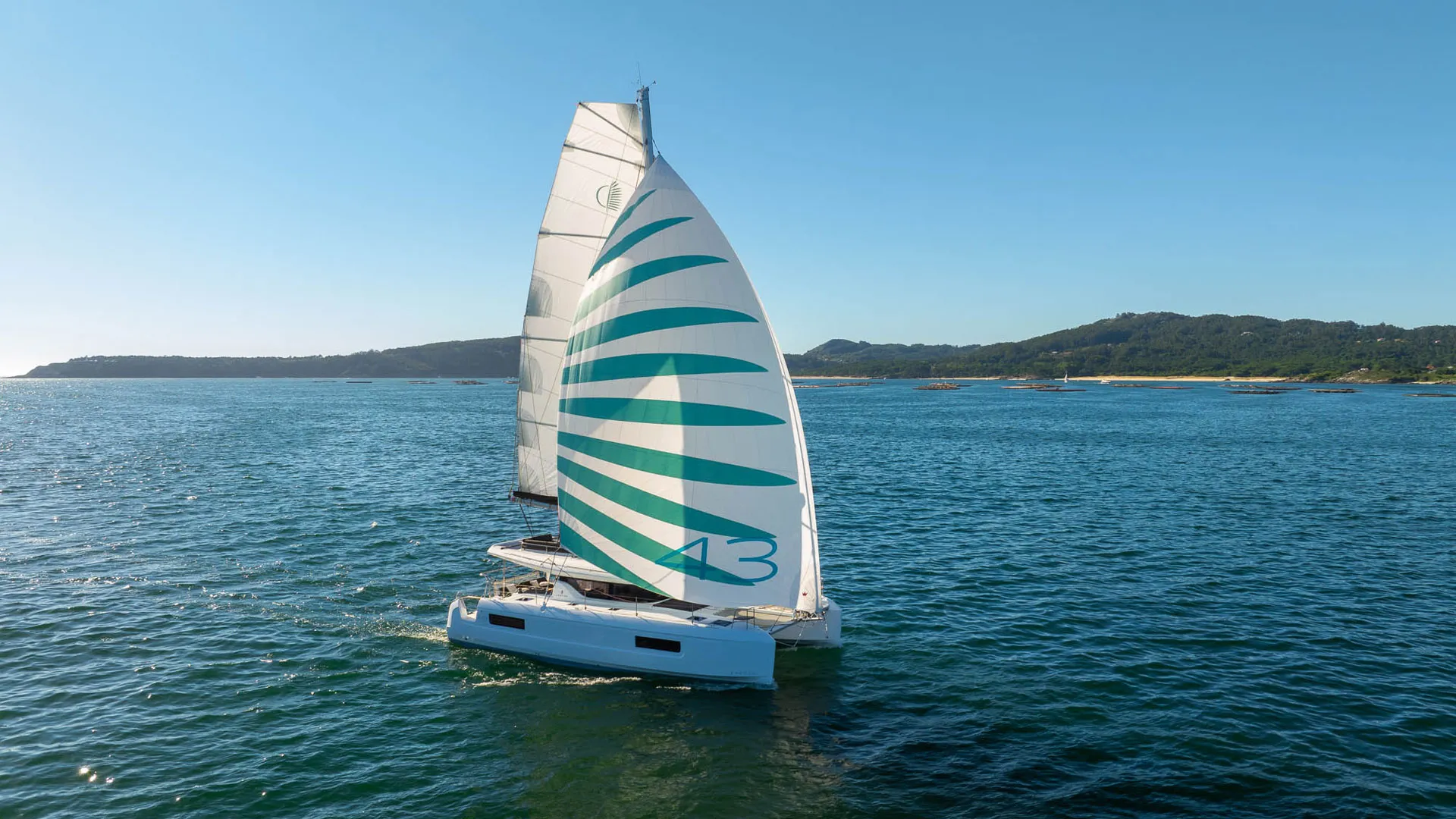
42 ft 7 in overall on a 23 ft 0 in beam, drawing 5 ft 2 in, with a 41 ft 0 in waterline and a displacement of 32,470 lbs. Tankage is 158 gallons of fuel, 174 gallons of water and a 44 gallon holding tank.
The number to pay attention to is load carrying capacity: 11,872 lbs. That decides how much of your life you can put aboard before the boat begins to feel it, so get the loaded displacement in writing once tender, ground tackle, watermaker and provisions are accounted for. Confirm the draft on the hull you are buying against your cruising ground too, because the shoal-water margin at this length is measured in inches.
Total sail area is 1,354 sq ft. The standard mainsail is 783 sq ft, with a square-top main of 825 sq ft for owners who want more power up high, and a composite longeron replaces the traditional bowsprit, which cleans up the foredeck and enlarges it at the same time.
The mast stands three feet taller than the Leopard 42's and upwind sail area is up 12 percent on that boat. Wave-piercing hull shapes and reverse bows are there to cut pitching in a seaway, which is what makes a catamaran this size feel sporty rather than merely stable.
Three or four. The four-cabin arrangement puts two guest cabins with island berths and en-suite bathrooms to port; the three-cabin version hands that whole hull back to the owner. Either way the owner's suite carries a large island berth, a desk with vanity, generous hanging and drawer space and a bathroom with an isolated shower.
The hulls are voluminous enough that the island berths can be reached from either side, with continuous panoramic windows at eye level. Take the four-cabin layout if there are ever more than four of you aboard; take the three-cabin version if the boat is yours and you want the volume back.
That is what it is drawn for. Helm layout, rig balance and control placement are all set up for singlehanded operation, the helm station sits in the protected cockpit rather than up on a flybridge, and an integrated side step makes getting off at a dock less of an event than it usually is on a catamaran this beamy.
Auxiliary power is twin Yanmar 45 hp diesels, and 1,365W of solar sits on the coachroof aft of the sun lounge, which is what keeps the house loads off the engines at anchor.