
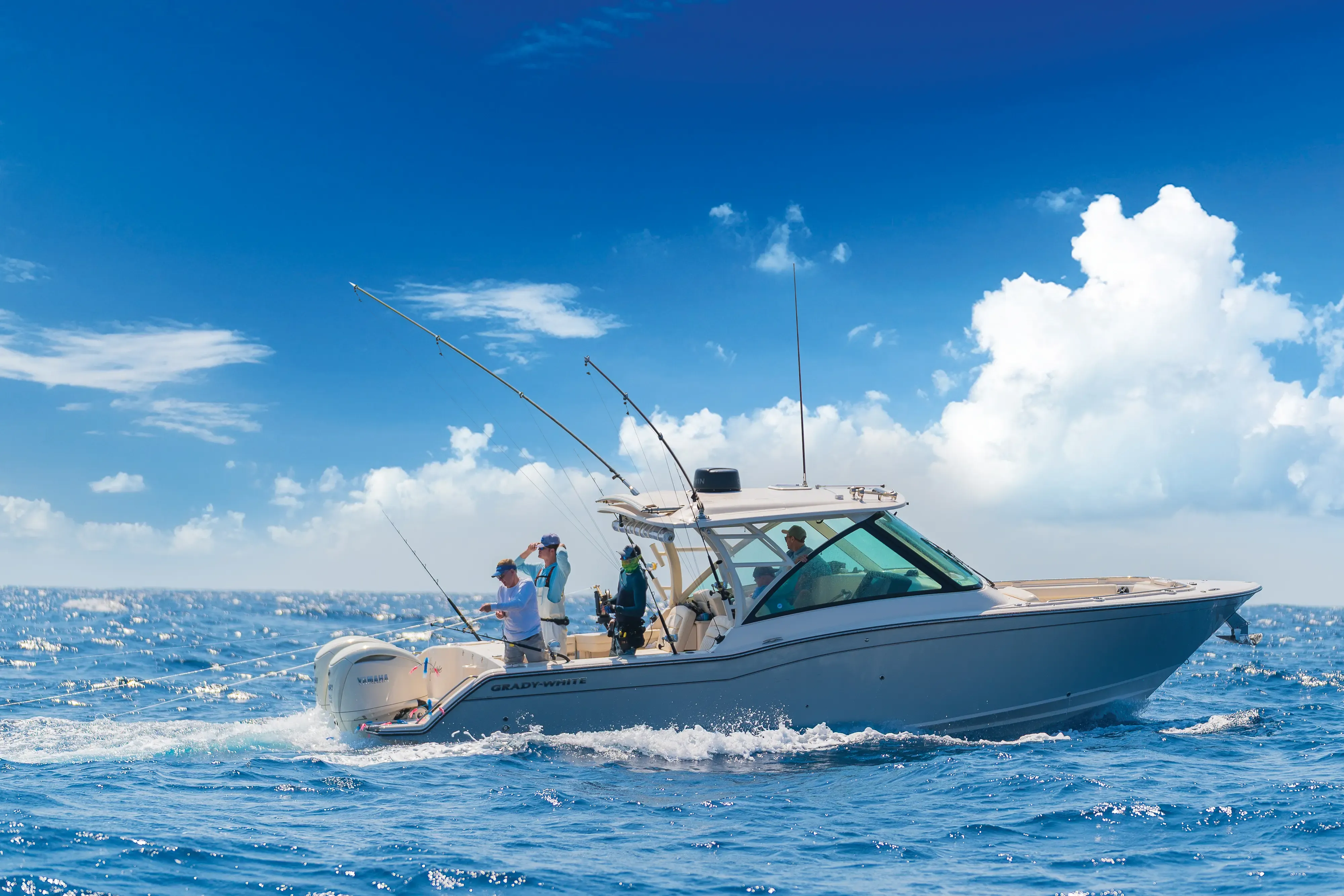
The Grady White 325 Freedom: When 32 Feet Feels Like 40
Versatile and spacious, the Grady White 325 Freedom packs yacht-level comfort and tournament-grade fishing into a 32-foot dual console—SeaV2…
Read the articleThe dual consoles — fish at dawn, cruise at sunset, from 31'2" to 33'6", rated 700 to 1,050 horsepower
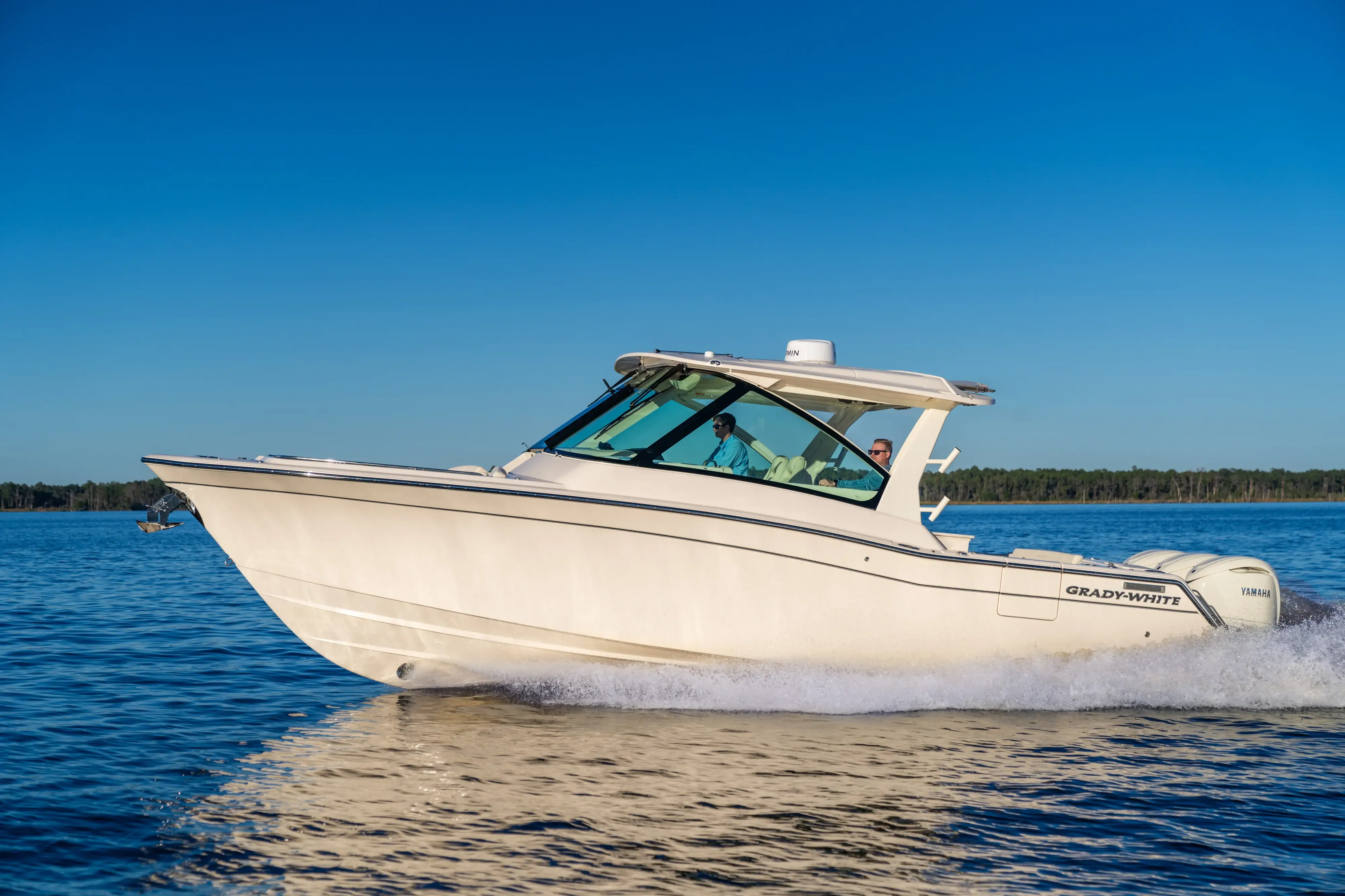
You want to fish hard on Saturday morning and take the family out on Sunday afternoon, and you do not want to own two boats to do it. That is the whole reason the Freedom line exists: dual consoles on the same SeaV2® hull form as the Canyon center consoles, with a windshield between you and the weather, a second console roomy enough for a berth or a head, and seating that converts from fishing to lounging without a fight.
The compromise is real and worth naming. A dual console gives up the walk-all-the-way-around deck a center console has — you cannot work a fish past the helm the way you can on a Canyon. What you get back is a dry helm, somewhere for people to sit facing forward, and a bow that is genuinely usable at anchor rather than just a casting platform.
We review two: the Freedom 325 at 31'2" and the Freedom 345 at 33'6". Grady-White's Freedom range runs from the 215 up to the 415, the largest outboard dual console the company has built.
Every Grady-White Freedom model we review in depth, in the order owners step up through the series.
Photo credit Grady-White.
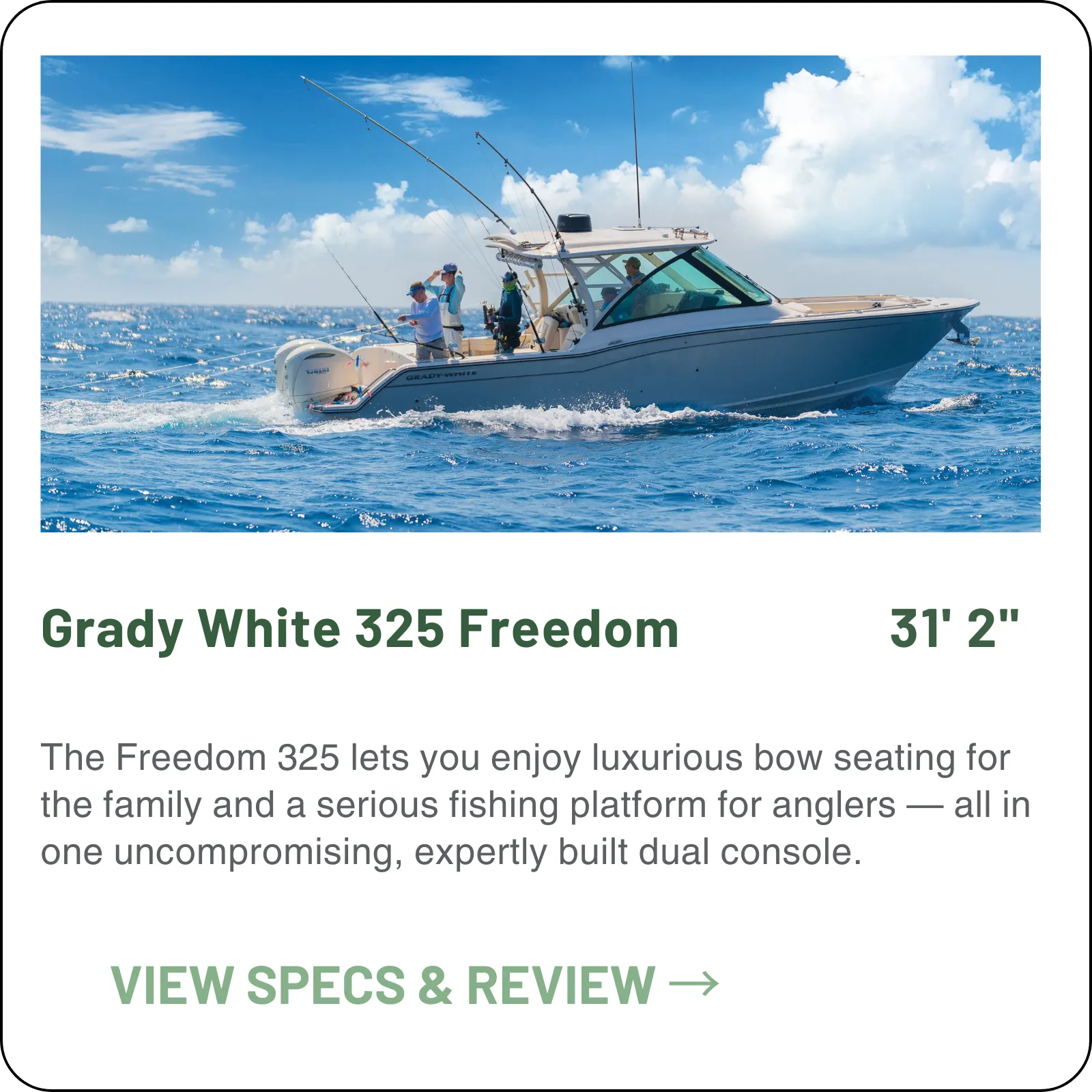
The dual console that still fishes — 31'2" on a 10'9" beam, 24 inches of draft, 288 gallons of fuel, and 53.9 mph on twin Yamaha 350s, with a berth in one console and a head in the other.
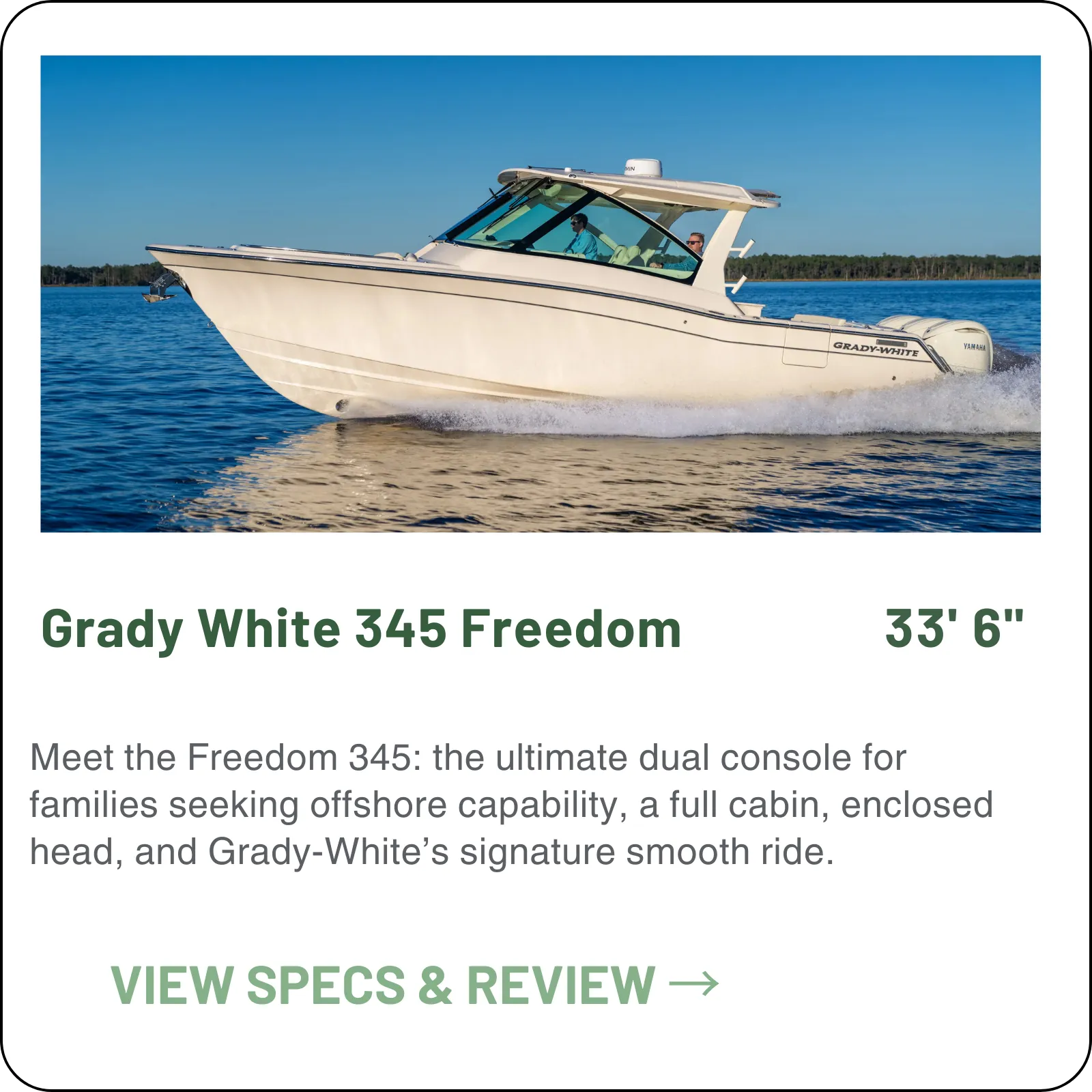
The biggest Freedom we review — 33'6" on an 11'7" beam, a port cabin with a sliding berth and an enclosed head, 300 gallons of fuel, and 56.2 mph on triple Yamaha 350s.

Don't see the Freedom model you're after — or a brand-new launch? Request specs through Yacht Specs Direct.
The 325 is 31'2" on the centerline, 10'9" of beam, 24 inches of draft, 288 gallons of fuel and 9,300 lbs without engines. Rated to 700 horsepower, it runs 48.5 mph on twin Yamaha 300s and 53.9 mph on twin 350s, cruising 30.2 mph at 3,700 RPM. The accommodation is split between the two consoles: a cushioned berth to starboard, and a VacuFlush head with a sink and a 10-gallon holding tank to port. Grady-White also quotes 33'1" overall with the swim platforms counted, which is the number that matters when you price a slip.
The 345 is a different proposition. It is 33'6" on an 11'7" beam, draws 27 inches, carries 300 gallons and weighs 12,510 lbs dry, with the ceiling at 1,050 horsepower — twin Yamaha XTO 450s for 52.2 mph, or a triple 350 package for 56.2. The real change is inside: instead of a berth tucked into a console, the 345 has a port cabin with an electrically operated sliding berth, a bench seat and a closet, plus a separate enclosed head with a sink and storage.
The step costs more than the twelve extra inches suggest. You add 3,210 lbs and three inches of draft, and cruise fuel burn goes from 20.7 gph to 28.3. What you buy is a cabin a couple can genuinely use, and a boat that stays comfortable in conditions that would send the 325 home early.

The 345 is the boat that justifies this whole category. A lot of dual consoles are center consoles with a windshield bolted on and a token berth; this one has a cabin with a sliding berth, a bench seat and a closet, plus a separate enclosed head — and it still takes 1,050 horsepower and still fishes properly. If you are buying a Freedom because you want the family aboard rather than merely tolerated, this is the one.
The case for the 325 is water and running cost. It draws three inches less, weighs 3,210 lbs less, and burns about eight gallons an hour less at cruise, which across a season of forty-mile runs is not a rounding error — and it fits slips and lifts the 345 does not. What you give up is the cabin. A berth inside a console is somewhere to get out of the sun or put a child down for an hour; it is not somewhere two adults will spend a night. Decide whether you are actually going to sleep aboard, because that one question separates these two boats more cleanly than any number on the spec sheet.
Videos courtesy of Grady-White.
Grady-White builds ten Freedom dual consoles: the 215, 235, 255, 275, 285, 307, 325, 345, 375 and the 415, which at 40'7" is the largest outboard dual console the company has produced.
We review two here — the 325 and the 345 — the pair that brackets the point where a dual console stops being a day boat and starts being something you can overnight on. If you are considering a Freedom we have not covered yet, ask and we will pull the specifications for you.
A Canyon is an open center console built around fishing; a Freedom is a dual console built around doing both. The Canyon puts the helm amidships and keeps the deck clear so you can work a fish all the way around the boat. The Freedom adds a windshield, a second console and forward-facing seating.
The trade is straightforward. You give up the walk-around deck and a little draft — the Canyon 306 draws 21 inches against the Freedom 325's 24 — and you get back a dry helm, somewhere for people to sit facing forward, and a bow that is genuinely usable at anchor. Both lines use the same SeaV2® hull form.
Of the two we review, only the Freedom 345. It has a port cabin with an electrically operated sliding berth, a bench seat and a closet, plus a separate enclosed head with a sink and storage.
The Freedom 325 splits its accommodation between the two consoles — a cushioned berth to starboard, a VacuFlush head to port. That is useful for changing in private or getting a child out of the sun, but it is not a cabin, and two adults will not spend a comfortable night in it.
Tell us how you plan to use the boat — guests, range, crew or no crew — and we'll give you the straight story on where in the Freedom series you belong, new or brokerage.
Explore All Grady-White ModelsOr reach Tony directly: TS@MintedYachts.com · +1 (404) 805-9819