
August 21, 2026
Pursuit D 306 Denali: 346 Miles of Range in a 32-Foot Dual Console
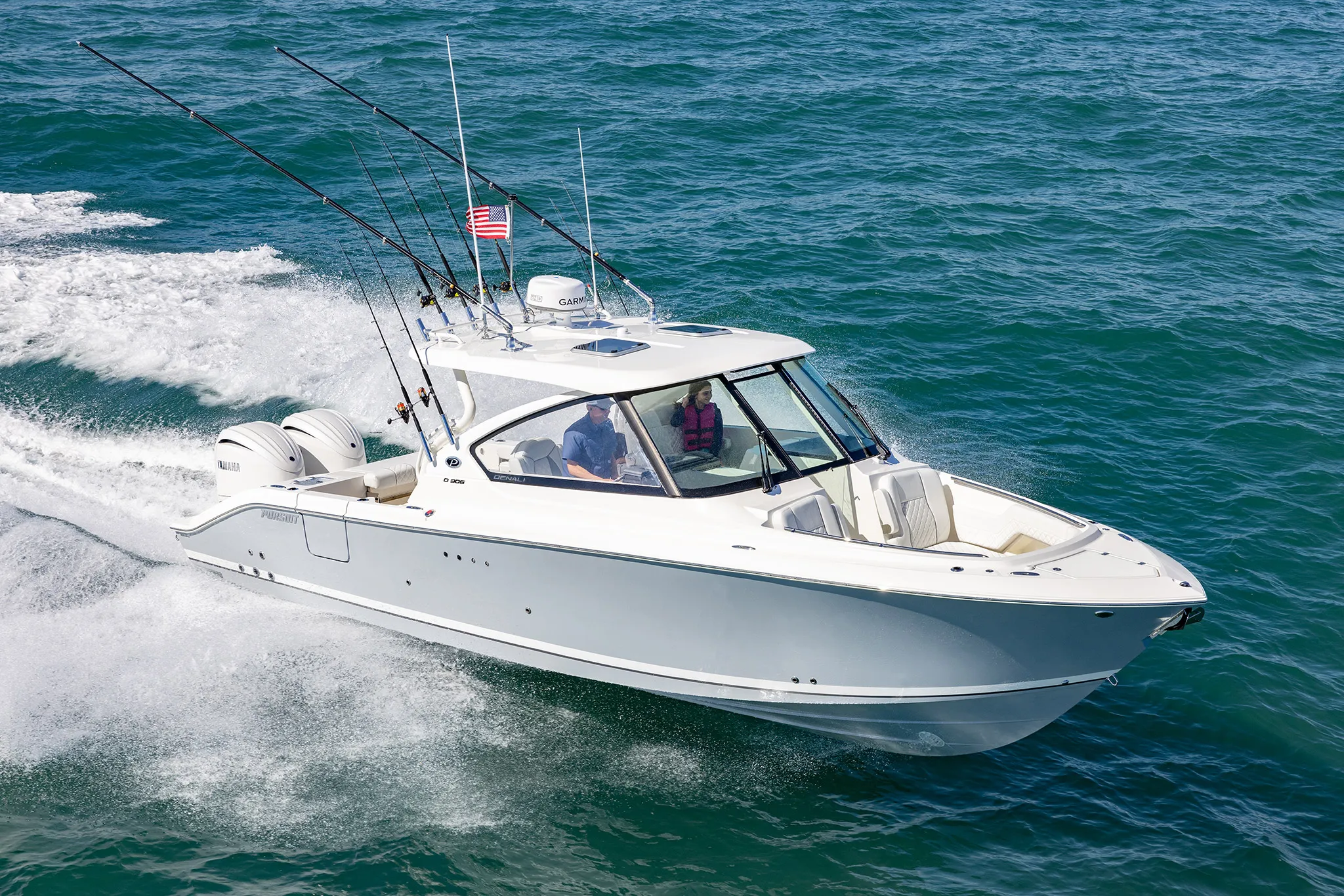
The Pursuit D 306 Denali is a 31'11" dual console with 224 gallons of fuel and twin Yamaha F300s good for 52.3 mph — and a published cruise …
Read the articleThe dual consoles — six boats from 25'8" to 37'11", walkthrough layout under a full-width hardtop
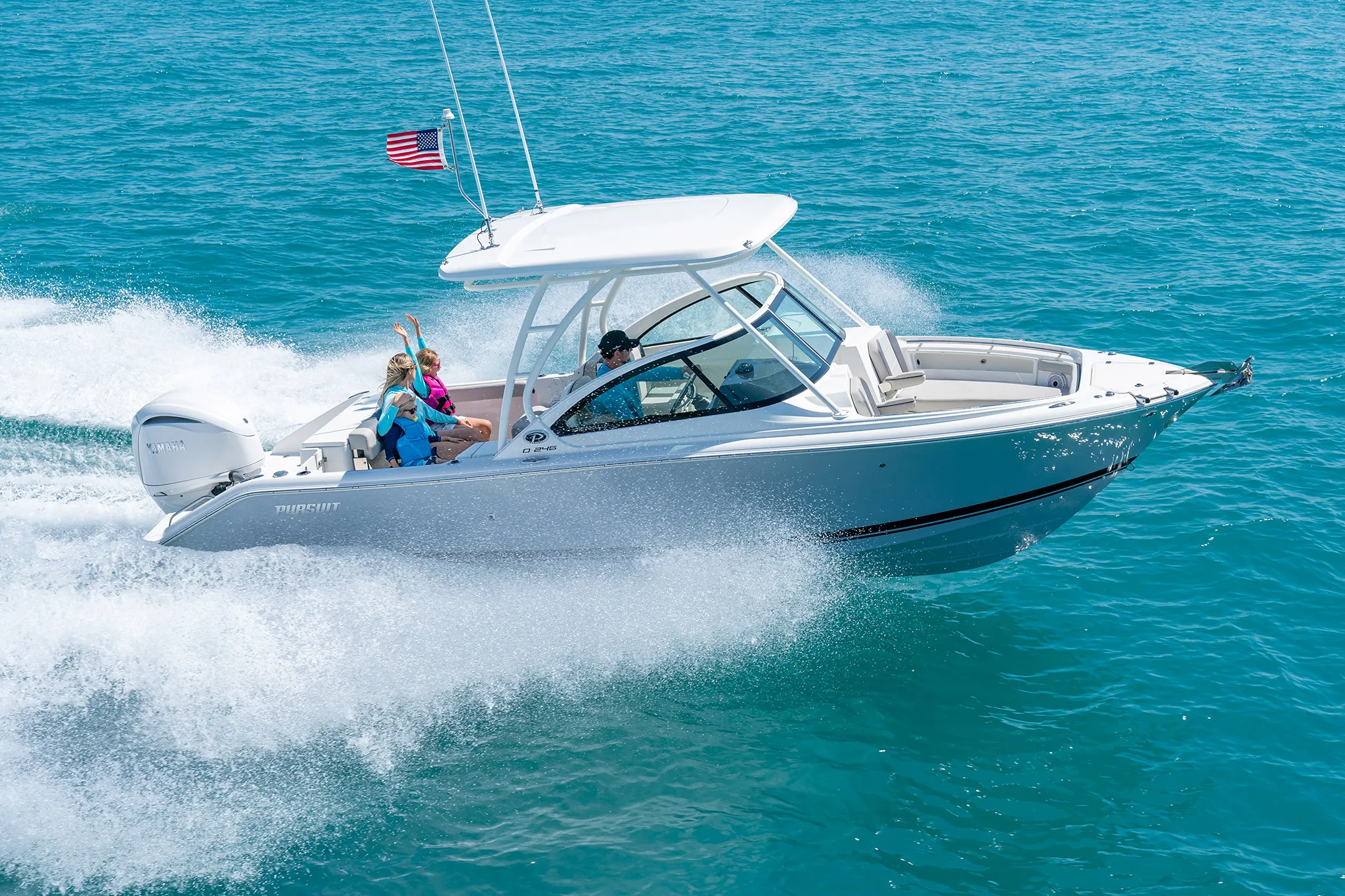
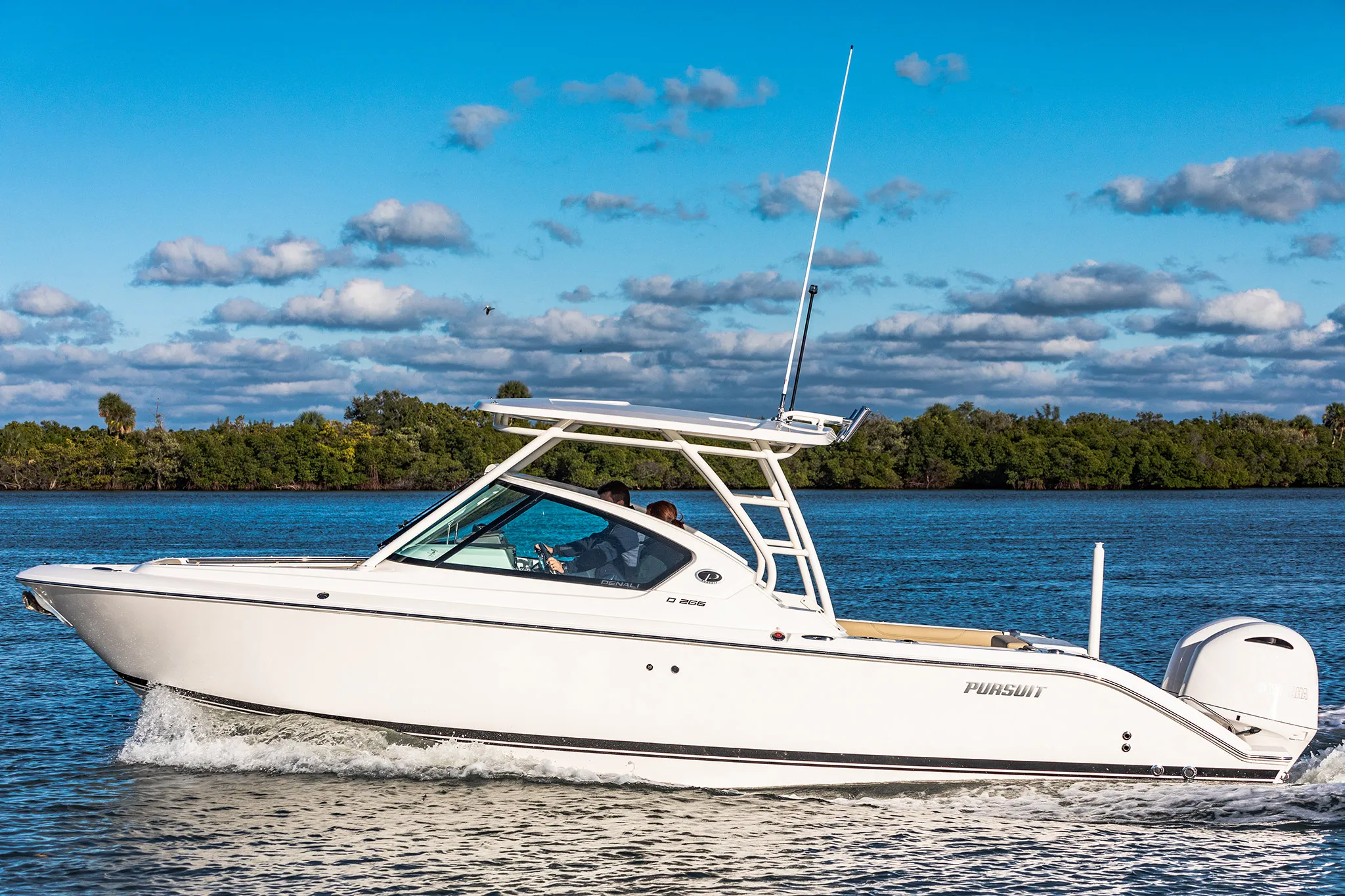
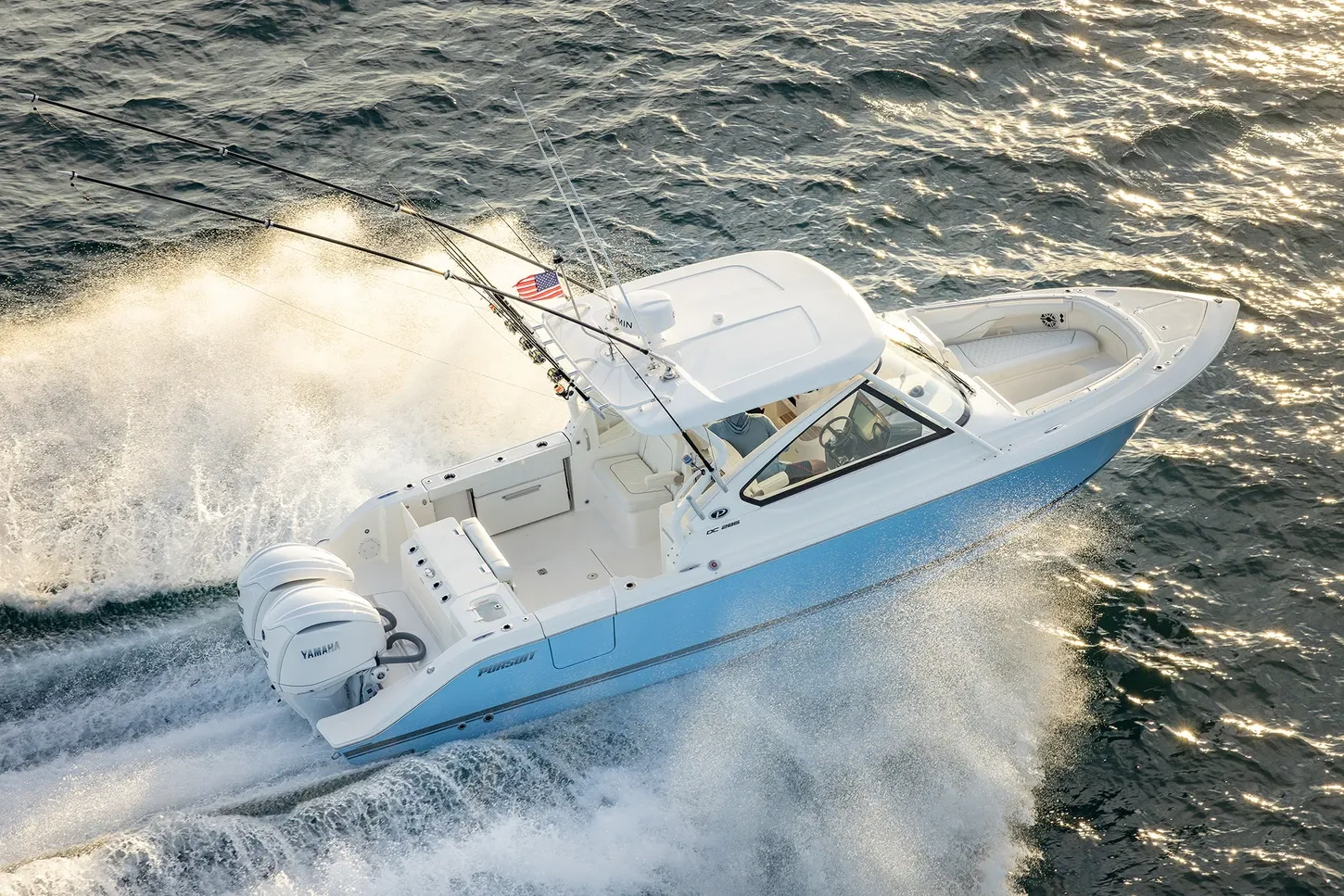
The problem the Denali line solves is the one that stops a lot of boat purchases: you want a fishing boat and someone else in the house wants a windshield. A dual console gives you both — a walkway down the centre with accommodation either side of it, and a tall wraparound windscreen under a full-width hardtop that keeps weather off everybody rather than just off the person driving.
Pursuit calls this the Denali series, and the name is not new marketing. It ran Denali models through the 1990s and 2000s — a Denali 2460 in 1994, a 2860 Denali in 1996, Denali LS models into the late 2000s — and brought the name back for the range that until recently carried the DC prefix. The boats are the same dual consoles, now carrying the names D 286 and D 326.
We review all six: the D246 at 25'8", the D266 at 27'4", the D286 at 30'0", the D306 at 31'11", the D326 at 34'6" and the D365 at 37'11". The steps between them are small enough that length is rarely the deciding question. What decides it is whether you tow or keep a slip, whether anyone will genuinely sleep aboard, and how many engines you are prepared to feed.
Every Pursuit Denali model we review in depth, in the order owners step up through the series.
Photo credit Pursuit.
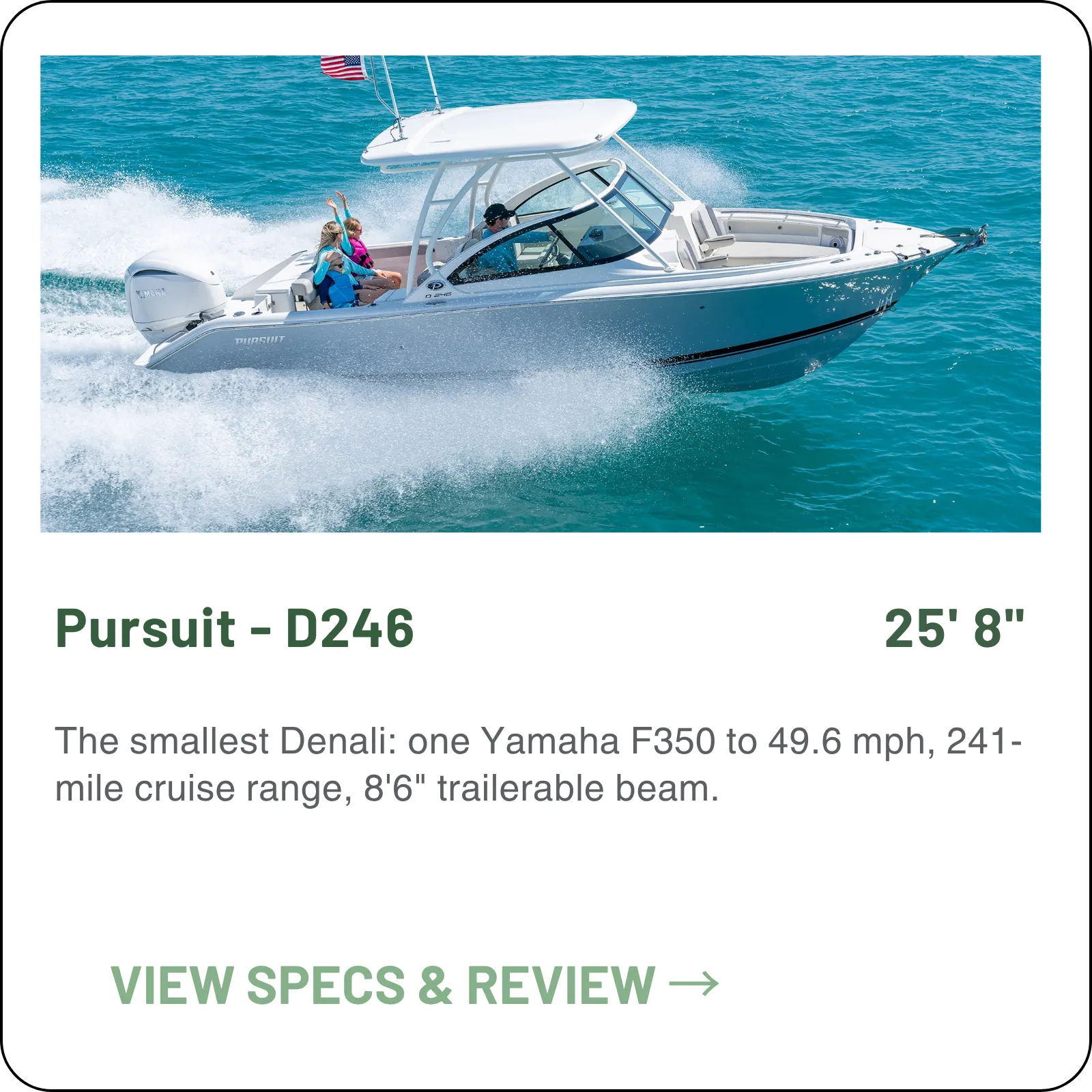
The smallest Denali: one Yamaha F350 to 49.6 mph, 241-mile cruise range, 8'6" trailerable beam.
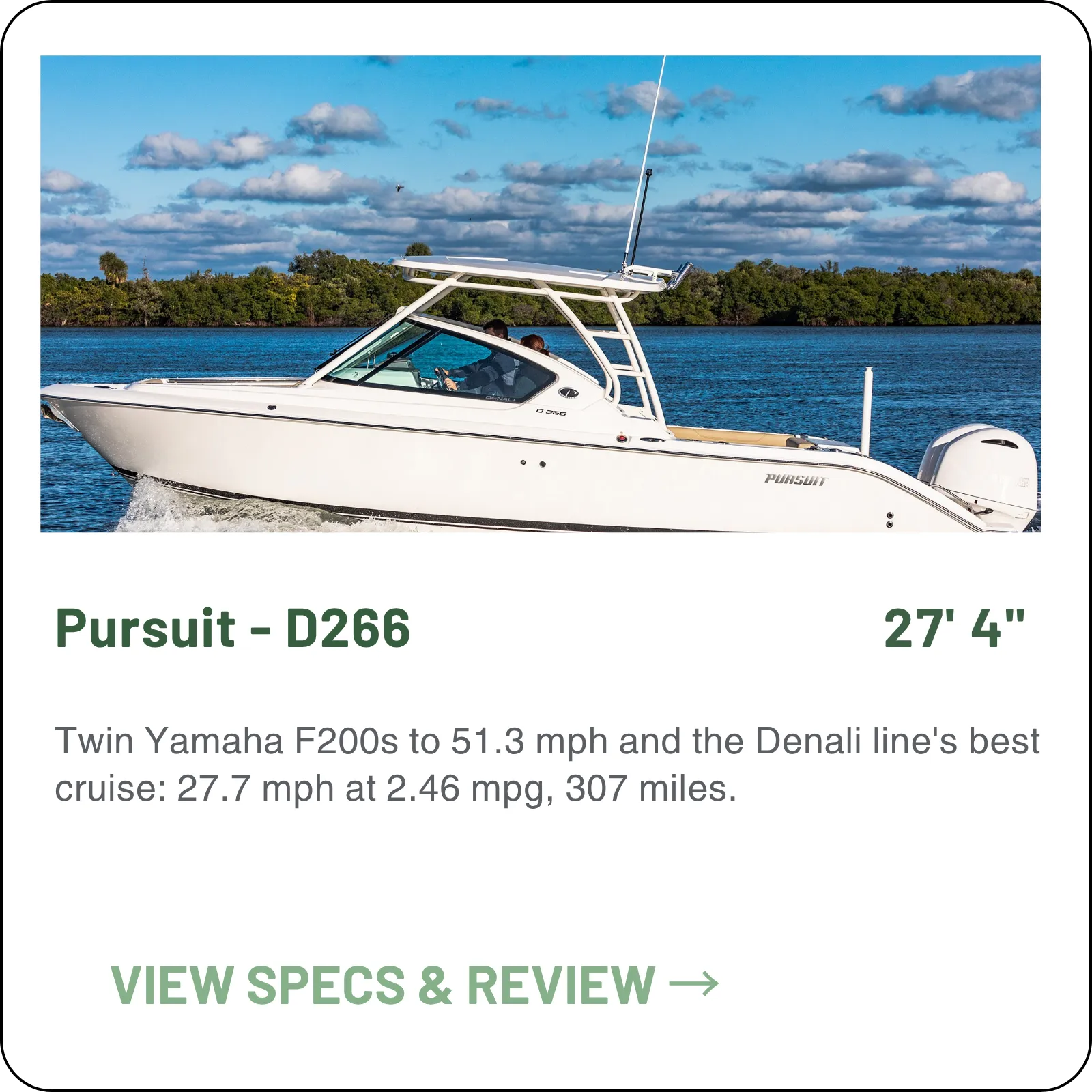
Twin Yamaha F200s to 51.3 mph and the Denali line's best cruise: 27.7 mph at 2.46 mpg, 307 miles.
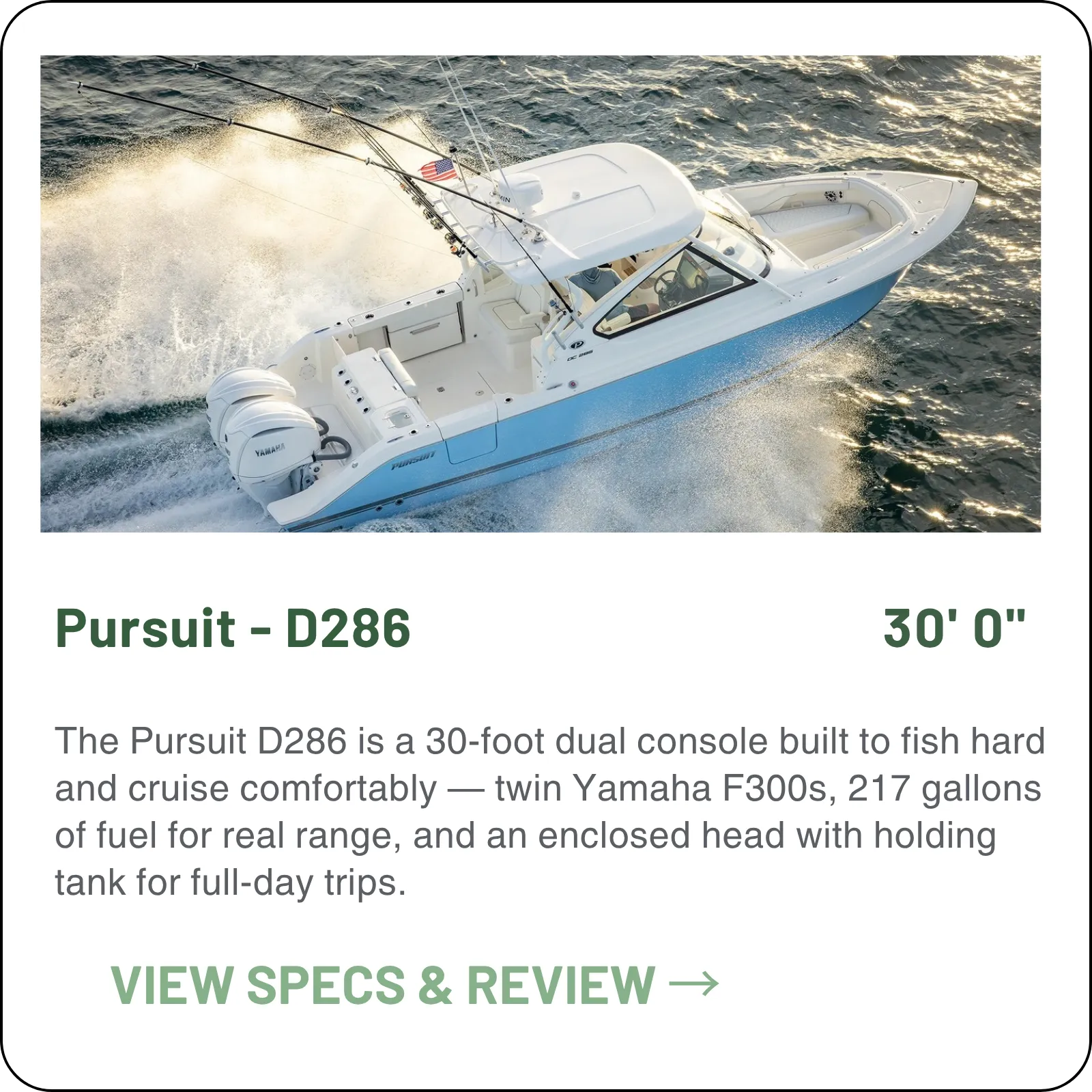
The Pursuit D286 Denali is a 30-foot dual console built to fish hard and cruise comfortably — twin Yamaha F300s to 55 mph, 217 gallons of fuel for a 330-mile range, and an enclosed head with a holding tank for full-day trips.
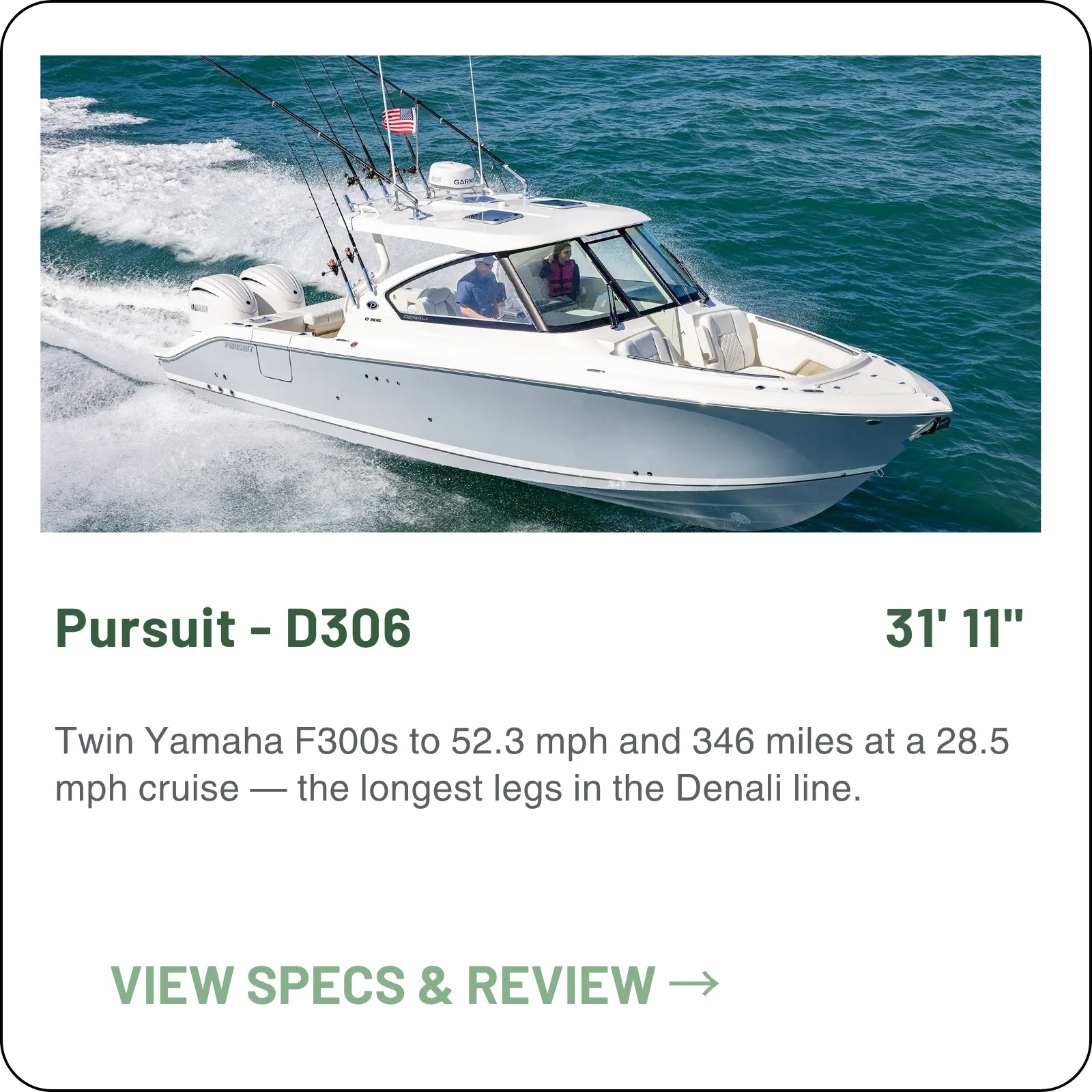
Twin Yamaha F300s to 52.3 mph and 346 miles at a 28.5 mph cruise — the longest legs in the Denali line.
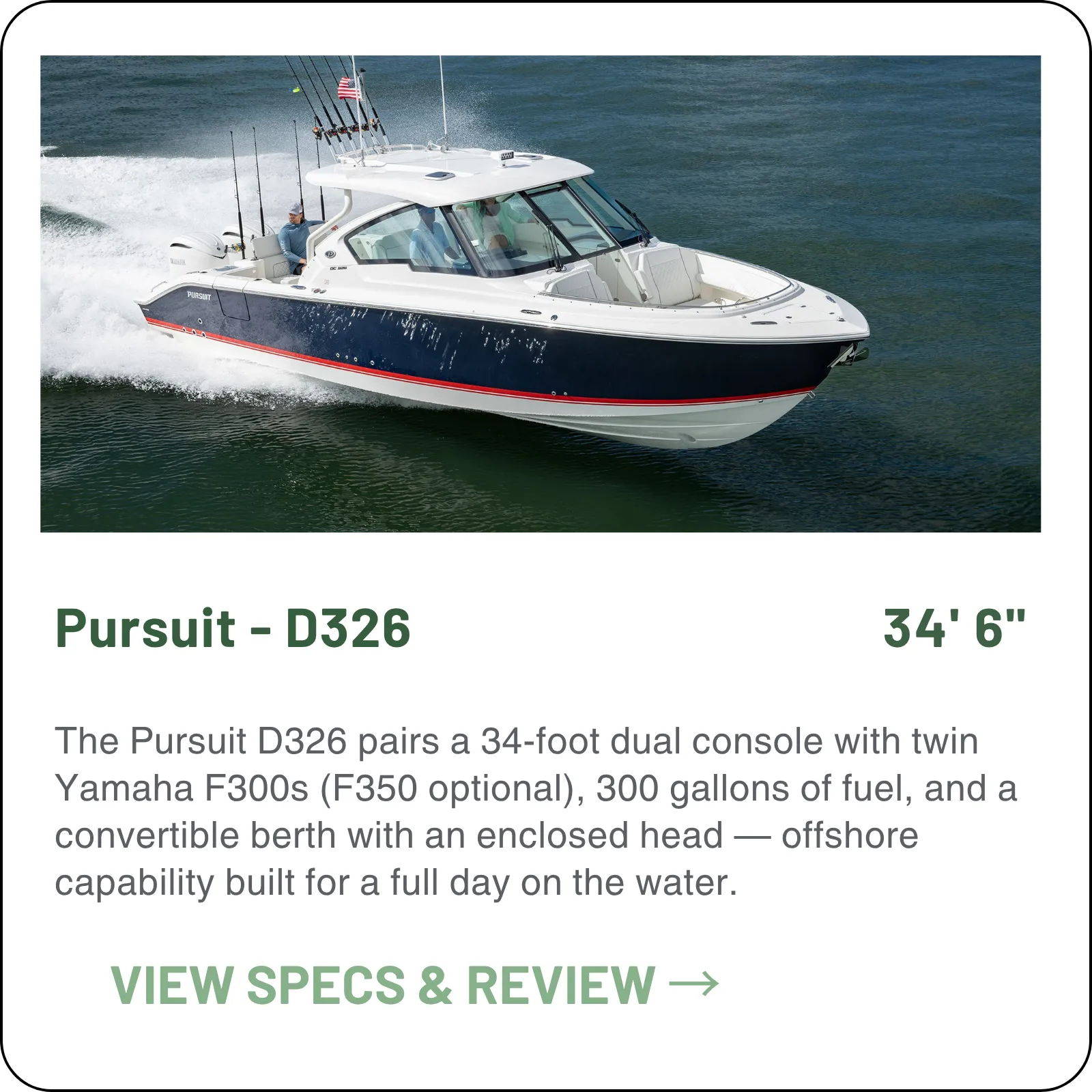
The Pursuit D326 Denali pairs a 34-foot dual console with twin Yamaha F350s, 300 gallons of fuel and a 394-mile range at cruise, plus a convertible berth and an enclosed head with a 10-gallon holding tank.
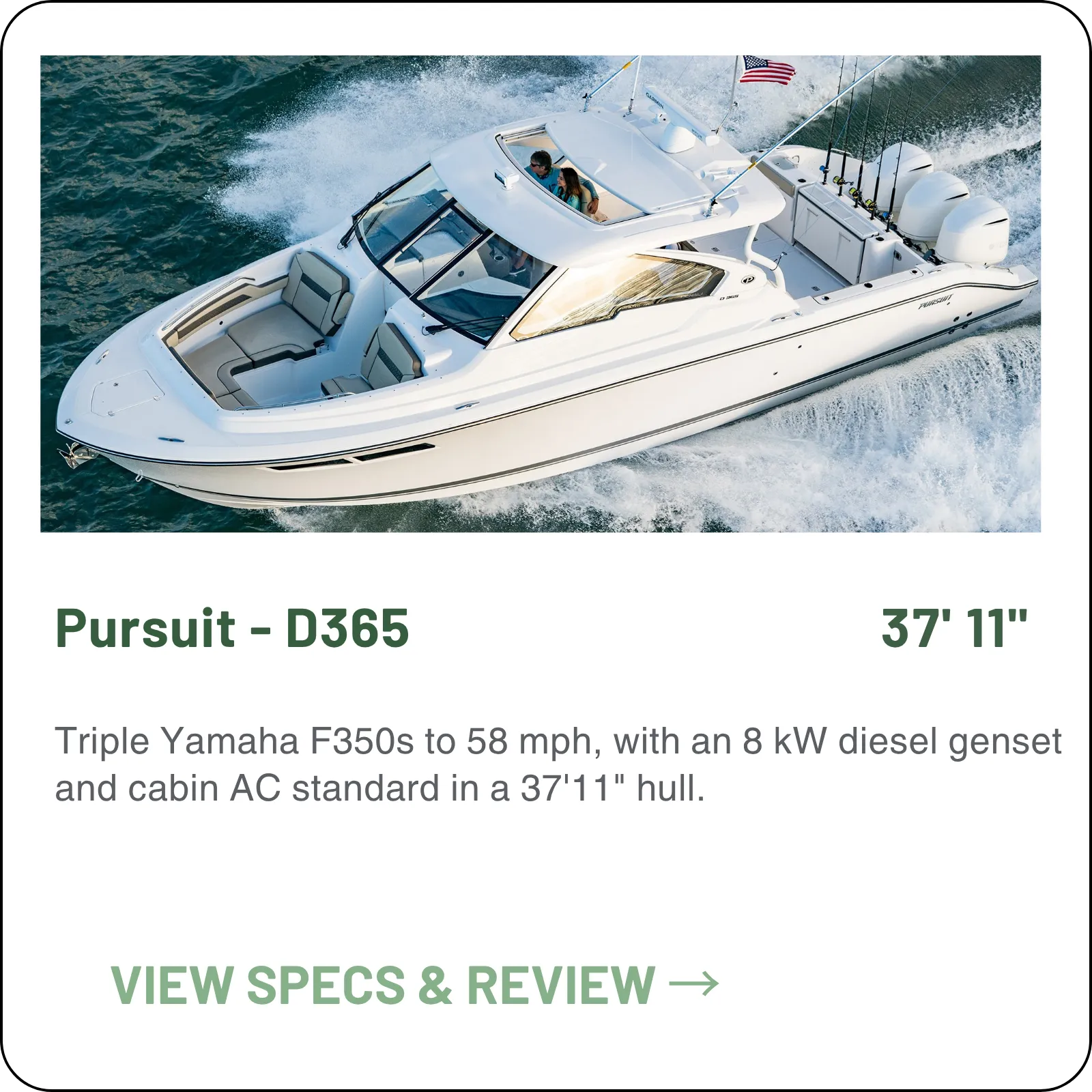
Triple Yamaha F350s to 58 mph, with an 8 kW diesel genset and cabin AC standard in a 37'11" hull.

Don't see the Denali model you're after — or a brand-new launch? Request specs through Yacht Specs Direct.
The D246 is the way into the line and the smallest Denali Pursuit builds. Twenty-five feet eight inches on an 8'6" beam, 21 degrees of deadrise, 6,138 lbs dry, 118 gallons of fuel and a 350-horsepower ceiling filled by a single Yamaha F350. Pursuit's sheet has it at 49.6 mph at 6,000 RPM and marks best cruise at 34.1 mph at 4,500 RPM — 14.8 gallons an hour, 2.31 miles per gallon and 241 miles of range, with nought to thirty in 12.9 seconds. Accommodation is a port console compartment with a portable head and a 316L stainless pump-out fitting, a molded sink with a pullout freshwater shower, a vanity mirror and a two-piece fiberglass door. There is no berth and there was never meant to be. What there is, at 8'6" of beam, is a legal tow rather than a permit job.
The D266 steps up to twins and to a head you can properly shut. Twenty-seven feet four inches on an 8'9" beam, 21 degrees of deadrise, 6,800 lbs dry, 139 gallons and a 400-horsepower ceiling filled by twin Yamaha F200s. Top speed is 51.3 mph at 5,975 RPM and best cruise is 27.7 mph at 3,500 RPM, burning 11.3 gallons an hour for 2.46 miles per gallon and 307 miles of range — the best cruise economy of any boat in the Denali line, and by some margin. Nought to thirty takes 8.0 seconds, which is quicker than boats two sizes up. The enclosed port-console head has an electric freshwater marine toilet, a 13-gallon holding tank, a sink and a Corian countertop, and there is a full fiberglass hardtop over the windscreen. It carries on the long-running DC 266 hull under the Denali name, with years of owner history behind it.
The D286 is the smaller boat and, on Pursuit's own numbers, the more efficient one by a distance. Thirty feet on a 9'6" beam, 21 degrees of deadrise, 9,340 lbs dry, 217 gallons, and a 600-horsepower ceiling filled by twin Yamaha F300s or twin Mercury 300 Verados. Pursuit's test sheet has it at 55.0 mph flat out and marks best cruise at 30.3 mph at 3,500 RPM — 16.5 gallons an hour, 1.83 miles per gallon and 330 miles of range, with nought to thirty in 7.8 seconds. There is an enclosed head with an electric marine head, a Corian vanity and a 9-gallon holding tank, a 22-gallon lighted recirculating livewell and a 36-gallon insulated transom fish box. What there is not is a berth: this is a day boat with a head, not an overnighter.
The D306 is the one that crosses into thirty-two feet, and Pursuit is open about what it replaces — the yard's own page says it builds on the D 295, one of its most popular dual consoles. Thirty-one feet eleven inches without the pulpit on a 9'11" beam, 21 degrees of deadrise, 10,563 lbs dry, 224 gallons and a 600-horsepower ceiling filled by twin Yamaha F300s. Pursuit records 52.3 mph at 5,800 RPM and best cruise at 28.5 mph at 3,500 RPM — 17.4 gallons an hour, 1.64 miles per gallon and 346 miles of range, with nought to thirty in 9.5 seconds. The enclosed head compartment has an electric marine head, a 9-gallon holding tank, a Corian countertop and a vanity mirror. Yamaha joystick control is on the options list rather than standard, and on a 32-footer with a 9'11" beam it is the option most worth having.
The D326 is where the line gains somewhere to sleep. It runs 34'6" on a 10'10" beam with 20 degrees of deadrise, weighs 12,900 lbs dry, carries 300 gallons and takes twin Yamaha F300s or F350s to a 700-horsepower ceiling. On the F350s Pursuit records 55.1 mph flat out and best cruise at 34.4 mph at 4,000 RPM, burning 24.6 gallons an hour at 1.40 miles per gallon for 394 miles — the longest range of any Denali. The port console holds convertible berthing with rod storage and a hanging locker; the starboard console is a fully enclosed head with a vacuum-flush porcelain toilet and a 10-gallon holding tank. A bow thruster is standard, which is rare in the class.
The D365 is the flagship, and it is a different kind of boat rather than simply a longer one. Thirty-seven feet eleven inches on a 12'0" beam, 20 degrees of deadrise, 17,000 lbs dry, 326 gallons and a 1,050-horsepower ceiling filled by triple Yamaha F350s. It is the fastest Denali by a clear margin — 58.0 mph at 5,900 RPM — and best cruise is 31.6 mph at 3,500 RPM, 29.0 gallons an hour, 1.09 miles per gallon and 312 miles of range. Nought to thirty takes 9.6 seconds on 17,000 lbs, which tells you what three F350s do to a hull this size. Below there is a forward berth with cushions and an aft berth on a 6-inch foam mattress, and an enclosed head with a vacuum flush, a 22-gallon holding tank, a Corian countertop and a dedicated shower area with an acrylic bi-fold divider — the only head in the Denali line with one.
Read the range as three decisions rather than six boats. The first is trailer or slip: the D246 at 8'6" of beam tows legally, and everything above it is a permit job or a berth. The second is berth or no berth — the D246, D266, D286 and D306 are day boats with heads; the D326 and D365 are the two you can sleep on. The third is how many engines you want to feed, and the sheet answers that one honestly: one F350 returns 2.31 miles per gallon at cruise on the D246, twin F200s return 2.46 on the D266, and three F350s return 1.09 on the D365 in exchange for 58 mph. The longest legs in the line belong to the D326 at 394 miles, and the D286's 1.83 miles per gallon and 330 miles out of 217 gallons remains the most quietly impressive number Pursuit publishes for a 30-footer.

I have watched more people talk themselves out of a center console and into one of these than any other category on the site, and the reason is always the same: the windshield. A T-top keeps the sun off whoever is driving. A full-width hardtop over a tempered-glass windscreen keeps the weather off everybody, and it is the difference between a boat that gets used nine months a year and one that gets used four.
The D286 is the one that gets underrated. On Pursuit's own figures it does 1.83 miles per gallon at cruise, which is a genuinely efficient 30-footer, and 330 miles of range out of 217 gallons means a crossing is a planning exercise rather than a gamble. Nought to thirty in 7.8 seconds is quicker than the boat looks, too.
The honest counter-argument is that the D326 is simply the better boat and everybody knows it — 394 miles of range, a berth, an enclosed head with a proper vacuum-flush toilet, and a bow thruster as standard so one person can put it away in a crosswind. If you will genuinely use the berth, buy it. If you will not, you are paying 3,500 lbs and half a mile per gallon for a bed nobody sleeps in.
The D365 has changed my answer at the top of the range, though not in the direction you would guess. Thirty-eight feet, triple F350s, 58 mph, two berths and the only Denali head with a real shower area in it — that is an overnighter, not a very good day boat, and nothing else in the line does both. But it is also the boat that shows you what the third engine costs: 1.09 miles per gallon at cruise against the D326's 1.40, and 312 miles of range against 394. If you want the speed and the accommodation together, it is the only Denali that has both. If you only want the accommodation, the D326 does it on two engines and goes 82 miles further on a tank.
And do not skate past the small end. The D266's 2.46 miles per gallon at cruise is the best number in the series and it is not a rounding difference — it is a different way of using a boat. The D246 gives up some of that and hands you an 8'6" beam in return, which means it tows legally and lives in your driveway instead of a slip. In my experience that single fact does more for how often a boat actually gets used than any figure on the spec sheet.
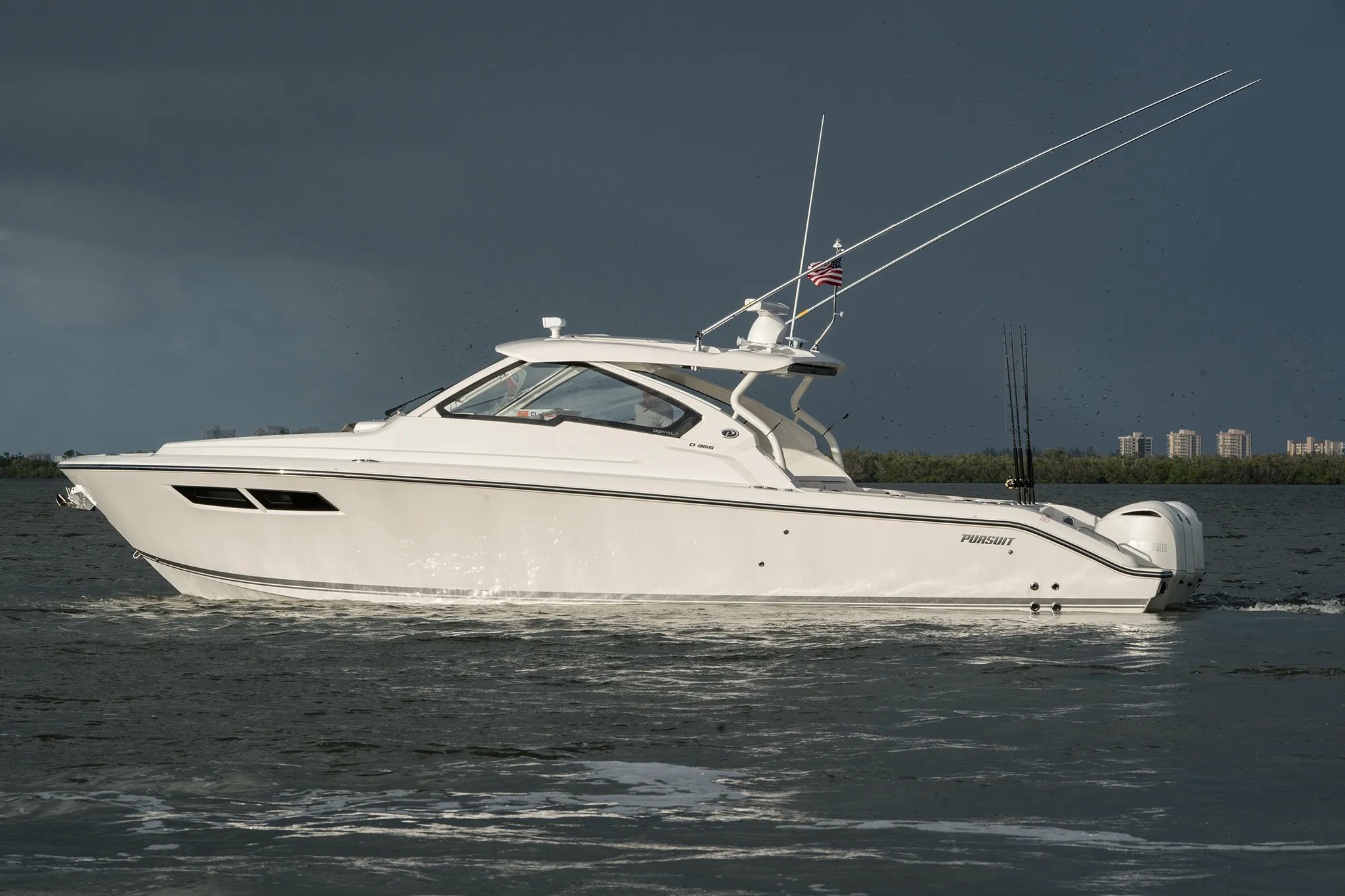
Videos courtesy of Pursuit.
Pursuit describes the Denali series as spanning 24 to 36 feet, across six models: the D 246, D 266, D 286, D 306, D 326 and D 365. We review all six in depth, from the D 246 at 25 feet 8 inches to the D 365 at 37 feet 11 inches. Every Denali model is a dual console with a walkway down the centre of the boat and accommodation either side of it.
Because Pursuit revived a name from its own history. The range used to carry a DC prefix, for dual console, and Pursuit replaced it with a D for Denali — a name the yard used on models including the Denali 2460 shown at the New York Boat Show in 1994, the 2860 Denali of 1996 and a run of Denali LS models through the 2000s. Pursuit describes the name as having returned. The boats are unchanged; older listings and reviews still use DC 286 and DC 326.
Tell us how you plan to use the boat — guests, range, crew or no crew — and we'll give you the straight story on where in the Denali series you belong, new or brokerage.
Explore All Pursuit ModelsOr reach Tony directly: TS@MintedYachts.com · +1 (404) 805-9819