
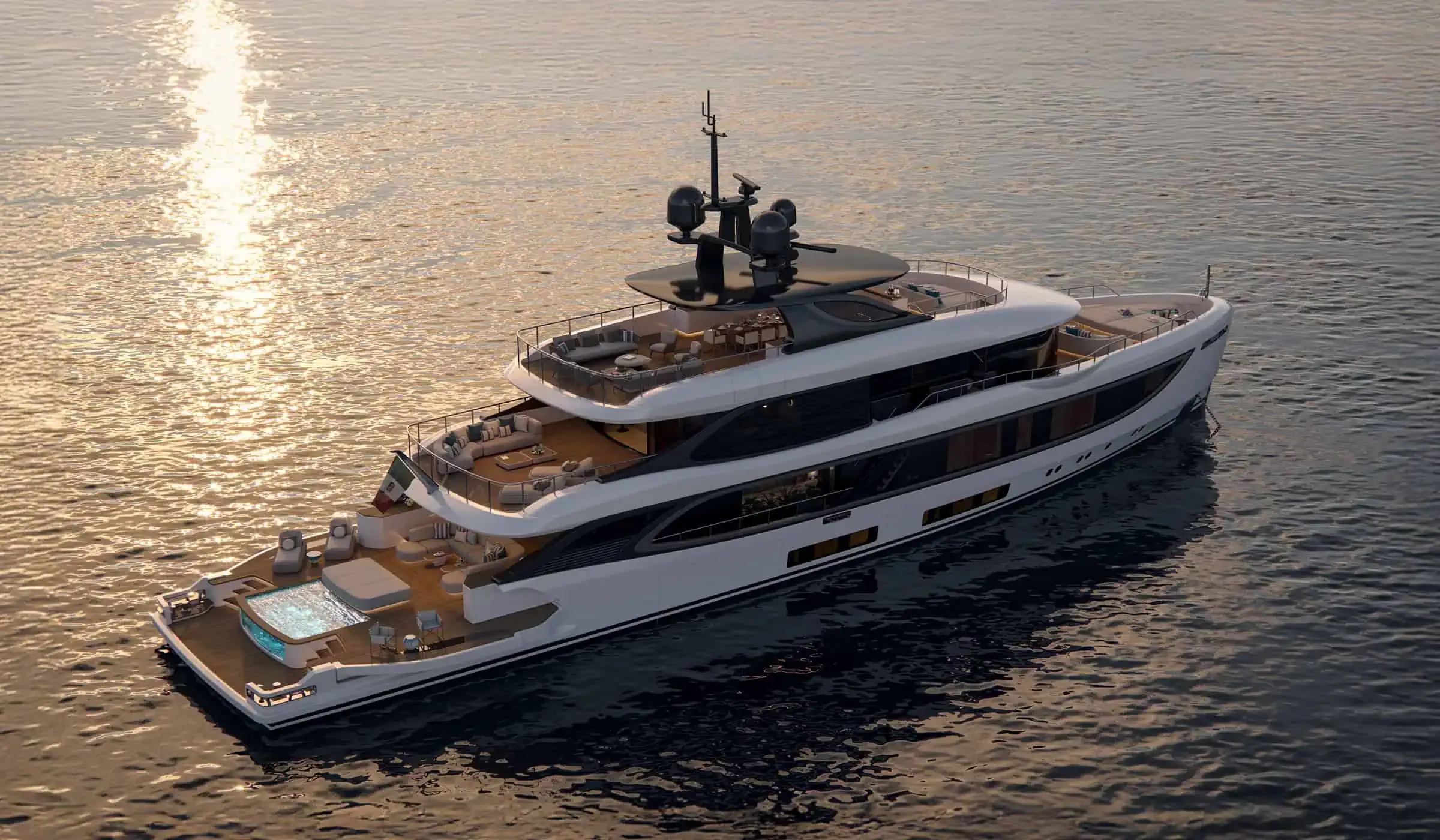
Benetti Oasis 42M139' 5"
View Specs & Review535 ft over 20 ft of draft, a 200-ton railway, and a national park that runs the dockage
Yachting in Antigua & Barbuda
A Minted Location · Antigua & Barbuda, The Leewards
If you want a berth that will take almost anything afloat, Falmouth Harbour publishes one: 535 ft (163 m) over 20 ft (6.1 m) of draft. Falmouth Harbour Marina states it plainly, along with the dock it sits on: "an expansive 20-foot-wide by 535-foot-long dock." Next door, Antigua Superyacht Marina & Resort publishes 330 ft (100 m) over a 25 ft (7.6 m) maximum draft — five feet deeper, two hundred feet shorter. Between them, one harbour covers both ends of the size question.
Those two marinas, and Nelson's Dockyard around the headland, all sit inside the Nelson's Dockyard National Park. The gazetted boundary, in the Second Schedule of the 1984 National Parks Act, covers "all land adjacent to English Harbour and Falmouth Harbour or in the vicinity thereof." The park is administered by the National Parks Authority, a statutory corporation — and the Authority runs the Dockyard marina itself. A working Georgian naval dockyard, a UNESCO World Heritage Site since 2016, and a marina, all one organisation.
Budget for the park as well as the berth. The Falmouth superyacht marina tells every arriving vessel, in its own rate card, that "All vessels are subject to a national parks fee", and the 1984 Act gives the Minister power to make regulations "for the levying of fees and charges ... for any services or amenities provided by the Authority." The amount is settled with the Authority — call (268) 481 5021/22 before you sail and put a line in the budget for it.
What Antigua does exceptionally well is get you out of the water. Antigua Slipway's marine railway is "unique in the region, with a maximum haul-out capacity of two hundred (200) tons for vessels up to one hundred- and fifty-feet (150ft) length overall (LOA) x forty feet (40ft) beam x fourteen feet (14ft) draft." Jolly Harbour, on the west coast, runs two 75-ton travelifts, stores 240 boats ashore and has a purpose-built catamaran yard beside them.
So take the market as it is: deep, long berths on the south coast, serious refit capacity on two coasts, and a national park administering the most famous harbour of the lot. Budget the dockage from the marinas' own rate cards, which are excellent, and telephone the Authority for everything it governs.
Where to keep a yacht in Antigua & Barbuda
Falmouth Harbour is where the largest yachts lie, and two operators split it.
Falmouth Harbour Marina publishes the ceiling for the whole market: "Accommodating yachts up to 535 feet in length and drafts up to 20 feet", with stern-to and alongside berthing, VHF 10, and electricity at 110V, 220V, 380V and 400V. Its rate card is seasonal and it is public:
| Per ft / day | Winter (1 Nov – 31 May) | Summer (1 Jun – 31 Oct) |
|---|---|---|
| Stern-to, daily | $3.50 | $2.55 |
| Stern-to, monthly | $3.20 | $2.45 |
| Alongside, daily | $6.50 | $4.65 |
| Alongside, monthly | $5.95 | $4.44 |
Read the terms alongside the table. The same page states "Alongside rates are double", while the table itself prints 1.86× in winter ($6.50 against $3.50) and 1.82× in summer ($4.65 against $2.55). Plan against the table — it is the specific figure — and confirm the alongside rate at booking. Berthing fees are payable in advance and check-out is 12:00 noon. Fuel is ultra-low-sulphur diesel delivered to the berth at up to 1,000 litres per minute, tax and duty-free, daily in high season and weekdays in low season.
Antigua Superyacht Marina & Resort — the former Antigua Yacht Club Marina — publishes the deeper water and the fuller rate card. Its own technical specifications state berthing for "superyachts and gigayachts up to 330ft in length with stern-to berthing", described elsewhere as 100 m+, over a 25 ft maximum draft with "Deep water access maintained throughout the marina basin and approach channel." Shore power runs to 400 A in 110V, 220V and 380V, single and three-phase. Hail VHF 68 or 09.
| Alongside | $3.75/ft to 75 ft · $4.75 to 99 ft · $6.00 to 140 ft · $6.50 above 140 ft |
| Stern-to | $3.25/ft to 100 ft · $4.00/ft above 100 ft |
| Mooring | $0.75/ft to 50 ft · $1.00/ft to 80 ft — maximum vessel length 80 ft |
| Utilities | Electricity $0.60/kWh · fresh water $0.05/litre · garbage $10–$30/day |
| Season | In season 1 Nov – 31 May; out of season 1 Jun – 31 Oct, rates 25% less |
| Multihulls | "Catamarans: 50% surcharge applies to base dockage rates" |
| Park fee | "All vessels are subject to a national parks fee" — settled with the Authority on (268) 481 5021/22 |
That 50% catamaran surcharge is one of two published multihull prices in the market — Jolly Harbour runs a whole separate catamaran rate card twenty miles away, and it is in the cruising section.
Nelson's Dockyard Marina is the most famous berth here, and you arrange it on the telephone. The National Parks Authority's marina page lists "Berthing slips, Bow moorings, Three phase electricity, Water, Waste oil disposal, 24-hour security, Immigration and Customs, High-speed internet" — and berth count, maximum length, depth and rate are all settled on the call: (268) 481 5021/22, Monday–Saturday 08:00–17:00. Book early for the winter season; the Charter Yacht Show fills the Dockyard.
Jolly Harbour, on the west coast, is the volume marina and the one that publishes most. Its own pages state 155 berths across four concrete docks for vessels up to 75 ft, plus a separate Superyacht Dock — "2 concrete piers of 100ft in length, easily accommodating vessels of up to 200ft. alongside", quoted elsewhere as "vessels ranging in length from 80 – 200 feet." Power is 120V and 220V, 60Hz on the main docks and 120V, 240V and 380V, 60Hz at the superyacht dock. Hail the dock staff on VHF 68. Ashore there is storage for 240 boats. Rates run $1.45/ft/day stern-to in winter and $1.25 in summer, with "Alongside rate x 2 for monohulls", and moorings at $35 a night capped at "Max length 50ft. Max Wt. 15 Ton."
⚠️ Plan the Jolly Harbour entrance on 12 ft (3.7 m). The operator publishes both figures for its own channel — "Boats of up to 13 feet draft can enter Jolly Harbour" and a "13 ft. dredged channel" on one page, a "12 feet dredged channel" on another — so take the shallower of the two and radio ahead, which the marina asks for anyway: "If draft is a concern please radio ahead to our dock staff on VHF Channel 68." The entrance outer marker is a safe-water mark at 17°04'.5N 61°54'.3W, the approach is buoyed 1 to 15 under IALA B (red right returning), there is a 5-knot no-wake zone from the entrance, and the operator states plainly: "We do not recommend approaching the Marina after dark."
Which sets up the market's real division, and it is a depth division. English and Falmouth take 20 to 25 ft (6.1–7.6 m); Jolly Harbour takes 12 to 13 ft (3.7–4.0 m). The south coast is where a deep-draft yacht goes. The west coast is where everything else does — and where the travelifts are.
Marinas
| Name | Where | Max yacht | Slips | Fuel |
|---|---|---|---|---|
| Falmouth Harbour MarinaThe market's published ceiling: "Accommodating yachts up to 535 feet in length and drafts up to 20 feet", on "an expansive 20-foot-wide by 535-foot-long dock." Electricity 110V, 220V, 380V and 400V. Winter (1 Nov–31 May) stern-to $3.50/ft/day, monthly $3.20; alongside $6.50/ft/day, monthly $5.95. Summer (1 Jun–31 Oct) stern-to $2.55, monthly $2.45; alongside $4.65, monthly $4.44. The rate card also states "Alongside rates are double", while the table prints 1.86× in winter and 1.82× in summer — plan against the table and confirm the alongside rate at booking. Fees are payable in advance and check-out is 12:00 noon. | Falmouth Harbour, south coast | 535 ft | — | Ultra-low-sulphur diesel to the berth at up to 1,000 litres per minute, tax and duty-free |
| Antigua Superyacht Marina & ResortThe deeper of the two Falmouth marinas and the one with the fullest rate card. Publishes berthing for "superyachts and gigayachts up to 330ft in length with stern-to berthing" — described elsewhere as 100 m+ — over a 25 ft maximum draft, with "Deep water access maintained throughout the marina basin and approach channel." Shore power to 400 A in 110V, 220V and 380V. Alongside $3.75/ft to 75 ft, $4.75 to 99 ft, $6.00 to 140 ft, $6.50 above; stern-to $3.25/ft to 100 ft and $4.00 above. Moorings $0.75–$1.00/ft, maximum vessel length 80 ft. Electricity $0.60/kWh, water $0.05/litre, garbage $10–$30/day. In season 1 Nov–31 May; out of season 1 Jun–31 Oct at 25% less. "Catamarans: 50% surcharge applies to base dockage rates." And "All vessels are subject to a national parks fee" — the amount is settled with the National Parks Authority on (268) 481 5021/22, so budget for it before you arrive. Formerly Antigua Yacht Club Marina. | Falmouth Harbour — 17°00'N 61°46'W | 330 ft | — | Duty-free ultra-low-sulphur diesel by mobile tanker at the berth, 400 litres per minute |
| Nelson's Dockyard MarinaThe most famous berth in the eastern Caribbean, and a genuinely unusual arrangement: the dockage is run by the National Parks Authority, a statutory corporation administering a national park, rather than by a private marina. The Authority's marina page lists "Berthing slips, Bow moorings, Three phase electricity, Water, Waste oil disposal, 24-hour security, Immigration and Customs, High-speed internet, Restrooms, Showers and laundry." Berth count, maximum length, depth and rate are all settled on the telephone: (268) 481 5021/22, Monday–Saturday 08:00–17:00. The 1984 National Parks Act sets the park boundary at the Second Schedule as "all land adjacent to English Harbour and Falmouth Harbour or in the vicinity thereof", and empowers the Minister to levy "fees and charges ... for any services or amenities provided by the Authority." The 2012 General Regulations add that no one may "use any boat or motorized watercraft" in the Park "without the prior written permission of the Parks Commissioner", that mooring time limits are set by posted notice, and that contravention carries a fine "not exceeding five thousand dollars" — so make the call part of your arrival plan rather than an afterthought. | English Harbour, inside the UNESCO World Heritage Site | — | — | — |
| Jolly Harbour Marina & BoatyardThe volume marina and the market's most detailed publisher: "155 berths spread over 4 docks" for vessels up to 75 ft, plus a Superyacht Dock of "2 concrete piers of 100ft in length, easily accommodating vessels of up to 200ft. alongside", quoted elsewhere as "vessels ranging in length from 80 – 200 feet." Power 120V/220V 60Hz on the main docks, 120V/240V/380V 60Hz at the superyacht dock. Storage ashore for 240 boats. Winter stern-to $1.45/ft/day, summer $1.25, "Alongside rate x 2 for monohulls"; 1–6 hrs at 50% of the standard daily rate. Moorings $35/night, "Max length 50ft. Max Wt. 15 Ton", and boats "must not be left unattended overnight." Anchoring inside the harbour is prohibited and priced — $100 on the monohull rate card, $150 on the catamaran card. Plan the entrance on 12 ft (3.7 m): the operator publishes "Boats of up to 13 feet draft can enter Jolly Harbour" and a "13 ft. dredged channel" on one page and a "12 feet dredged channel" on another, so take the shallower figure and radio ahead on VHF 68, which the marina asks for anyway. Approach buoyed 1–15 under IALA B, 5-knot no-wake zone from the entrance, and "We do not recommend approaching the Marina after dark." | West coast — outer marker 17°04'.5N 61°54'.3W | 200 ft | 155 | Full-service fuel dock, 08:00–17:00 seven days in high season (Nov–Apr); duty-free diesel on advance booking |
Figures are as each facility publishes them on its own site; blank cells mean the facility doesn't state a number. Confirm slip availability and current rates directly — or ask us to make the calls.
Cruising from Antigua & Barbuda
Antigua is where a Caribbean-based yacht gets hauled, and both yards publish what they can lift.
Antigua Slipway, in English Harbour, publishes the larger capacity:
| Marine railway | "maximum haul-out capacity of two hundred (200) tons for vessels up to one hundred- and fifty-feet (150ft) length overall (LOA) x forty feet (40ft) beam x fourteen feet (14ft) draft" |
| Hydraulic trailer | 35 tons — to 50 ft LOA × 24 ft beam × 10 ft draft |
| Catamarans | "Able to accommodate Catamarans up to 30 foot beam" |
| Dockage | "Controlling depths are 18 ft" — stern-to and alongside, ground tackle for smaller yachts |
| Fuel | To 150 ft LOA, "unlimited fuel bunkering supply of duty-free Low Sulphur Diesel and Gasoline" |
| VHF | 68 |
The yard's own words for the railway are "unique in the region", and rates are "quoted in XCD dollars and subject to Government taxes" — ask for a per-foot quote when you book the slot.
Jolly Harbour is the other yard, and it is built around multihulls. Two Marine Travelifts, 75 tons, for monohulls to 75 ft; three separate boatyards; storage for 240 boats; and, from May 2024, a purpose-built catamaran yard with "twin piers 80 feet x 10 feet" and its own dedicated 75-ton lift. Plan a catamaran on 33 ft (10.1 m) of beam: the haul-out page reads "catamarans up to 34 feet beam width" while the boatyard page and all three rate cards read "a maximum beam of 33 ft", and a foot of beam decides whether a boat fits — take the lower figure and confirm before you book. Yard hours are 07:00–16:00, Monday to Friday, and "There is no living aboard permitted when vessels are ashore."
Jolly Harbour's multihull pricing is not a surcharge — it is a whole separate rate card. Winter stern-to runs $2.45/ft/day for a catamaran against $1.45 for a monohull, a 69% premium. Moorings are $50 a night against $35. Haul, launch, pressure-wash and chock is $24.20/ft against $17.75. Even the penalty for anchoring in the harbour is priced by hull type: $150 on the catamaran card and $100 on the monohull card. Price a catamaran against a monohull here before you book either.
Clearance is straightforward, and the government publishes the mechanics. The Customs & Excise Division lists the legal ports of entry as Deep Water Harbour, English Harbour, Jolly Harbour, Heritage Quay, Crabbs Peninsula and Barbuda. Every vessel must "prepare an eSeaclear notification prior to their arrival in Antigua and Barbuda" — the advance filing that customs, immigration and the port authority all read. On arrival, only the captain may go ashore to clear, though "a crew member may accompany the captain" where language assistance is needed. Bring clearance from the last port, a crew and passenger list, and the vessel's registration. Departing passengers who have been in the country more than 24 hours pay the Embarkation Sea Port Tax of $75.00 XCD, which Customs states is equivalent to $30.00 USD.
A foreign-registered vessel needs a cruising permit, and ADOMS states it "may be issued up to a maximum period of six consecutive months", with a small-craft safety advisory attached: "Non-compliant vessels may be denied a cruising permit, or when underway may be required to return to port or leave Antigua and Barbuda waters immediately." The permit is issued at the Port Authority office at your port of entry — take cash and a card.
Barbuda is thirty miles north, and it is a legal port of entry with no marina, no yard and no berth. Boats lie at anchor. Its marine zoning is real: the Barbuda (Fisheries) Regulations 2014 (S.I. No. 33 of 2014) established sanctuary, anchoring and mooring zones, and the boundaries are confirmed locally rather than downloaded. Clear into Antigua, then telephone the Barbuda Council to confirm where you may lie before you commit to an anchorage.
Hurricane season here is a conversation with your underwriter and your yard, not a form. Jolly Harbour welds summer stands in pairs as standard and calls lateral welding "highly recommended"; Antigua Slipway's dock and yard regulations run to nineteen clauses covering utilities, welding, wakes and waste. Book the haul-out slot early and agree the tie-down spec on the telephone. One booking term worth having in writing: the Falmouth superyacht marina refunds deposits in full "if arrival is prevented by a named storm, official port closure, or mandatory evacuation."
- Clearing into Antigua & Barbuda — eSeaClear and the six ports of entry — Antigua & Barbuda watersThe Customs & Excise Division lists the legal ports of entry as Deep Water Harbour, English Harbour, Jolly Harbour, Heritage Quay, Crabbs Peninsula and Barbuda. Every vessel must "prepare an eSeaclear notification prior to their arrival in Antigua and Barbuda", which customs, immigration and the port authority all read. Only the captain may go ashore to clear, though "a crew member may accompany the captain" where language assistance is needed. Bring clearance from the last port, a crew and passenger list, and the vessel's registration. Departing passengers in the country more than 24 hours pay the "Embarkation Sea Port Tax of $75.00XCD which is equivalent to $30.00usd." A foreign-registered vessel also needs a cruising permit: ADOMS publishes the six-month ceiling, an attached small-craft safety advisory, and that "Non-compliant vessels may be denied a cruising permit, or when underway may be required to return to port or leave Antigua and Barbuda waters immediately." The permit is issued at the Port Authority office at your port of entry — take cash and a card.
- Barbuda — Barbuda, roughly thirty miles north of AntiguaBarbuda is a legal port of entry — Customs lists it alongside the five Antiguan ports — and it has no marina, no yard and no berth of any kind. Boats lie at anchor, thirty miles north of Antigua. Its marine zoning is real: the Barbuda (Fisheries) Regulations 2014 (S.I. No. 33 of 2014) established sanctuary, anchoring and mooring zones, and the boundaries are confirmed locally rather than downloaded. Clear into Antigua, then telephone the Barbuda Council to confirm where you may lie before you commit to an anchorage.
Service, refit & supplies
Shipyards & refit
| Name | Where | Max yacht | Dockage |
|---|---|---|---|
| Antigua SlipwayA marine railway the yard calls "unique in the region, with a maximum haul-out capacity of two hundred (200) tons for vessels up to one hundred- and fifty-feet (150ft) length overall (LOA) x forty feet (40ft) beam x fourteen feet (14ft) draft." A Brownell hydraulic trailer adds 35 tons to 50 ft LOA × 24 ft beam × 10 ft draft, and the yard states it can "accommodate Catamarans up to 30 foot beam." It also publishes its own controlling depth: "Controlling depths are 18 ft." Established 1966 on the site of the original 1725 dockyard. Rates are "quoted in XCD dollars and subject to Government taxes" — ask for a per-foot quote when you book the slot. The nineteen-clause dock and yard regulations cover utilities, welding, wakes and waste; agree the summer tie-down spec with the yard at the same time. | English Harbour, at the 1725 St Helena site | 150 ft | Stern-to and alongside dockage with ground tackle for smaller yachts; VHF 68 |
| Jolly Harbour Boatyard — the catamaran yard"We have two Marine Travelifts... We can accommodate vessels up to 75 tons and 75ft in length." Three separate boatyards, storage for 240 boats, and from May 2024 a purpose-built catamaran yard with "twin piers 80 feet x 10 feet" and its own dedicated 75-ton lift. Cradles come in three sizes — small to 45 ft, medium 45–55 ft, large 55–70 ft — and summer stands are welded in pairs as standard, with lateral welding "highly recommended." A covered rack takes 56 dinghies to 14 ft. Yard hours 07:00–16:00 Monday–Friday; "There is no living aboard permitted when vessels are ashore." Plan a catamaran on 33 ft of beam: the haul-out page reads "catamarans up to 34 feet beam width" and the boatyard page and all three rate cards read "a maximum beam of 33 ft", and a foot of beam decides whether a boat fits — take the lower figure and confirm before you book. Haul, launch, pressure-wash and chock runs $17.75/ft for a monohull and $24.20/ft for a catamaran, +15% at 45 ft and +30% at 60 ft. | Jolly Harbour, west coast | — | — |
On the Antigua & Barbuda calendar
Antigua runs year-round, and the dates that fill the harbours are published years ahead.
- Antigua Charter Yacht Show: 4–9 December 2026, at Nelson's Dockyard. The harbour fills; book a berth long before.
- Antigua Sailing Week 2027: 21–25 April. Early-bird entry is US$12 per foot for entries paid by 31 October 2026, and the organiser has already published 2028 as 19–23 April and 2029 as 18–22 April.
- Marina seasons are the money, and both south-coast marinas draw the line in the same place: in season 1 November – 31 May, out of season 1 June – 31 October. The Falmouth superyacht marina prices summer 25% less; Falmouth Harbour Marina drops stern-to from $3.50 to $2.55 a foot.
- Jolly Harbour uses the same calendar: winter 1 November – 31 May at $1.45/ft, summer 1 June – 31 October at $1.25/ft.
- Jolly Harbour fuel dock: 08:00–17:00, seven days a week in high season (November to April).
- Jolly Harbour boatyard: 07:00–16:00, Monday to Friday. Yard work is a weekday business.
- National Parks Authority office: Monday–Saturday, 08:00–17:00, on (268) 481 5021/22 — the number for everything the Authority governs, the park fee included.
- Haul-out cancellations need 24 hours' notice at both yards or a fee applies.
- Hurricane season is agreed with your underwriter and your yard rather than published as a rule. Book the slot early, agree the tie-down spec on the telephone, and note the one storm clause in the market: a full deposit refund "if arrival is prevented by a named storm, official port closure, or mandatory evacuation."
Yachts we'd shortlist for Antigua & Barbuda
Reviewed the same way as everything on this site — specifications verified against the builder's own numbers.
Frequently Asked Questions
Do catamarans pay more in Antigua?
Yes, and the premium is published twice, by two different operators. Antigua Superyacht Marina states plainly that "Catamarans: 50% surcharge applies to base dockage rates." Jolly Harbour goes further and runs an entirely separate catamaran rate card: winter stern-to is $2.45 per foot per day against $1.45 for a monohull, a 69% premium, with moorings at $50 a night against $35 and haul, launch, pressure-wash and chock at $24.20 per foot against $17.75. Price a catamaran against a monohull on running cost before you book either, because both marinas apply the difference to dockage rather than to a one-off fee.
Is there dock and dine in Antigua?
Yes, and two operators publish a price for it. Antigua Slipway's dock and yard regulations state that vessels below 20 feet use the dinghy dock free, and that "Any vessel above 20ft is charged at USD $50.00 per hour" — an hourly rate for coming ashore rather than staying the night. Jolly Harbour publishes the same idea as a discount, charging "1-6 hrs — 50% standard daily rate" on both its monohull and catamaran cards, roughly $36 for an afternoon on a 50-footer. Everywhere else in English and Falmouth Harbour, dining works from a mooring or an anchorage and the tender takes you in — the dockage terms belong to the marinas rather than the kitchens. Note that anchoring inside Jolly Harbour itself is prohibited, with a published penalty of $100 for a monohull and $150 for a catamaran.
Is there a national parks fee at Nelson's Dockyard, and how much is it?
There is a fee, and the amount is settled with the National Parks Authority — call (268) 481 5021/22 and put a line in your budget for it before you sail. Antigua Superyacht Marina states in its own rate card that "All vessels are subject to a national parks fee", and the 1984 National Parks Act empowers the Minister to levy "fees and charges ... for any services or amenities provided by the Authority." The Authority is the same body that runs the Dockyard marina itself: a statutory corporation administering a UNESCO World Heritage Site whose gazetted boundary covers all land adjacent to English Harbour and Falmouth Harbour. Berth count, maximum length, depth, rate and the park fee are all agreed on that one telephone call, so make it early — in the December charter show weeks the Dockyard is full.
How do you clear into Antigua and Barbuda by boat?
File an eSeaClear notification before you arrive, then clear at one of six legal ports of entry: Deep Water Harbour, English Harbour, Jolly Harbour, Heritage Quay, Crabbs Peninsula or Barbuda. Customs states that only the captain may go ashore to clear, though a crew member may accompany where language assistance is needed. Bring clearance from the last port, a crew and passenger list, and the vessel's registration. A cruising permit is required for foreign-registered vessels and may be issued up to a maximum of six consecutive months; it is issued at the Port Authority office at your port of entry, so take cash and a card. Departing passengers in the country over 24 hours pay an Embarkation Sea Port Tax of $75.00 XCD, which Customs states equals $30.00 USD.
Can you haul a yacht out in Antigua?
Yes, at two yards on one island. Antigua Slipway in English Harbour states a marine railway "unique in the region, with a maximum haul-out capacity of two hundred (200) tons for vessels up to one hundred- and fifty-feet (150ft) length overall (LOA) x forty feet (40ft) beam x fourteen feet (14ft) draft", plus a 35-ton hydraulic trailer for boats to 50 feet. Jolly Harbour on the west coast runs two 75-ton Marine Travelifts for vessels to 75 feet, three separate boatyards and storage for 240 boats ashore, with a purpose-built catamaran yard added in May 2024. Rates at both are quoted in XCD and subject to government taxes, so ask for a per-foot quote when you book the slot. For a lift heavier than 200 tons, the yards to ask are further south, in Martinique and Grenada.
What is the largest yacht that can berth in Antigua?
Five hundred and thirty-five feet, at Falmouth Harbour Marina, which publishes "yachts up to 535 feet in length and drafts up to 20 feet" on an expansive 20-foot-wide by 535-foot-long dock. That is the ceiling for the market. Next door, Antigua Superyacht Marina & Resort publishes berthing for superyachts up to 330 feet — quoted elsewhere as 100 m+ — over a deeper 25-foot maximum draft, so the choice between them is a trade of length against depth. On the west coast, Jolly Harbour's superyacht dock takes vessels from 80 to 200 feet alongside, over a dredged channel its own site publishes as both 12 and 13 feet: plan on 12 ft and radio the dock staff on VHF 68 before you commit to the entrance.