
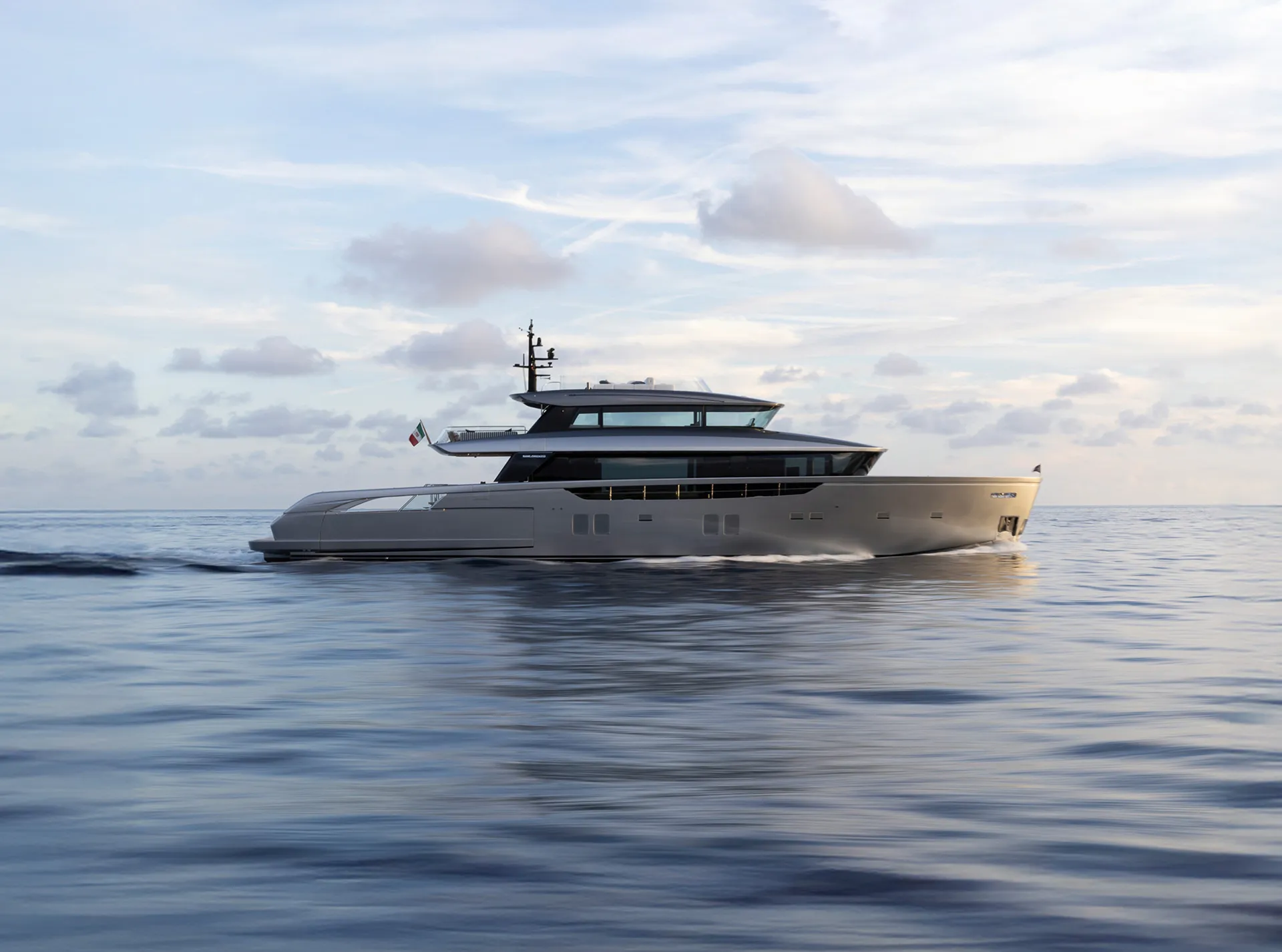
Sanlorenzo SX120120' 0" (36.58 m)
View Specs & ReviewNine miles from St Martin — day moorings, one port of entry, permits by the ton
Yachting in Anguilla
A Minted Location · Anguilla, The Leewards
The number that decides an Anguilla trip is $375 — one day, over 20 registered tons, the top band of the Government of Anguilla's cruising permit schedule. It is banded by registered tonnage, not by length, so the figure on your tonnage certificate sets the price rather than your LOA.
This is an anchorage market, and the government writes the rules. The Department of Fisheries and Marine Resources installs and maintains mooring fields at Little Bay, Sandy Island, Prickly Pear and Shoal Bay East, and three lines shape every day you spend here: anchoring in the parks is "permitted ONLY in specially designated sandy areas", ⚠️ there is "Absolutely NO anchoring in Little Bay or Shoal Bay East", and "All Marine Park moorings are for DAY USE ONLY (6.00am to 7.00pm daily)." The Marine Parks Regulations put the same clock in statute — "no vessel shall be moored or anchored in a marine park between the hours of 7 p.m. and 6 a.m." — and the penalty is $500 or 6 months' imprisonment, or both.
Clearance is one place and one place only. The Anguilla Tourist Board's official guide states that "All persons traveling to and from Anguilla by private boat or yacht charter must contact and clear Customs & Immigration at Road Bay in Sandy Ground, Anguilla", and that "The assistance of a local yacht agent is required to handle the entry process." Blowing Point is the ferry terminal, not the yacht port of entry — worth knowing before you pick the harbour closest to St Martin.
Berths are a 2027 question. Port Nimara at Maundays Bay publishes 16 ft (4 m) of water and a maximum draught of 15 ft (4 m) on its berths, with the marina "expected to be completed in early 2027." Until then Anguilla runs on anchors and Government buoys, with Sint Maarten nine miles south as the service port.
So treat Anguilla as what it is: an anchorage and paperwork market, nine miles from a full-service port. You arrive from Sint Maarten, you clear at Road Bay, you take a day mooring off a cay, and you are off it by seven in the evening. The boat that suits is the one that is comfortable at rest and carries its own tender — not the one that needs a berth.
Where to keep a yacht in Anguilla
Anguilla works on anchors and Government moorings rather than berths, and that shapes the whole trip.
The Anguilla Air and Sea Ports Authority "is established with the exclusive right to manage the ports of Anguilla. Namely: The Clayton J. Lloyd International Airport, Blowing Point Port, Road Bay Port, the Marine Base in Sandy Ground, and Corito Port." Depths, jetty lengths, tariffs and hours for those ports are settled with the Authority and your agent rather than off a published schedule, so make the call before you plan around any of them.
| Ports of entry for a private yacht | Road Bay (Sandy Ground) — one |
| Marine-park mooring fields | Little Bay · Sandy Island · Prickly Pear · Shoal Bay East |
| Mooring hours | 06:00–19:00 daily, day use only |
| Mooring permit | Required; a non-locally-owned vessel applies with its cruising permit |
| Berths | Port Nimara, from early 2027 |
| Fuel, yard work and heavy service | Sint Maarten, nine miles south |
| Mooring authority | Department of Fisheries and Marine Resources — (264) 497-2871, fisheriesmr@gov.ai |
The mooring system is a government service with a published price list. The Department of Fisheries and Marine Resources installs and maintains the buoys: $810.00 per buoy installed "including pickup line chaffing hose etc.", $1,000.00 to service a mooring — "Does not include replacement material" — downlines at $60.00 "Plus 3$EC per foot", and rope splicing at $30.00 "Per head." A one-year warranty and free servicing applies to anchors and moorings the Department installs, "except for negligent acts." On liability it is plain: "the Government of Anguilla does not bear any responsibility for any loss or injury resulting from their use", and "All buoys are used at users risk."
The one berthing project that publishes numbers is not open yet. Port Nimara, at Maundays Bay on the south-west coast at 18°09'46.5"N 63°09'04.0"W, publishes "118 Berths up to 240+ feet accessible via open channel entry", a dedicated customs and immigration facility, and a marina "expected to be completed in early 2027" with the hotel and villas "following in early 2028." Berth A6 is published at length 207 ft (62 m), width 47 ft (14 m), water depth 16 ft (4 m), max. draught 15 ft (4 m), nominal boat size 200 ft (60 m) and 330 kW at 480 V, on 2× Med mooring with 40-ton break-load bollards.
Two ceilings are published. The marina pages give "118 berths for yachts up to 240+ feet"; the berth search runs to 265.0 ft (80 m) in length, 81.0 ft (25 m) in width and 8.6 ft to 15.7 ft (2.0–4.0 m) of draught. Plan against 240 ft and confirm anything larger with the marina — it is a construction site until early 2027.
Until it opens, the working instruction for Anguilla is: do not plan on a berth. Clear at Road Bay, lie at anchor or on a park mooring, and treat Sint Maarten, nine miles south, as the service port — the fuel, the yard and the berths are there, and always have been.
Marinas
| Name | Where | Max yacht | Slips | Fuel |
|---|---|---|---|---|
| Berthing in Anguilla — anchor or take a Government mooringAnguilla works on anchors and Government moorings rather than berths, and that is the defining fact of the market. The Anguilla Air and Sea Ports Authority "is established with the exclusive right to manage the ports of Anguilla. Namely: The Clayton J. Lloyd International Airport, Blowing Point Port, Road Bay Port, the Marine Base in Sandy Ground, and Corito Port" — depths, jetty lengths, tariffs and hours for those ports are settled with the Authority and your agent rather than off a published schedule. Plan on anchoring or a marine-park mooring, keep the tender in mind for everything ashore, and treat Sint Maarten nine miles south as the service port for fuel, yard work and berths. Anguilla's own berths arrive with Port Nimara at Maundays Bay, expected early 2027. | The whole island | — | — | Sint Maarten, nine miles south |
| Port Nimara, Maundays Bay — under constructionThe one berthing project in Anguilla that publishes numbers, and it is a construction site until it opens. Its own pages state "118 Berths up to 240+ feet accessible via open channel entry", a dedicated customs and immigration facility, and the Beaufort Yacht Club; the marina is "expected to be completed in early 2027" with the hotel and villas "following in early 2028." Berth A6 publishes length 207 ft (62 m), width 47 ft (14 m), water depth 16 ft (4 m), max. draught 15 ft (4 m), nominal boat size 200 ft (60 m), 330 kW at 480 V, 2× Med mooring, 40-ton break-load bollards. Two ceilings are published: "up to 240+ feet" on the marina pages, and a berth-search length range running to 265.0 ft (80 m), widths to 81.0 ft (25 m) and draughts of 8.6–15.7 ft (2.0–4.0 m). Plan against 240 ft and confirm anything larger with the marina. It publishes 26 nautical miles to Gustavia and 11 nautical miles to the Sint Maarten airport. | South-west coast, West End · 18°09'46.5"N 63°09'04.0"W | 240 ft | 118 | From 2027, with the marina |
Figures are as each facility publishes them on its own site; blank cells mean the facility doesn't state a number. Confirm slip availability and current rates directly — or ask us to make the calls.
Cruising from Anguilla
Anguilla prices entry by registered tonnage, and the whole schedule is in the statute.
Under Schedule 2 of the Cruising Permit Regulations (R.R.A. C165-1, as amended by R.A. 18/2010), the Government of Anguilla publishes:
| Period | Up to 5 tons | 5 to 20 tons | Over 20 tons |
|---|---|---|---|
| One day | $75 | $150 | $375 |
| One week | $275 | $750 | $1,500 |
| One month | $700 | $2,250 | $3,000 |
| Three months | $1,400 | $6,000 | $8,500 |
Read the columns before you read the rows. These are registered tons, not feet — check the tonnage on your certificate, because the step from the middle column to the right-hand one is $2,250 against $3,000 for a month and $6,000 against $8,500 for three. Then read the rows: on the top band a week costs the same as four days and a month the same as two weeks, so the short permit is rarely the cheap one. Three months at $8,500 saves only $500 against three separate months.
Two Government of Anguilla sources describe who the permit binds. The Cruising Permit Act binds a "charter boat" — "No charter boat shall cruise in the territorial sea without the owner having obtained a cruising permit from the Comptroller" — and defines cruising as including "halting in any part of the territorial sea" but not "mere passage." The Department of Fisheries and Marine Resources' brochure prints the identical table under the heading "Mooring and Cruising Permit Fees" and labels it "Foreign Vessels (EC$)." A private owner should settle which applies with the Comptroller of Customs before arrival.
⚠️ Settle the currency on the same call. The Department's table is marked EC$; the statutory Schedule 2 carries the same figures with a bare $. On a three-month permit for a boat over 20 tons that is roughly US$3,100 against US$8,500 — confirm it before you budget. The Customs Department's head office publishes (264) 497-2513 and hmcustoms@gov.ai, with the Road Bay office on (264) 497-2213.
The rest of the permit regime is short and worth knowing.
- Durations are fixed: one day, one calendar week, one calendar month, or three calendar months. Every permit "shall be valid from 9:00 a.m. on the date on which the permit commences and shall expire at midnight of the date on which the permit expires."
- A permit is issued for a specific boat and is not transferable.
- It is not entry to Anguilla. Section 10 is explicit: "A cruising permit does not confer any right or entitlement on any person to come ashore or enter Anguilla unless he is entitled for the time being to do so under or by operation of any other law."
- You need an agent. The Regulations require every owner to "have an agent in Anguilla" and to notify the Comptroller of the agent's name and address at or before application. The Tourist Board's guide says the same in plainer words: "The assistance of a local yacht agent is required to handle the entry process."
- Locally-owned boats pay nothing — a boat at least 67% owned by persons belonging to Anguilla.
- The penalties are published: a $10,000 fine under the Act for cruising without a permit or breaching its conditions, and $2,000 plus $1,000 for every further day under the Regulations for a continuing offence.
Now the part that shapes an Anguilla itinerary: where you may anchor. Schedule 4 of the Cruising Permit Regulations sets out five areas, each by coordinate, in which "No charter boat shall anchor … except within the areas of the sea indicated on the maps … and demarcated by Government of Anguilla marker buoys" — Little Bay (bounded by a yellow Government marker buoy), Sandy Island (with orange marker buoys defining the two permitted pockets), Prickly Pear Cays, Seal Island and Seal Island Reef, Dog Island, and Rendezvous Bay. The Department's own instruction is blunter still: "Absolutely NO anchoring in Little Bay or Shoal Bay East."
The parks themselves are designated by statute.
| Designated in Schedule 1, Marine Parks Regulations | Junks Hole · Dog Island · Prickly Pear Cays & Seal Island Reefs · Sandy Island · Little Bay · Shoal Bay & Island Harbour Reefs · Sombrero Island Nature Reserve — seven |
| Also protected | Rendezvous Bay, which the Department counts among "eight marine protected areas" and which Schedule 4 of the Cruising Permit Regulations covers by coordinate |
| Mooring fields installed | Little Bay · Sandy Island · Prickly Pear · Shoal Bay East |
| Mooring hours | 06:00–19:00 daily — statute: "no vessel shall be moored or anchored in a marine park between the hours of 7 p.m. and 6 a.m." |
| Park permit | Required for mooring or anchoring; a non-locally-owned vessel's application "shall be accompanied by a cruising permit" |
| Park penalty | $500 or 6 months' imprisonment, or both |
Section 12(1) requires a park permit application to be accompanied by the appropriate fee, and the published price for mooring and anchoring is the cruising-permit table above — which the Department heads "Mooring and Cruising Permit Fees." Schedule 3 prices the other park permits: filming at EC$2,700 per day, erecting structures at 5% of the cost or value, camping at EC$28 per tent per week, carrying on business at 5% of gross income, and EC$5 for a duplicate permit.
Size limits apply to the Government moorings — "Users must adhere to vessel restrictions for all Government moorings in Marine Parks" — so confirm the limit for your boat with the Department on (264) 497-2871 before you plan a day around a buoy.
Inside a park the rest of the rules are absolute: no bilge, sewage, litter or pollutant discharge; no water skiing or jet skis; no fires on any beach; nothing may be removed or damaged; visitors may not fish within park boundaries; and non-Anguillians may only scuba dive under permit or under the supervision of a licensed local dive operation, with a Diver Down flag displayed.
Yard work belongs to Sint Maarten. Schedule haul-out and heavy service around the crossing: the Tourist Board puts St Martin nine miles south, and Port Nimara measures 11 nautical miles from the Sint Maarten airport and 26 nautical miles from Gustavia.
Clearance itself is done in person at Road Bay through your agent — there is no online pre-clearance and no advance filing to make. The Customs Department publishes head-office hours of 08:00–16:00, Saturday and Sunday closed; the Road Bay office is on (264) 497-2213, so confirm its hours before you plan an evening or weekend arrival.
- Road Bay (Sandy Ground) — the port of entry — North-west coast, Sandy GroundThe one place a private yacht may clear into Anguilla. The Anguilla Tourist Board's official guide states that "All persons traveling to and from Anguilla by private boat or yacht charter must contact and clear Customs & Immigration at Road Bay in Sandy Ground, Anguilla", and that "The assistance of a local yacht agent is required to handle the entry process." The Cruising Permit Regulations reinforce it — every owner must "have an agent in Anguilla" and notify the Comptroller of the agent's name and address. It is an open roadstead rather than a harbour: lie at anchor off Sandy Ground and go ashore to the Customs and Immigration office. Depth, berthing and fuel are settled with your agent rather than off a published schedule. Customs publishes head-office hours of 08:00–16:00 with weekends closed; the Road Bay office is on (264) 497-2213, so confirm its hours before an evening or weekend arrival.
- Blowing Point and Corito — the ferry and cargo ports, not yacht clearance — South coastBlowing Point is the ferry terminal facing St Martin and the closest harbour to it, which is exactly why people assume it is where a yacht clears. It is not. The Tourist Board publishes that all travellers clear at the airport or the Blowing Point Ferry Terminal, and separately that persons arriving by private boat must "contact and clear Customs & Immigration at Sandy Ground." Corito is the cargo port. Customs lists a Blowing Point office on (264) 497-6853 and a Marine Base on (264) 497-5461, with hours for both arranged by telephone.
- The Anguilla cruising permit — priced by registered ton — Anguilla's territorial seaPriced on registered tonnage rather than on length or heads. Schedule 2 (R.A. 18/2010) publishes: one day $75 / $150 / $375; one week $275 / $750 / $1,500; one month $700 / $2,250 / $3,000; three months $1,400 / $6,000 / $8,500. On the top band a week costs the same as four days and a month the same as two weeks. Two Government of Anguilla sources describe who it binds: the Cruising Permit Act says "No charter boat shall cruise in the territorial sea without the owner having obtained a cruising permit from the Comptroller", while the Department of Fisheries and Marine Resources prints the identical table headed "Mooring and Cruising Permit Fees" and labelled "Foreign Vessels (EC$)." The currency differs too — EC$ on the Department's table, a bare "$" in the statute, which on a three-month permit is roughly US$3,100 against US$8,500. Settle both with the Comptroller of Customs on (264) 497-2513 or hmcustoms@gov.ai before you budget. Permits are boat-specific, non-transferable, valid from 09:00 on the start date to midnight on the expiry date, free to boats at least 67% owned by persons belonging to Anguilla, and confer "no right or entitlement on any person to come ashore or enter Anguilla." Penalties: $10,000 under the Act; $2,000 plus $1,000 per further day under the Regulations.
- The marine parks — anchor only in the designated sandy areas — Little Bay · Sandy Island · Prickly Pear · Dog Island · Shoal Bay–Island Harbour · Junks Hole · Sombrero · Rendezvous BayThe strongest published rule set in this market. The Department of Fisheries and Marine Resources states anchoring is "permitted ONLY in specially designated sandy areas", that there is "Absolutely NO anchoring in Little Bay or Shoal Bay East", and that "All Marine Park moorings are for DAY USE ONLY (6.00am to 7.00pm daily)." The Marine Parks Regulations put the same clock in statute and require a permit to moor or anchor at all; a non-locally-owned vessel's application "shall be accompanied by a cruising permit." Schedule 4 of the Cruising Permit Regulations separately sets out five no-anchor areas by coordinate — Little Bay (yellow Government marker buoy), Sandy Island (orange buoys marking the permitted pockets), Prickly Pear Cays and Seal Island Reef, Dog Island and Rendezvous Bay. Schedule 1 of the Marine Parks Regulations designates seven parks by name — Junks Hole, Dog Island, Prickly Pear Cays and Seal Island Reefs, Sandy Island, Little Bay, Shoal Bay and Island Harbour Reefs, and the Sombrero Island Nature Reserve — and the Department counts Rendezvous Bay among "eight marine protected areas." Size limits apply to the Government moorings: "Users must adhere to vessel restrictions for all Government moorings in Marine Parks", so confirm the limit for your boat with the Department on (264) 497-2871. Inside a park: no bilge, sewage, litter or pollutant discharge, no water skiing or jet skis, no fires on any beach, no fishing by visitors, and scuba by non-Anguillians only under permit or a licensed local operation, with a Diver Down flag. Penalty $500 or 6 months, or both.
Service, refit & supplies
Shipyards & refit
| Name | Where | Max yacht | Dockage |
|---|---|---|---|
| Haul-out and yard work — Sint Maarten, nine miles southAnguilla has no yard: no travelift, marine railway or slipway is published by any operator or by the Government of Anguilla, so haul-out and heavy service are scheduled around the crossing to Sint Maarten, where the lifts are. The Tourist Board puts St Martin nine miles south, and Port Nimara measures 11 nautical miles to the Sint Maarten airport. Plan a yard date around that passage rather than around Anguilla, and fuel on the same trip. | The whole island | — | The nearest lifts are in Sint Maarten, nine miles south |
Chandleries & specialty suppliers
- Department of Fisheries and Marine Resources — the mooring authority — The Valley · mooring fields at Little Bay, Sandy Island, Prickly Pear and Shoal Bay EastThe Government mooring buoys are installed and maintained by the Department, which publishes its own price list: mooring buoy installation $810.00 per buoy "including pickup line chaffing hose etc."; mooring servicing $1,000.00, which "Does not include replacement material"; downlines $60.00 "Plus 3$EC per foot"; rope splicing $30.00 "Per head." A one-year warranty and free servicing applies to anchors and moorings the Department installs for general wear and tear, "except for negligent acts." It is equally clear on risk: "the Government of Anguilla does not bear any responsibility for any loss or injury resulting from their use" and "All buoys are used at users risk." Money collected is stated to go "to mooring buoy maintenance and other coral reef and seagrass bed protection activities." Contact (264) 497-2871 / (264) 497-8705, fisheriesmr@gov.ai.
On the Anguilla calendar
Anguilla runs year-round, and the clocks that matter here are the government's rather than any operator's.
- Marine-park moorings: 06:00–19:00 daily, day use only. Published twice — as the Department's instruction ("All Marine Park moorings are for DAY USE ONLY") and as statute ("no vessel shall be moored or anchored in a marine park between the hours of 7 p.m. and 6 a.m."). It is the hardest clock in the market, and the penalty behind it is $500 or 6 months, or both.
- Cruising permits run on fixed periods — one day, one calendar week, one calendar month or three calendar months — and each is valid from 09:00 on the commencement date and expires at midnight on the expiry date. A permit that starts on a travel day starts at nine in the morning, not on arrival.
- Anguilla Customs Department head office: 08:00–16:00, Saturday and Sunday closed. The Road Bay office is on (264) 497-2213 — confirm its hours before you plan a weekend or evening clearance.
- Port Nimara opens in early 2027. Its own pages state the marina is "expected to be completed in early 2027", with the hotel and villas "following in early 2028."
- Permit renewals are capped: a marine-park permit may be renewed "for a like period, but the aggregate of such renewal periods shall not exceed 1 year", and a single-user mooring lease "shall not exceed 12 months."
Boat racing is Anguilla's national sport and the racing calendar belongs to the organising clubs — confirm dates with the organiser before you plan a passage around a regatta.
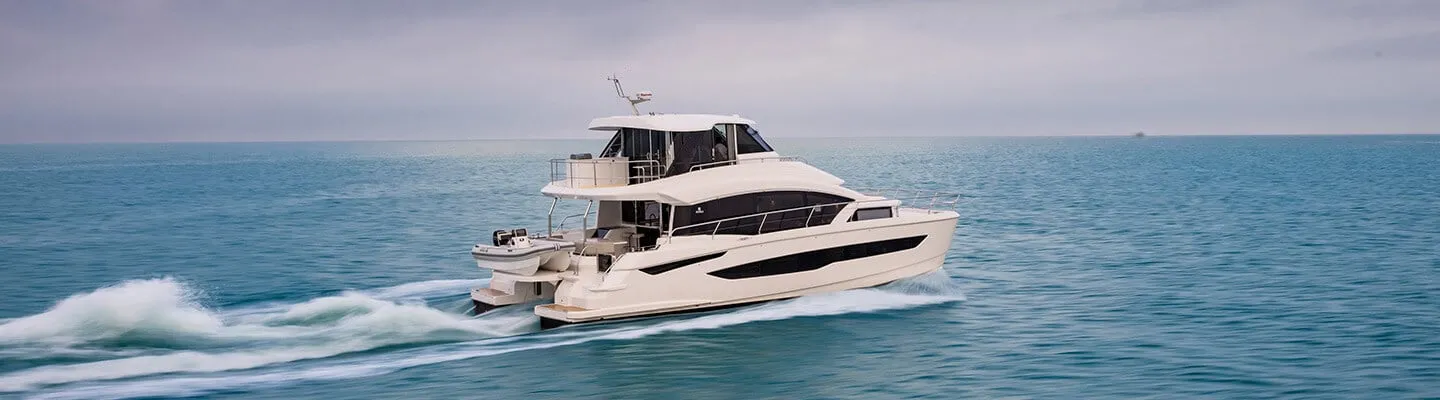
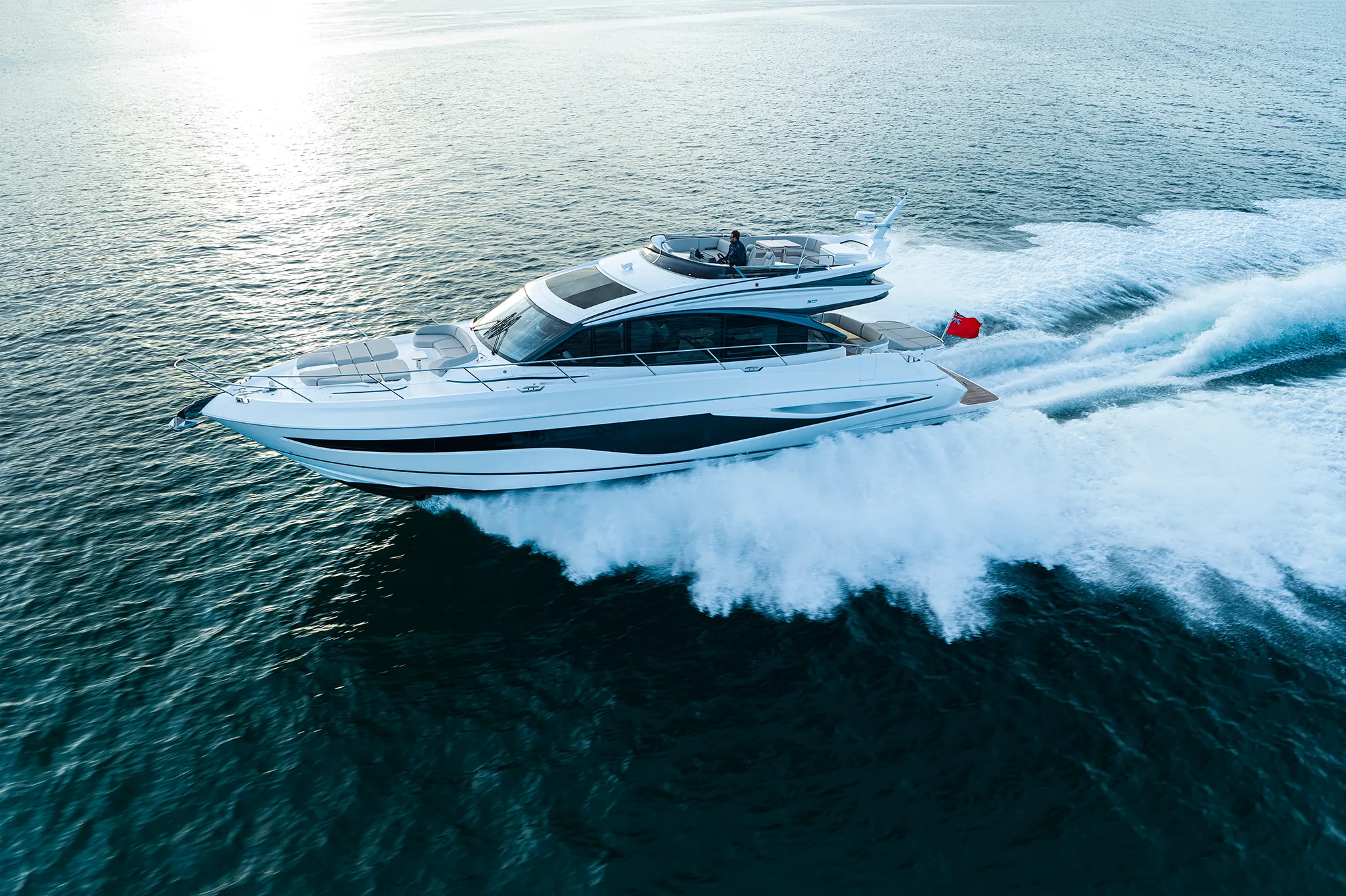
Yachts we'd shortlist for Anguilla
Reviewed the same way as everything on this site — specifications verified against the builder's own numbers.
Frequently Asked Questions
Is there dock and dine in Anguilla?
The mechanism here is a Government mooring and a tender, and the terms come from a fisheries department rather than from a restaurant. All marine park moorings are day use only, 6.00am to 7.00pm daily, in the mooring fields at Little Bay, Sandy Island, Prickly Pear and Shoal Bay East. Pick up a buoy in the morning, tender ashore, and be off it before seven. Clear at Road Bay first — the Department requires applicants to have clearance forms in their possession before applying for a mooring permit. No venue on the island runs a guest dock, so plan the day around the buoy rather than around a berth.
How much is an Anguilla cruising permit?
It is banded by registered tonnage rather than by length. Schedule 2 of the Cruising Permit Regulations publishes one day at $75 up to 5 tons, $150 from 5 to 20 tons and $375 over 20 tons; one week at $275, $750 and $1,500; one month at $700, $2,250 and $3,000; and three months at $1,400, $6,000 and $8,500. On the top band a week costs the same as four days and a month the same as two weeks, so the short permit is rarely the cheap one. Two things to settle before you budget: the Act binds a charter boat by its own words, while the Department of Fisheries and Marine Resources prints the identical table headed for foreign vessels — and the Department marks the figures EC$ where the statute carries a bare dollar sign, which on three months is roughly US$3,100 against US$8,500. Confirm both with the Comptroller of Customs on (264) 497-2513.
Where do you clear customs in Anguilla by yacht?
Road Bay in Sandy Ground, and nowhere else. The Anguilla Tourist Board's official guide states that all persons travelling to and from Anguilla by private boat or yacht charter must contact and clear Customs and Immigration at Road Bay in Sandy Ground, and that the assistance of a local yacht agent is required to handle the entry process. The Cruising Permit Regulations back that up by requiring every owner to have an agent in Anguilla and to notify the Comptroller of the agent's name and address. Blowing Point is the ferry terminal, not the yacht port of entry — a distinction that catches people who pick the harbour closest to St Martin. Clearance is done in person through your agent; there is no online pre-clearance and no advance filing to make. Confirm the Road Bay office's hours on (264) 497-2213 before you arrive.
Can you anchor in Anguilla's marine parks?
Only in specially designated sandy areas, only under permit, and in two places not at all. The Department of Fisheries and Marine Resources publishes that anchoring in the parks is permitted only in specially designated sandy areas and that there is absolutely no anchoring in Little Bay or Shoal Bay East. The Marine Parks Regulations require a permit to moor or anchor in any park, and a non-locally-owned vessel's application must be accompanied by a cruising permit. Schedule 4 of the Cruising Permit Regulations sets out five no-anchor areas by coordinate — Little Bay, Sandy Island, Prickly Pear Cays and Seal Island Reef, Dog Island and Rendezvous Bay — permitting anchoring only inside the pockets demarcated by Government of Anguilla marker buoys, yellow at Little Bay and orange at Sandy Island. Every Government mooring is day use only, 6.00am to 7.00pm, and the same window appears in statute. The penalty for getting it wrong is $500 or six months, or both.
Is there a marina in Anguilla?
Not yet. Anguilla works on anchors and Government moorings, and the Anguilla Air and Sea Ports Authority — which manages Road Bay Port, Blowing Point Port, Corito Port and the Sandy Ground Marine Base — settles berthing, depths and tariffs directly rather than off a published schedule. The one project that does publish numbers is not open: Port Nimara at Maundays Bay states 118 berths up to 240-plus feet and a marina expected to be completed in early 2027, with hotel and villas following in early 2028. Its berth pages carry 16 feet of water with a maximum draught of 15 feet on berth A6. Until it opens, plan on anchoring or a park mooring, with Sint Maarten nine miles south as the service port.
Can a yacht be hauled out in Anguilla?
No — the nearest lifts are in Sint Maarten, and so is the fuel. No travelift, marine railway or slipway is published by any operator or by the Government of Anguilla. Schedule yard work, fuel and heavy service around the nine-mile crossing to St Martin and Sint Maarten, which Port Nimara measures at 11 nautical miles from the Sint Maarten airport and 26 nautical miles from Gustavia in St Barths.