
August 19, 2026
Lagoon Sixty 7 Review: The 66-Foot Power Catamaran Built for Living Aboard
The Lagoon Sixty 7 is a 66'1" flybridge power catamaran with twin 440 HP Yanmar diesels, a 4'11" draft, and four to six cabins plus crew qua…
Read the articleExpert Review, Technical Specifications & Market Analysis
| Feature | Specifications |
|---|---|
| Overall Length | 66'1" (20.15 m) |
| Beam | 32'10" (10.00 m) |
| Draft | 4'11" (1.50 m) |
| Displacement | 93,338 lbs (42,300 kg) |
| Engines | Twin Yanmar (2 x 440 HP) |
| Fuel Capacity | 1,453 gal (5,500 L) |
| Water Capacity | 264 gal (1,000 L) |
| Cabins / Heads | 4-6 Cabins / 4-6 Heads + Crew |
| Max Speed | 16 knots |
| Cruise Speed | 12 knots |
Source: Spec & Photos courtesy of Lagoon. Specs verified by Tony Smith, USCG 100 Ton Master, on August 18, 2026.
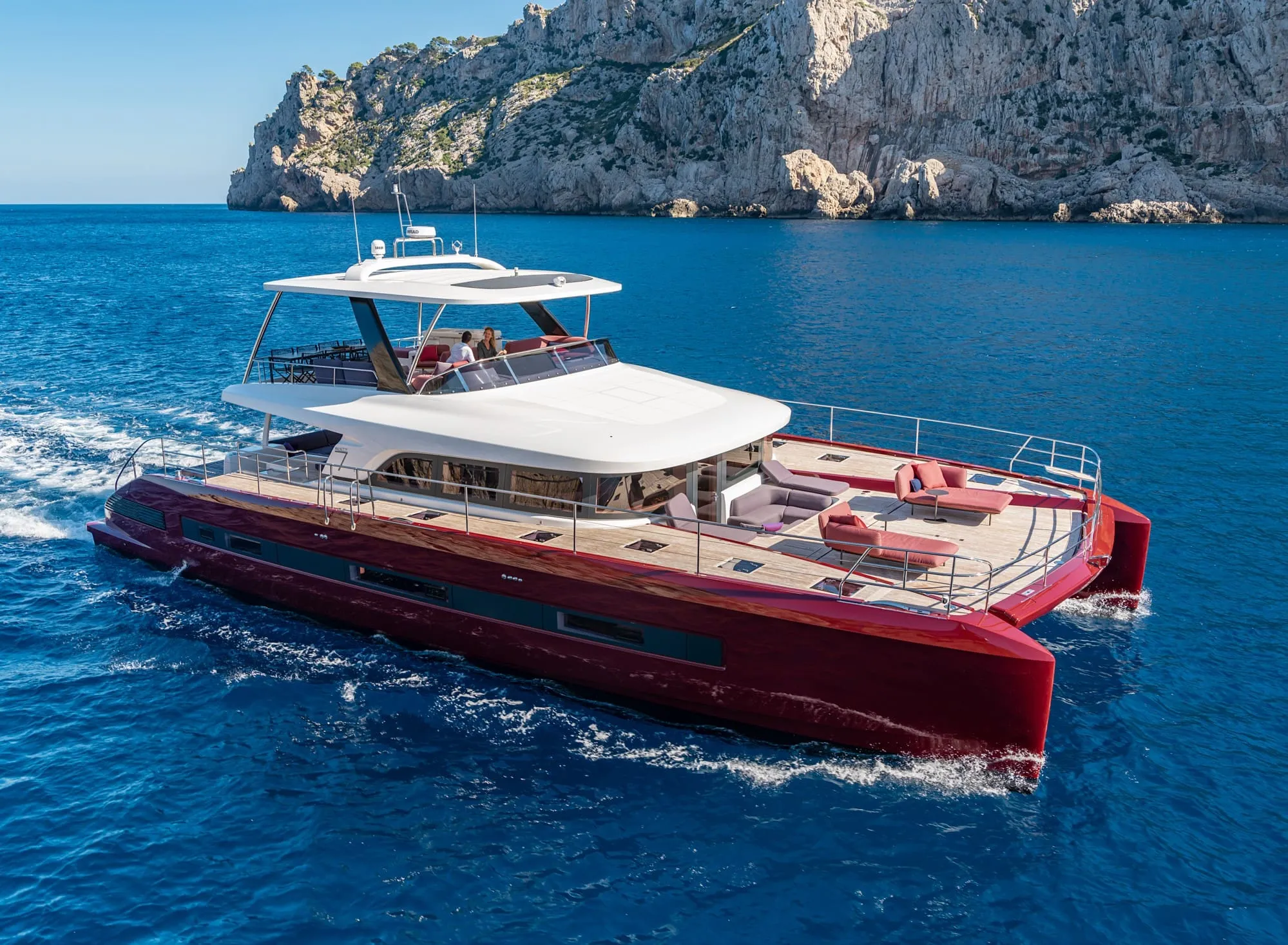
You want a 66-foot yacht that can still slip into the anchorage everyone else has to admire from half a mile out. The Lagoon Sixty 7 draws 4'11", sleeps four to six cabins plus crew, and puts a flybridge living deck above all of it.
Part of the Lagoon Power Catamarans series — see how owners step up through the lineup.

I have walked a lot of catamarans in the 60-to-70-foot bracket, and the Sixty 7 is one of the few where I do not have to explain away a compromise. The thing I point at first is the draft. Four feet eleven inches on a 66-foot yacht is not a rounding error - it is the difference between anchoring where you want and anchoring where the chart lets you. Clients who cruise the Bahamas understand that within about thirty seconds of standing on the foredeck.
The second thing I point at is the flybridge, and specifically the fact that the helm is forward and the living space is aft. That sounds like a small layout decision. It is not. It means the person driving is not sitting in the middle of everyone's afternoon, and it means the flybridge is a deck you actually use rather than a place you climb to only when it is time to move the boat. Pair that with the owner's suite - the walk-in closet and the full bathroom are not a gimmick at this beam, they are just what the volume allows - and you have a boat that works for real time aboard rather than a long weekend.
What I tell buyers to think hard about is the beam and the crew question. Thirty-two feet ten inches will get you turned away from marinas that would happily take an 80-foot monohull, so make your calls before you fall in love. And while a capable couple can run this boat, docking 42 tonnes in a crosswind is a two-person job. Get that settled honestly and the Sixty 7 will do more for your time on the water than almost anything else her length.
Video courtesy of Lagoon.
.B8QjsGes_1t0WwW.webp)
.CZPLrrPb_Z15rxRq.webp)
_0.CjkZnC-N_17fIkL.webp)
Photos courtesy of Lagoon.
The Lagoon Sixty 7 is a flybridge power catamaran measuring 66'1" (20.15 m) overall on a 32'10" (10.00 m) beam, drawing 4'11" (1.50 m) and displacing 93,338 lbs (42,300 kg) unladen. Accommodation runs to 4-6 Cabins / 4-6 Heads + Crew, with a choice of lateral or central galley, and Lagoon rates her for eight to sixteen people aboard. Tankage is 1,453 gal (5,500 L) of fuel carried in four tanks and 264 gal (1,000 L) of water.
Lagoon built her to do two jobs at once - their own description covers ocean crossings and the pleasures of coastal cruising - and the specification supports both. The hulls carry CE Category A offshore certification for 14 people, while the 4'11" (1.50 m) draft and a published air draft of 26'11" (8.20 m) keep thin water and inside routes on the itinerary. What you end up with is a boat sized for months aboard with family or guests, with dedicated crew quarters in every layout so a captain and mate can join for the longer legs without displacing anyone.
Propulsion is Twin Yanmar (2 x 440 HP), and Lagoon publishes a maximum of 16 knots with a cruise of 12 knots. That is displacement-style pacing rather than sportboat pace, and it is the honest way to read the boat: the Sixty 7 is built to hold 12 knots comfortably all day across a wide, stable platform, not to plane. Twin screws set 32'10" apart also give the kind of low-speed control that makes tight manoeuvring manageable on a 93,338 lbs (42,300 kg) yacht.
The flybridge helm station is laid out specifically to make handling straightforward, which is what keeps owner-operation realistic at this size - though a 32'10" beam is a two-person docking job in any real breeze. Fuel capacity is 1,453 gal (5,500 L), and Lagoon points to that autonomy as what enables longer crossings; how far it carries you depends entirely on speed, loading and conditions, so treat the sea trial on the specific hull as the real answer. Check the 26'11" (8.20 m) air draft against fixed bridges on any inside route you plan to run.
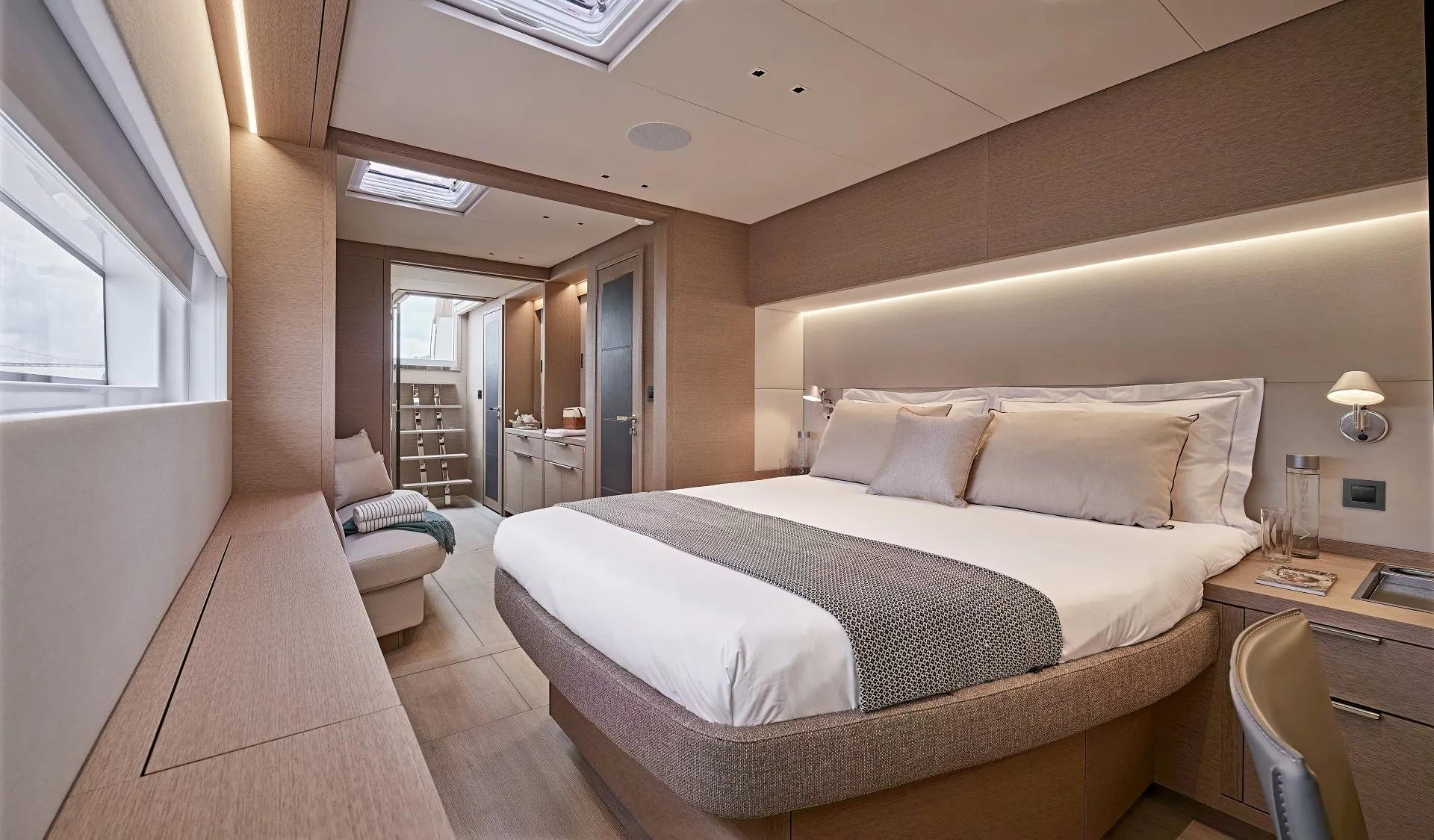
The owner's suite is the Sixty 7's headline. Lagoon builds it around a large walk-in closet, a spacious bathroom and a bedroom they compare to the finest hotels, and at 32'10" (10.00 m) of beam there is genuinely enough volume to make that read as description rather than aspiration. Guest cabins carry their own heads across the 4-6 Cabins / 4-6 Heads + Crew plan, and crew accommodation is separate in every version. Nauta Design handled the interior.
The main living spaces are designed to run together: adjoining interior and exterior areas connect the saloon and the cockpit into one social zone, with glazing sized so natural light does the work. You choose a lateral or central galley, and the lounge can be specified with a coffee table or a standard dining table. Above it, the flybridge is the space that changes how the boat gets used - open to the view, helm forward, and the rest of the deck available standard, with a sunbath arrangement, or with optional loose furniture you rearrange for dinner one evening and lounging the next.
Inside Lagoon's range the Sixty 7 is the entry point to power catamarans: the sailing line runs from the 38 up through the Sixty 5 and the Eighty 2, while the power side is the Sixty 7 and, above her, the 78-foot Eighty 3. That leaves her the smallest and most owner-operable of Lagoon's motor cats, which is precisely her position - enough boat for four to six cabins plus crew quarters, still compact enough at 66'1" (20.15 m) that a capable couple can run her with a captain aboard only for the demanding legs. Against the cross-brand field she is measured on the Fountaine Pajot MY 67, the Aquila 70 and the Leopard 53 PC, and her distinguishing card within that group is the pairing of a 4'11" (1.50 m) draft with CE Category A certification for 14 people: shoal-water access and offshore capability in the same hull.
Buy the Sixty 7 if your cruising is measured in months rather than weekends, the anchorages you want are the shallow ones - the Bahamas banks, the inside routes, the thin-water corners of the Grenadines - and you want four to six cabins plus crew quarters while you are there. Be honest about the beam before anything else: 32'10" (10.00 m) is wider than plenty of 80-foot monohulls, and not every marina in your home grounds can take her without a T-head or an end tie. If you want the same shoal-draft idea stretched to 78 feet with more deck to live on, the Eighty 3 sits above her; and if you want to sail rather than motor, the Sixty 5 is the boat to look at instead - the Sixty 7 is a power catamaran and makes no pretence otherwise.
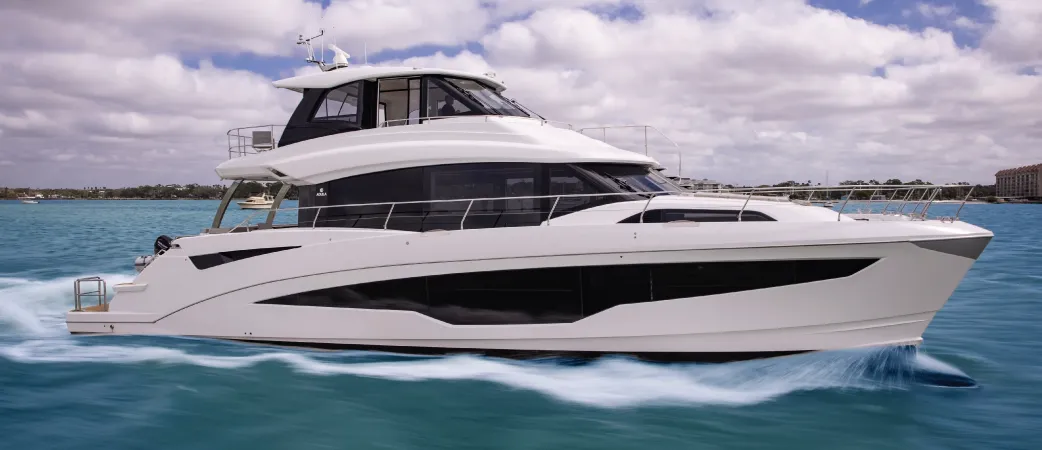
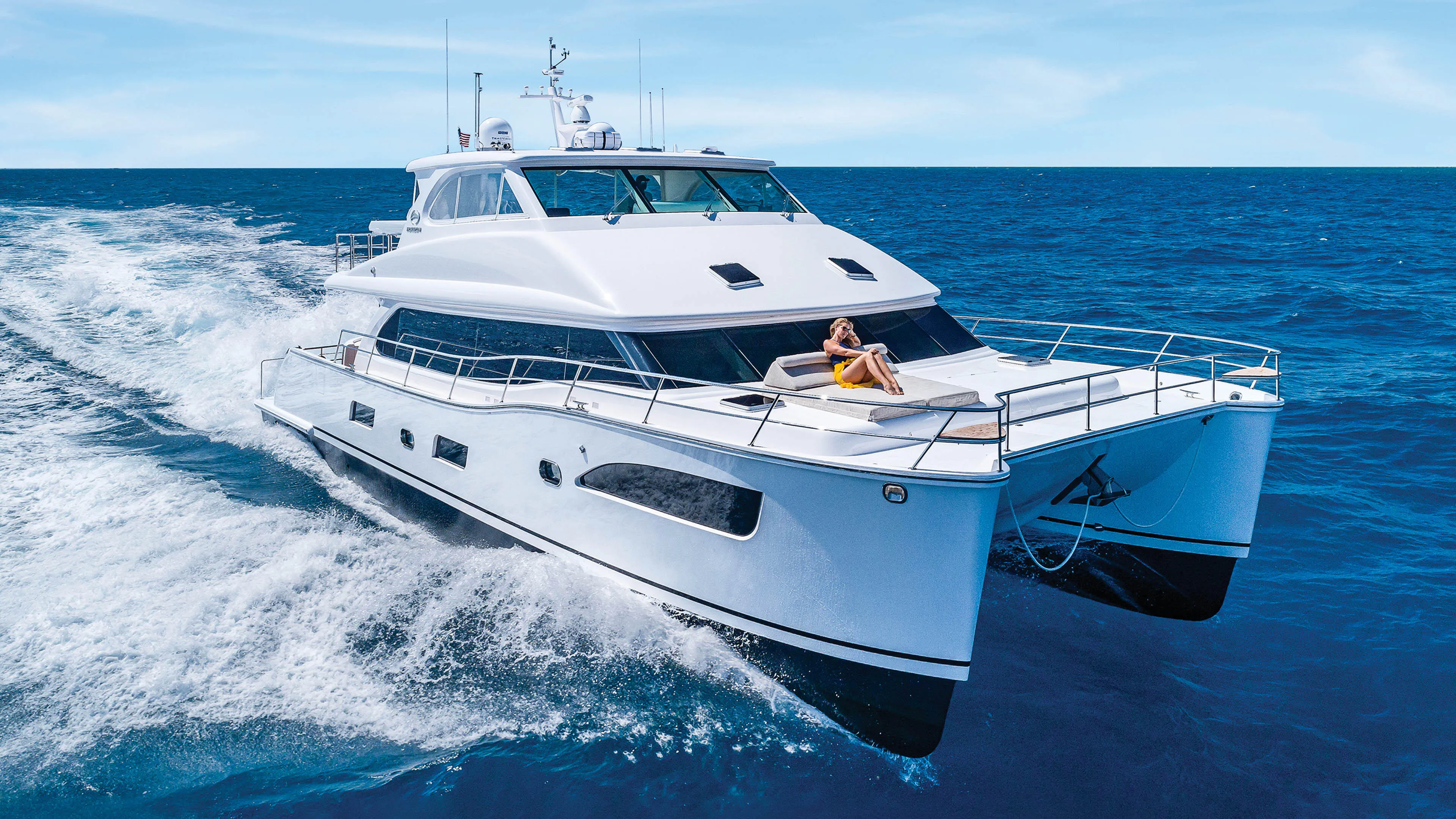
Buy the Sixty 7 if you want the smaller boat you can realistically run yourself; buy the Seventy 8 if you host regularly and want a full extra deck of living space. Both are flybridge power catamarans with separate crew quarters — the Sixty 7 is 66'1" (20.15 m) overall, the Seventy 8 is 78'1" (23.80 m).
The numbers split them cleanly. The Sixty 7 runs Twin Yanmar (2 x 440 HP) for a maximum of 16 knots and a cruise of 12 knots; the Seventy 8 runs Twin Volvo D11-510 (2 x 510 HP) for a maximum of 19 knots and a cruise of 10 knots. Accommodation is 4-6 Cabins / 4-6 Heads + Crew against 3-6 Cabins / 3-6 Heads + Crew, where the Seventy 8's lower counts buy larger cabins and stowage rather than more berths. Counter-intuitively, the bigger boat is the shallower one — 4'2" (1.27 m) against the Sixty 7's 4'11" (1.50 m) — while beam goes the other way, 36'1" (11.00 m) against 32'10" (10.00 m). If marina access at home is tight, that beam difference decides it.
Lagoon builds the Sixty 7 in 4-6 Cabins / 4-6 Heads + Crew, rated for eight to sixteen people aboard, with dedicated crew accommodation in every version — taking on a captain never costs you a guest cabin. Alongside the cabin count you choose whether the galley sits laterally or centrally in the main living space.
The owner's suite is the headline. Lagoon builds it around a large walk-in closet, a spacious bathroom and a bedroom they compare to the finest hotels, and on a 32'10" (10.00 m) beam there is genuinely the volume to make that read as description rather than aspiration. Guest cabins carry their own heads. In the saloon the lounge can be specified with a coffee table or a standard dining table, and the flybridge comes standard, with a sunbath arrangement, or with optional loose furniture you rearrange for dinner one evening and lounging the next.
She draws 4'11" (1.50 m), which is shallow for a 66'1" (20.15 m) yacht and keeps thin water on the itinerary — the Bahamas banks, the inside routes, the shallow corners of the Grenadines. Her published air draft is 26'11" (8.20 m), the figure to check against fixed bridges before you commit to any inside passage.
The constraint that will actually shape your season is width, not depth. A 32'10" (10.00 m) beam is wider than plenty of 80-foot monohulls, so confirm your home port can take her on a T-head or an end tie before anything else. None of that shallow-water ability is bought at the expense of offshore capability: she holds CE Category A certification for 14 people, and Lagoon describes her as built for ocean crossings as much as coastal cruising.