
August 19, 2026
Lagoon Eighty 3 Review: The New Flagship Power Catamaran, Layout by Layout
The Lagoon Eighty 3 is the new flagship of the yard's power-catamaran range: 80'1" overall, twin 580 HP John Deere diesels, a 12-knot cruise…
Read the articleExpert Review, Technical Specifications & Market Analysis
| Feature | Specifications |
|---|---|
| Overall Length | 80'1" (24.40 m) |
| Beam | 36'1" (11.00 m) |
| Draft | 4'2" (1.27 m) |
| Displacement | 151,017 lbs (68,500 kg) |
| Engines | Twin John Deere N13-580 (2 x 580 HP) |
| Fuel Capacity | 2,246 gal (8,500 L) |
| Water Capacity | 422 gal (1,600 L) |
| Cabins / Heads | 4-6 Cabins / 4-6 Heads + Crew |
| Max Speed | 18 knots |
| Cruise Speed | 12 knots |
Source: Spec & Photos courtesy of Lagoon. Specs verified by Tony Smith, USCG 100 Ton Master, on August 18, 2026.
Your best days on the water happen outside, and most 80-foot yachts make you climb a staircase to find them. The Lagoon Eighty 3 lays 300 m² of exterior living space across one flush deck on an 80'1" power catamaran that draws just 4'2".
Part of the Lagoon Power Catamarans series — see how owners step up through the lineup.

If you asked me which of Lagoon's two new flagships most people should actually buy, I would say this one, and I would say it before you finished the question. Not because the sailing Eighty 2 is a lesser boat — they share architects, a yard and an interior designer — but because the Eighty 3 matches how the majority of large-catamaran owners really cruise. Flush deck on one level. Four feet two inches of draft. Three hundred square meters of outdoors. No mast to plan around, no watch schedule, no rig survey.
One caution, and it is the one I give every buyer looking at a long-legged boat. Lagoon publishes a fuel-autonomy figure for the Eighty 3, but the yard does not say at what speed it was calculated, and I will not let a client plan an ocean crossing on a number with no speed attached to it. Treat the published figure as a ceiling, then get real consumption data off the specific hull you are buying. That is a five-minute conversation with a dealer and it is one of the most useful things you can do on a sea trial.
What I like most is what the personalisation brief implies. Marble, braided leather, stone counters, brushed wood — Lagoon is not handing you a trim level, it is handing you a specification meeting. That is worth real time and it is worth starting early, because the decisions are the long pole in the build, not the fibreglass. And be clear about the trade: she tops out at 18 knots and cruises at 12. If that sounds slow to you, you want a different kind of boat. If it sounds like the pace of an actual holiday, you want this one.
Video courtesy of Lagoon.
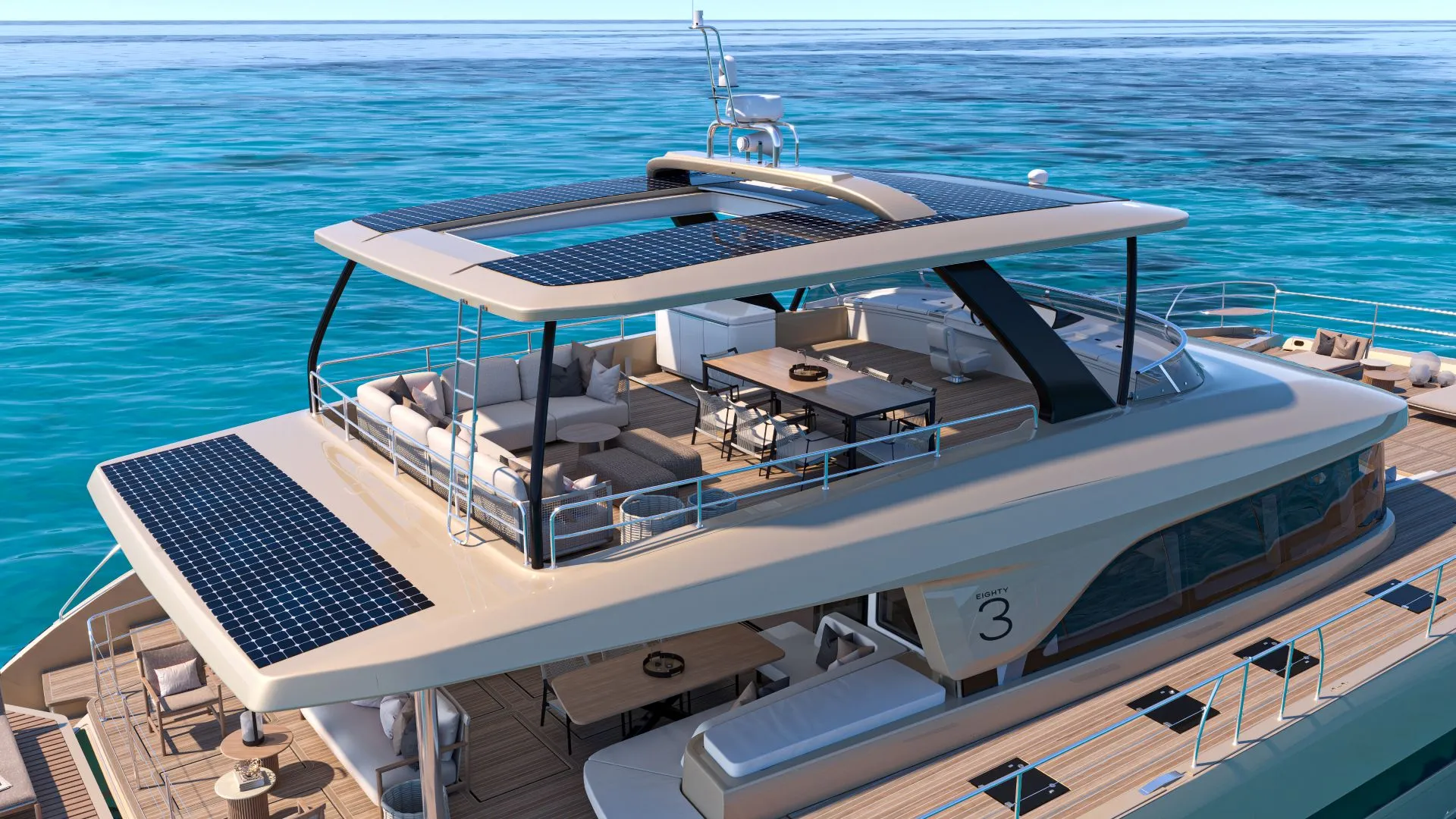
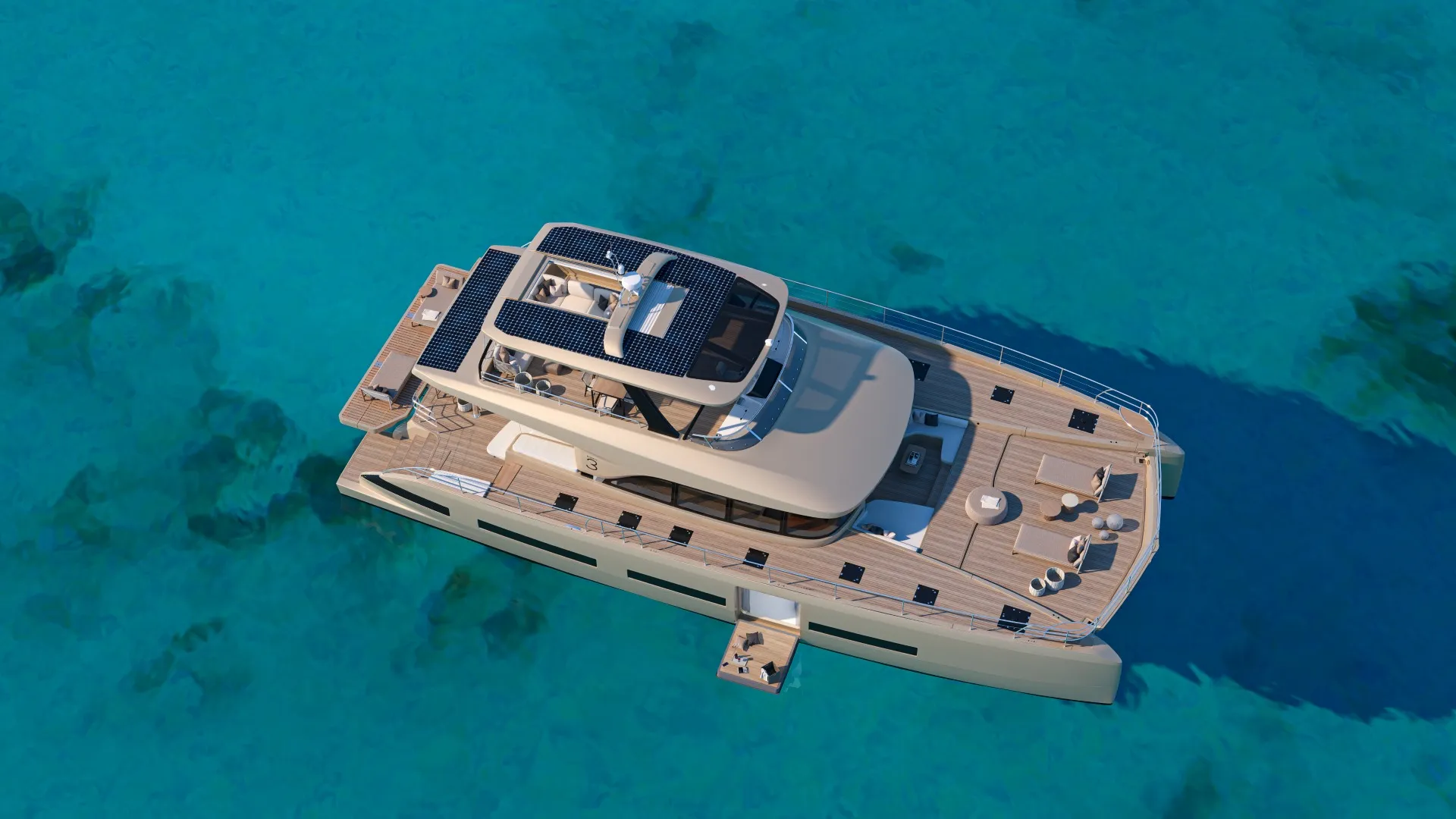
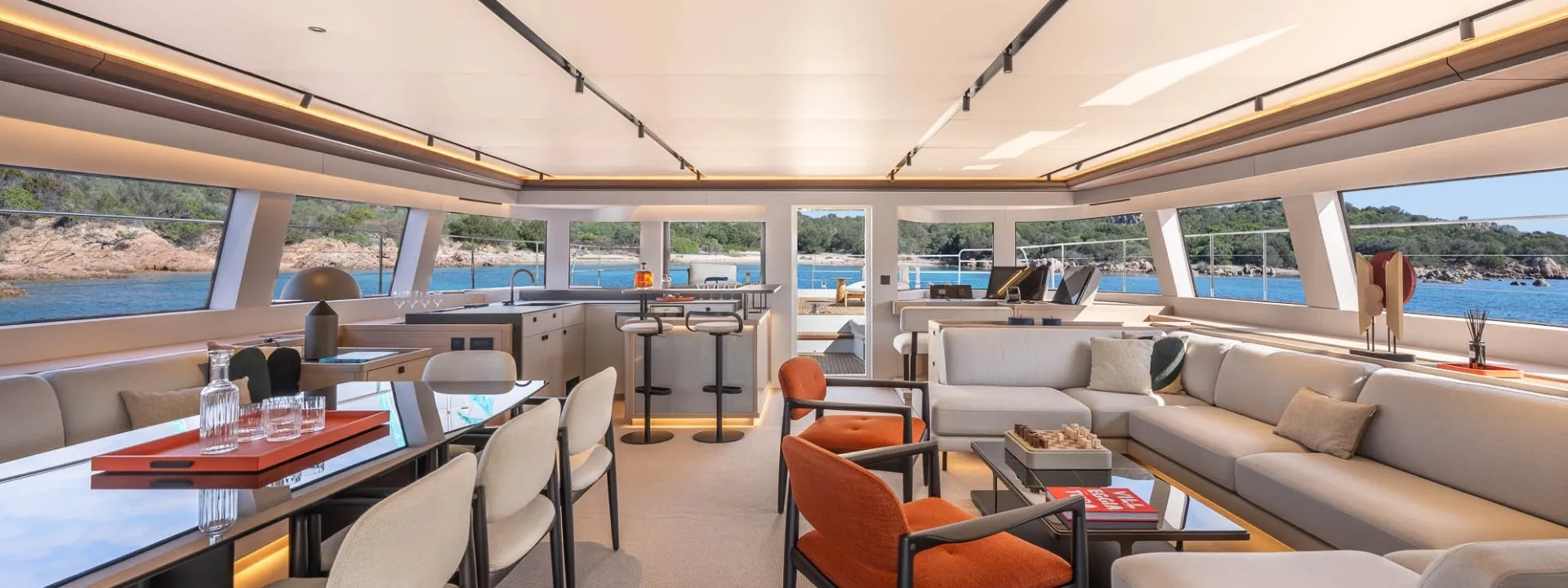
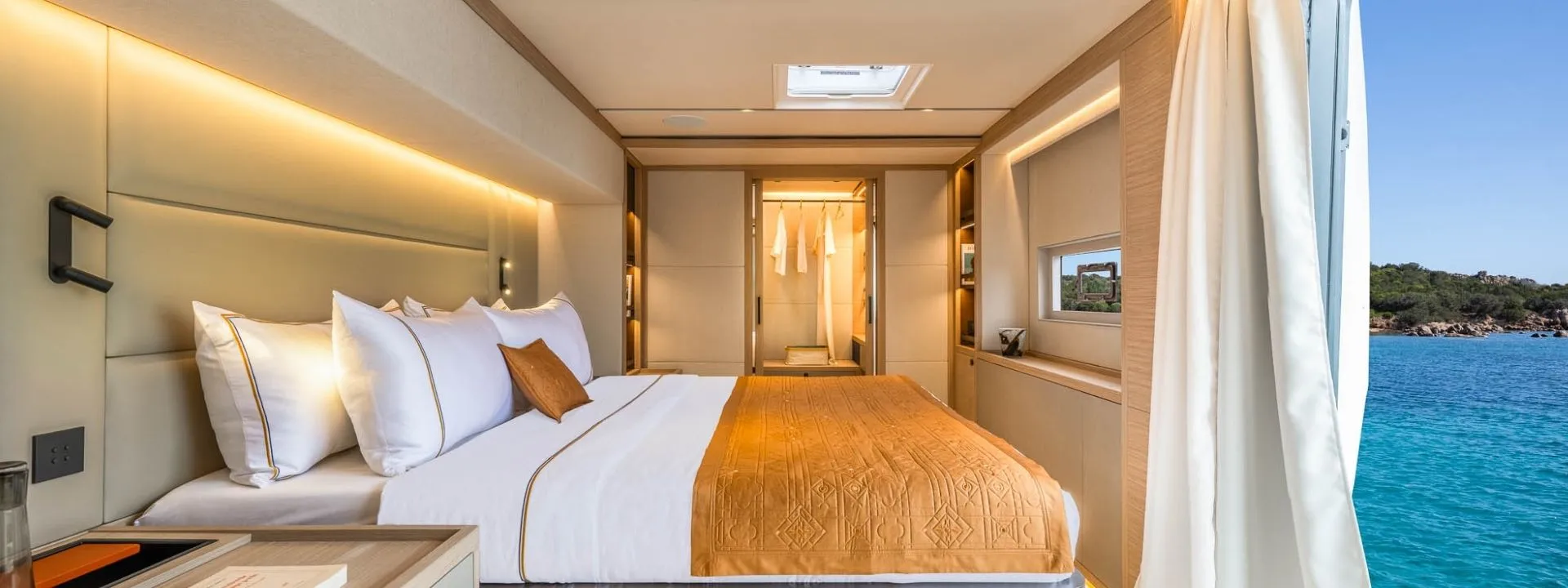
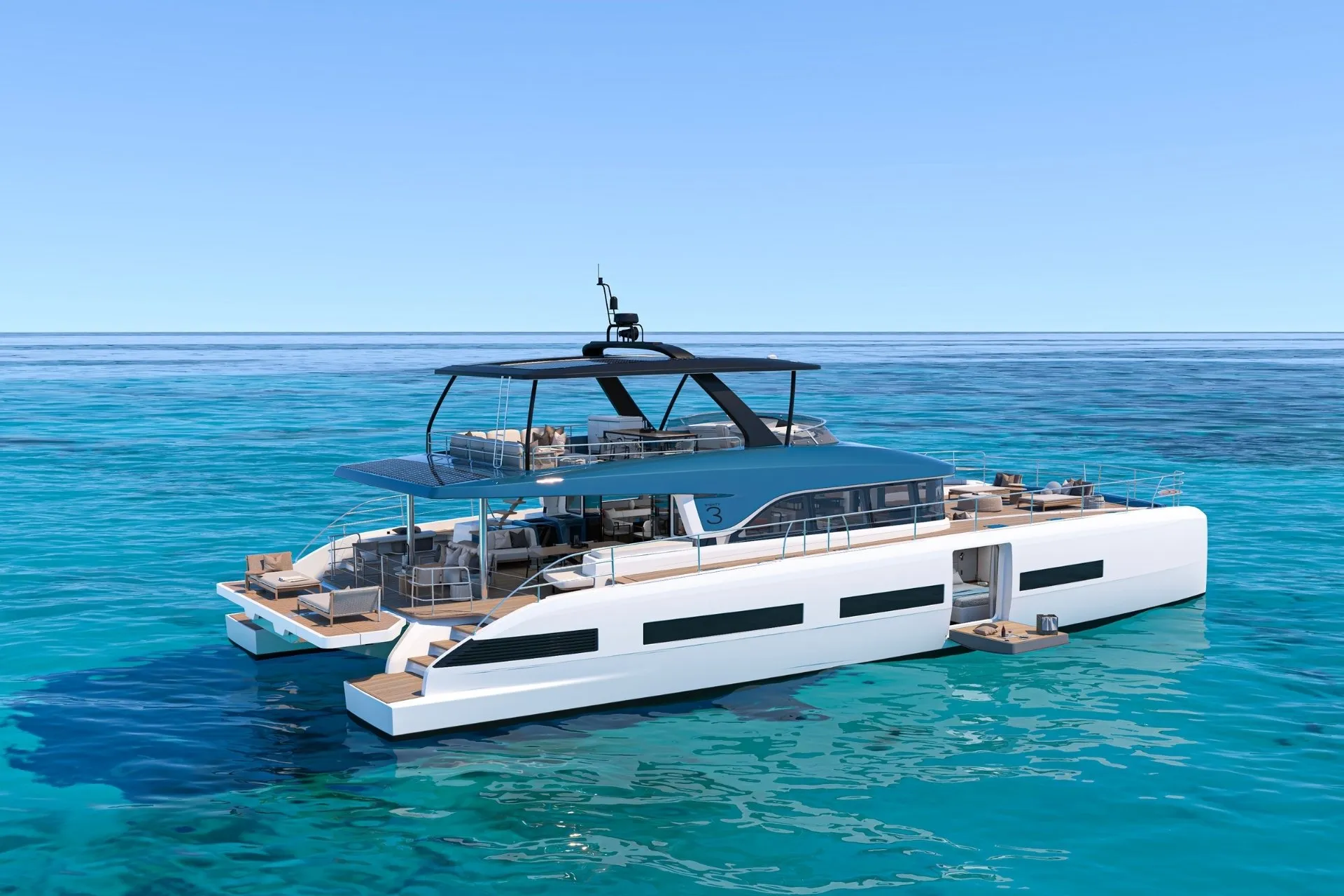
Photos courtesy of Lagoon.
The Eighty 3 is the new flagship of Lagoon's power-catamaran range and the counterpart to the sailing Eighty 2. She measures 80'1" (24.40 m) overall on a 36'1" (11.00 m) beam, draws 4'2" (1.27 m), and has a light displacement of 151,017 lbs (68,500 kg). Lagoon publishes three interior configurations — four cabins with the galley down, five cabins with the galley down, and five cabins with the galley up — summarised as 4-6 Cabins / 4-6 Heads + Crew and sleeping 8 to 16, with crew accommodation on top of that.
She is built around living aboard for weeks rather than running out for weekends. The flush main deck and that shallow draft tell you most of what you need to know about the intended use: everything happens on one level, and she can follow water that deeper 80-footers have to admire from outside. Fuel capacity is 2,246 gal (8,500 L) and fresh water is 422 gal (1,600 L). CE certification is A: 14 / B: 18 / C: 24 / D: 40. Naval architecture is by VPLP Design, exterior design is credited to VPLP Design and Patrick Le Quément, the interior is by Nauta Design, and she is built at Lagoon's Bordeaux shipyard. As a brand-new model, the imagery available today is largely Lagoon's own renders and general-arrangement drawings.
Twin John Deere N13-580 (2 x 580 HP) diesels drive her, and Lagoon publishes a cruise of 12 knots and a maximum of 18 knots. That makes her a displacement cruiser, not a planing motor yacht, and the yard makes no attempt to pretend otherwise — your crossings are measured in days and your weather planning has to be done like a passagemaker's. The yard's 3,500-nautical-mile fuel-autonomy figure is a planning ceiling rather than a schedule — verify real consumption on the specific hull you are buying before you build a crossing around it. Fuel capacity is 2,246 gal (8,500 L), a genuinely large reserve for an 80-foot catamaran.
The character of the ride comes from the platform. A 36'1" beam and 151,017 lbs of light displacement give you a hull that sits flat at anchor and does not roll guests out of their bunks in a cross swell — the reason people move to catamarans and stay there. Pair that with a 4'2" draft and the itinerary opens up: shallow cuts, close-in anchorages and thin water are all available to you. Loading discipline is the counterweight. Tenders, toys, stores, water and a full fuel load all come off her trim and her legs, so be honest about what you actually carry.
The layout choice sets the character. Galley down keeps the main deck entirely social and service traffic out of sight, which is what you want with a chef aboard; galley up trades a cabin to put the cooking in the middle of the living space, which is what many owner-operators prefer. The owner's cabin is a full suite either way — a king-sized berth with a view of the sea, a private terrace, and dedicated relaxation space — and Lagoon has drawn the living areas around natural light and 360-degree ocean views, which is what a wide, low, flush-decked platform can do and a stacked motor yacht cannot.
The published interior specification is unusually specific for a production yacht: a marble table, armchairs with braided leather seatbacks, decorative glass panels, natural stone countertops, and wooden furniture in a brushed finish. Furnishings, upholstery and accessories are chosen individually, which puts her closer to a semi-custom brief than a catalogue order — and means longer lead times and more decisions than an off-the-shelf boat. Outside, the 300 m² of dedicated exterior living space runs from the flybridge down to an aft swim platform that extends to as much as 22 m², with dedicated space aft for a jet ski or tender. Because the main deck is flush, you move from that platform forward without steps or thresholds, which matters for guests who are not agile.
Inside Lagoon's range the Eighty 3 sits at the top of the power-catamaran line above the Sixty 7, and takes over the flagship position previously held by the Seventy 8. Her closest relative is the sailing Eighty 2, launched alongside her — the same architects, the same Bordeaux yard and the same interior designer, with a rig where the Eighty 3 carries her larger fuel load. Against the wider market she is cross-shopped with the Sunreef 100 Power, the solar-electric Silent 120 and the Horizon PC74, and her argument against all three is usable outdoor area and shallow-water access rather than speed. At 8 to 16 berths across four to six cabins plus crew quarters, she is designed to be run by a small professional crew or an experienced owner with a captain — markedly less structure than a conventional 80-foot motor yacht demands, which is the practical reason buyers move to her from the 60-foot class.
Buy the Eighty 3 if outdoor living is the reason you are buying a boat at all — 300 m² of it, all on one level, with a 22 m² platform for the jet ski and the tender and a 4'2" draft that puts you inside the anchorages your friends have to watch from the channel. She suits the family that lives aboard for weeks, the owner who has already done a 50- to 60-foot power cat and wants more deck and more legs, and anyone who would rather not plan a cruise around a mast or a watch schedule. Two honest limits: she tops out at 18 knots, so this is passagemaking rather than dashing across to lunch, and her 36'1" beam makes marina access the recurring practical constraint — multihull berths, booked early, and some older harbours not at all. If what you actually want is to shut the engines down and sail, buy the Eighty 2 instead; it is the same boat philosophy with a rig, and it is the only question that really separates the two.
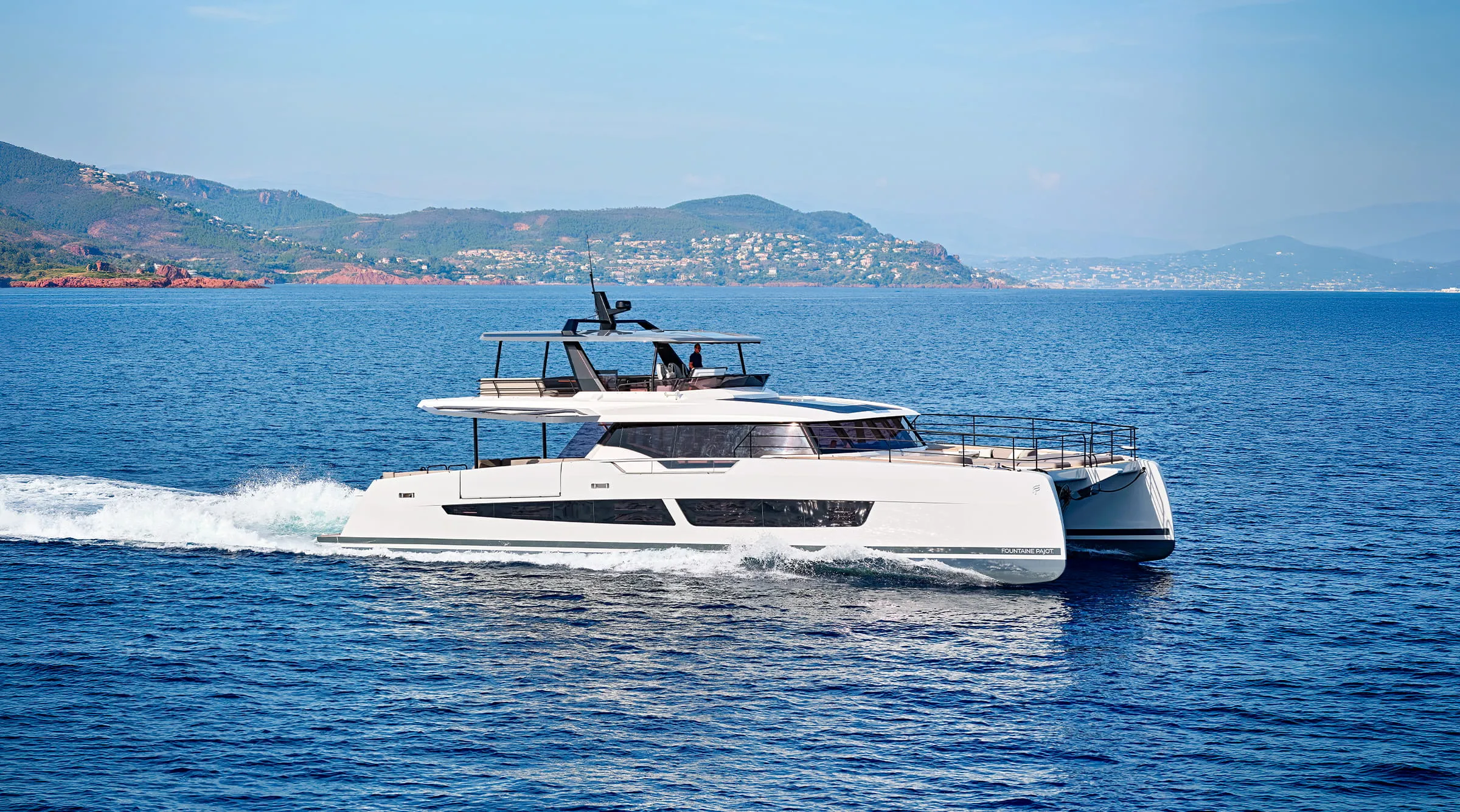
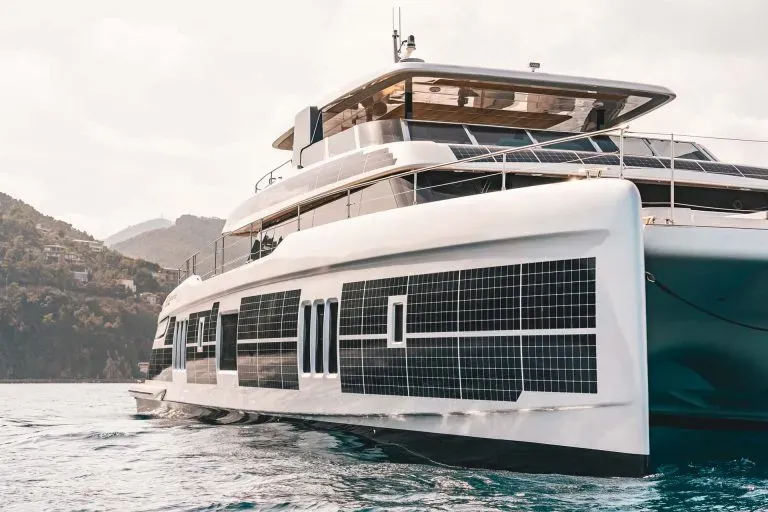
One question separates them: do you want to sail? The Eighty 2 is the sailing flagship at 81'9" (24.97 m) with roughly 338 m² of upwind sail area; the Eighty 3 is the power flagship at 80'1" (24.40 m) running Twin John Deere N13-580 (2 x 580 HP). Interior philosophy, layout choices and outdoor living are shared.
The practical difference is draft and planning. The Eighty 3 draws 4'2" (1.27 m) with no rig and no air draft to plan around, so shallow cuts and close-in anchorages stay open; the Eighty 2 draws 6'3" (1.90 m) and carries a 120'1" (36.6 m) air draft. The speeds tell the same story — the Eighty 3 cruises at 12 knots with a maximum of 18 knots, against a cruise of 9-10 knots (under sail/power) and a maximum of 11 knots (under power) on the Eighty 2. Both are drawn by VPLP Design, with exterior design credited to VPLP Design and Patrick Le Quément and interiors by Nauta Design, and both carry 36'1" (11.00 m) of beam — so marina access is the same problem whichever you choose.
3,500 nautical miles of fuel autonomy on 2,246 gal (8,500 L) of fuel, by Lagoon's own figure. Treat it as the manufacturer's planning ceiling and verify real consumption on the specific hull before building a crossing schedule around it.
Published speeds are a cruise of 12 knots and a maximum of 18 knots from Twin John Deere N13-580 (2 x 580 HP). That makes her a displacement cruiser rather than a planing motor yacht: crossings are measured in days, and weather planning is a passagemaker's job. Loading is the honest counterweight to any autonomy claim — tenders, toys, stores, water and a full fuel load all come off her trim and her legs, so be realistic about what you actually carry before you plan the long one.
Lagoon publishes three configurations — four cabins with the galley down, five with the galley down, and five with the galley up — summarised as 4-6 Cabins / 4-6 Heads + Crew, sleeping 8 to 16, with crew accommodation on top of that count rather than inside it.
The owner's cabin is a full suite in every version: a king-sized berth with a view of the sea, a private terrace and dedicated space to relax. The galley decision sets the character of the boat — galley down keeps the main deck entirely social and service traffic out of sight, which is what you want with a chef aboard, while galley up trades a cabin to put the cooking in the middle of the living space. Outside, Lagoon counts 300 m² of dedicated exterior living space, running from the flybridge back to a swim platform that deploys to as much as 22 m². Because the main deck is flush, guests move forward from that platform without steps or thresholds — which matters more than it sounds for anyone who is not agile.