
August 25, 2026
Galeon 560 FLY: 15' 10" Under Way, 22' 6" at Anchor
The 560 FLY is 15' 10" of beam under way and 22' 6" with the Beach Mode balcony down, and that transformation is most of the reason people b…
Read the articleExpert Review, Technical Specifications & Market Analysis
| Feature | Specifications |
|---|---|
| Overall Length | 57' 7" |
| Beam | 15' 10" |
| Draft | 3' 7" |
| Displacement | 70,565 lbs |
| Engines | 2 x 670 hp; up to 2 x 900 hp |
| Fuel Capacity | 581 gal |
| Water Capacity | 198 gal |
| Cabins / Heads | 3 Cabins + 1 Crew / 2 Heads |
| Max Speed | 31 knots |
Source: Spec & Photos courtesy of Galeon. Specs verified by Tony Smith, USCG 100 Ton Master, on August 24, 2026.
15' 10" of beam under way, 22' 6" with the balcony down. The 560 FLY is the boat in Galeon's flybridge range where the crew cabin stops being an option and becomes part of the layout.
Part of the Galeon FLY series — see how owners step up through the lineup.

The 560 is the boat in this part of Galeon's range where the argument stops being about length and starts being about how you want to live aboard. Fourteen inches separate it from the 520 on paper. The real distance is everywhere else on the sheet: a hundred more gallons of fuel, a crew cabin that is part of the boat instead of a box you tick against a tender garage, and nearly six and a half tons more weight. That is not a stretched 520. It is a different class of boat wearing a similar number.
What I would send you to look at first is the thing photographs never quite convey. This boat is 15' 10" of beam under way and 22' 6" with the balcony down. Stand in that cockpit with Beach Mode open, bars to port and starboard and the hydraulic platform at water level behind you, and you will understand why people buy these boats rather than the obvious alternatives. Then go up top, because the flybridge is laid out as several separate places rather than one long bench - opposing seating and dining, a helm with company beside it, a wet bar and grill, and shade you can put a lounger under. And take a proper look at the crew cabin door: it opens from the bathing platform, not through your saloon. If you ever run this boat with help aboard, that detail matters far more on the fourth day than on the first.
Now the practical part. Draft comes three ways: 3' 7", 3' 4" for the bare hull, and 5' 7" with the running gear on it - plan your berth and your lift off the deepest. Guests are quoted at fourteen against a crew limit of twelve. On the weight and engine side you are on firm ground: Volvo Penta is named and the base engine rating is real, which makes that 70,565 lb light-craft mass a number you can actually use. Before you sign, get the draft with running gear, the rigged weight for your engine choice, and observed burn at your intended cruise, all in writing. And if it is the profile you are chasing rather than the flybridge, look at the 570 SKY on the same length first.
Video courtesy of Galeon.
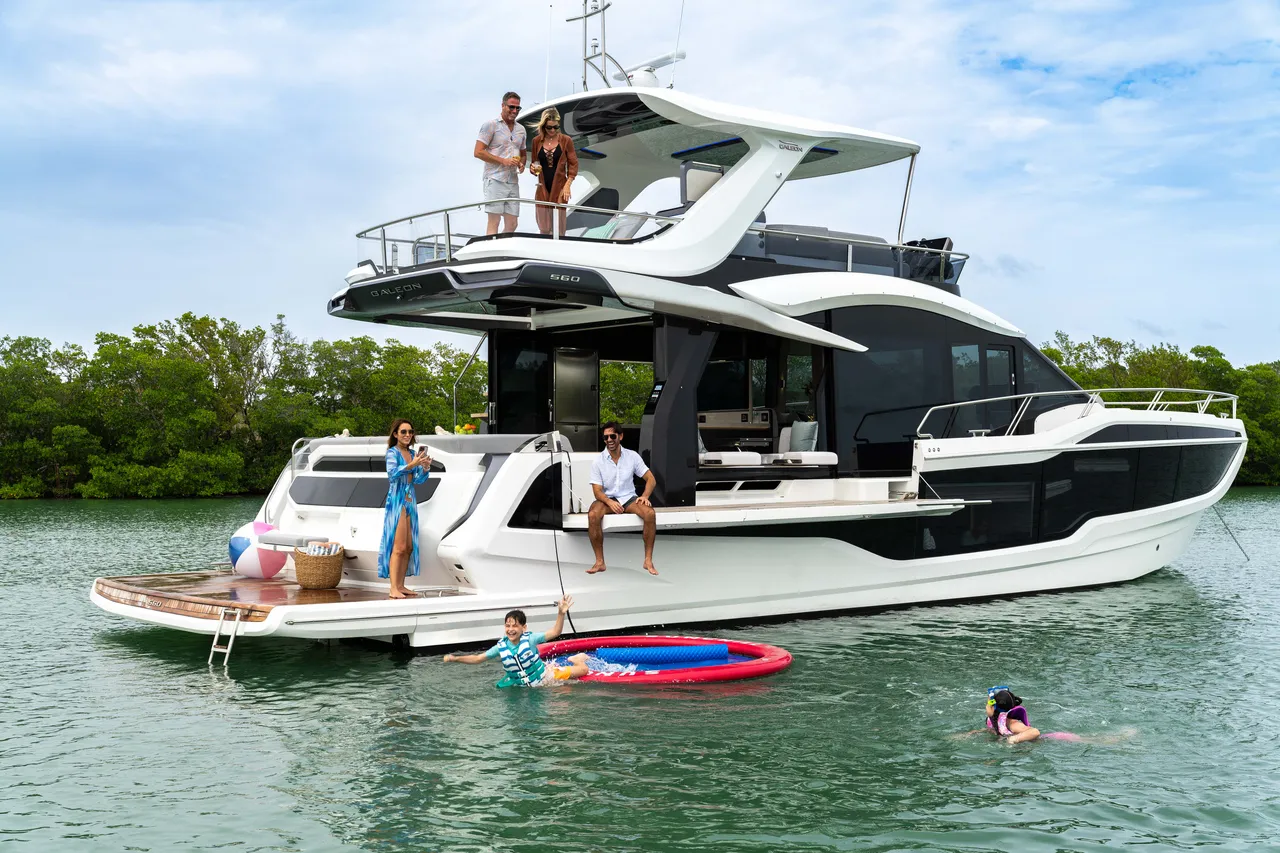
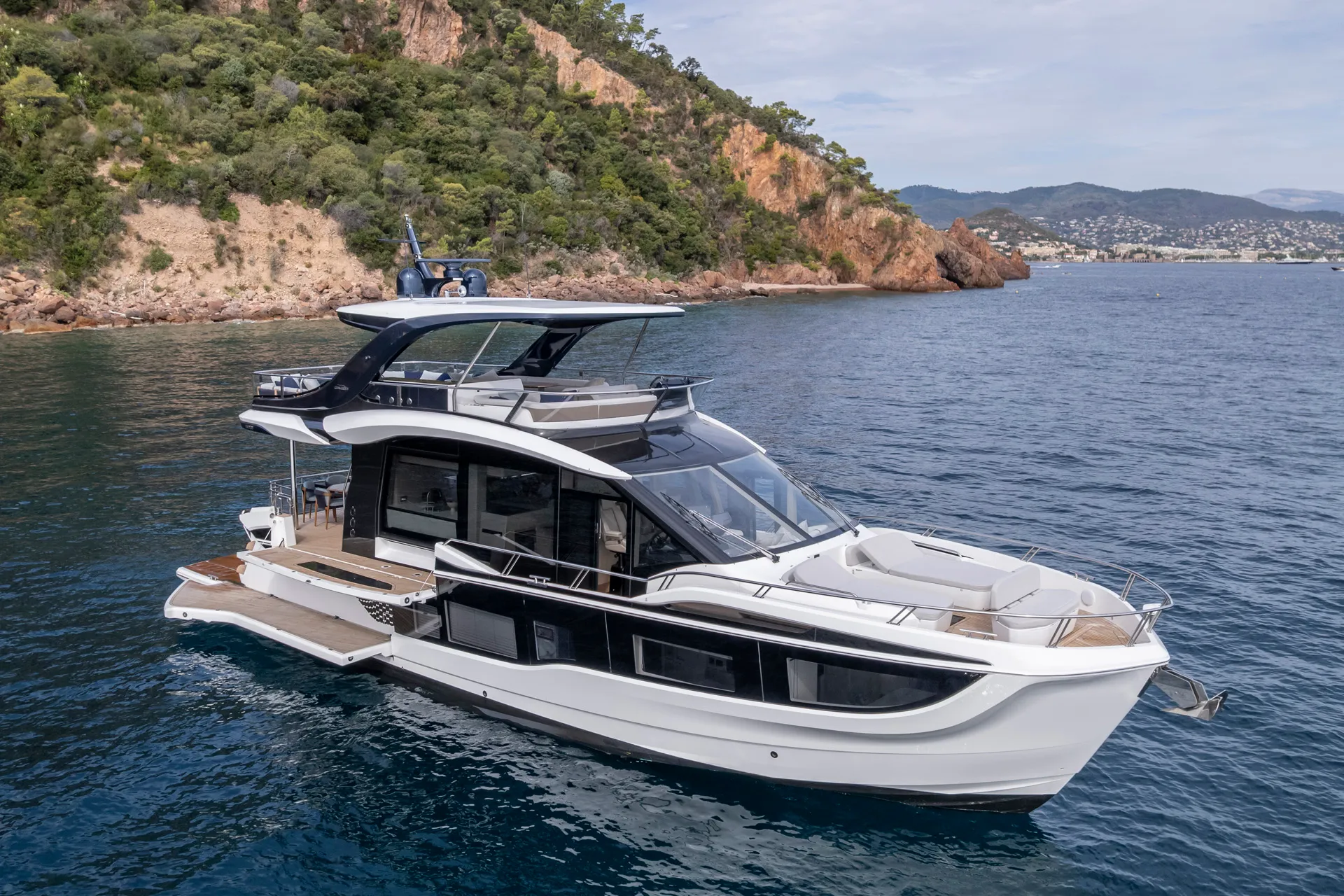
Photos courtesy of Galeon.
The 560 FLY bridges Galeon's own lineup - built for an owner who wants the engineering of the yard's mid-range flybridges with the volume and finish of the boats above them, in a size that still fits a normal marina. At 57' 7" length overall on a 53' 8" hull, that is about where it lands.
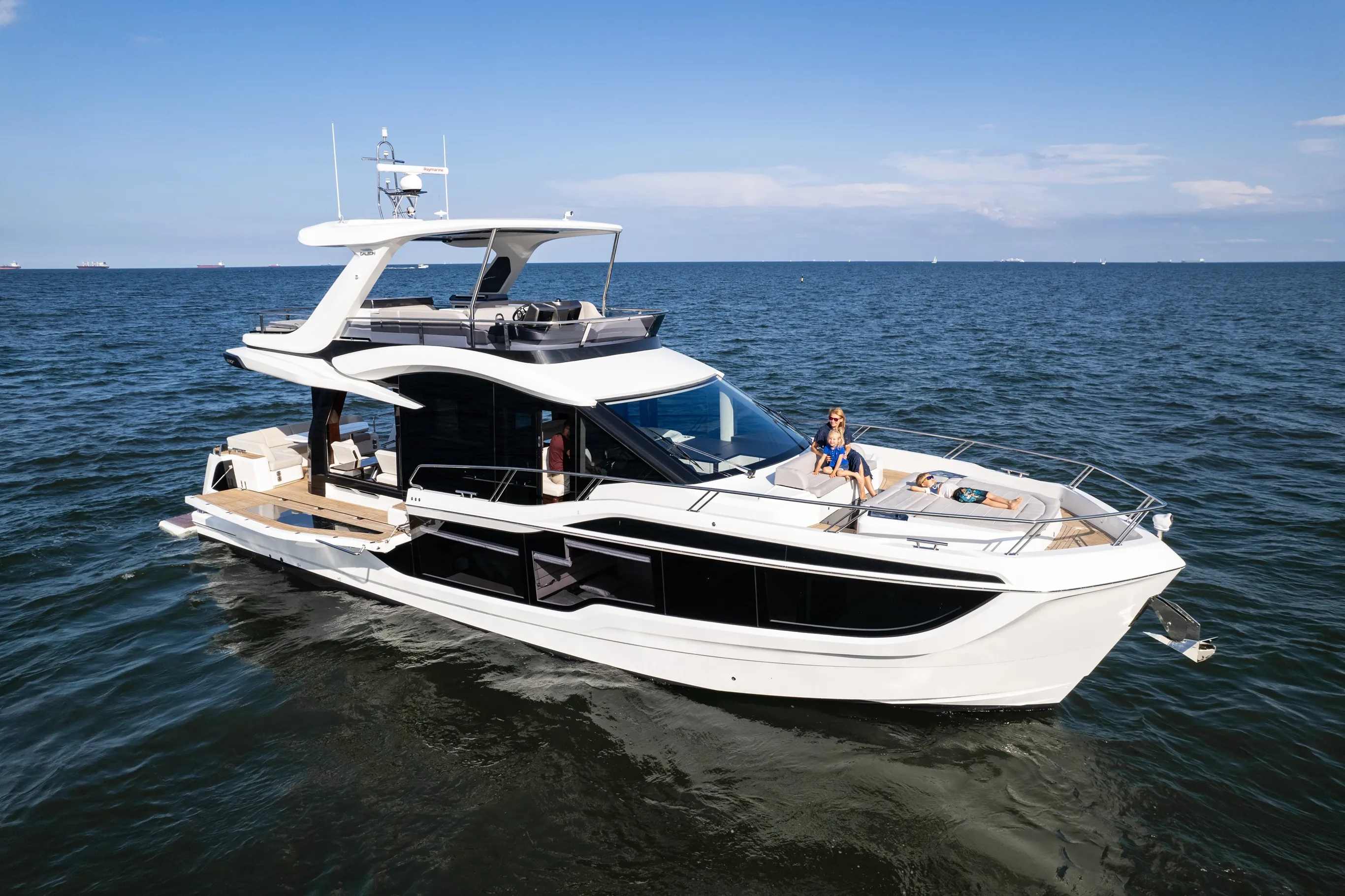
The upper deck is arranged around opposing U-shaped seating and dining areas, with a forward seating space and helm station alongside a wet bar and grill, and an overhang that leaves room for free-standing sun loungers. That is several distinct places on one deck rather than one long bench, and it is the reason owners spend their evenings up there. Sleek stainless rails with integrated glass panels keep the view uninterrupted.
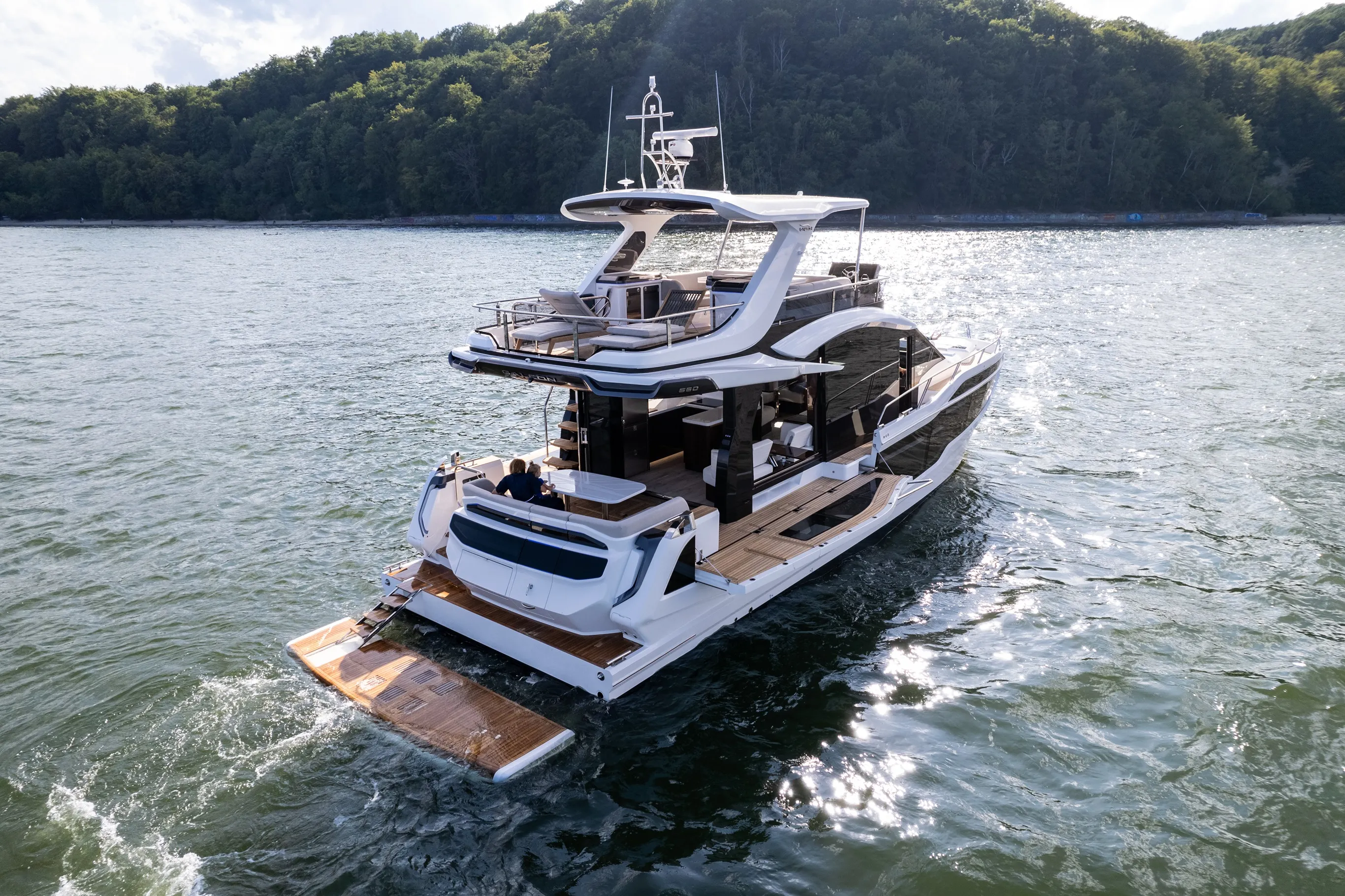
On the main deck, Galeon's Beach Mode connects cockpit and saloon with bars to port and starboard; the optional drop-down portside balcony takes the beam from 15' 10" to 22' 6". Openable side doors extend the living space further. Forward there is a sundeck and a bench with a backrest for running in a seaway. Aft, a hydraulic platform handles water toys, water access and the entrance to the twin crew cabin.
Light craft condition is 70,565 lbs with base engines, with 11,435 lbs of maximum load on top of it. Engines run from a minimum of 2 x 670 hp to twin Volvo Penta D13-900s at 2 x 900 hp, and top speed is up to 31 knots. Capacities are 581 gallons of fuel in two tanks and 198 gallons of fresh water.
Twin Volvo Penta D13-900s are the top engine option at 2 x 900 hp, with a minimum rating of 2 x 670 hp below them, and the 560 will run to 31 knots. A named engine builder makes the service and parts question an easy one to answer before you buy.
For fuel planning, ask for observed burn at your intended cruise, in writing, from a boat rigged the way yours will be, and work your own range arithmetic off the 581 gallons the boat carries.
Weight is worth reading closely. Light craft condition is 70,565 lbs with base engines, plus a maximum load of 11,435 lbs on top of that - together, a mass you can size a lift and a load against. Bridge clearance is 25' 4" from the waterline at minimum draft, and transport height is 28' 4".
Draft needs settling before you commit to a berth. It is quoted at 3' 7", with 3' 4" for the bare hull without propellers and 5' 7" once the running gear is on. Size a shallow slip or a travelift sling off the deepest of those three, and get the figure for your own build confirmed in writing.
Guest capacity is 14 with a crew limit of 12. Confirm the certified people-aboard figure - along with anything you intend to size a slip, a lift or an insurance policy from - on your build documents.
Three cabins and two heads accommodate six berths below deck, with a twin crew cabin aft reached from the hydraulic bathing platform rather than through the accommodation. That is the arrangement you want if the boat is ever going to be run for you - a mate or a captain can come and go without walking through your saloon.
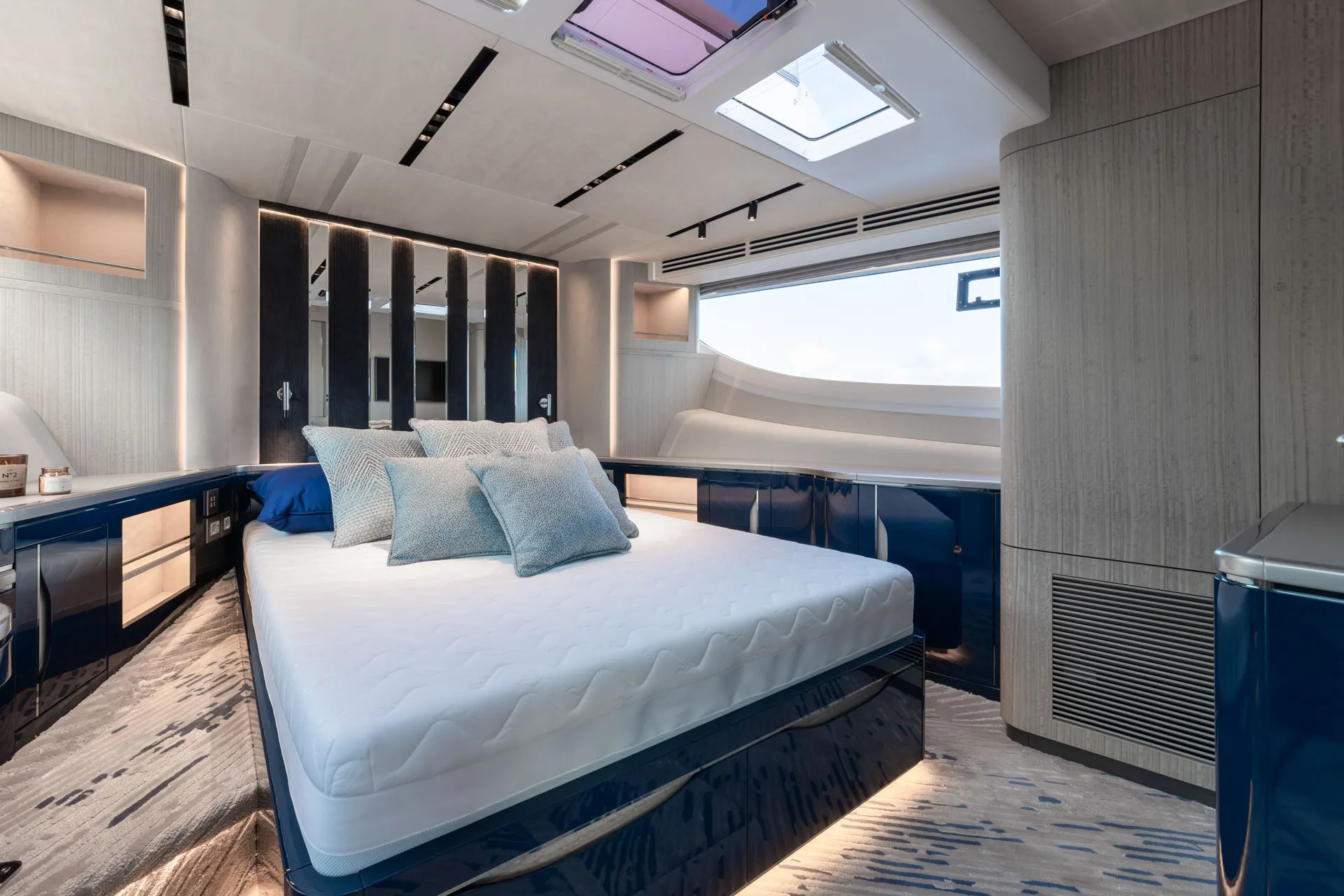
The midship owner's cabin is the full-beam suite, with a 43" LED television, a make-up desk, a sofa, generous storage and direct access to its own bathroom. Forward, the VIP takes a U-shaped layout that opens the space up rather than tucking a bed into the point of the bow; it carries its own 43" television, a closet, storage, an overhead skylight and access to a private bathroom. The starboard guest cabin has twin berths with an optional sliding mechanism to bring them together, and hull-side windows that give it real daylight instead of a hatch - a considerably better room than the bunk cabin that usually occupies that corner of a boat this size.
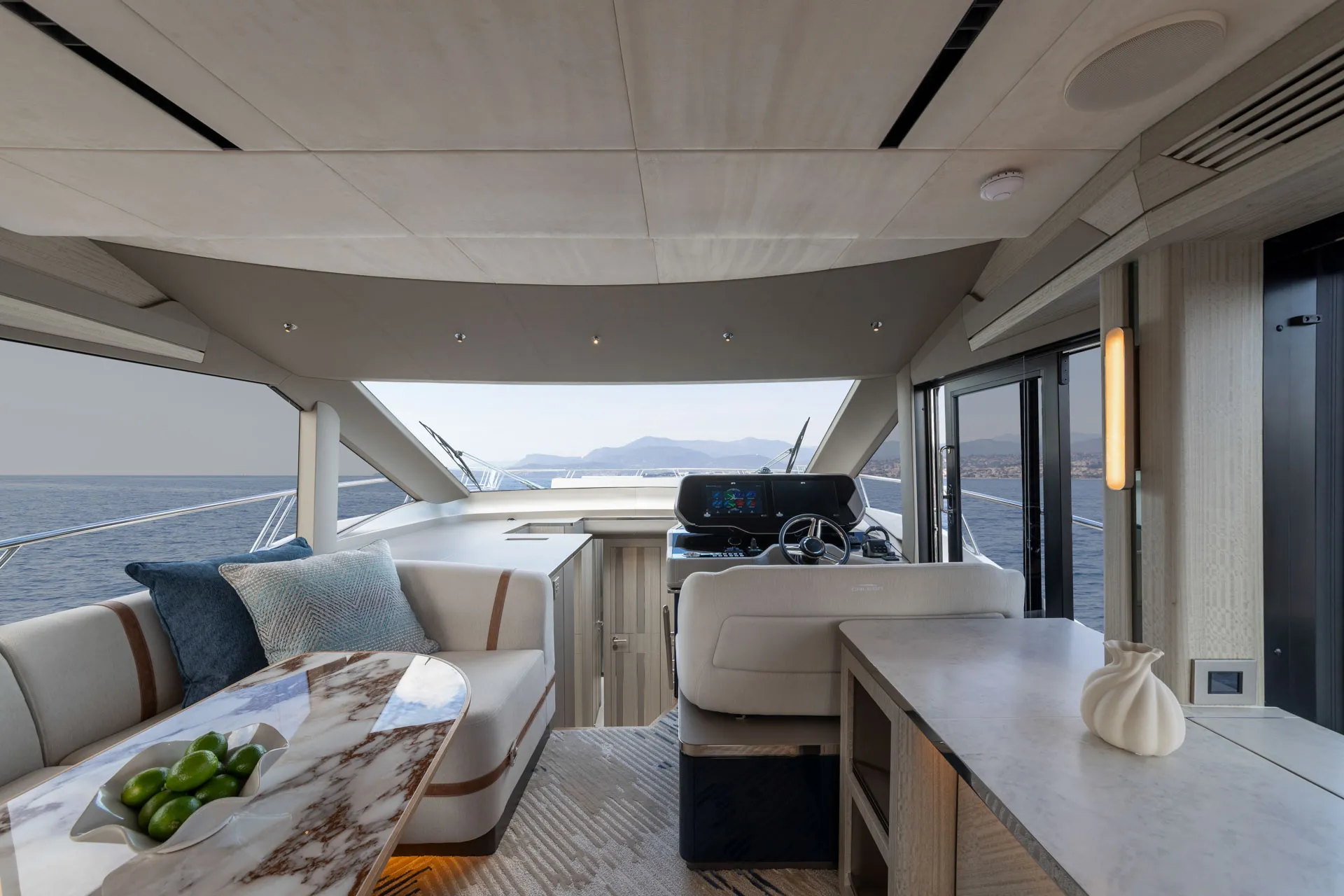
On the main deck the saloon is glazed hard down both sides, with a full galley, a lounge and a helm station with clear sightlines. Bar stools at the galley put it in conversation with the cockpit, and the openable side doors extend the room outward when the boat is stopped. Galeon offers the interior as a customisable package rather than a fixed scheme, with a choice of woodwork, fabrics and detailing.
Two numbers set the practical limits: 198 gallons of fresh water, and a black tank quoted between 66 and 70 gallons, with 61 gallons of grey. Those are the figures to plan pump-outs around.
The 560 FLY sits between the 520 FLY and the 620 FLY in Galeon's flybridge range, and the step up from the 520 is bigger than the fourteen inches of length overall suggest. Fuel goes from 476 gallons to 581 and fresh water from 172 to 198. The crew cabin stops being an option you trade against a tender garage and becomes part of the layout. Weight goes from 57,757 lbs to 70,565 - nearly six and a half tons - which says more about the difference in build than either length figure does.
Its closest relation is not in the flybridge range at all. The 560 FLY and the 570 SKY share the same 57' 7" length overall and the same 22' 6" beam with the balconies down. If you are drawn to this size and this beam but want the sportier profile, that is a conversation to have before you configure a flybridge rather than after - the two boats start from the same place and are ordered very differently.
Against the wider market, a high-fifties flybridge with crew quarters and a hydraulic platform puts a buyer in the same set as the Princess F55, the Ferretti 580 and Azimut's Fly range. What usually settles it here is what happens when the boat stops: the beam goes from 15' 10" under way to 22' 6" with the balcony down, and if that transformation is the feature you want, the shortlist gets short quickly.
One practical note. A new 560 FLY is a build slot rather than something waiting on a dock, so start the configuration conversation earlier than you think you need to.
The 560 FLY fits an owner who wants a crewed-capable boat that still feels like a private yacht rather than a small ship. The twin crew cabin aft is entered from the hydraulic bathing platform, not through the accommodation, so a captain or a mate can live aboard without ever crossing your saloon. That single detail is what separates this boat from the 520 below it, where the same volume is an option you trade against a tender garage.
It fits the buyer whose season is spent at anchor and on the top deck. The flybridge carries opposing U-shaped seating and dining areas, a forward helm with companion seating beside it, a wet bar and grill, and an overhang with room for free-standing loungers. Below that, Beach Mode opens the aft main deck with bars to port and starboard, and the optional portside balcony takes the beam from 15' 10" to 22' 6".
It fits a family that wants three real cabins and refuses to compromise the third. The starboard guest cabin has twin berths with an optional sliding mechanism and hull-side windows at berth level, which makes it a room rather than a locker with a mattress in it.
It is the wrong boat to buy without a sea trial - fuel burn is a number you will be measuring yourself, and the draft and the guest count belong on a build sheet rather than a shortlist. It is also the wrong boat if what you actually wanted was the sportier profile: the 570 SKY comes in at the same 57' 7" and the same 22' 6" open beam, and that decision is far easier to make before you configure than after.
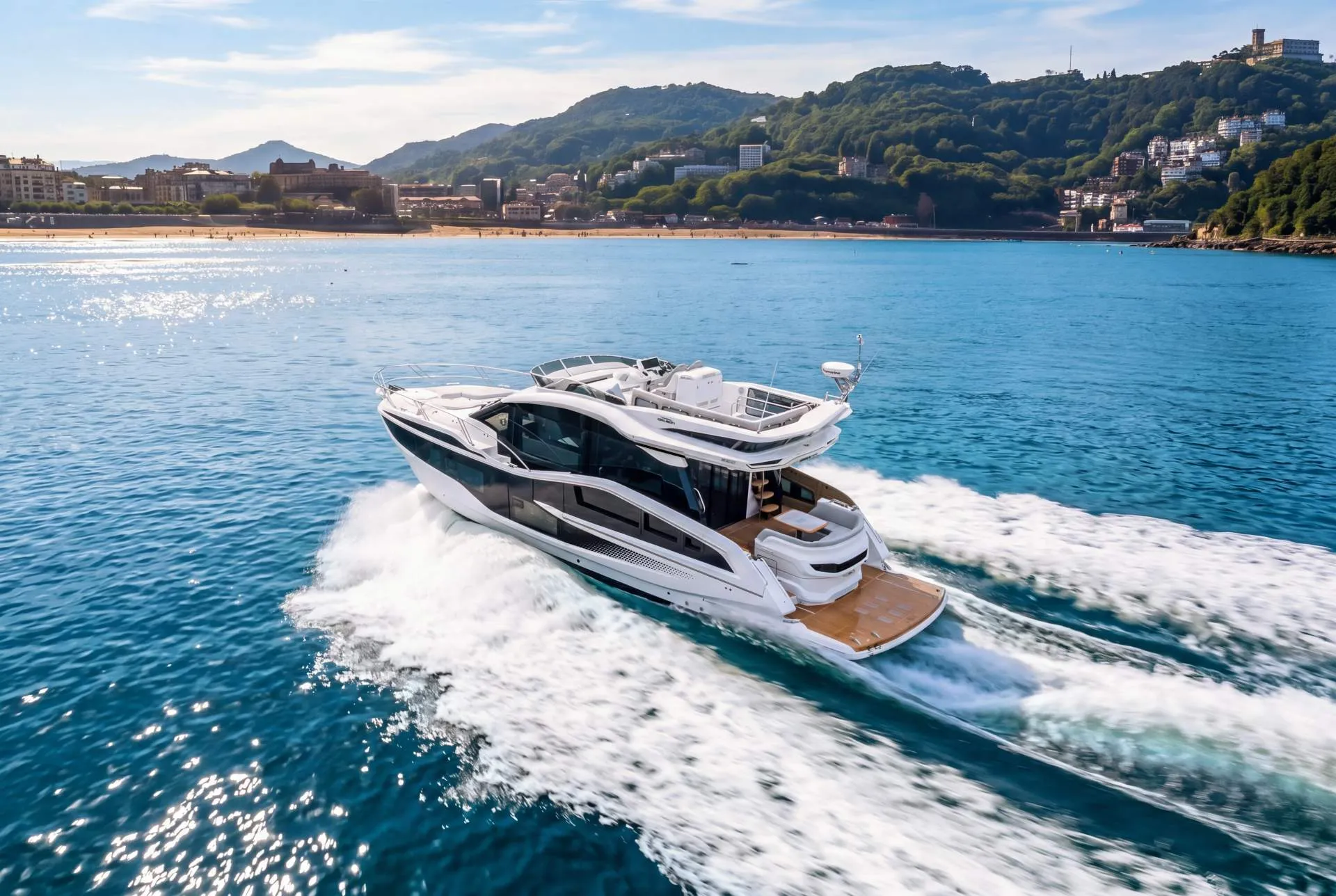
Twin Volvo Penta D13-900s, up to 31 knots. That is the top rig at 2 x 900 hp, and there is a smaller one below it - a minimum rating of 2 x 670 hp - so not every 560 FLY leaves the yard with the big engines. Read the 31 knots as a builder's "up to" rather than a measured result.
Tankage is 581 gallons of fuel and 198 gallons of fresh water. If a listing quotes a range, ask how it was measured - the number to work from is observed burn at your intended cruise, taken at sea trial and put in writing.
57' 7". That is the length overall to work from, and it is what the specification carries. The 56-foot figure comes from the marketing copy, which is where most listings pick it up. There is a third measurement worth knowing as well - a hull length of 53' 8" - which is a different thing again and is often what a yard is working from when it quotes a haul-out.
Guests are quoted at 14 with a crew limit of 12 - put the figure you intend to plan around on your build sheet. One thing this length does settle: the 570 SKY comes in at the same length overall and the same balconies-down beam, so the FLY and the SKY are the same hull with different top decks.
One side, port, and it is an option rather than standard equipment. The drop-down portside balcony is what takes the 560 from a beam of 15' 10" closed to a maximum beam of 22' 6" with the balcony down - a single balcony off the port side deck, ticked on the order form rather than fitted to every boat.
For scale against the boats either side of it, the 520 FLY goes 15' 3" closed to 21' 10" open, and the 620 FLY 16' 10" to 27' 2" - with both Beach Mode and Terrace Mode standard rather than optional. Because Beach Mode is an option here, two 560 FLYs can have two different beams. Ask which boxes were ticked on the specific boat you are looking at before you assume the balcony is there.
Plan for 5' 7", not the 3' 7" on the specification. Draft is quoted three ways on this boat: 3' 7" overall, 3' 4" for the bare hull without propellers, and 5' 7" for the hull with appendages once the running gear is on it. The largest of the three is the one a travelift sling and a shallow slip actually meet.
Two more numbers matter for the same reason: bridge clearance of 25' 4", which is a maximum height from the waterline at minimum draft, and height to transport of 28' 4". Light craft mass is 70,565 lbs with a maximum load of 11,435 lbs on top of it. If your berth or your bridge is tight, get the draft in writing against your own hull number rather than off a published figure.