
August 25, 2026
Galeon 400 FLY: What the Flybridge Costs on This Hull, and What It Buys
Galeon builds one 40' 11" hull and sells it two ways. The 400 FLY is the flybridge version - a second helm station with an L-shaped upper de…
Read the articleExpert Review, Technical Specifications & Market Analysis
| Feature | Specifications |
|---|---|
| Overall Length | 40' 11" |
| Beam | 12' 11" |
| Draft | 2' 11" |
| Displacement | 25,981 lbs |
| Engines | 2 x Diesel (up to 440 hp) |
| Fuel Capacity | 264 gal |
| Water Capacity | 118 gal |
| Cabins / Heads | 2 Cabins / 2 Heads |
| Max Speed | 28 knots |
Source: Spec & Photos courtesy of Galeon. Specs verified by Tony Smith, USCG 100 Ton Master, on August 24, 2026.
40' 11" on the same hull Galeon builds the 410 HTC on, ordered with a flybridge and a second helm station instead of a hardtop - plus the Beach Mode fold-out balconies the 360 FLY does not get.
Part of the Galeon FLY series — see how owners step up through the lineup.

Galeon has done something with this hull that I wish more builders would do, and it makes my job much easier when a client is torn. They build one 40' 11" boat and then let you decide what goes on top of it. Flybridge and a second helm, and it is a 400 FLY. Fixed hardtop with a sunroof and no upper deck, and it is a 410 HTC. Same length, same beam, same tanks, same engine band. So when a buyer asks me which one is the better boat, that is the wrong question. There is no better boat here. There is a roof you either want or you do not.
Here is how I would think about it. The flybridge buys you a second station and an outdoor room, and both of those change the boat at anchor more than they change it underway. The hardtop buys you about twelve hundred pounds less weight, a knot more on the top end by Galeon's own numbers, a foot less air draft, and a lower centre of gravity that you will feel in a beam sea. If you cruise inland with fixed bridges, or you want the boat to feel sporty under you, the hardtop is the honest answer. If you entertain at anchor and you want somewhere to sit that is not the cockpit, take the flybridge and do not apologise for it.
What I would tell you not to skip is Beach Mode, and not because it is clever - because you need to find out whether you would actually use it. Those balconies drop hydraulically and turn the cockpit into a terrace sitting just above the water, and buyers split hard on it. Half of them deploy it every single weekend and cannot imagine the boat without it. The other half open it twice the first summer and then stop. Go stand in a deployed cockpit before you commit, because it is a lot of hardware to carry around if you turn out to be the second kind of owner. One last thing: get real burn numbers off your own sea trial with your own engine package, in writing, and do not let anyone hand you an estimate instead.
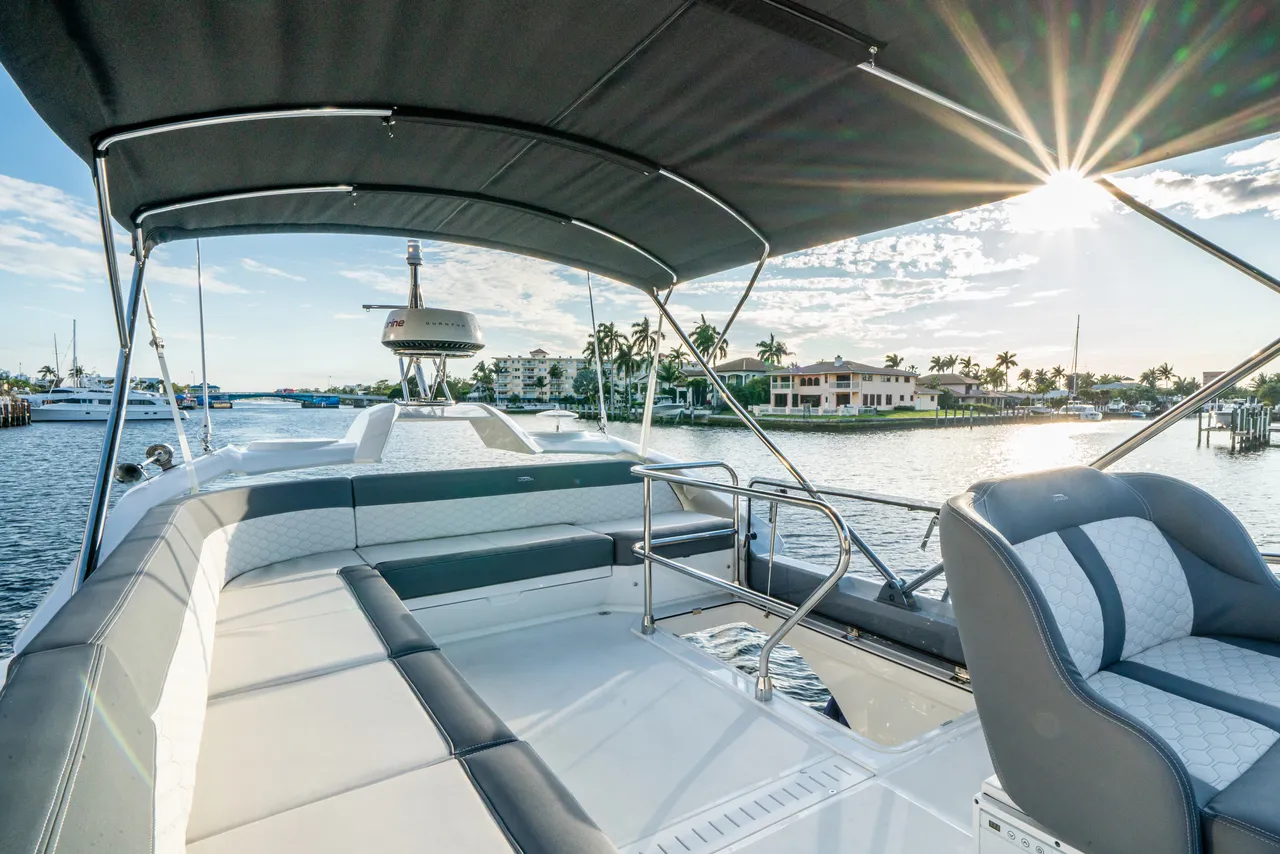
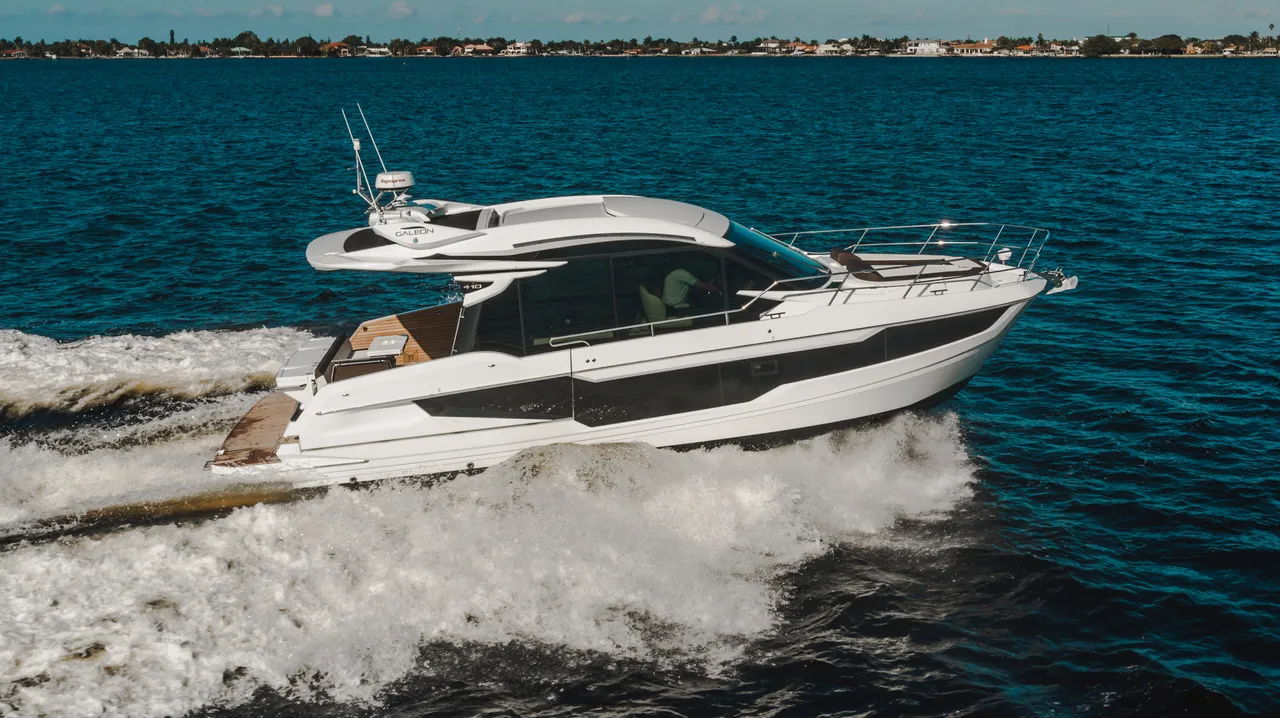
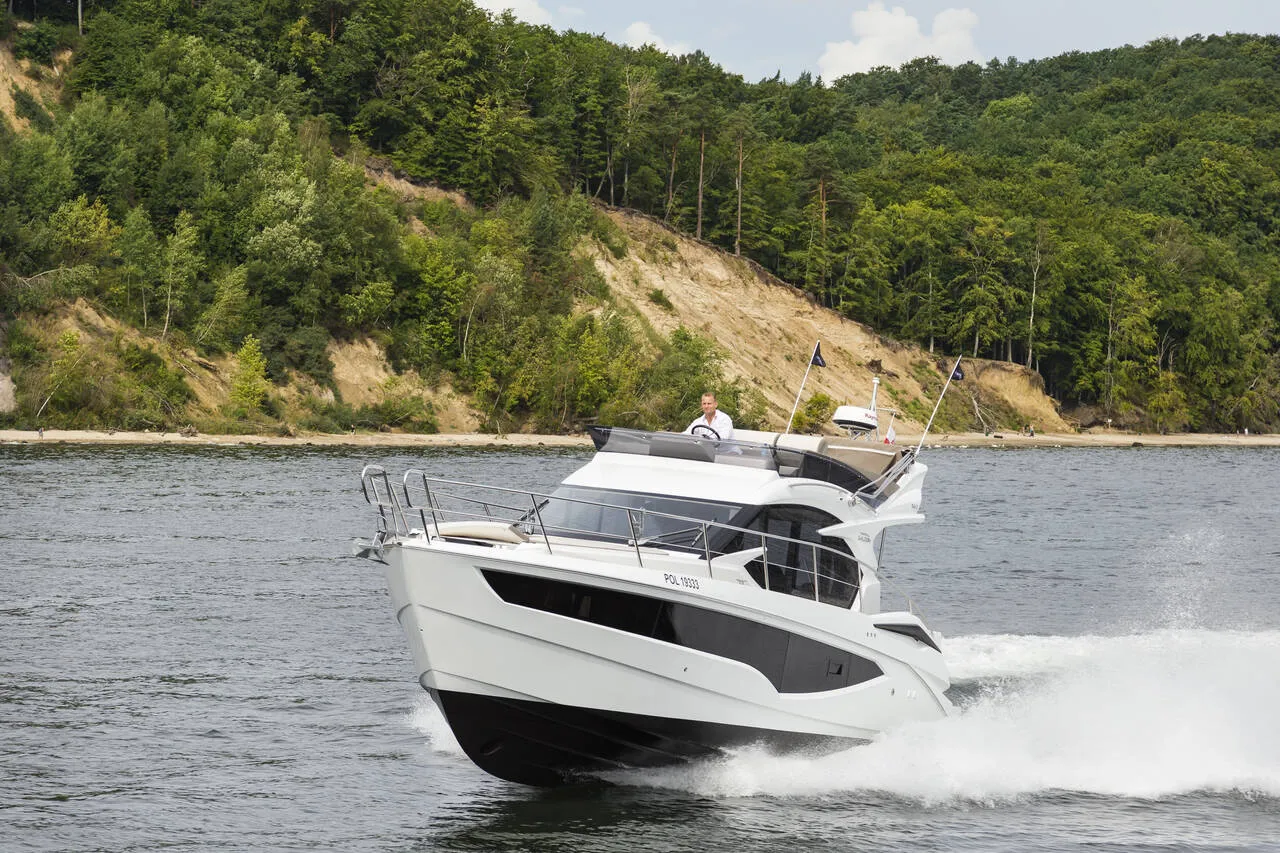
Photos courtesy of Galeon.
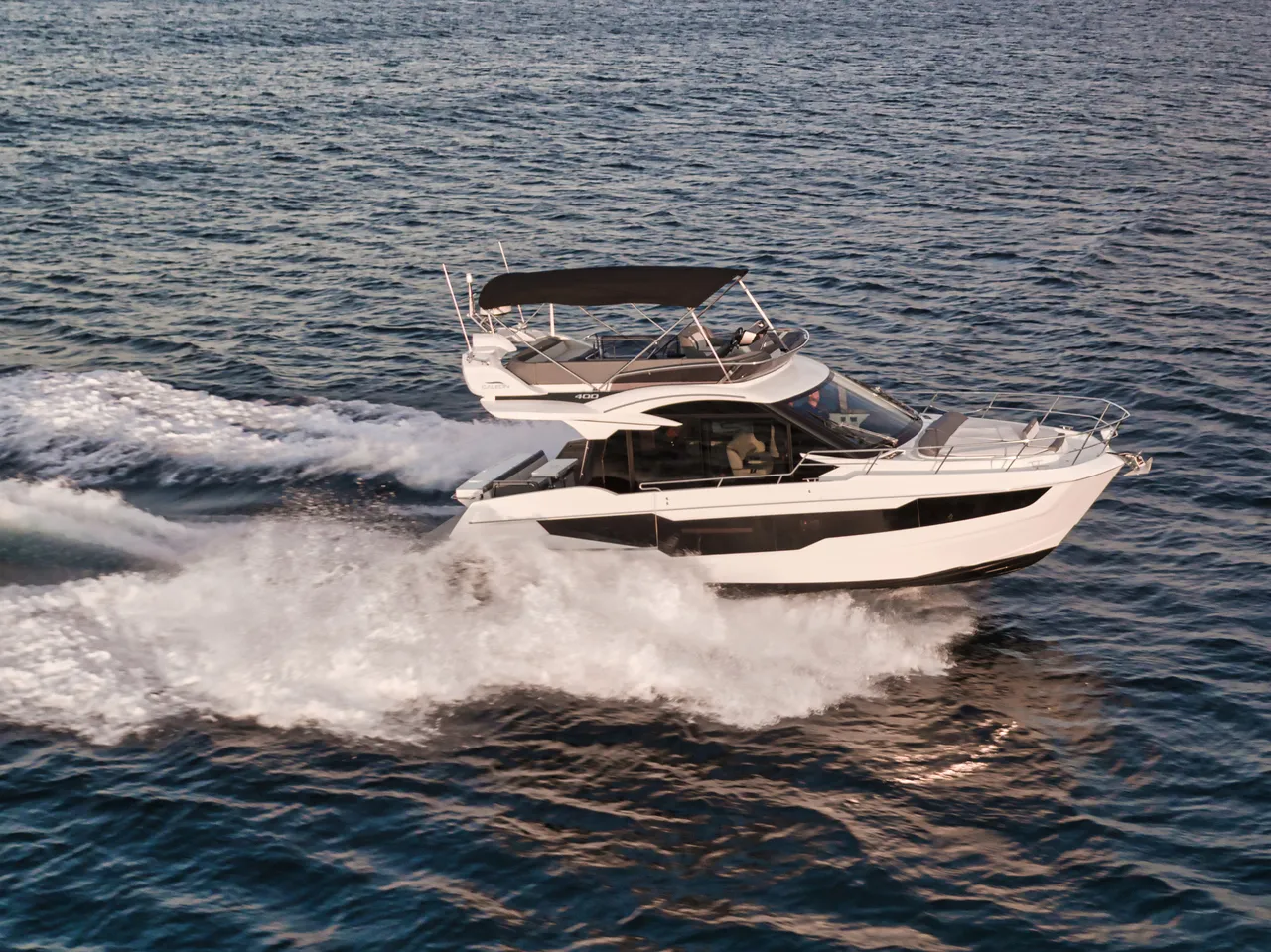
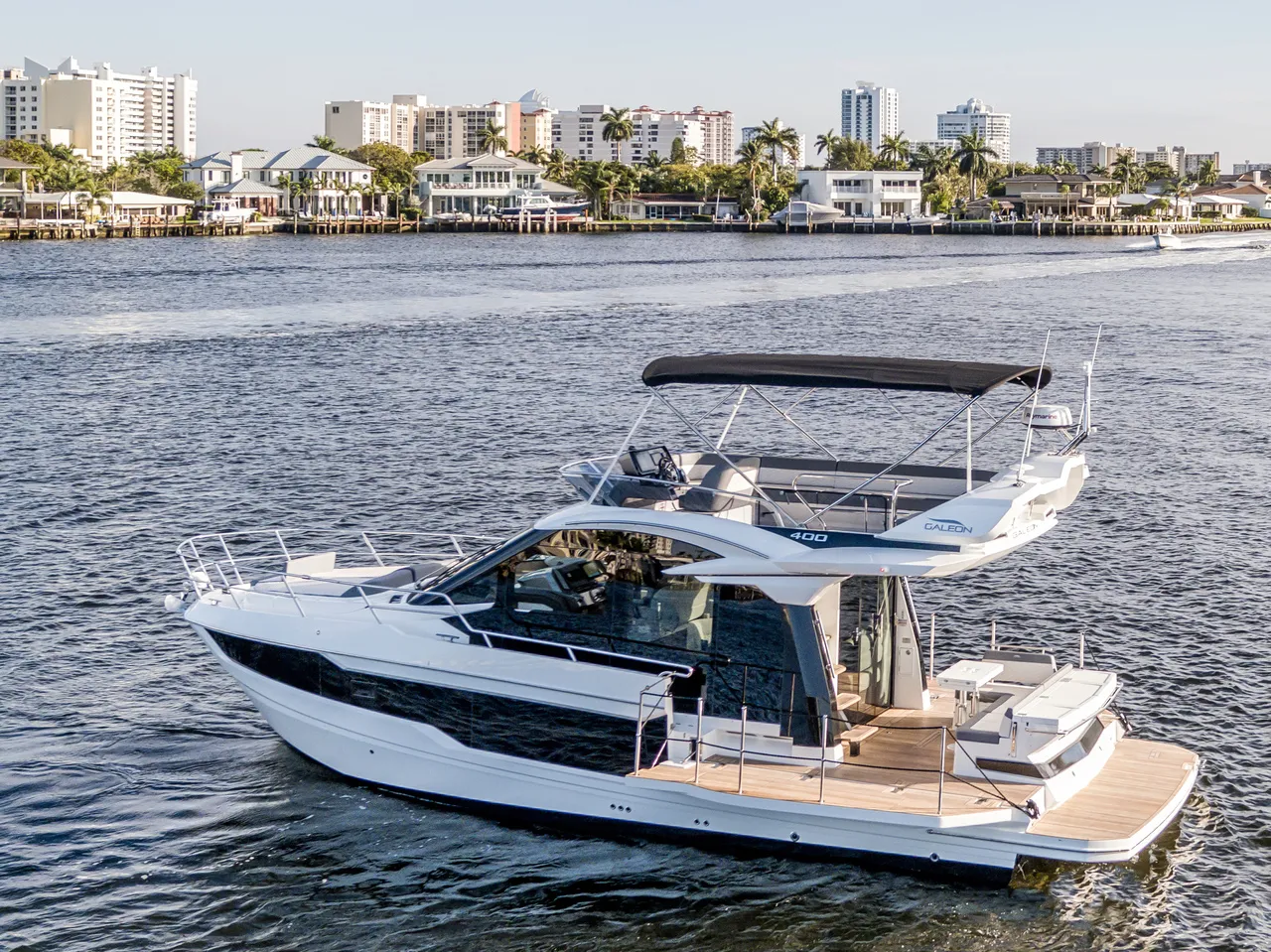
The Galeon 400 FLY is 40' 11" overall on a 12' 11" beam, and it shares that hull with the 410 HTC - Galeon describes the hardtop as inspired by the 400 FLY. Hull length, length overall, beam of hull, beam overall, fuel, water and both waste tanks are the same on the two models. What separates them is what sits above the main deck: the 400 FLY carries a flybridge with a second helm station, the 410 HTC carries a fixed hardtop and no upper deck at all.
The flybridge is the reason to buy this one. Galeon specifies an L-shaped seating and dining arrangement up there, a double helm sport seat, a compact wet bar and an optional bimini, with an expansive forward sundeck and an integrated front seat ahead of it. The aft cockpit runs Galeon's Beach Mode - hydraulic drop-down side balconies that open the cockpit out over the water. A hydraulic swim platform sits behind it, with an optional transom bar carrying a grill, chopping board, sink and drained cooler.
Fuel is 264 US gallons across two tanks. Fresh water is quoted between 118 and 119 gallons, grey between 34 and 42 and black between 33 and 34 - confirm all three on your build sheet. Light craft mass is 25,981 lbs with base engines, against a maximum load of 6,327 lbs. Bridge clearance is 15' 5", height to transport 14' 6", and the boat is CE Category B with a crew limit of twelve.
Engines are diesel and Galeon does not tie the boat to one builder: a minimum package of 2 x 270 hp and a maximum of 2 x 440 hp, for a top speed of up to 28 knots.
Galeon quotes a top speed of up to 28 knots for the 400 FLY. Work every number you plan a passage with off your own sea trial: observed burn at your intended rpm, in writing, on the engine package you are actually ordering.
The engine band runs from a minimum of 2 x 270 hp to a maximum of 2 x 440 hp, and Galeon does not tie the boat to one engine builder, so the specification is a power band and nothing more. A listing that tells you which diesels are fitted is describing one individual boat's build, not the model.
Draft is the number to pin down before you sign a slip lease. It is quoted at 2' 11" measured without propellers, with 4' 3" for the deeper measurement, while the same hull sold as the 410 HTC is quoted at 3' 3". Treat 2' 11" as the light figure and 4' 3" as the one that decides whether you clear your channel, and get the number for your own drive package in writing.
Light craft mass is 25,981 lbs with base engines and maximum load is 6,327 lbs, so a fully loaded 400 FLY is a little over sixteen tons. Bridge clearance is 15' 5" from the waterline at minimum draft and height to transport is 14' 6" - the numbers to check before you plan a route with a fixed bridge on it, and a foot taller than the same hull carrying a hardtop instead.
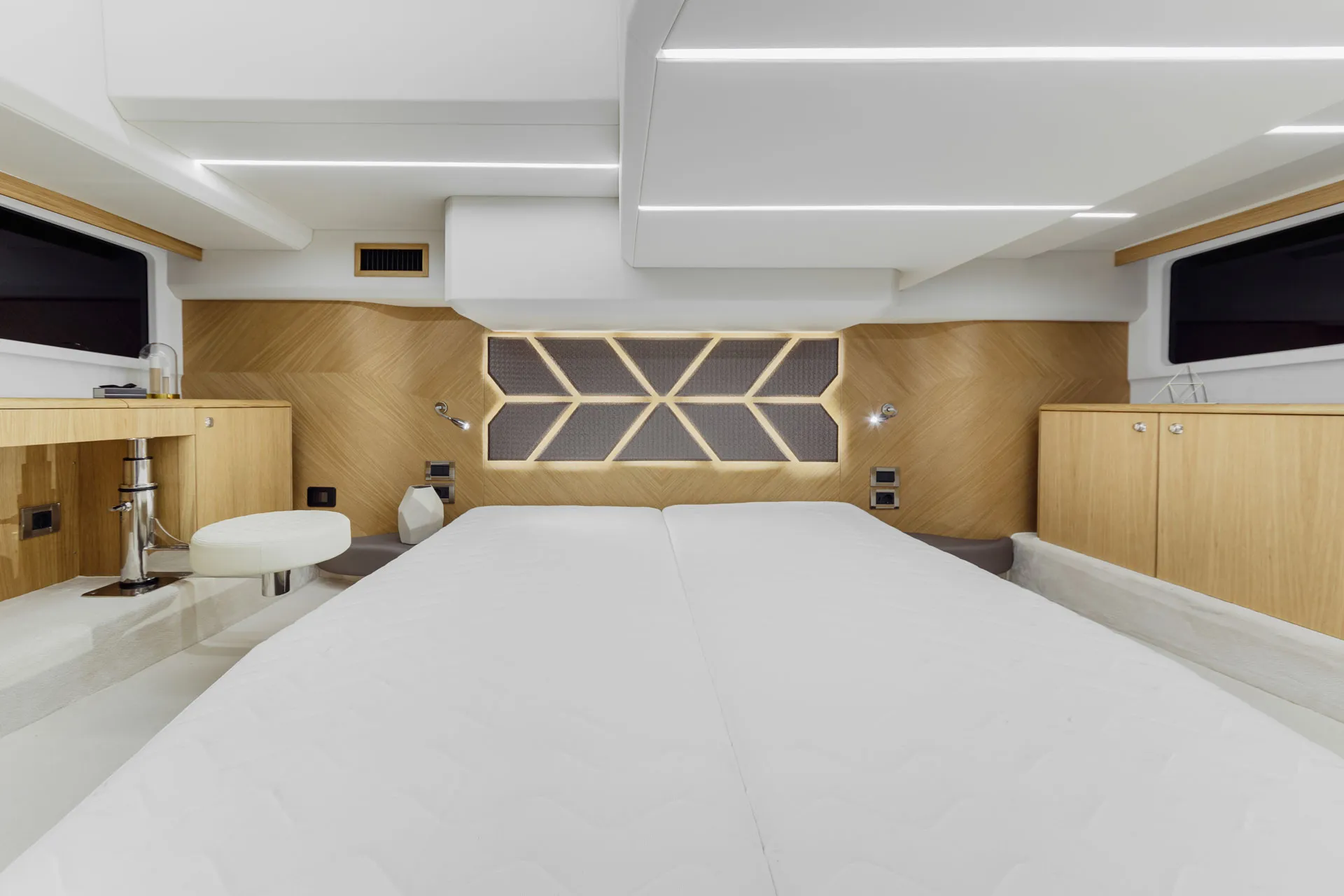
Two cabins, two heads, and both cabins get their own bathroom. That is the whole accommodation story, and on a 41-footer it is a genuinely uncommon one. Galeon puts the master midship where the hull is at full beam, with a generous double berth, a vanity station and storage worked into the volume under the saloon sole. The bow VIP takes twin V-shaped berths. Four people sleep aboard comfortably and nobody shares a head.
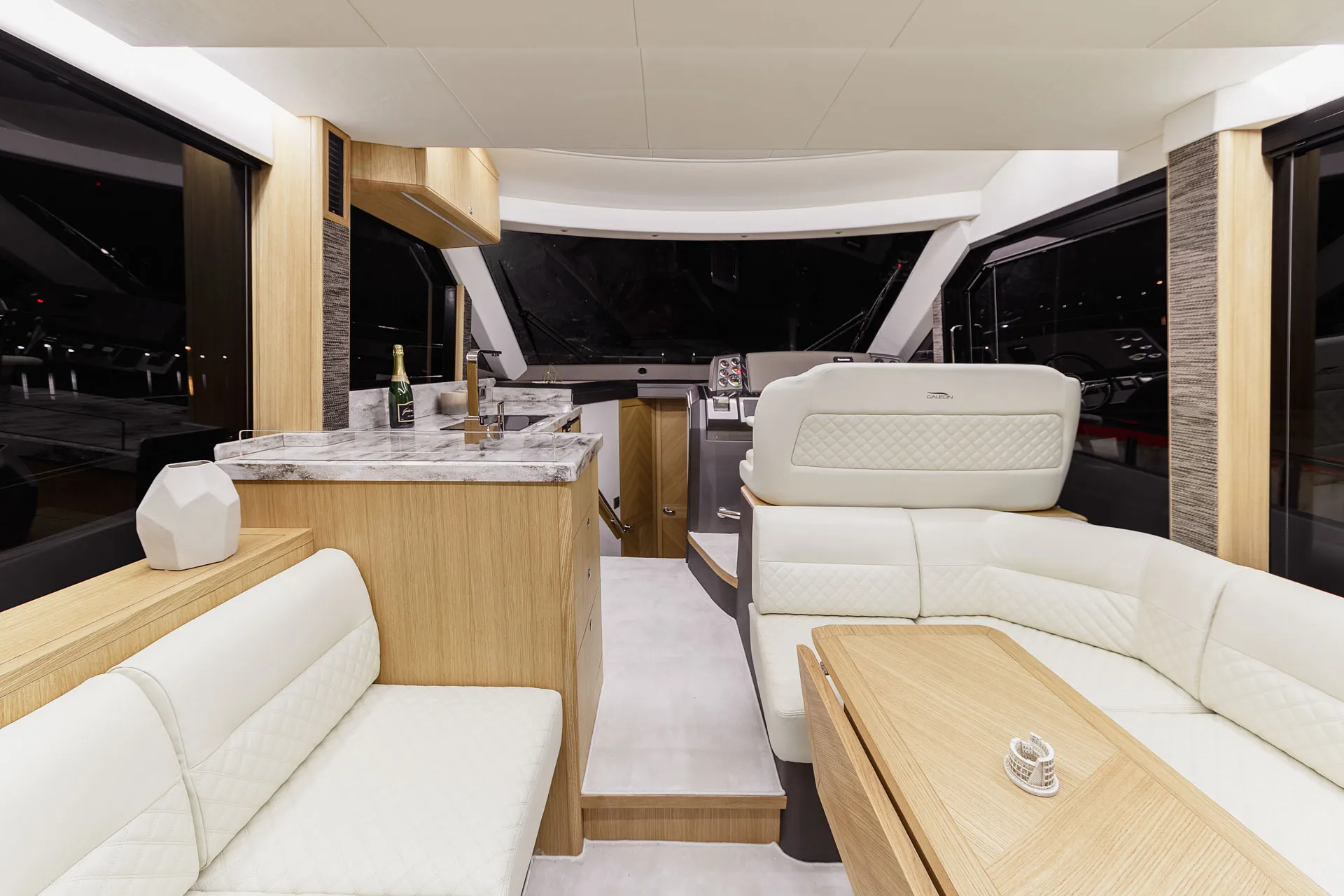
The main deck is one connected space. A C-shaped dinette and entertainment area sit aft, the galley and helm forward, and the galley's upper window slides open for cross-ventilation while you cook. Sliding starboard doors beside the helm let the driver step out to take a line without crossing the saloon. Sliding dividing doors open the saloon into the cockpit, and a two-way backrest and a pivoting double bench turn the aft seating so that indoor and outdoor spaces face each other rather than away.
Then Beach Mode. The side balconies drop hydraulically to open the cockpit outward over the water - Galeon calls it an over-the-water terrace. It is a system to see deployed rather than read about.
Interior finishes are offered as Oak matte, Dark Walnut Gloss, Lati Grey and Dark Walnut. Fresh water is 118 gallons against a 33-gallon black tank, and the black tank is what sets your pump-out interval, not the shower.
The 400 FLY's closest relative is not a competitor, it is the 410 HTC - the same 40' 11" hull with the same 12' 11" beam, the same 264 gallons of fuel, the same 118 gallons of water and the same 2 x 270 to 2 x 440 hp band. Galeon says outright that the 410 HTC was inspired by the 400 FLY. The difference is the roof. The 400 FLY carries a flybridge with a second helm, L-shaped seating and dining, and a wet bar. The 410 HTC deletes the upper deck entirely for a fixed hardtop with a retractable sunroof.
The consequences are measurable in three places. Weight: the 410 HTC's light craft mass is 27,192 lbs against the 400 FLY's 25,981, so the hardtop version is about 1,210 lbs heavier. Speed: 29 knots for the HTC against 28 for the FLY. Air draft: bridge clearance is 14' 5" for the HTC and 15' 5" for the FLY, a foot that matters on inland runs. And Galeon's own argument for the hardtop is that removing the flybridge lowers the centre of gravity and sharpens the handling.
So the choice is not a spec-sheet exercise. It is whether you want a second station and an outdoor room upstairs, or a lower, marginally faster boat with weather protection over the helm. Both are the same hull underneath.
Inside the FLY line the step below is the 360 FLY at 38' 7", which gives up a foot and a half of beam, 53 gallons of fuel, the second head as standard, and Beach Mode altogether. The step above is the 420 FLY. Against the wider market, buyers at 41 feet with a flybridge are cross-shopping European production flybridge cruisers in the 40- to 45-foot band, and what usually settles it is whether Beach Mode changes how you would actually use the cockpit. See it deployed before you decide it is a gimmick, and see it deployed before you decide it is the reason to buy.
The 400 FLY fits the owner who wants a flybridge and a second helm on a boat he still drives himself. Twelve is the crew limit, four is the overnight number, and the flybridge is a genuine outdoor room - L-shaped seating and dining, a double helm sport seat, a wet bar, an optional bimini, and an expansive sundeck ahead of it.
It fits entertainers particularly well, because of what happens at anchor. Beach Mode drops the side balconies and turns the cockpit into a terrace over the water. The hydraulic swim platform behind it takes a tender or the water toys, and the optional transom bar puts a grill, a sink, a chopping board and a drained cooler where the cooking should happen - outside, aft, out of the galley. Fold-out tables on both decks mean you can feed people upstairs or downstairs without moving furniture.
It fits couples who take guests rather than families who take children. Two cabins, two en-suite heads, no bunk cabin and no third berth. If the boat has to sleep six, Galeon does not offer a layout here that makes it one.
It is the wrong boat if air draft is a constraint. Bridge clearance is 15' 5" and height to transport is 14' 6"; on the identical hull the hardtop 410 HTC is a foot lower at the bridge. And if you want the lower, sharper-riding version of this hull, that boat already exists - it is the 410 HTC, and the only thing you give up is the upstairs.
It carries about 264 US gallons of fuel in two tanks and about 118 gallons of fresh water. Range is a sea-trial number on this boat: get observed burn at your intended rpm in writing and work your own numbers off the 264 gallons, because a boat rated from 270 to 440 hp per side will not return one answer.
If a listing hands you a range or economy figure, ask who ran it, at what load, and with which engine package. The published performance figure is a top speed of up to 28 knots. Draft is worth a question too - it is quoted at 2' 11" and at 4' 3" for the deeper measurement, so size a berth off the deeper figure.
They are the same boat below the rail, so the decision is entirely about the roof. Galeon builds one 40' 11" hull here and sells it two ways, and says as much itself: the 410 HTC is the hardtop version, inspired by the award-winning 400 FLY, with a sleek coupe-like silhouette. Length overall, beam, fuel and water are the same on both - 40' 11" by 12' 11", two cabins, two en-suites, the same tankage and the same 2 x 440 hp ceiling.
Four differences decide it. The 410 HTC is heavier, at 27,192 lbs against 25,982 for the FLY - about 1,210 lbs, which is essentially the flybridge you did not build. It is lower, with bridge clearance of 14' 5" against 15' 5". It is a knot quicker, 29 knots against 28. And Galeon's stated argument for it is handling: without a flybridge the centre of gravity is lower, which improves handling and reduces sway. Buy the FLY for the second deck and the entertaining space above; buy the HTC for the bridge clearance and the ride.
The closed beam is 12' 11", and the opened-balcony figure is one to get from Galeon in writing for your own hull. Beach Mode is the model's headline feature - the first time Galeon brought the idea into the 40-foot flybridge class - and the balconies genuinely transform the cockpit at anchor.
For reference points, the identical hull sold as the 410 HTC opens to 21 ft, and the larger 420 FLY opens to 19' 4" from a 13' 1" beam. Do not plan a side-tie, a slip width or a swing on a figure inferred from either of those - a shared hull does not guarantee a shared balcony. Ask for the opened beam in writing before you commit to a berth that depends on it.
Two, both with private bathrooms, sleeping four. The full-beam master sits amidships and carries a vanity station and a generous double bed; the VIP cabin at the bow takes twin V-shaped beds. Galeon rates the boat plainly as two cabins and two en-suites, with a crew limit of 12, CE Category B and a maximum load of 6,327 lbs.
The trade against its neighbours in the range is berths versus privacy. The smaller 360 FLY offers two or three cabins but only one en-suite plus a day head, so it can sleep more people less privately; the 420 FLY keeps the same two-cabin, two-en-suite arrangement on a longer hull with a king-size master and more headroom. On the main deck the 400 gives you a C-shaped dinette and entertainment area with the galley and helm forward, a sliding galley window for ventilation, and sliding starboard doors for mooring.