
The Horizon RP110: Where Ocean-Crossing Capability Meets Raised-Pilothouse Luxury
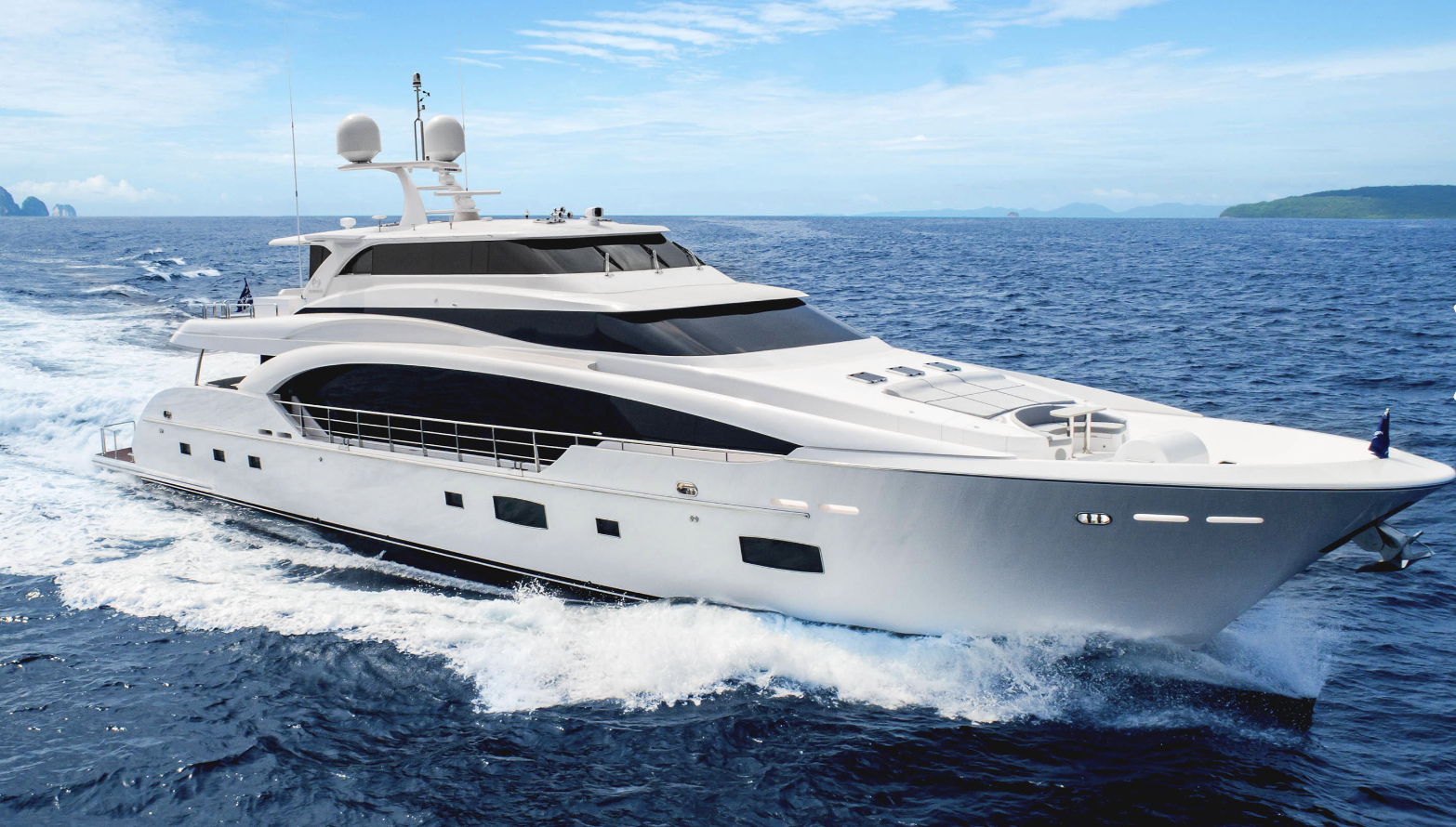
Photo Credit: Horizon Yachts
Picture this: you're anchored off the Abrolhos Islands, 40 miles west of Geraldton, Western Australia. The sun is setting over one of the world's last true wilderness coastlines. Your crew has just secured the 5.3-meter tender in the hydraulic beach club, and you're watching the day's catch being prepped on the flybridge teppanyaki grill. Tomorrow, you'll push north toward the Kimberley, 650 nautical miles of open ocean ahead. Tonight, you're sipping wine in the climate-controlled skylounge, watching thermal imaging screens track a pod of dolphins circling the hull.
This is the Horizon RP110's design brief in action. Not a floating palace that hides from weather. A genuine ocean-crossing platform that happens to deliver superyacht-level comfort while doing it.
Who It's For
The RP110 sits in a specific sweet spot: serious cruisers who've outgrown the 80-foot segment but aren't ready to commit to the operational complexity of a 130-footer. You're looking at 110 feet of length overall, a 25-foot beam, and 230 gross tons. This is crew-operated territory—budget for four to six professionals—but the systems are approachable enough that an experienced owner-operator can handle coastal passages with a good captain and engineer aboard.
The raised pilothouse configuration is the tell. You're buying this layout because you want a private upper salon—a climate-controlled retreat separate from guest entertaining spaces—and because you value the helm visibility that comes with an elevated bridge deck. Owners tend to be experienced cruisers, often upgrading from semi-custom production yachts in the 80- to 90-foot range, who've learned that range and seakeeping aren't negotiable when your cruising grounds include the Pacific Northwest, the Bahamas' outer islands, or Australia's remote northwest coast.
The RP110 competes directly with the Westport W117 and Ocean Alexander 32L, but Horizon's Taiwan build quality and customization flexibility give it an edge for buyers who want a semi-custom experience without full custom pricing.
Design & Layout
J.C. Espinosa's exterior lines are purposeful rather than flashy. The raised pilothouse creates a streamlined profile—graceful sheer from bow to transom, with the superstructure flowing naturally over the elevated helm deck. The hardtop over the flybridge is permanent, not a targa arch, which tells you everything about this yacht's intended use: serious miles in serious conditions.
The real story is below the waterline. Naval architect Donald Blount designed a double-chine semi-displacement hull that delivers genuine seakeeping. The chines minimize drag, improve hydrodynamic efficiency, and provide roll damping without relying solely on stabilizers. One Australian owner extended the keel 30 centimeters along its length to reduce swing at anchor in strong winds—a modification that speaks to the platform's flexibility and the real-world thinking of Horizon's client base.
On deck, the layout prioritizes usable space over Instagram moments. The aft deck seats ten for dinner with room to move. The flybridge runs the full beam, with multiple seating zones, a wet bar, and optional teppanyaki grill. The hydraulic swim platform extends 60 centimeters beyond the standard spec to accommodate a 5.3-meter RIB, and it doubles as a beach club when the tender's deployed—fold-down bulwarks, underwater lighting, and direct access to the day head and shower.
Inside, the main deck is anchored by a full-beam master suite forward. Walk-in closets, a king berth, and ensuite with separate shower and tub. The salon is open-plan, with the galley forward and dining for eight amidships. Sightlines run unobstructed through floor-to-ceiling windows—you're buying this much glass because you want to see the ocean, not hide from it.
Below deck, four guest cabins sleep eight: two doubles, two twins with Pullman berths. Each cabin gets its own ensuite. Crew quarters are forward or aft depending on layout choice, with three cabins for up to six crew. The flexibility here is real—Horizon has built RP110s with six guest cabins, forward master layouts, and enclosed or open flybridges. This is a semi-custom platform, not a cookie-cutter production boat.
Performance & Handling
Twin Caterpillar C32 ACERT engines are standard—1,800 horsepower each at 2,300 rpm. Optional 1,900-horsepower versions push top speed to 22 knots, though most owners cruise at 18 knots for a 650-nautical-mile range. The real number is 8.5 knots: at that speed, you're burning 80 liters per hour combined, and the 21,000-liter fuel capacity delivers 2,350 nautical miles of range. Fremantle to Bali and back without refueling.
The semi-displacement hull is efficient at displacement speeds and capable at planing speeds. At 14.5 knots, you're burning 400 liters per hour—a middle ground that covers ground without hemorrhaging fuel. At 20 knots, consumption jumps to 770 liters per hour, but you're moving at 23 miles per hour in a 255,000-pound yacht. The physics are impressive.
Seakeeping is where the Blount hull earns its reputation. The double-chine design provides natural roll damping, and zero-speed stabilizers keep the yacht steady at anchor. Owners report confident handling in 6- to 8-foot seas, with the raised pilothouse offering excellent visibility for navigating reef passes and uncharted waters. The helm is equipped for serious offshore work: five color screens covering navigation, radar, sounder, systems monitoring, and FLIR thermal imaging. One owner added 3D scanning sonar—commercial-grade equipment that maps the seabed in real time and locates fish schools 360 degrees around the hull.
The twin Muir VRC6000 windlasses and 160-kilogram Ultra anchors are overkill for most anchorages. They're sized for the conditions you'll encounter when you're 1,000 miles from the nearest boatyard and the forecast calls for 30-knot winds overnight.
The Ownership Conversation
Pricing for a new RP110 starts around $10 million and climbs quickly with options. Used examples range from $4.5 million for a 2014 hull to $8.5 million for a recent build. Annual operating costs—crew, fuel, insurance, maintenance, dockage—run $800,000 to $1.2 million depending on how much you cruise. That's $70,000 to $100,000 per month to keep the yacht ready to go.
Here's the value proposition: you're buying the freedom to say yes when the weather window opens. The Kimberley. The Sea of Cortez. The Exumas. These aren't weekend destinations. They require range, seakeeping, and systems redundancy. The RP110 delivers all three, with enough onboard comfort that your guests don't feel like they're on an expedition vessel.
Crew is non-negotiable at this size. Budget $250,000 to $350,000 annually for a captain, engineer, chef, and stewardess. Good crew makes the difference between a yacht that sits at the dock and one that logs 3,000 miles per season. Horizon's systems are well-documented, and the yard's support network extends through Asia-Pacific, the Americas, and Europe. Parts availability is strong, and the Caterpillar engines are supported worldwide.
The customization process is where Horizon separates itself from production builders. Buyers make multiple trips to the Taiwan yard during the 18- to 24-month build. You're not picking from a catalog. You're specifying keel extensions, windlass upgrades, additional generators, fuel transfer systems, dive compressors, and custom interior layouts. One owner added a 55-horsepower stern thruster and rope cutters on the props—details that matter when you're maneuvering in tight anchorages or navigating kelp beds.
Resale is steady. The RP110 holds value because it's a proven platform with a strong owner community. Buyers looking at used examples should focus on maintenance records, engine hours, and how the yacht was used. A well-maintained RP110 with 1,500 hours and documented service history is a better buy than a low-hour yacht that sat unused for years.
Where to Start
Explore full specifications at www.YachtSpecsDirect.com.
Browse available Horizon inventory at www.mintedyachts.com/horizon.
The RP110 rewards owners who use it the way it was designed: long passages, remote anchorages, and the kind of cruising that requires a yacht built to go the distance.