
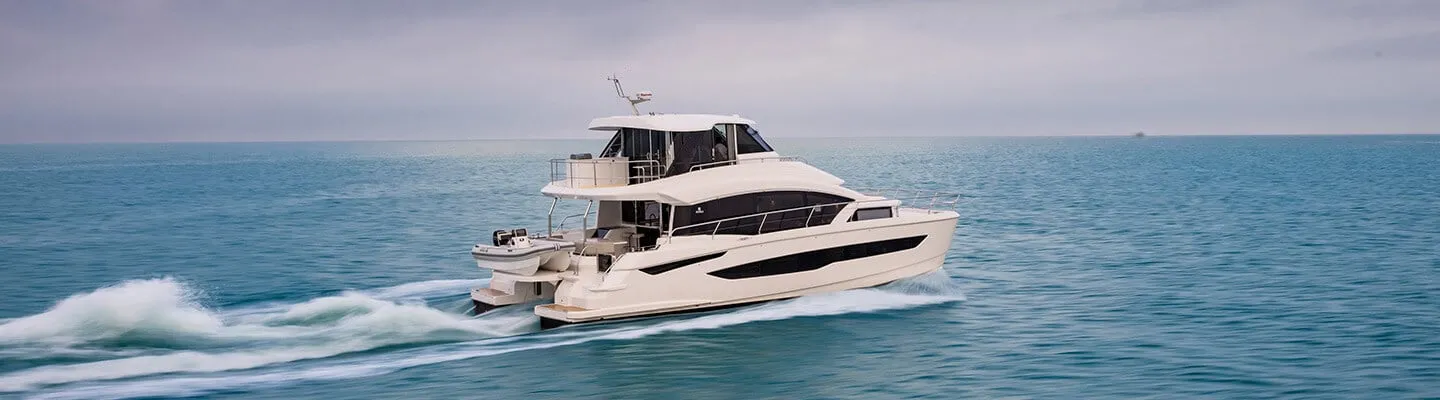
Aquila 54 Yacht 54' 2"
View Specs & Review1,260 berths, a 35-tonne lift, and a customs regime written in Paris
Yachting in Guadeloupe
A Minted Location · Guadeloupe, The Leewards
If you want somewhere in the eastern Caribbean to leave a boat with a berth waiting and a price you can work out before you call anyone, you are looking at Pointe-à-Pitre — and the price is printed to two decimal places, per foot, in euros.
Marina Bas-du-Fort publishes 1,260 berths on pontoons, spread over twenty-three closed and secured quays, plus fifty mooring buoys across three basins. The Grand Port Maritime de la Guadeloupe, which granted the concession, gives "plus de 1000 places réparties sur 23 quais, complétées par 45 postes de mouillage sur bouées." The marina's own presentation calls it "la plus ancienne marina de la Guadeloupe, mais aussi la plus importante de la Caraïbe" — the oldest marina in Guadeloupe, and the largest in the Caribbean. It was built in 1977 to host the first Route du Rhum, and it still runs the finish.
The ceiling is published in the harbour rules rather than the brochure, and it is a hard one. Article 2.1 of the règlement intérieur reserves the port for pleasure vessels "ne dépassant pas les 150 tonnes et 50 mètres de long" — not exceeding 150 tonnes and 164 ft (50 m). The quai d'honneur Florence Arthaud takes the big units "jusqu'à 50 m de long et 4,50 m de tirant d'eau" — 164 ft (50 m) and 14.8 ft (4.50 m) of draft. Article 2.4 adds the detail people argue about at the desk: the length that gets billed is "la longueur hors tout", overall length, not registered length.
And then the paperwork, which is where the "it's France, so it's easy" instinct needs correcting. French customs publishes that Guadeloupe "fait partie du territoire douanier de l'Union européenne mais est considérée sur le plan fiscal comme un territoire tiers" — inside the EU customs territory, treated as a third territory for tax. Clearance is compulsory in both directions for every pleasure vessel "quels que soient leur nationalité et leur port d'attache" — whatever her flag and whatever her home port — and has been electronic since 1 September 2024. An EU flag buys you a customs territory here. It does not buy you a shortcut.
Where to keep a yacht in Guadeloupe
Bas-du-Fort is the market, and it publishes its numbers in full.
| Berths | 1,260 on pontoons, over 23 "quais fermés et sécurisés" · the port authority gives "plus de 1000" |
| Buoys | 50 "postes de mouillage sur bouée" in three basins · the port authority gives 45 |
| Îlet Cochon | a further 55 moorings, managed by the marina |
| Port ceiling | 150 tonnes and 164 ft (50 m) — règlement intérieur, art. 2.1 |
| Big-yacht quay | Quai d'honneur Florence Arthaud — 164 ft (50 m), 14.8 ft (4.50 m) draft |
| Fuel | 07:00–19:00 every day including public holidays · unleaded, diesel, and duty-free unleaded and diesel · bunkering from 5,000 litres |
| Utilities | Drinking water, electricity and Wi-Fi on the quays · ISPS, full CCTV |
| VHF | Channel 9 for the dock agents · CROSS AG on 16 for emergencies |
| Dock agents | 07:30–18:30 daily low season · 07:00–20:00 daily high season |
| Capitainerie | 08:00–13:00 / 14:00–17:00 Mon–Fri low season, Sat to 13:00 · 08:00–13:00 / 14:00–17:30 Mon–Sat high season |
Public holiday hours are published as 08:00–13:00 on the French pages and as 8 a.m. to 12 p.m. on the English one — ask when you book.
The 2026 tariff is published in full, in euros including tax, and it is charged per foot per day. You can price a season before you call anyone.
| Band | Per ft/day | Per ft/month | Per ft/year |
|---|---|---|---|
| 10–21 ft | €0.69 | €6.79 | €60.72 |
| 22–31 ft | €0.77 | €9.27 | €82.90 |
| 32–49 ft | €0.89 | €10.19 | €91.08 |
| 50–65 ft | €1.01 | €11.08 | €99.26 |
| 66–99 ft | €1.24 | €13.38 | on request |
| 100 ft + | €2.04 | €24.04 | on request |
Annual rates are published up to 65 feet. Above that, price the month and agree the year with the capitainerie — a 70-footer at €13.38 per foot is €936.60 a month.
"Majoration de 1,5 pour les multicoques." A catamaran pays one and a half times the monohull rate, and that is published rather than negotiated. On a 45-footer the annual rate goes from €4,098.60 to €6,147.90. There is also a 1.3× uplift for floating cradles and lifts, 1.36× if they are over 4.50 m wide, a 9% surcharge on liveaboard boats from one month of berthing, and a 50% reduction on the buoy moorings except the ten-day package.
Rivière-Sens, on the south-west corner at Gourbeyre, is the second real marina and it publishes the number that actually selects the boat. 330 berths, "Profondeur : maximum 2.50m / 8.3pied" — a maximum depth of 8.2 ft (2.50 m) — and a welcome pontoon "jusqu'à 25m / 83pied". Lit pontoons, water and power on the quay, badge-gated access, VHF channel 9, and a customs clearance terminal in the capitainerie. Eight feet is the whole story there: it is a comfortable base for a 60-foot flybridge drawing five feet and it is closed to a deep-draft performance boat, regardless of length.
Saint-François is a telephone call. The commune runs the port, and its capitainerie keeps Monday, Tuesday and Thursday 07:30–16:00, Wednesday and Friday 07:30–13:30 — berth length, depth and availability are settled on that call, or at marina@ville-saintfrancois.fr.
Marie-Galante works without a harbour office. The island's own tourist office puts it plainly — "Pas de capitainerie à Marie-Galante" — so plan it as an anchorage. Grand-Bourg publishes 1.80 m (5.9 ft) maximum draft and describes that basin as "toujours très encombré." Water and electricity are paid services, available at Grand-Bourg only, through the community of communes in office hours.
Marinas
| Name | Where | Max yacht | Slips | Fuel |
|---|---|---|---|---|
| Marina Bas-du-FortThe operator's own words: "la plus ancienne marina de la Guadeloupe, mais aussi la plus importante de la Caraïbe", built in 1977 for the first Route du Rhum. 1,260 berths across twenty-three secured pontoons, 50 mooring buoys in three basins, and 55 more the marina manages at Îlet Cochon. The ceiling comes from the règlement intérieur: vessels "ne dépassant pas les 150 tonnes et 50 mètres de long", with the quai d'honneur Florence Arthaud taking 50 m on 4,50 m of draft (164 ft / 14.8 ft). Berthing is billed on overall length and catamarans pay 1.5× — read the marina's current tariff for your own band before you budget. Water, power and Wi-Fi on the quays, metered on a pre-credited badge. Bring the acte de francisation and an insurance attestation covering "RC - INCENDIE - CYCLONE", and confirm approach depth with the dock agents on VHF 9 before you arrive. | Petit Cul-de-Sac Marin, Pointe-à-Pitre / Le Gosier | 164 ft | 1,260 | Station d'avitaillement, 07:00–19:00 every day including public holidays — unleaded, diesel, duty-free unleaded and diesel; bunkering from 5,000 litres |
| Marina de Rivière-SensThe market's depth story. The operator publishes "330 Postes d'amarrage" and "Profondeur : maximum 2.50m / 8.3pied" — a maximum depth of 8.2 ft (2.50 m) — with a welcome pontoon "jusqu'à 25m / 83pied". Eight feet governs here regardless of length: comfortable for a 60-foot flybridge, closed to a deep-draft performance boat. Lit pontoons, water and electricity on the quay, badge-gated pontoon access, Wi-Fi, marine forecasts posted, a plateau technique, and "Clearances douanière - Ordinateur disponible" — a customs terminal at the desk. Run by Sud Ancrage under a public service delegation since 2010, after dredging and full pontoon replacement, and put back together again after the 2022 storm season. Fuel, lifting and berth rates are agreed with the capitainerie on VHF 9. | Gourbeyre, south Basse-Terre | 82 ft | 330 | Station service "à proximité" — confirm hours with the capitainerie |
| Port de plaisance de Saint-FrançoisThe commune of Saint-François runs the port, and it works by telephone. The capitainerie keeps Monday, Tuesday and Thursday 07:30–16:00 and Wednesday and Friday 07:30–13:30, and berth length, depth, VHF working channel and rate are all settled on that call or at marina@ville-saintfrancois.fr. Call before you plan a stop around it. | Saint-François, east Grande-Terre | — | — | — |
Figures are as each facility publishes them on its own site; blank cells mean the facility doesn't state a number. Confirm slip availability and current rates directly — or ask us to make the calls.
Cruising from Guadeloupe
⚠️ Clearance in the French Antilles is compulsory in both directions, whatever your flag, and going without it is prosecuted.
The Direction générale des douanes publishes that since 1 September 2024, under a prefectural order, clearance formalities apply to "tous les navires ou embarcations de plaisance à usage personnel ou professionnel, quels que soient leur nationalité et leur port d'attache" — all pleasure vessels, personal or professional, whatever their nationality and home port — arriving into French waters of Guadeloupe, Martinique, Saint-Martin or Saint-Barthélemy from a foreign port, foreign waters or the high seas, and again on leaving. Customs cites article 410 of the code des douanes and article L.5242-2 of the code des transports.
It is filed online at demarches-simplifiees.fr, and customs adds a practical warning: "Dans l'attente de la reconnaissance de la déclaration électronique par les autres États de la Caraïbe, les usagers devront imprimer un exemplaire au format papier de l'attestation de clearance." Print it. The neighbouring islands do not yet recognise the electronic version. Where there is no connection, the formalities can be done at a Point agréé Clearance — and both Bas-du-Fort and Rivière-Sens put a dedicated computer at the desk for exactly this. Bas-du-Fort prices it at €10.
The declaration is long, so prepare it at sea. Customs lists what must be filled in: vessel name and any previous name, registration, flag and date of flag registration, home port, year of build, activity, MMSI, type, length, tonnage, number of masts, number of engines, total power, hull material and hull colour; the owner's name and country of residence; every person aboard with date of birth, nationality and passport number; goods to declare; previous and next country of call; arrival and departure dates, times and berths; expected length of stay; and the master's signature.
On EU status, be precise. Guadeloupe "fait partie du territoire douanier de l'Union européenne mais est considérée sur le plan fiscal comme un territoire tiers." It uses the euro and it is inside the EU customs territory; it is outside it for tax, and the octroi de mer applies to goods arriving. Customs also publishes the relief a visiting owner cares about: "Votre bateau peut être dispensé des droits et taxes si vous ne résidez pas de façon habituelle dans le DOM et si vous l'utilisez pour un usage personnel." Confirm your own position with the Direction régionale des douanes de Guadeloupe, Allée Maurice-Micaux, 97100 Basse-Terre, before you plan around it.
The yard publishes its limits, down to the beam the lift will take.
| Travel-lift | 35 tonnes, with a lifting dock |
| Lift limits | 59 ft (18 m) long · 16.4 ft (5 m) wide · 9.8 ft (3 m) draft |
| Technical zone | 6,000 m², professional |
| Also | Slipway, hydraulic lifting trailer, storage on cradles and props, high-pressure washer, the multi-service barge MIKE BIRCH |
| Team | Four technicians — hull handling, engine craning, stepping and unstepping masts, dropping keels, removing and refitting rudders |
| Hardstanding, 32–49 ft | €0.60/ft/day for the first 10 days · €0.78 from day 11 · €1.02 from day 31 |
| Hours | Mon–Fri 08:00–13:00 / 14:00–17:00 · Saturday published as "8h à 13h" and as "8h-12h" — confirm when you book |
Sixteen feet of width is the constraint most people will hit before the tonnage. The lift takes 5 m of beam, and a 45-foot cruising catamaran is wider than that — talk to the yard before you plan a multihull haul-out around it.
⚠️ Anchoring is prohibited in the Grand Cul-de-Sac Marin. The Parc national de la Guadeloupe publishes it in one sentence: "Le mouillage forain est interdit. Seul l'amarrage aux bouées mises à disposition est autorisé." Only the buoys provided may be used. The park has installed 131 ecological moorings across 11 sites off Petit-Canal, Morne-à-l'Eau, Port-Louis and Sainte-Rose, under arrêté n°2021-552 of 15 November 2021 — white buoys for private boats, pink for tourism operators, the pink ones on a three-point buried mooring rated for a 50-tonne vessel.
The rest of the park regime is stricter than most visitors expect. Fishing and hunting are prohibited, professional and recreational; so are jet skis, drones and light aircraft without authorisation, and lighting the islets or the sea at night. Diving is authorised at Passe à Colas only, "mouillage uniquement sur la bouée mise en place par l'établissement du Parc national" and "un seul bateau au maximum sur le site pour une période donnée" — one boat on the site at a time. Buffer zones close Carénage, Christophe and Fajou to navigation, movement and stopping all year, and Îlet Blanc is closed until 31 October under the same rule, with landing prohibited between 15 April and 30 September.
Les Saintes runs an organised mooring field rather than free anchoring, and the State file gives its shape. The DEAL Guadeloupe environmental analysis for the renewal of the Terre-de-Haut ZMEL lists 80 existing moorings across four zones — 33, 24, 12 and 11 — with 19 more planned (7, 6 and 6). Buoys are banded by boat length: ≤ 12 m (40 ft), ≤ 15 m (50 ft), ≤ 18 m (60 ft), ≤ 21 m (70 ft), with heavier boats moved to the buoy matching their tonnage rather than their length, and swing circles of 15, 18, 21 and 24 m respectively. The concrete sinkers weigh 2.5 to 3.5 tonnes. Buoy rates are settled on the water — ask the field's operator when they come alongside.
- Marie-Galante — Grand-Bourg, Saint-Louis and Anse CanotThe island's own tourist office states it in four words: "Pas de capitainerie à Marie-Galante." Plan it as an anchorage and go in by tender. Grand-Bourg publishes a maximum draft of 5.9 ft (1.80 m), easy access, good shelter, no night entry, and the honest note that "ce petit port est toujours très encombré". Saint-Louis is published as easy access, good shelter, night entry and night anchorage permitted, no draft restriction stated, and "mouillage calme et abrité". Anse Canot is published as a "mouillage sauvage" with medium shelter. Water and power are paid services and only at Grand-Bourg, obtained from the community of communes Mon and Thu 08:00–13:00 / 14:00–17:00, Tue, Wed and Fri 08:00–13:30.
- Terre-de-Haut ZMEL — the Saintes mooring field — Baie de Terre-de-Haut, Les SaintesFrom the State's own environmental file for the renewal of the mooring-zone authorisation: 80 existing moorings on the maritime public domain across four zones — 33, 24, 12 and 11 — with 19 more planned (7, 6 and 6). Buoys are banded by boat length: "Bateaux de longueur inférieure ou égale à 12 m (40 pieds)", "15 m (50 pieds)", "18 m (60 pieds)" and "21 m (70 pieds)", with swing circles of 15, 18, 21 and 24 m respectively, and boats heavier than their length band moved to the buoy matching their tonnage. Sinkers weigh 2.5 to 3.5 tonnes. The same file records what the fleet has become: "la très importante flotte de location porte principalement sur des catamarans dont la longueur est généralement supérieure à 12m", with motor yachts of 20 m and more now common. Buoy rates are settled on the water — ask the field's operator when they come alongside.
- Grand Cul-de-Sac Marin — anchoring prohibited — North coast: Petit-Canal, Morne-à-l'Eau, Port-Louis, Sainte-RoseThe strongest rule in this market, and the park states it in one sentence: "Le mouillage forain est interdit. Seul l'amarrage aux bouées mises à disposition est autorisé." Anchoring is prohibited; only the buoys provided may be used. 131 ecological moorings across 11 sites under arrêté n°2021-552 of 15 November 2021 — white buoys for private boats, pink for tourism operators, the pink ones on "un mouillage enterré en trois points" rated for "un navire de 50 tonnes". Also prohibited: fishing and hunting, professional and recreational; jet skis; drones and aircraft without authorisation; lighting the islets or the sea at night; disturbing wildlife. Diving is authorised at Passe à Colas only, "mouillage uniquement sur la bouée mise en place par l'établissement du Parc national" and "mouillage d'un seul bateau au maximum sur le site pour une période donnée". Buffer zones close Carénage, Christophe and Fajou to navigation, movement and stopping all year, and Îlet Blanc is closed until 31 October under the same rule, with landing prohibited 15 April to 30 September.
- French clearance — compulsory, electronic, and flag-blind — Guadeloupe waters, and the French Antilles generallyDo not assume an EU flag exempts you. Since 1 September 2024, under a prefectural order, clearance applies to "tous les navires ou embarcations de plaisance à usage personnel ou professionnel, quels que soient leur nationalité et leur port d'attache" arriving into French waters of Guadeloupe, Martinique, Saint-Martin or Saint-Barthélemy from a foreign port, foreign waters or the high seas, and again on departure. Filed electronically at demarches-simplifiees.fr; customs warns "dans l'attente de la reconnaissance de la déclaration électronique par les autres États de la Caraïbe, les usagers devront imprimer un exemplaire au format papier" — print it. The declaration requires MMSI, tonnage, hull material and colour, engine count and total power, every person's passport number and date of birth, previous and next country of call, and the expected length of stay. Non-declaration is prosecuted under article 410 of the code des douanes and article L.5242-2 of the code des transports. On status: Guadeloupe "fait partie du territoire douanier de l'Union européenne mais est considérée sur le plan fiscal comme un territoire tiers" — in the EU customs territory, a third territory for tax, with octroi de mer on arriving goods. Relief exists — "votre bateau peut être dispensé des droits et taxes si vous ne résidez pas de façon habituelle dans le DOM et si vous l'utilisez pour un usage personnel" — so confirm your own position with the Direction régionale des douanes de Guadeloupe, Allée Maurice-Micaux, 97100 Basse-Terre.
Service, refit & supplies
Shipyards & refit
| Name | Where | Max yacht | Dockage |
|---|---|---|---|
| Marina Bas-du-Fort zone technique — a 35-tonne travel-liftA 35-tonne travel-lift with a lifting dock, for boats up to 59 ft (18 m) long, 16.4 ft (5 m) wide and 9.8 ft (3 m) of draft, in a 6,000 m² professional technical zone with a slipway, a hydraulic lifting trailer, storage on cradles and props, a high-pressure washer and the multi-service barge MIKE BIRCH. A four-person team handles hull moves, engine craning, stepping and unstepping masts, dropping keels and removing rudders. 2026 hardstanding, 32–49 ft: €0.60/ft/day for the first 10 days, €0.78 from day 11, €1.02 from day 31, with a €75 deposit returned if the berth is left clean and no relaunch until the bill is settled; longer stays are quoted by the yard. 16.4 ft of width, not the tonnage, is the binding limit — a 45-foot cruising catamaran is wider than the published rating, so agree a multihull with the yard before you plan on it. Hours are Mon–Fri 08:00–13:00 / 14:00–17:00, with Saturday published as "8h à 13h" and as "8h-12h" — confirm when you book a lift. | Marina Bas-du-Fort | — | — |
On the Guadeloupe calendar
Guadeloupe runs year-round, and the clocks here belong to a fuel dock, a capitainerie and the French State.
- Fuel station: 07:00–19:00 every day, including public holidays. The most dependable published hour in this market.
- Dock agents (VHF 9): 07:30–18:30 daily in low season, 07:00–20:00 daily in high season. An on-call service covers closing hours in an emergency.
- Capitainerie, low season (May–October): Mon–Fri 08:00–13:00 / 14:00–17:00, Sat 08:00–13:00, Sun and holidays 08:00–12:00.
- Capitainerie, high season (November–April): Mon–Sat 08:00–13:00 / 14:00–17:30, Sun 08:00–12:00. Public holidays are published as 08:00–13:00 on the French pages and as 8 a.m.–12 p.m. on the English one — ask when you book.
- Technical zone: Mon–Fri 08:00–13:00 / 14:00–17:00, with Saturday published as "8h à 13h" and as "8h-12h" — confirm when you book a lift.
- Clearance: compulsory on entry and on exit, electronic since 1 September 2024, at demarches-simplifiees.fr — and print the paper attestation, because the other Caribbean states do not yet accept the electronic one.
- Tariffs are re-indexed on the first day of every year, "sur la base d'un indice systématique approuvé par le Grand Port Maritime de la Guadeloupe" — so the 2026 figures on this page have a known expiry.
- Metered water and power since 1 February 2025 — €8/m³ and €0.40/kWh, on a badge you must credit before use.
- Insurance is a condition of entry, not an afterthought: the harbour rules require an attestation covering "RC - INCENDIE - CYCLONE" — third party, fire and cyclone — produced at the desk on arrival with the acte de francisation or its equivalent.
- Îlet Blanc closes seasonally — landing prohibited 15 April to 30 September, with the buffer-zone restriction published as running until 31 October.
The marina was built for the first Route du Rhum in 1977 and still receives the finish; confirm the next edition's dates with the organiser, as you would any race or regatta run by an organising club.
Yachts we'd shortlist for Guadeloupe
Reviewed the same way as everything on this site — specifications verified against the builder's own numbers.
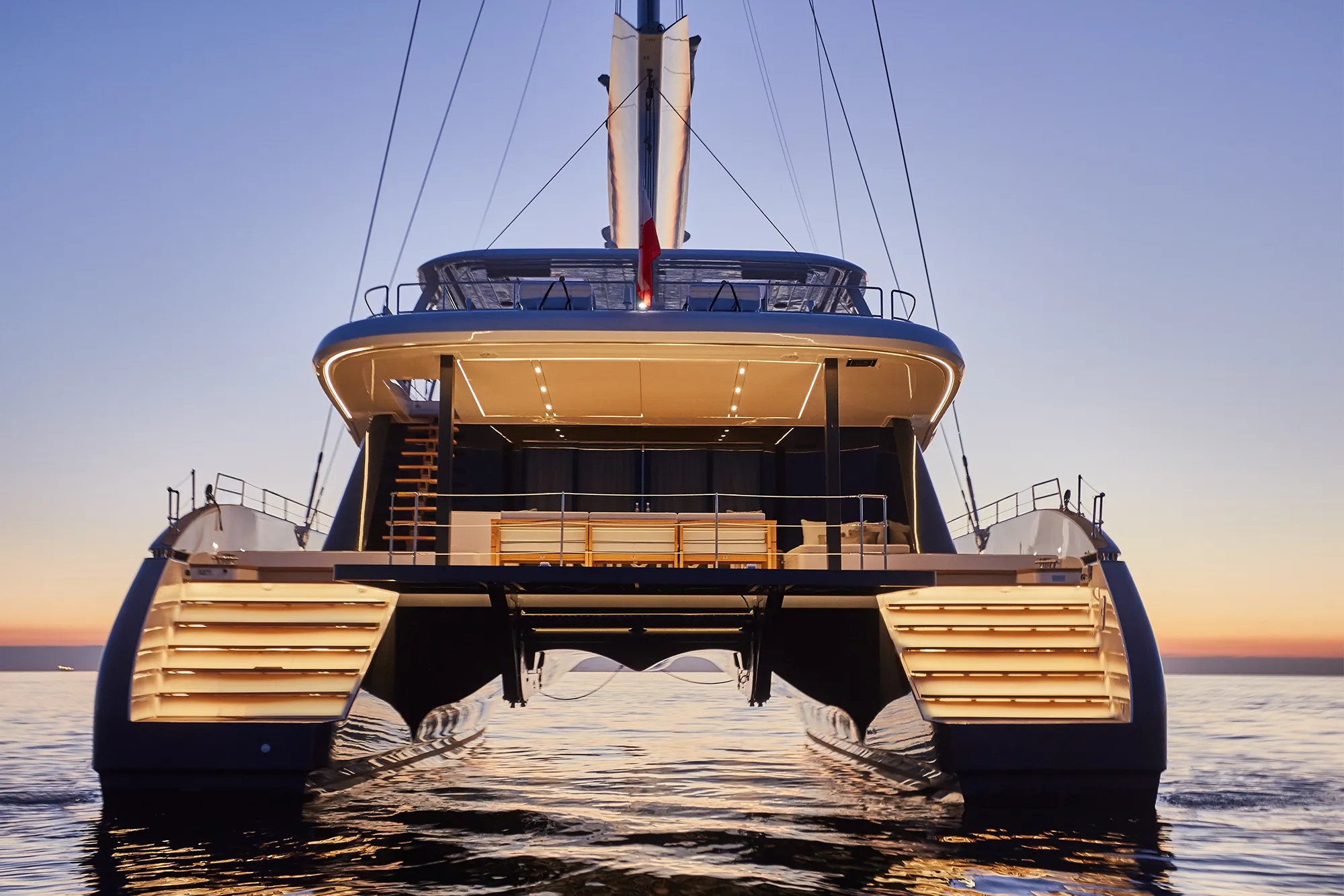
Sunreef 80 Sail NEXT ( Eco-Option )23.87 m (78 ft 4 in)
View Specs & Review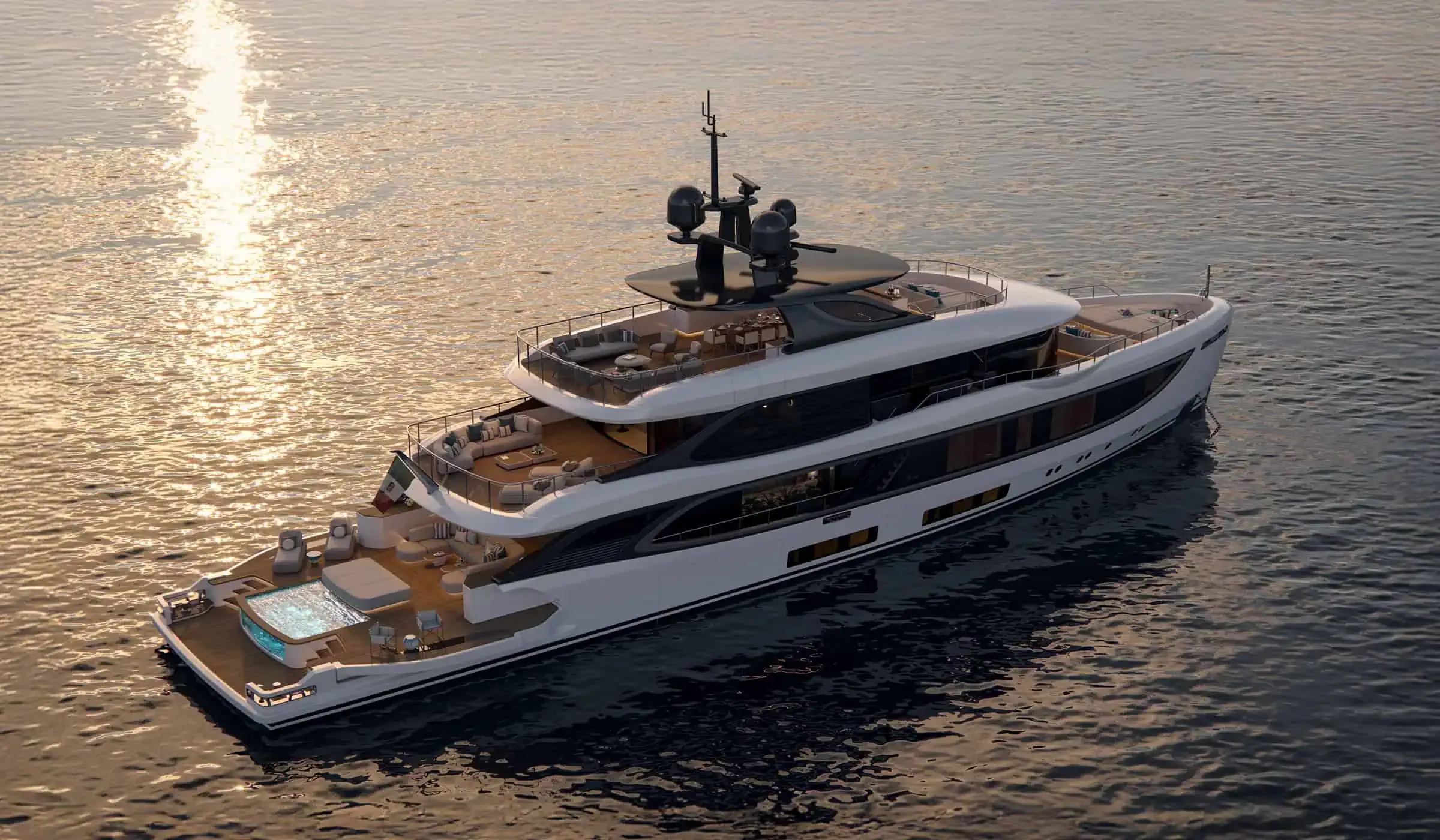
Benetti Oasis 42M139' 5"
View Specs & ReviewFrequently Asked Questions
How much does a berth cost at Marina Bas-du-Fort?
The 2026 tariff is published per foot per day, in euros including tax, and runs from €0.69 a foot for 10–21 ft to €2.04 a foot for boats over 100 ft. A 55-footer sits in the 50–65 ft band at €1.01 a foot per day, which is €55.55. Catamarans pay one and a half times the monohull rate — "majoration de 1,5 pour les multicoques" — so the same 55 ft as a catamaran is €83.33 a day. Annual rates are published up to 65 ft, topping out at €99.26 per foot per year, and the capitainerie quotes the year above that. Liveaboards pay 9% more from one month, buoy moorings get 50% off, and since 1 February 2025 water and electricity are metered separately at €8 per m³ and €0.40 per kWh.
Can you anchor in the Grand Cul-de-Sac Marin?
No. The Parc national de la Guadeloupe publishes the rule in one sentence: "Le mouillage forain est interdit. Seul l'amarrage aux bouées mises à disposition est autorisé" — anchoring is prohibited and only the buoys provided may be used. The park has laid 131 ecological moorings across 11 sites off Petit-Canal, Morne-à-l'Eau, Port-Louis and Sainte-Rose under arrêté n°2021-552 of 15 November 2021, white for private boats and pink for tourism operators, the pink ones on a three-point buried mooring rated for a 50-tonne vessel. Buffer zones close Carénage, Christophe and Fajou to navigation all year, diving is authorised at Passe à Colas only with one boat on site at a time, and jet skis and unauthorised drones are banned outright.
Is there dock and dine in Guadeloupe?
Dining in Guadeloupe works from a berth rather than from a guest dock, and Marina Bas-du-Fort makes that easy: its own site carries restaurants, bars, bakeries, two supermarkets, a pharmacy, doctors and a laundry inside the marina, so you berth and walk rather than berth and drive. The fuel dock opposite the capitainerie is open 07:00 to 19:00 every day of the year including public holidays, the desk prices online customs clearance at €10, and a boat taxi to the Îlet Cochon moorings is published at €25. Elsewhere in the archipelago — Rivière-Sens, Les Saintes, Marie-Galante — take a berth or a buoy and go in on foot or by tender.
Can you haul out a yacht in Guadeloupe?
Yes. Marina Bas-du-Fort publishes a 35-tonne travel-lift with a lifting dock, taking boats up to 59 ft (18 m) long, 16.4 ft (5 m) wide and 9.8 ft (3 m) of draft, inside a 6,000 m² professional technical zone with a slipway, a hydraulic lifting trailer and storage on cradles and props. Width, not tonnage, is the binding limit here: a 45-foot cruising catamaran is wider than the published 5 m rating, so agree a multihull with the yard first. Hardstanding for a 32–49 ft boat is €0.60 per foot per day for the first ten days, €0.78 from day eleven and €1.02 from day thirty-one.
Do you have to clear customs in Guadeloupe if your boat is EU-flagged?
Yes. Since 1 September 2024 French customs requires clearance on both entry and exit from "tous les navires ou embarcations de plaisance à usage personnel ou professionnel, quels que soient leur nationalité et leur port d'attache" — every pleasure vessel, whatever her flag and home port — arriving into French waters of Guadeloupe, Martinique, Saint-Martin or Saint-Barthélemy from a foreign port, foreign waters or the high seas. It is filed electronically at demarches-simplifiees.fr, and customs tells you to print the paper attestation because other Caribbean states do not yet recognise the electronic one. Guadeloupe is inside the EU customs territory but is "considérée sur le plan fiscal comme un territoire tiers", so octroi de mer applies to goods arriving.
What is the largest yacht that can berth in Guadeloupe?
One hundred and sixty-four feet, and the limit is written into the harbour rules rather than the brochure. Article 2.1 of Marina Bas-du-Fort's règlement intérieur reserves the port for pleasure vessels "ne dépassant pas les 150 tonnes et 50 mètres de long" — not exceeding 150 tonnes and 50 m. The quai d'honneur Florence Arthaud takes the large units at up to 50 m of length and 4.50 m (14.8 ft) of draft, and the marina keeps a sector dedicated to yachts over 23 m. Billing is on overall length, "la longueur hors tout". Elsewhere in the archipelago the ceiling falls sharply: Rivière-Sens publishes a welcome pontoon to 25 m and a maximum depth of just 8.2 ft (2.50 m).