
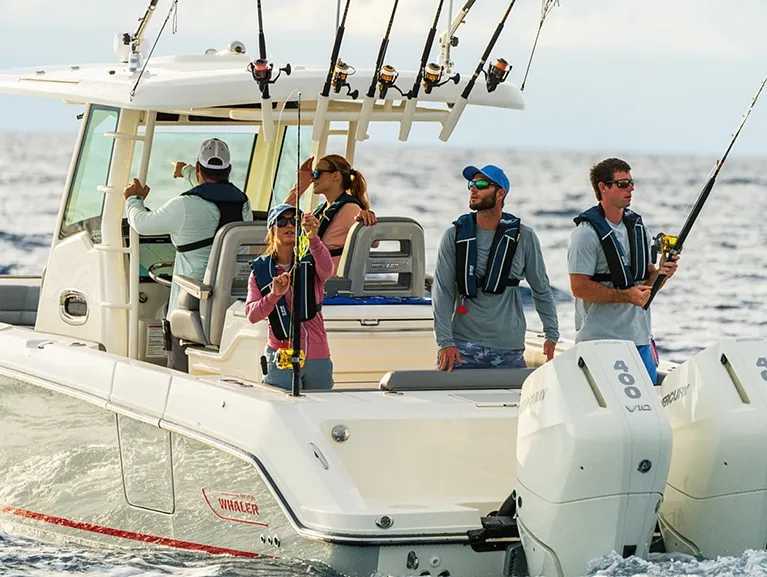
Boston Whaler 330 Outrage33' 0"
View Specs & ReviewThe clear-water run from the Grove to the Keys
Yachting in Biscayne Bay
A Minted Location · Biscayne Bay, Florida
If the boat you're shopping for is really a ticket to clear water, Biscayne Bay is the strongest argument in Florida. South of the Rickenbacker Causeway the bay becomes Biscayne National Park — 172,971 acres, 95 percent of it water — protecting the longest stretch of mangrove forest on Florida's east coast and the northern end of the world's third-longest barrier reef. NOAA's own Coast Pilot puts it plainly: this water is "unexcelled as a yachting and small-boating area."
For an owner, the draw is a cruising ground you never outgrow: seawall dinners in No Name Harbor, weekends under the Boca Chita lighthouse, sandbar afternoons at Sands Cut, and a run down Card Sound that ends where the Keys begin — with Ocean Reef's private harbor at the top of Key Largo waiting on a sponsor's invitation.
Minted Yachts runs this bay from the Dinner Key slips to the Jewfish Creek fuel docks, and everything below is laid out north to south, because that is the sequence a boat actually works it.
Where to keep a yacht in Biscayne Bay
Dockage on this run is public-first and shallow-honest. The City of Miami's Dinner Key Marina — 587 wet slips, the largest wet-slip marina on the East Coast by the city's own count — anchors the Coconut Grove end, and Miami-Dade County's park marinas space themselves down the western shore: Crandon on Key Biscayne, Matheson Hammock, Black Point, and Herbert Hoover Marina at Homestead Bayfront, every one selling daily transient dockage by the county's own rate sheet. The far end is the exception: Ocean Reef's 175-slip club harbor, where access runs through member sponsorship.
Depth decides more than pedigree here. Black Point carries 5.5 ft dockside, Boca Chita about 4 ft at the entrance at low tide and Elliott Key about 2.5 ft — match the boat to the stop before you plan the day, and hail the Ocean Reef dock office on VHF 16 for the current controlling depth in its channel.
Marinas
| Name | Where | Max yacht | Slips | Fuel |
|---|---|---|---|---|
| Dinner Key Marina & Mooring FacilityThe East Coast's largest wet-slip marina by the city's own count — 587 slips for 30–135 ft beside Miami City Hall on the old Pan Am Clipper base, with 250+ moorings to 50 ft east of the docks. | Coconut Grove — ICW Statute Mile 1095 | 135 ft | 587 | — |
| Crandon MarinaThe only fuel-and-slips stop on Key Biscayne itself — vessels to 80 ft, a dive shop and charter dock, and a 24-hour boat ramp between downtown and the weekend anchorages. | Key Biscayne — Statute Mile 1094 | 80 ft | — | Gas & diesel |
| Matheson Hammock MarinaMiami-Dade's second-largest county marina — roughly 330 vessels of 30–50 ft across wet slips and dry storage, inside the county's oldest park, with 11 ramp lanes for the trailer fleet. | Coral Gables — Matheson Hammock Park | 50 ft | — | Fuel dock on site |
| Black Point Park & MarinaThe 24-hour launch closest to the park's reef line, with a dockside restaurant and a 1.5-mile fishing jetty — 5.5 ft dockside, so it's outboard country, not big-boat dockage. | Cutler Bay — west shore, off ICW markers 5 & 6 | — | — | — |
| Herbert Hoover Marina — Homestead Bayfront ParkThe last gas-and-diesel stop before Biscayne National Park waters and Card Sound — vessels to 50 ft, bait and basics ashore, next door to the park's own headquarters. | Homestead — Convoy Point, beside the park headquarters | 50 ft | — | Gas & diesel |
| Ocean Reef Club MarinaThe marquee address at the top of the Keys: a 175-slip private harbor most comfortable, in the club's words, with yachts to 175 ft — hail the dock office on VHF 16 for the channel's controlling depth. | North Key Largo — private club basin off the Angelfish approaches | 175 ft | 175 | Fuel dock on site |
| Gilbert's Resort & MarinaThe classic first (or last) stop of the Keys — fuel, slips and the tiki-bar reward right where the ICW squeezes into Blackwater Sound. | Upper Key Largo — Jewfish Creek at the US-1 bridge | — | — | Rec 90 & diesel — full-service fuel dock |
| Anchorage Resort & Yacht ClubThe quieter side of Jewfish Creek — condo-resort dockage in 18–20 ft wide slips for vessels to 120 ft, with pool and showers ashore. | Upper Key Largo — Jewfish Creek at Blackwater Sound | 120 ft | — | — |
| Garden Cove MarinaThe only oceanside gas-and-bait stop in upper Key Largo before Angelfish Creek — small, shallow, and built around the Buzzard's Roost dock-and-dine crowd. | Upper Key Largo oceanside — MM 106.5, direct Atlantic access | — | — | Gas |
Yacht clubs
| Name | Where | Max yacht | Slips | Fuel |
|---|---|---|---|---|
| Biscayne Bay Yacht ClubFounded 1887 by Commodore Ralph Munroe — one of the oldest yacht clubs in the southeastern United States, still racing on its home bay. | Coconut Grove — S Bayshore Dr | — | — | — |
| Coral Reef Yacht Club“The Spirit of Yachting Since 1955” — a member club whose calendar runs from world-championship regattas to family cruising. | Coconut Grove — S Bayshore Dr | — | — | — |
| Coconut Grove Sailing ClubThe volunteer-driven club since 1946 — community regattas, sailing classes and a mooring field in the heart of the Grove waterfront. | Coconut Grove — S Bayshore Dr | — | — | — |
| Key Biscayne Yacht ClubFounded 1955 “to promote boating in all of its branches” — a member club with its own marina, adult racing and youth sailing. | Key Biscayne — Harbor Dr | — | — | — |
| US Sailing Center MiamiThe Olympic training site on the Grove waterfront — host of the Orange Bowl Regatta and the reason world-class fleets call this bay home water. | Coconut Grove — S Bayshore Dr | — | — | — |
Figures are as each facility publishes them on its own site; blank cells mean the facility doesn't state a number. Confirm slip availability and current rates directly — or ask us to make the calls.
Cruising from Biscayne Bay
The park. Biscayne National Park has no entrance fee and no fuel, water or provisions on its islands — you bring everything and pack it out. Docking at the Boca Chita and Elliott Key harbors runs $25 on Fridays through Mondays and federal holidays, plus a separate $35 camping fee if you stay the night, both paid through the Recreation.gov app. Reef mooring buoys take vessels to 45 feet for up to four hours — never anchor on coral, and keep 300 feet clear of a buoy if you anchor instead. Personal watercraft are prohibited parkwide, and the park teaches free boater-education classes, in English or Spanish, on exactly this water.
The passes. Inside, the ICW runs the length of the bay and crosses Featherbed Bank at Mile 1107.6 — stay mid-channel; the Coast Pilot's advice is that the shoals to either side are usually visible. Outside, Hawk Channel runs 127 miles inside the reef from Cape Florida to Key West in 9 to 34 feet of water. The connectors are the creeks: Caesar Creek (reported 8 feet, shoaling to about 2 feet at the bayside entrance) and Angelfish Creek (reported 5 feet, rock-ledge bottom — buoy your anchor). Both are "reported" depths in the Coast Pilot rather than surveyed ones, so run them against current local knowledge and NOAA chart 11451.
Card Sound to the Keys. Below Cutter Bank the bay hands off to Card Sound — about five miles long with 7 to 12 feet down the middle and, per the Coast Pilot, good anchorage in 9 feet on the south side of Pumpkin Key. Two fixed spans gate the finish: the Card Sound Bridge at 65 feet and the Jewfish Creek bridge at 67 feet. Clear those and you're in Blackwater Sound — the Keys proper.
Mind the grass. Nearly everything outside the park sits inside the Biscayne Bay Aquatic Preserves — 64,607 acres protected since 1974 — and damaging seagrass in a preserve can bring a fine of up to $1,000. Manatee protection zones blanket the bay's edges (vessel strikes are the leading cause of manatee deaths in Miami-Dade), and the zones tighten in the colder months — read FWC's Miami-Dade zone maps before you run the shorelines. Everywhere else, read the water: in the lower bay on a calm day you can see bottom at depth, which is both the charm and the warning.
- No Name Harbor — Bill Baggs Cape Florida State Park — bay side of Key BiscayneThe only all-weather basin between Dinner Key and the upper Keys — pay the honor box (cash or check; card at the ranger gate in park hours), raft no more than two boats, and Boater's Grill is on the seawall.
- Nixon Sandbar — Off southwest Key BiscayneMiami's most famous raft-up, on the flats off Key Biscayne — no posted rules and no facilities, so anchor smart, keep off the grass and pack out everything you bring.
- Stiltsville — Biscayne Flats — off Cape Florida, inside the parkSeven surviving stilt houses on the flats mark the top of the park — access to the structures is by permit via the nonprofit Stiltsville Trust, so treat it as a slow photo pass.
- Boca Chita Key Harbor — Biscayne National Park — north islandsThe 1930s lighthouse harbor is the park's postcard — cleated bulkhead only, raft max two deep, roughly 4 ft at the entrance at low tide, and no water, power or sales on the island.
- Sands Cut — Between Sands Key and Elliott Key — Biscayne National ParkThe park's own sandbar scene, run under posted NPS limits — a slow zone with a five-boat raft cap that the rangers actually enforce.
- Elliott Key Harbor — Biscayne National Park — the park's largest islandThirty-three slips, fresh water and cold showers make Elliott the park's only marina-style stop — but mind the roughly 2.5 ft of harbor depth at low tide.
- Adams Key — North side of Caesar Creek — Biscayne National ParkThe island that was once the Cocolobo Club, host to four presidents, is now the park's picnic stop off Caesar Creek — pavilion, toilets, and a dawn-to-dusk clock.
- Pumpkin Key — Card Sound — off north Key LargoCard Sound's lunch hook, straight from the Coast Pilot — good anchorage in nine feet on the island's south side, in Monroe County's 90-day anchoring-limitation waters.
Service, refit & supplies
Shipyards & refit
| Name | Where | Max yacht | Dockage |
|---|---|---|---|
| Grove Harbour Marina & BoatyardThe Grove's full-service yard: dockage for vessels to 135 ft, wet slips and dry storage, with hull, fiberglass and gelcoat work and engine service for Mercury, Mercury Racing and Yamaha. | Coconut Grove — 2640 S Bayshore Dr | 135 ft | — |
Chandleries & specialty suppliers
- West Marine — South Miami (Coconut Grove) — US 1 at SW 27th Ave — minutes from the Grove docksThe big-box chandlery closest to Dinner Key — parts, safety gear and rigging before you head down the bay.
- West Marine — Cutler Bay — Cutler Bay — near the Black Point launchThe mid-corridor stop for the Black Point and Homestead launch crowd.
- West Marine — Key Largo — Overseas Highway, Key LargoLast full chandlery of the run — stock up before the park miles or on the way through to the lower Keys.
On the Biscayne Bay calendar
Bacardi Cup Invitational Regatta — March, out of Coconut Grove. At the heart of Star Class racing since 1927 and now a multi-fleet week (Star, J/70, Melges 24, VX One, Snipe) hosted across the Grove's clubs — the bay at its most serious.
Columbus Day Regatta — October. Miami's oldest regatta, seventy editions in, raced on the bay with Coconut Grove Sailing Club and Coral Reef Yacht Club among its backers — and the anchor-out weekend that follows it is a bay institution of its own.
Orange Bowl Regatta — December 26–31 at the US Sailing Center Miami in Coconut Grove: the youth championship week that fills the bay with sails between the holidays.
Vintage Weekend at Ocean Reef — the first weekend of December since 1994: classic yachts, vintage aircraft and collector automobiles judged together at the top of Key Largo.
Yachts we'd shortlist for Biscayne Bay
Reviewed the same way as everything on this site — specifications verified against the builder's own numbers.
Frequently Asked Questions
Where can I dock overnight in Biscayne National Park?
Two island harbors, both first-come through the Recreation.gov app: Boca Chita Key's cleated bulkhead (raft no more than two deep, roughly four feet at the entrance at low tide) and Elliott Key's 33 slips (about 2.5 feet at low tide, with fresh water and cold showers ashore). The park publishes a $25 docking fee for Fridays through Mondays and federal holidays, plus a separate $35 camping fee for staying the night — both apply if you sleep aboard. There's no water or power at Boca Chita and no fuel anywhere in the park, so provision before you go.
Should I run Biscayne Bay inside or Hawk Channel outside?
Inside is the smooth-water ICW route: down the bay, across Featherbed Bank at Mile 1107.6 (stay mid-channel), through Card Sound and under two fixed bridges — 65 feet at Card Sound and 67 feet at Jewfish Creek. Outside, Hawk Channel runs 127 miles inside the reef in 9 to 34 feet, avoids the Gulf Stream, and the Coast Pilot cautions strangers not to attempt it at night. The connectors are Caesar Creek (reported 8 feet, shoaling near 2 feet at the bayside entrance) and Angelfish Creek (reported 5 feet) — "reported" depths rather than surveyed ones, so verify against current local knowledge and chart 11451.
Where can I get fuel on Biscayne Bay?
Working south: Crandon Marina on Key Biscayne (gas and diesel), Matheson Hammock's fuel dock, and Herbert Hoover Marina at Homestead Bayfront (gas and diesel) — the last fuel before park waters. There is no fuel inside Biscayne National Park. The run resumes at Jewfish Creek, where Gilbert's full-service dock pumps Rec 90 and diesel, and Garden Cove Marina on the ocean side carries gas.
Is Biscayne Bay a good place to own a boat?
It's the rare market where the argument is the water itself: a national park for a backyard, public marinas with published daily rates at both ends, and a protected run that ends where the Keys begin. The bay rewards honest boats — shallow-capable outboards, day yachts and power cats — over sheer length, which keeps ownership costs sane. Minted Yachts runs this water every week; tell us how you'll use the bay and we'll tell you what to buy. TS@MintedYachts.com or +1 (404) 805-9819.
Can I take my boat to Ocean Reef Club?
Only with a member behind you. Ocean Reef is a private club, and its own visitor policy requires non-member guests to be sponsored by an Equity Member. The marina itself is serious infrastructure — 175 slips, comfortable with yachts to 175 feet by the club's FAQ, with a fuel dock and pump-out at every slip. The club warns that shallow water may exist in its channel; the dock office monitors VHF 16 for the current controlling depth.
How much does it cost to anchor in No Name Harbor?
The state park publishes it exactly: $8 per boat for day use and $20 per boat per night to anchor overnight, paid at the honor stations along the seawall by cash or check (credit cards at the ranger station during park hours). No more than two boats may be moored together in the harbor. Boater's Grill sits right on the seawall, which is why the harbor is the bay's flagship stop.
What are the rules at the Biscayne Bay sandbars?
At Sands Cut, inside the national park, the posted NPS limits are real: a slow-speed zone with rafting capped at five boats and at least 100 feet between rafted groups. The Nixon sandbar off Key Biscayne has no posted rules — anchor smart and pack everything out. Parkwide, never anchor on coral (mooring buoys serve vessels to 45 feet, four-hour limit), personal watercraft are prohibited, and damaging seagrass in the surrounding aquatic preserve can bring a fine of up to $1,000.
Which Biscayne Bay restaurants can I reach by boat?
From each venue's own published welcome: Monty's Raw Bar in Coconut Grove (boat mooring — hail the Dock Master), The Bayshore Club at Dinner Key (zero-distance dock access), Boater's Grill on the No Name Harbor seawall, Gilbert's Resort on Jewfish Creek (dock for the day, week or longer), and The Buzzard's Roost at Garden Cove (come by land or by sea). Alabama Jack's on Card Sound Road is the landmark exception — the Keys tourism council calls it a favorite stop for boaters, but it keeps no dock, so plan that last leg by road. Our Dock & Dine guide maps the full run.