
August 25, 2026
Galeon 640 FLY: One 68' 3" Hull, Three Different Boats Below Deck
Galeon offers the 640 FLY with three distinct lower-deck arrangements on the same 68' 3" hull - a midship super master, a twin-guest layout,…
Read the articleExpert Review, Technical Specifications & Market Analysis
| Feature | Specifications |
|---|---|
| Overall Length | 68' 3" |
| Beam | 16' 5" |
| Draft | 3' 3" |
| Displacement | 78,264 lbs |
| Engines | Twin Diesel (2 x 900 hp); optional 2 x 1,200 hp |
| Fuel Capacity | 991 gal |
| Water Capacity | 211 gal |
| Cabins / Heads | 3-4 Cabins + 1 Crew / 3 Heads |
| Max Speed | 30 knots |
Source: Spec & Photos courtesy of Galeon. Specs verified by Tony Smith, USCG 100 Ton Master, on August 24, 2026.
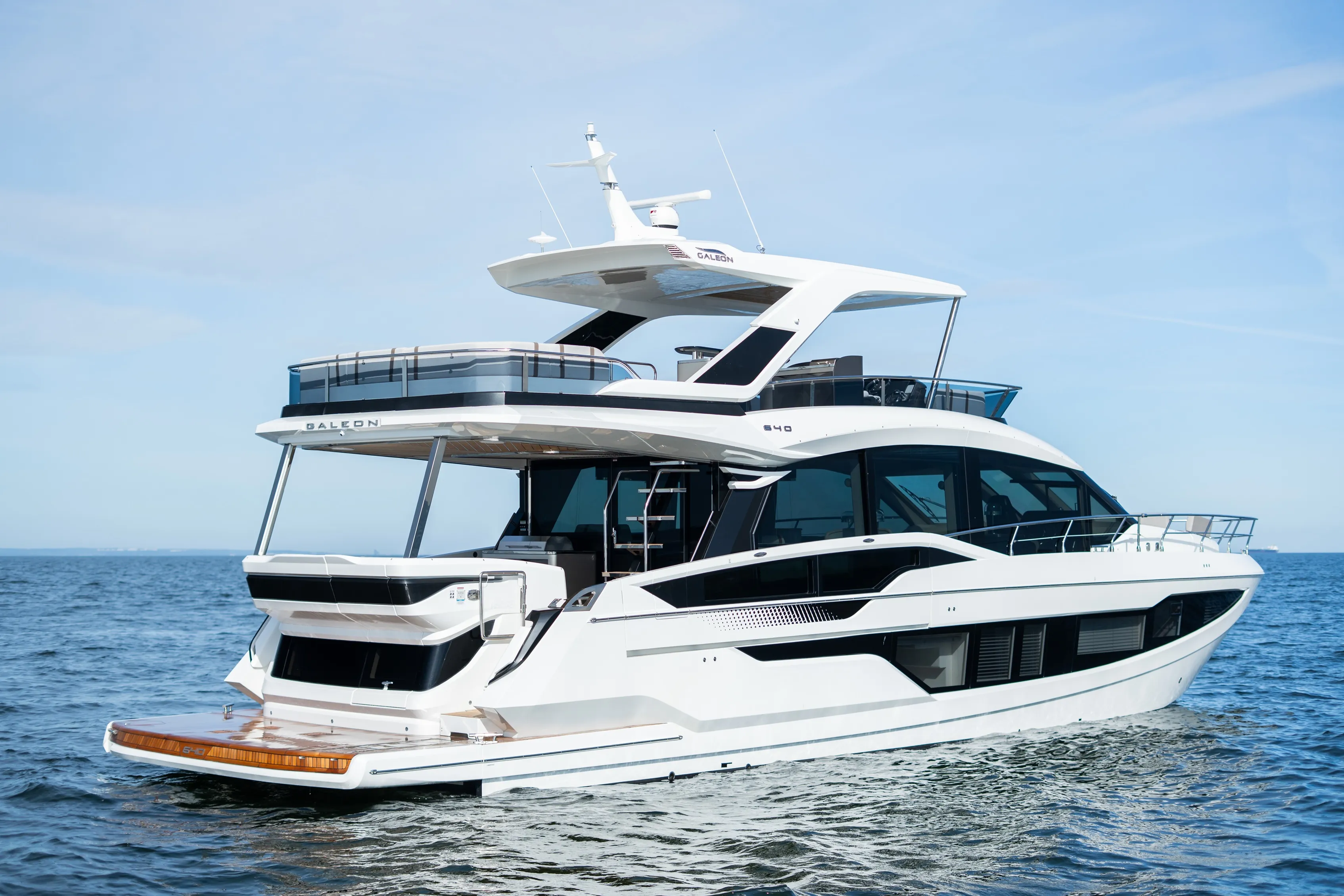
Three different lower-deck layouts on one 68' 3" hull - a midship super master, a twin-guest arrangement, or a four-cabin charter plan - and Beach Mode balconies that take the beam from 16' 5" to 24' 3".
Part of the Galeon FLY series — see how owners step up through the lineup.

Most builders in the high sixties hand you one lower deck and a choice of upholstery. Galeon hands you three. On the 640 you can take the midship super master and give the owner's suite the room, or take the twin-guest layout, or take the four-cabin charter plan and put more heads in beds. Every one of them keeps private bathrooms for the principal cabins, and every one of them keeps a separate main-deck entrance to the master so the owner is not walking through the guest accommodation to go to bed. If you are buying a boat that has to be a couple's boat in May and a full house in August, that is the single most useful thing on this spec sheet, and it is why I put the 640 in front of clients who genuinely have not decided yet.
The two numbers I would draw your eye to are not the speed. Draft is three feet three inches without props, on a sixty-eight-foot boat that weighs seventy-eight thousand pounds light. Bridge clearance is twenty-four feet nine from the waterline. Between them those two figures open up water that a lot of boats this size cannot get into or under, and if your home cruising ground has a fixed bridge or a bar across the inlet, they matter more than another two knots ever will. Check them against your own chart before you get seduced by the flybridge. Two claims turn up in listings that are worth correcting: this is not the flagship - the 800 FLY is - and the carbon on this boat is the flybridge bimini, not the hull.
Now the honest part. The engine brand on this model comes down to whatever the yard is offering for your build slot, so what you are buying is a band from nine hundred to twelve hundred horsepower a side rather than a badge. And I will not let a client plan a passage off a top speed nobody has tested. Before you sign, get the engine package written into the contract, get observed burn at cruise in writing, and get a rigged and loaded weight rather than the light-craft figure. Then go stand on that flybridge with the balconies down and decide whether twenty-four feet three inches of beam at anchor is the boat you actually want.
Video courtesy of Galeon.
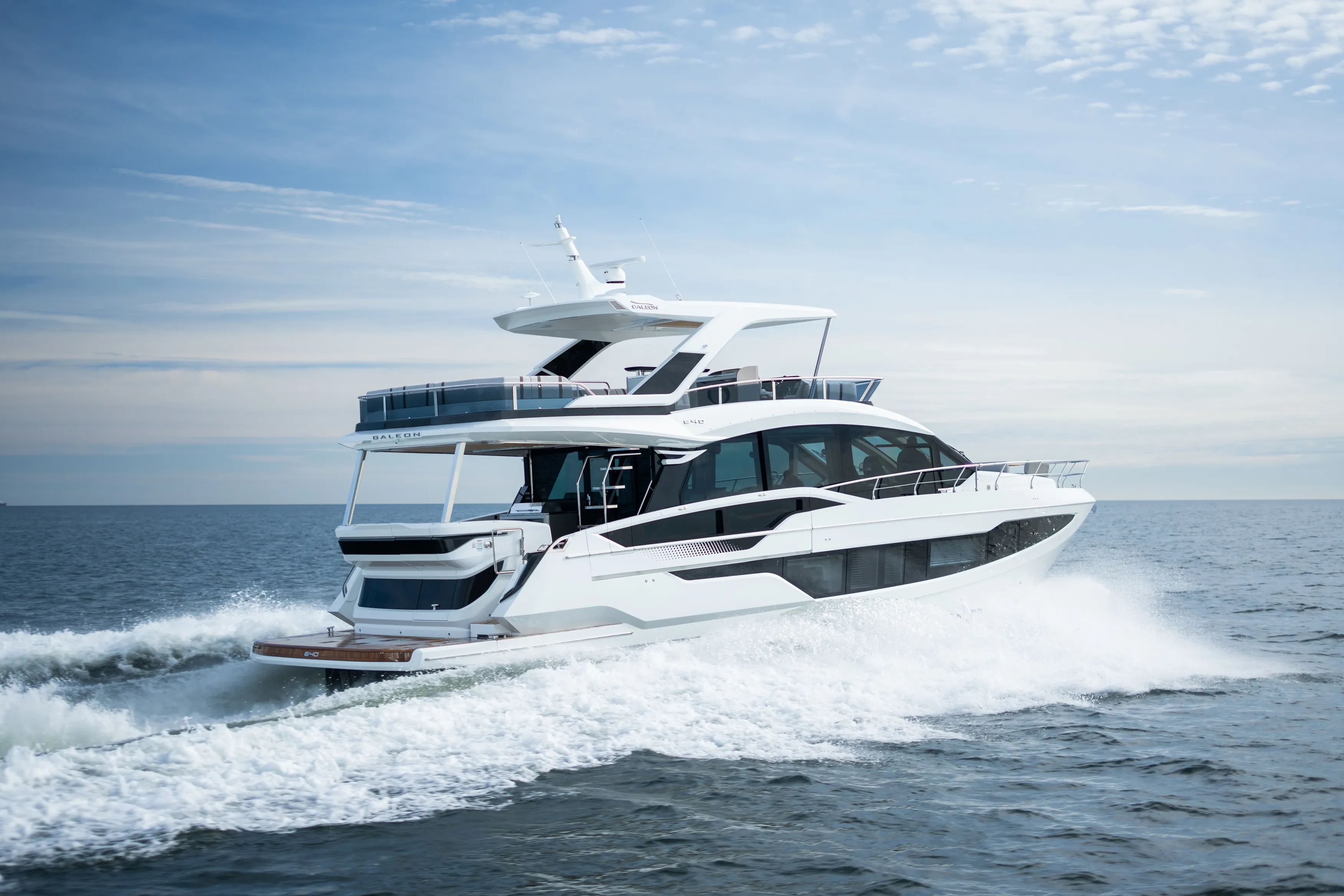
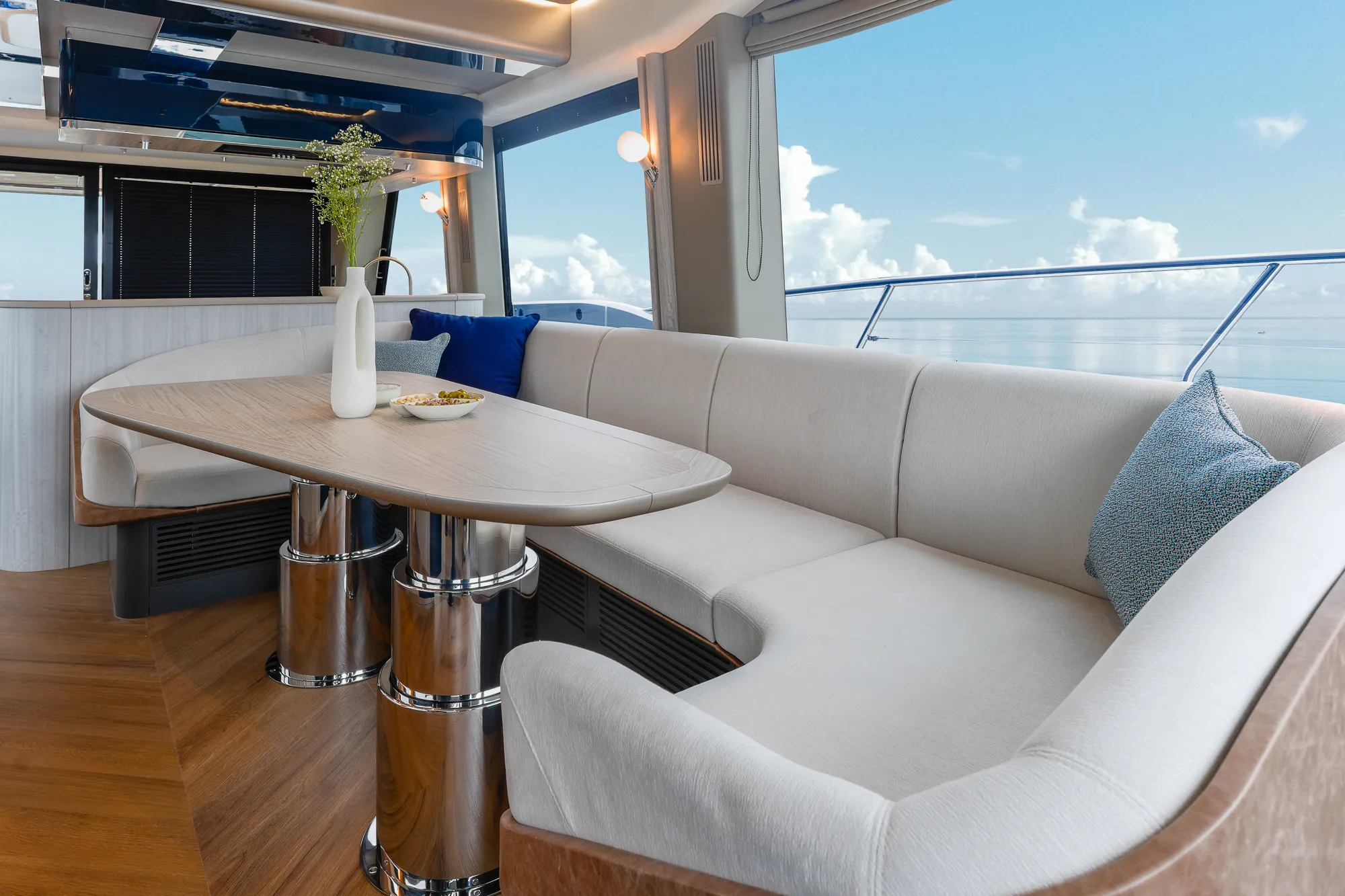
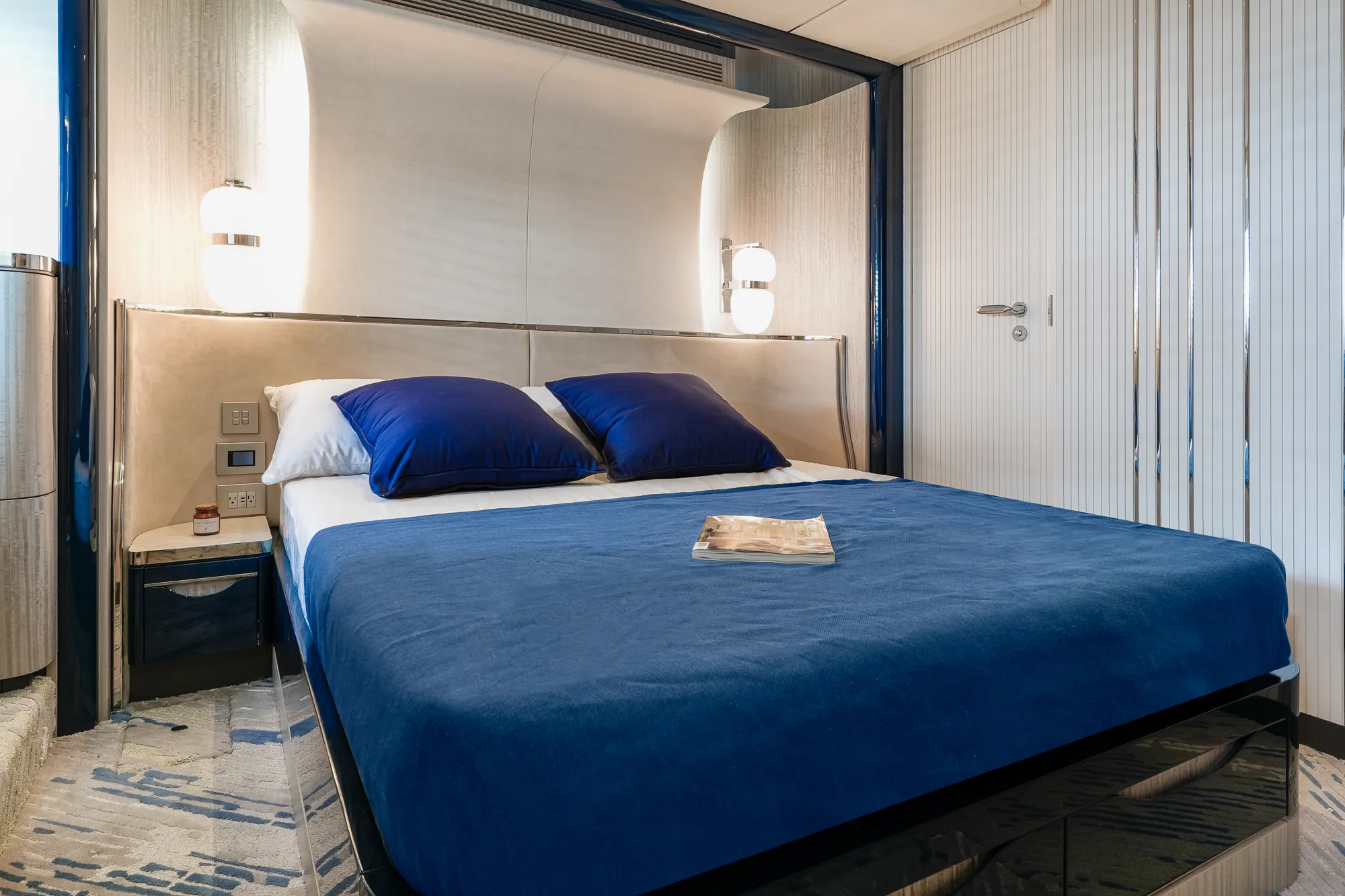
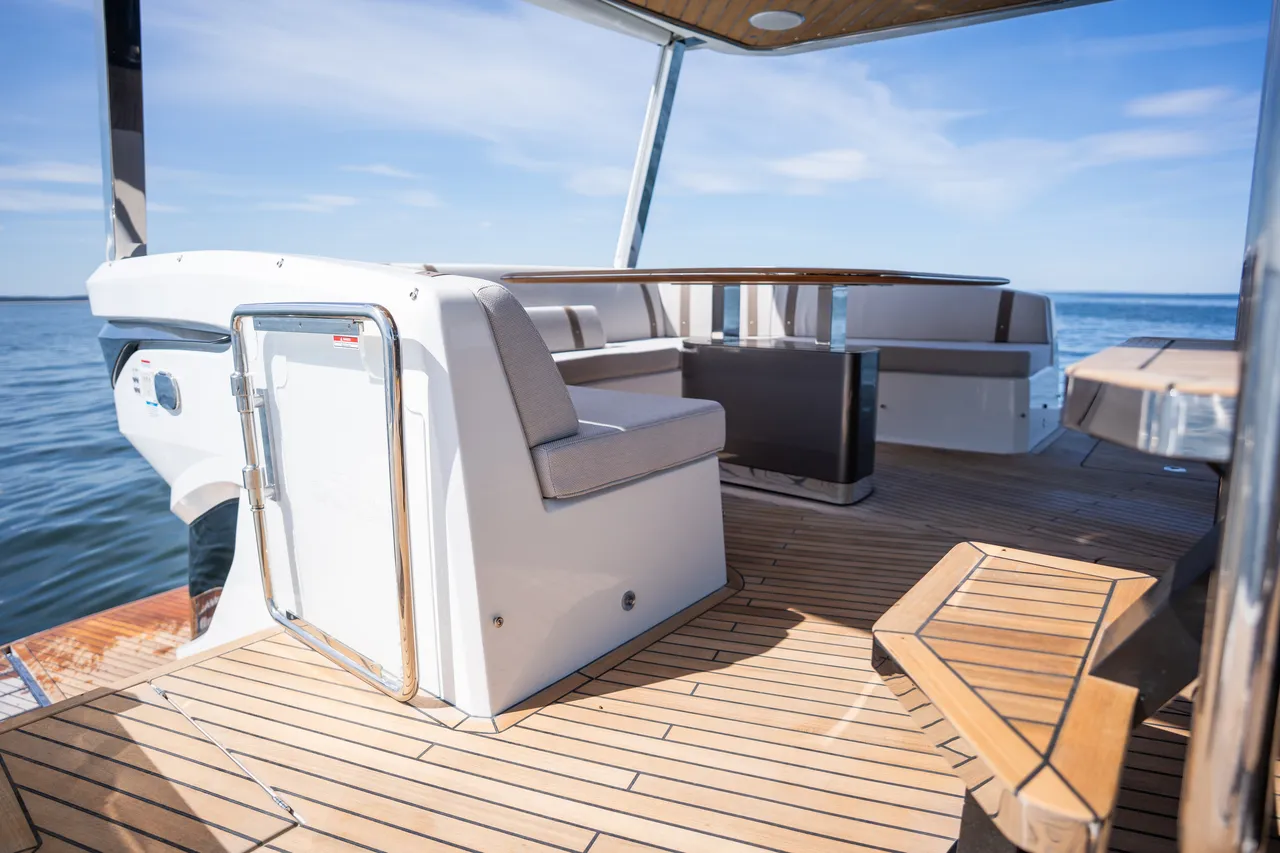
Photos courtesy of Galeon.
The Galeon 640 FLY is a 68' 3" flybridge motoryacht, and the thing to understand about it before anything else is that Galeon does not sell you one interior. Below deck there are three distinct arrangements on the same hull: a midship super master with the owner's suite expanded, a twin-guest layout, or a four-cabin charter plan that adds berths. All three give every cabin its own bathroom. Add the crew cabin aft and the cabin count reads three or four plus one.
Beam is 16' 5" closed. With Beach Mode - fold-out side platforms with glass balcony panels, a bar counter and integrated stools - the beam opens to a maximum of 24' 3". Draft is 3' 3", which is shallow for a boat of this length and displacement and is worth noting if you cruise thin water. Fuel is 991 gallons in two equal tanks, fresh water is 211 gallons, the grey tank holds 110 gallons and the black tank 92. Displacement in light craft condition is 78,264 lbs with 12,125 lbs of maximum load, and the boat is certified to CE Category B with a crew limit of fifteen.
Power is twin diesel, rated from a minimum of 2 x 900 hp to a maximum of 2 x 1,200 hp, with the engine brand settled at the order desk rather than fixed to the model - so get the package written into your contract. Maximum speed is 30 knots. Two dimensions matter more than they sound: bridge clearance is 24' 9" from the waterline at minimum draft, and transport height is 29' 4". Galeon builds the boat in Poland, and shares the 68' 3" hull with a Skydeck sibling in the same range - the deck arrangement above is the difference, not the boat underneath.
The 640 runs to 30 knots on Galeon's figure. For trip planning, ask for observed burn at cruise in writing and do your own range arithmetic against 991 gallons.
Engine power comes as a band rather than a package. The minimum is 2 x 900 hp and the maximum is 2 x 1,200 hp, twin diesel, with the brand settled at the order desk from whatever the yard is offering for your build slot. Get it written down rather than assumed.
Two figures matter more to an owner than the speed does. Displacement in light craft condition is 78,264 lbs with base engines, and maximum load is 12,125 lbs - that is your entire headroom for fuel, water, stores, tender and people combined, and it is the number to think about before you specify a heavy tender. Bridge clearance is 24' 9" measured from the waterline at minimum draft, and height to transport is 29' 4". If you have a fixed bridge on your route home, that first number is the one that decides the boat.
The last thing worth reading twice is the draft: 3' 3", measured without propellers. On a 68-foot, 78,000-lb boat that is genuinely shallow, and it is one of the 640's real advantages over its size class. Just remember the qualifier - the running gear sits below that figure.
The main deck is the 640's cleverest work. Galeon puts an independent entrance to the master cabin on the main deck, so the owner's suite is reached without going through the guest accommodation, and it partitions the galley from the forward entertainment section rather than leaving one long open space. The dining area seats a crowd and faces a pop-up television on the opposite side. A side pantograph door beside the helm gets the skipper onto the side deck in two steps, and a second side door beside the galley opens with a fold-out window to make an outdoor bar counter with stools - so the galley serves inside and outside at once.
Below deck, the three layouts are the real choice. The midship super master expands the owner's suite. The twin-guest arrangement trades that space for a second pair of berths. The four-cabin charter plan adds accommodation for hosting or chartering. All three give private bathrooms to each of the three principal cabins - three en-suites and a day head. The full-beam master carries panoramic hull windows, a king-size bed and a walk-in wardrobe. The crew cabin aft is entered from the hydraulic bathing platform, which keeps crew movement out of the guest areas entirely.
The cockpit is treated as an interior room when you want it to be. A U-shaped settee sits under the flybridge overhang, and Galeon offers a canvas to close it off for privacy or for watching the television screen concealed in the galley top. Sliding doors and an opening windshield connect the saloon and galley through to the cockpit, so the whole main deck can be run open. Forward, a genuinely good idea: a front entrance turns the usually inaccessible bow into a usable space with a convertible sundeck and seating. Interior finishes are offered in the same five-name palette as the rest of the range - Ivory, Pearl, Terra, Amber and Ocean.
Inside Galeon's flybridge range the 640 FLY sits between the 620 FLY and the 680 FLY, and it is not simply the middle of the three. It is longer than the 620 by about four and a half feet and carries about ninety more gallons of fuel, but the 620's balconies open the beam to 27' 2" where the 640's Beach Mode reaches 24' 3". So the smaller boat is the wider one at anchor. Against the 680 the trade is different again: the 680 gives you four cabins as standard and a carbon hardtop, and the 640 gives you a choice of three lower-deck layouts and a shallower draft. The flagship sits well above both - that is the 800 FLY - so the 640's argument is flexibility rather than size.
That layout choice is the 640's clearest argument in the wider 65-to-70-foot flybridge market. Most builders at this size offer one owner's arrangement and a guest-cabin variation. Galeon offers a genuinely different lower deck depending on whether you are running the boat for a family, for guests, or for charter, and it puts a separate main-deck entrance on the master so the owner's suite is private in all three. If you are buying a boat that has to do two jobs, that flexibility is worth more than another knot.
Where the 640 asks more of a buyer is paperwork. Take the dimensions that go on a slip application, a haul-out quote or a marina contract off your build documents, and plan a proper sea trial to verify the performance for yourself.
One practical positioning note. Galeon shares hulls across its classes, and the 640 FLY's 68' 3" length is also used by a Skydeck model in the same range. That is worth knowing so you are not surprised to see the dimension twice - the deck arrangement above is the difference, not the boat underneath.
The 640 FLY fits the owner who cannot answer the layout question yet. Three lower-deck arrangements on one hull - midship super master, twin guest, or four-cabin charter - is a real choice rather than a trim level, and every one of them keeps private bathrooms for the principal cabins and a separate main-deck entrance to the owner's suite. If the boat has to work for a couple most of the year and a full house in August, this is the hull that lets you decide which.
It fits an entertainer. Beach Mode takes the beam from 16' 5" to 24' 3" with glass balcony panels, a bar counter and integrated stools; the galley has its own side door and fold-open window so it serves an outside bar as well as an inside one; the cockpit settee closes off with a canvas when you want a room instead of a deck; and the flybridge carries a full bar, a grill, dual front-facing seating and a U-shaped sofa under a carbon bimini with a retractable soft roof.
It fits shallow-water cruising better than most boats its size. Draft is 3' 3" without propellers on a 68-foot hull, and bridge clearance is 24' 9" from the waterline at minimum draft. Those two numbers together open up cruising grounds that a deeper, taller 68-footer simply cannot use, and they are the first things to check against your own home waters.
It is the wrong boat if you need a tested performance table before you commit - you get a top speed and a horsepower band, and you will be measuring the rest yourself at sea trial. It is also the wrong boat if you want the widest possible footprint at anchor: within Galeon's own range, the shorter 620 FLY opens nearly three feet wider.
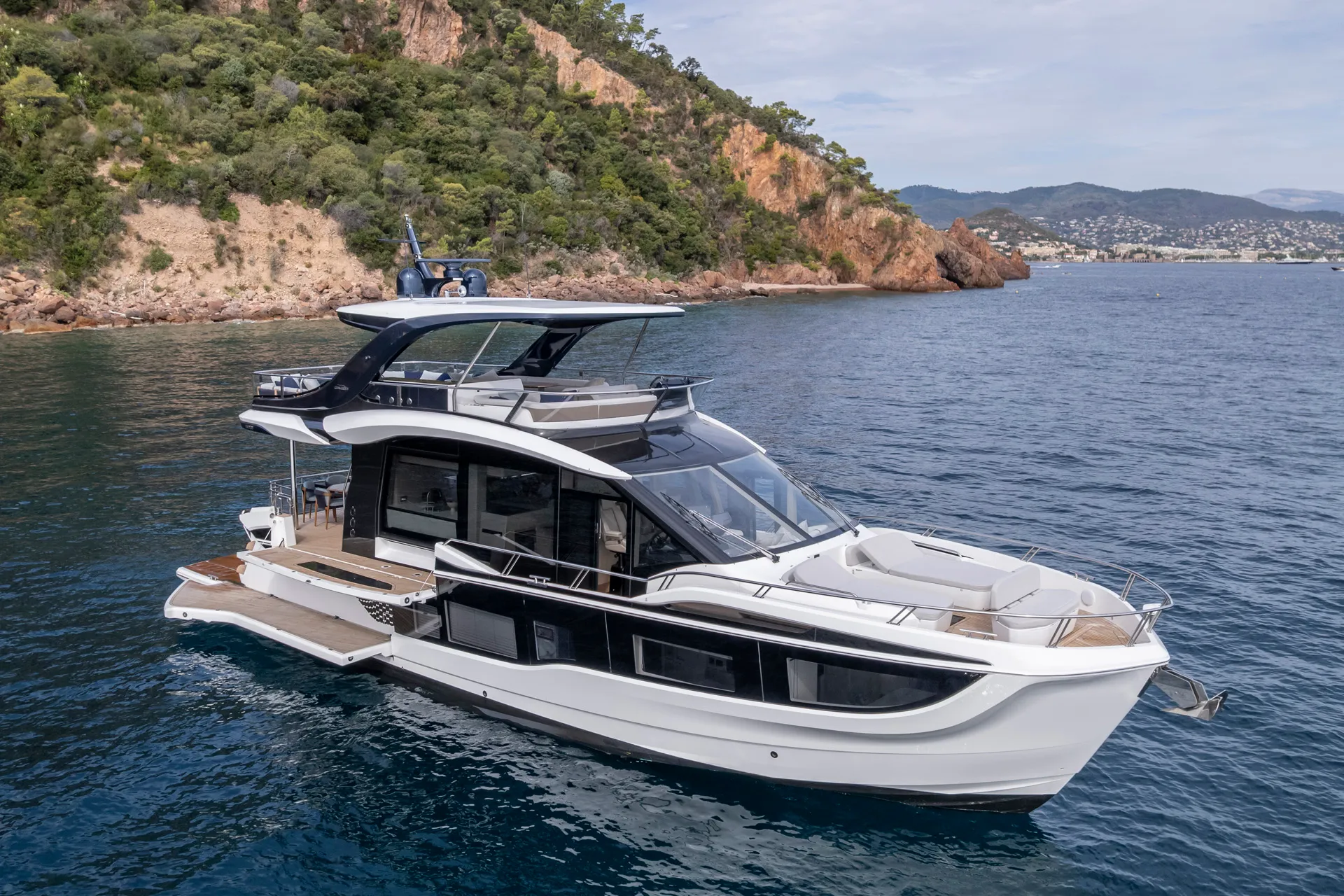
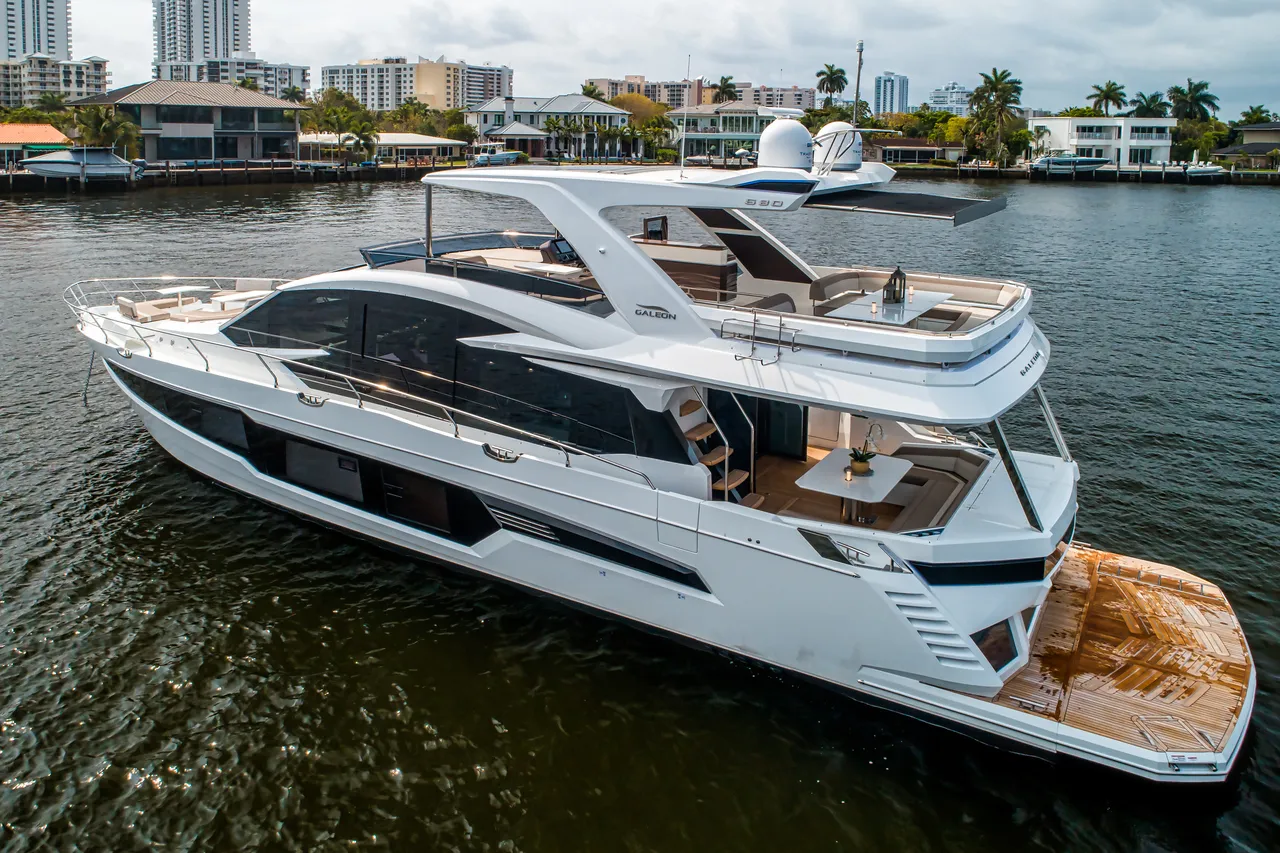
No. The 800 FLY is the flagship, at 84' 4". The 640 sits in the middle of the flybridge line, between the 620 FLY at 63' 8" and the 680 FLY at 72' 0". It is worth correcting because the claim turns up in listings, and it changes what you think you are cross-shopping.
What the 640 actually is: 68' 3" overall, 16' 5" of beam opening to 24' 3" with the Beach Mode balconies down, 991 gallons of fuel and 211 gallons of water, three en-suites and a day head, 15 guests, a crew limit of 15, and up to 30 knots. Its argument is the flexibility of the lower deck rather than size - three different layouts on one hull - and it is a genuinely good argument. It is just not a flagship argument.
Not the structure - the flybridge roof. The carbon on the 640 is its bimini, which carries a retractable soft panel roof for sun coverage. That is carbon over the upper deck, where taking weight out high up is worth real money in how the boat sits and rolls. The hull, the deck and the superstructure are not carbon or carbon-reinforced.
The distinction holds across the range, which is why it is worth getting right rather than repeating. On the 680 FLY the carbon is in the top structure, for structural integrity and weight reduction, keeping stability and balance. On the 800 FLY, carbon fibre structural elements are what allowed the upper deck to be expanded. In all three the carbon is high up and doing the same job. If a listing tells you a Galeon has a carbon-reinforced hull, ask the yard to put it in writing.
Three, on one hull. You choose between the midship super master, the twin guest quarters, or the charter option with four cabins to accommodate extra berths - 3- or 4-cabin configurations, with the supermaster expanding the owner's suite and the charter plan adding guest cabins. The result records as Cabins 3/4 + 1, with three en-suites and a day head. The crew cabin aft is entered from the hydraulic bathing platform, so it stays separate in every version.
This is the 640's real argument, and it is a decision you make once, at order. The super master takes the midship full beam and gives the owner the best cabin on the boat. The four-cabin plan trades that space for berths, which is what makes the boat work for a charter programme or for a family that travels deep. Guests are 15 and the crew limit is 15 either way, so the choice is about who sleeps where rather than how many come aboard.
Use 68' 3". That is the length overall to work from. Roughly 66' 2" also appears in Galeon's own materials, and the hull length is 60' 5" - a different measurement again.
Before you decide either figure is simply a mistake, note that Galeon shares platforms between models: the same length that appears as the 640's length overall in one place appears as the hull length of the 680 FLY. For anything that costs money by the foot - a berth, a haul-out quote, a marina contract - get the length off the build documents for your hull number rather than off a published figure.