
August 29, 2026
The Bali Catsmart: A Foredeck You Can Actually Furnish
The Bali Catsmart makes the brand's argument at its smallest size: 710 sq ft of usable deck on 39'7", a rigid foredeck instead of netting, t…
Read the articleExpert Review, Technical Specifications & Market Analysis
| Feature | Specifications |
|---|---|
| Overall Length | 39'7" |
| Beam | 21'2" |
| Draft | 3'7" |
| Displacement | 19,667 lbs |
| Engines | Twin Diesel (2 x 21 HP) — standard (2 x 30 HP optional) |
| Fuel Capacity | 106 gal |
| Water Capacity | 175 gal |
| Cabins / Heads | 2-4 Cabins / 2 Heads |
| Max Speed | - |
| Cruise Speed | - |
Source: Spec & Photos courtesy of Bali Catamarans.
You want a catamaran the two of you can run without a third pair of hands, and you do not want to trade away deck space to get it. The Bali Catsmart puts both helms aft at deck level, drops the boom to coachroof height, and replaces the trampoline with a rigid foredeck — 710 sq ft of usable deck on a 39'7" boat, in two-, three- or four-cabin layouts.
Part of the Bali Catamarans Cruising series — see how owners step up through the lineup.

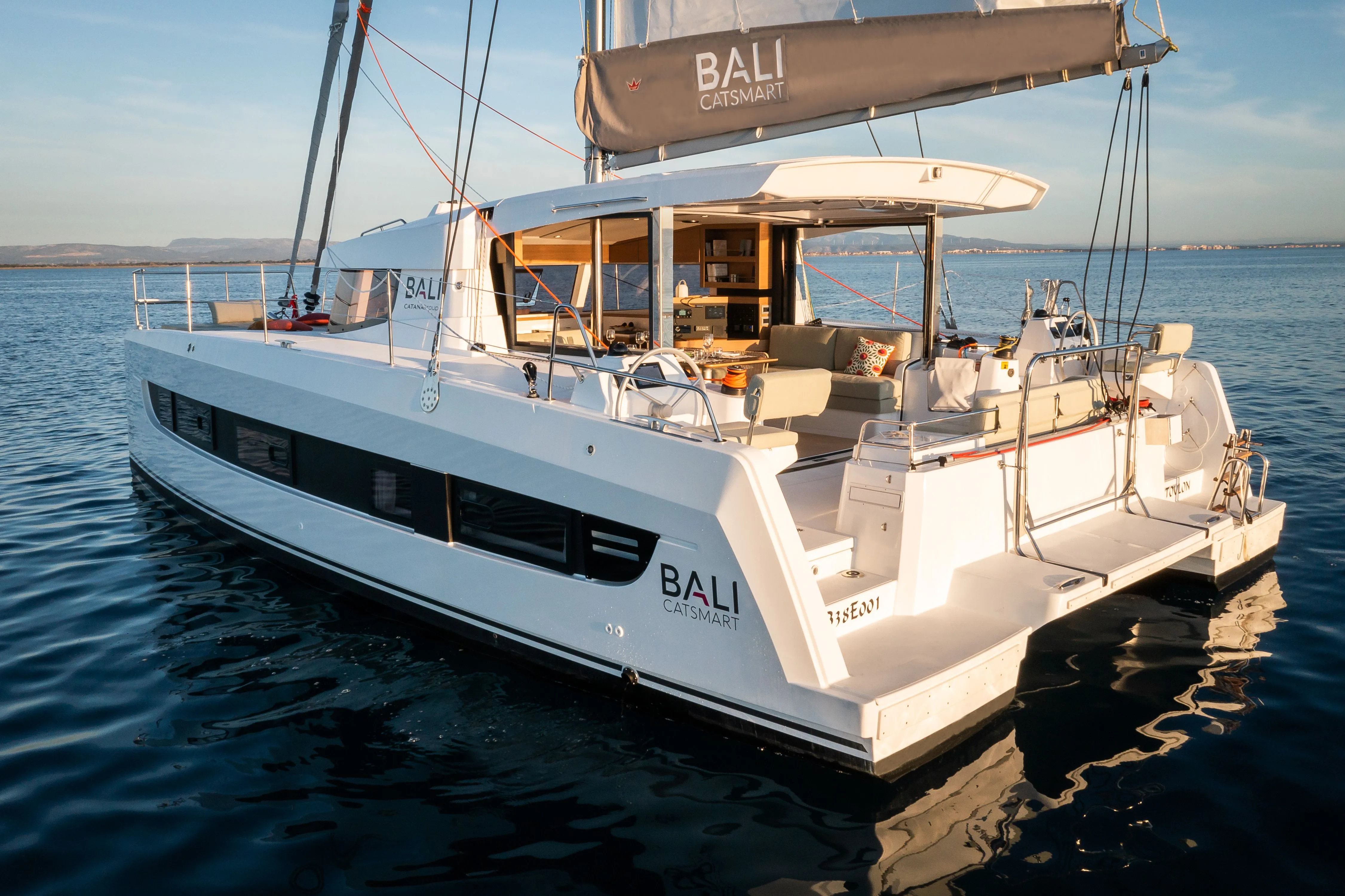
The Catsmart is the boat in this range I find easiest to explain to a first-time catamaran buyer, because everything on it points the same direction. The helms are aft and at deck level, which means you dock it by looking at the thing you are docking against instead of guessing from a raised station. The boom is low enough to reach. The foredeck is a moulded platform you can put cushions on. None of that is exotic engineering — it is a builder deciding that two people should be able to run the boat and then following through.
What you trade is the raised helm and the extra volume of the boats above it. Four cabins against two heads is a charter arrangement and I would not order it for private use; the two-cabin version is the one that makes this boat feel like yours. Tankage at 106 gal of fuel and 175 gal of water is honest for the length rather than generous, so if you are planning weeks away from a dock, sort out watermaking and provisioning before you sort out anything else.
My advice is to judge it on the two features it was designed around. Open and close the aft door yourself, several times, and then sit on the foredeck for ten minutes. If those feel like the rooms you would actually use, this is a well-judged boat at a manageable size. If you find yourself wanting to be up above the coachroof looking into the anchorage, you want the Catspace instead, and you will know that within a quarter of an hour of stepping aboard.
Video courtesy of Bali Catamarans.
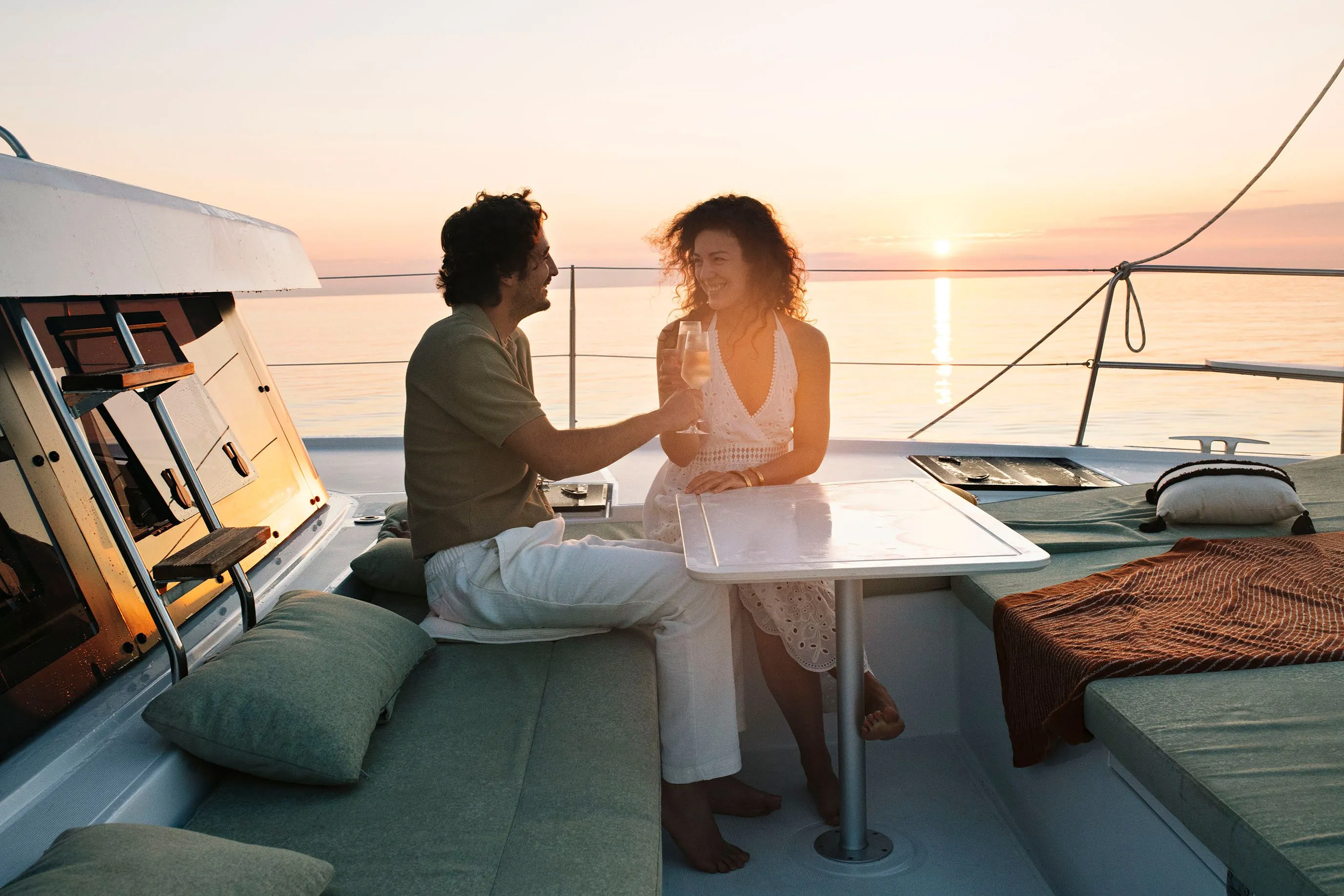
Photos courtesy of Bali Catamarans.
The Bali Catsmart is a sailing catamaran of 39'7" (12.08 m) overall on a 21'2" (6.46 m) beam, drawing 3'7" (1.11 m) — shallow enough to follow thin water through the Bahamas and the Keys. Hull length is 37'2" and waterline length 36'8". Empty weight is 19,667 lbs, and displacement at maximum load is 27,650 lbs.
She was designed by Olivier Poncin with naval architecture by Xavier Faÿ and interiors by PIATON BERCO, and she is built at the Catana yard. The defining number is the deck: 710 sq ft (66 m²) of usable surface, because the foredeck is a rigid moulded platform rather than netting. Tankage is 106 gal of fuel and 175 gal of water, with two 55-liter black water tanks. Layouts run two, three or four cabins against two heads, and CE certification is A: 8 / B: 10 / C: 16 / D: 20 persons.
Auxiliary power is a pair of 21 hp diesels, sized for a boat whose 3'7" draft matters more than its horsepower: that draft is what opens the sandbanks and back-channel anchorages deeper boats have to watch from the open roadstead, and the 21'2" beam is what keeps the platform level once you are in there.
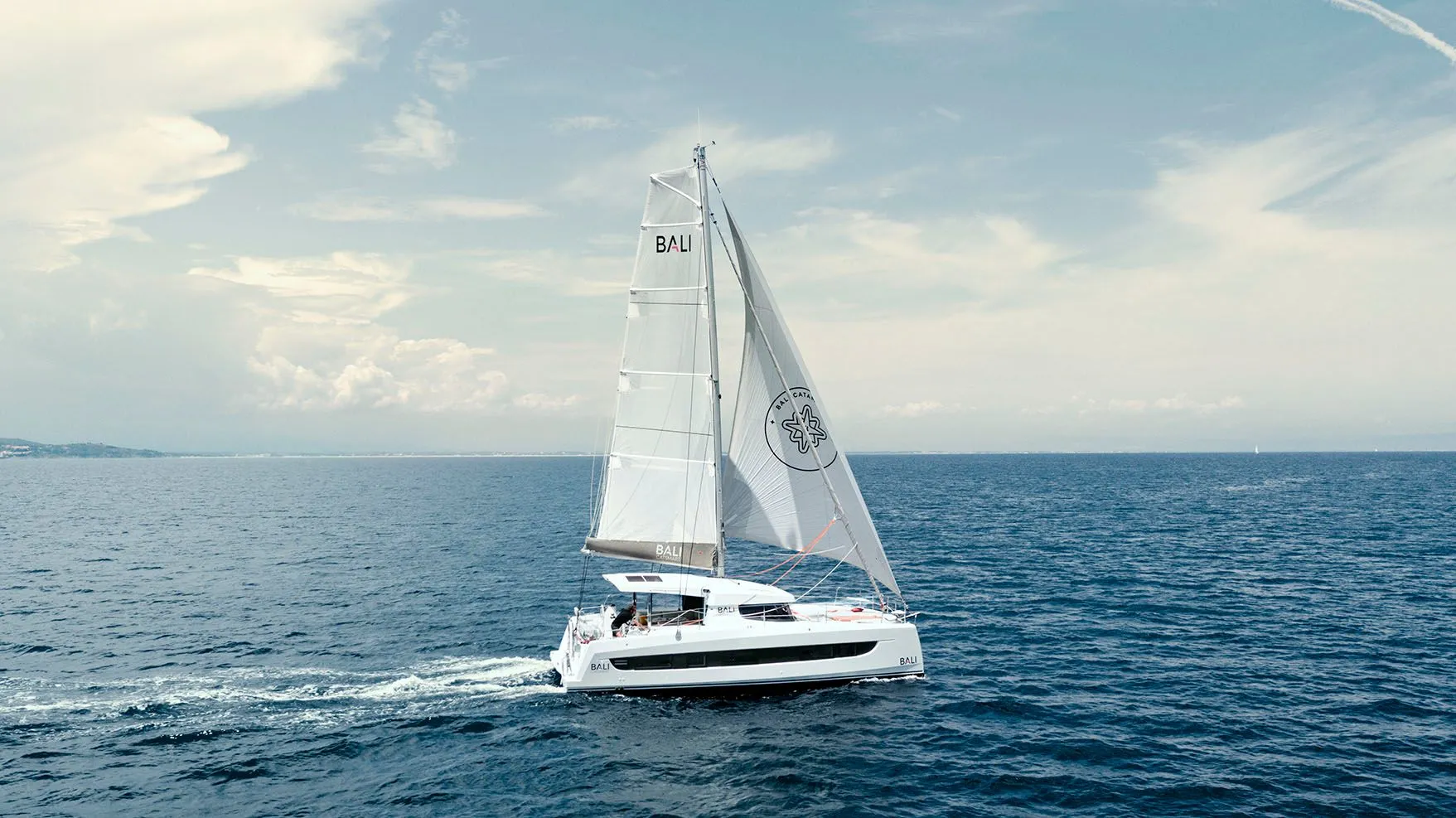
Under sail the Catsmart carries 818 sq ft as standard, rising to 1,076 sq ft of maximum upwind sail area. The rig is set up for a shorthanded crew: the boom sits down at coachroof level, which puts the mainsail within reach instead of over your head, and the twin helm stations are aft to port and starboard, so the person steering can see the quarter they are about to put alongside a dock. That aft, low, deck-level helm position also keeps the helmsman close to the water, which is where a catamaran gives you the most feedback. At sea trial, run her onto and off a windward berth in both directions before you sign, and ask for observed fuel burn at your intended cruising rpm in writing so you can work your own numbers off the 106 gal tankage.
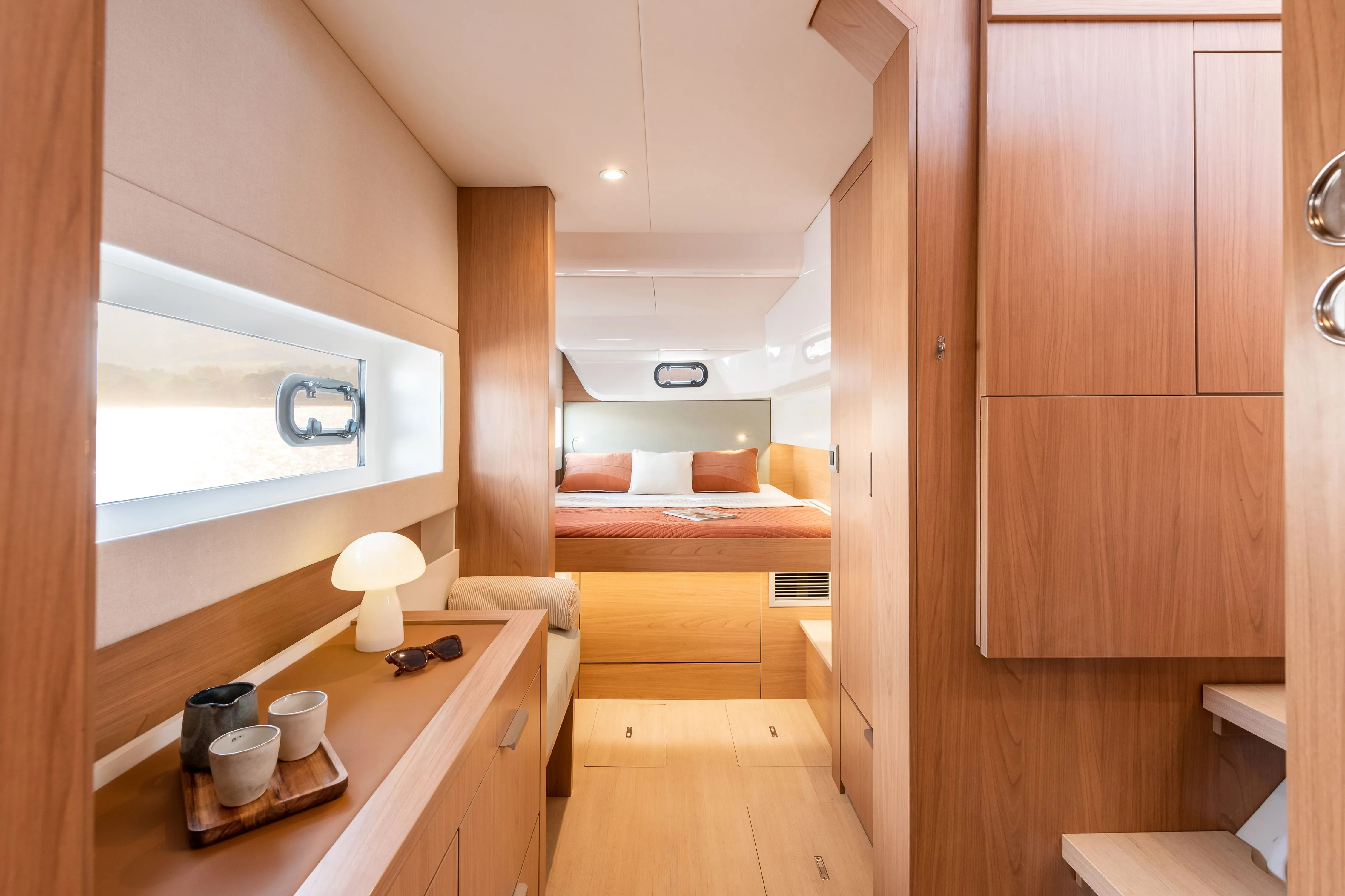
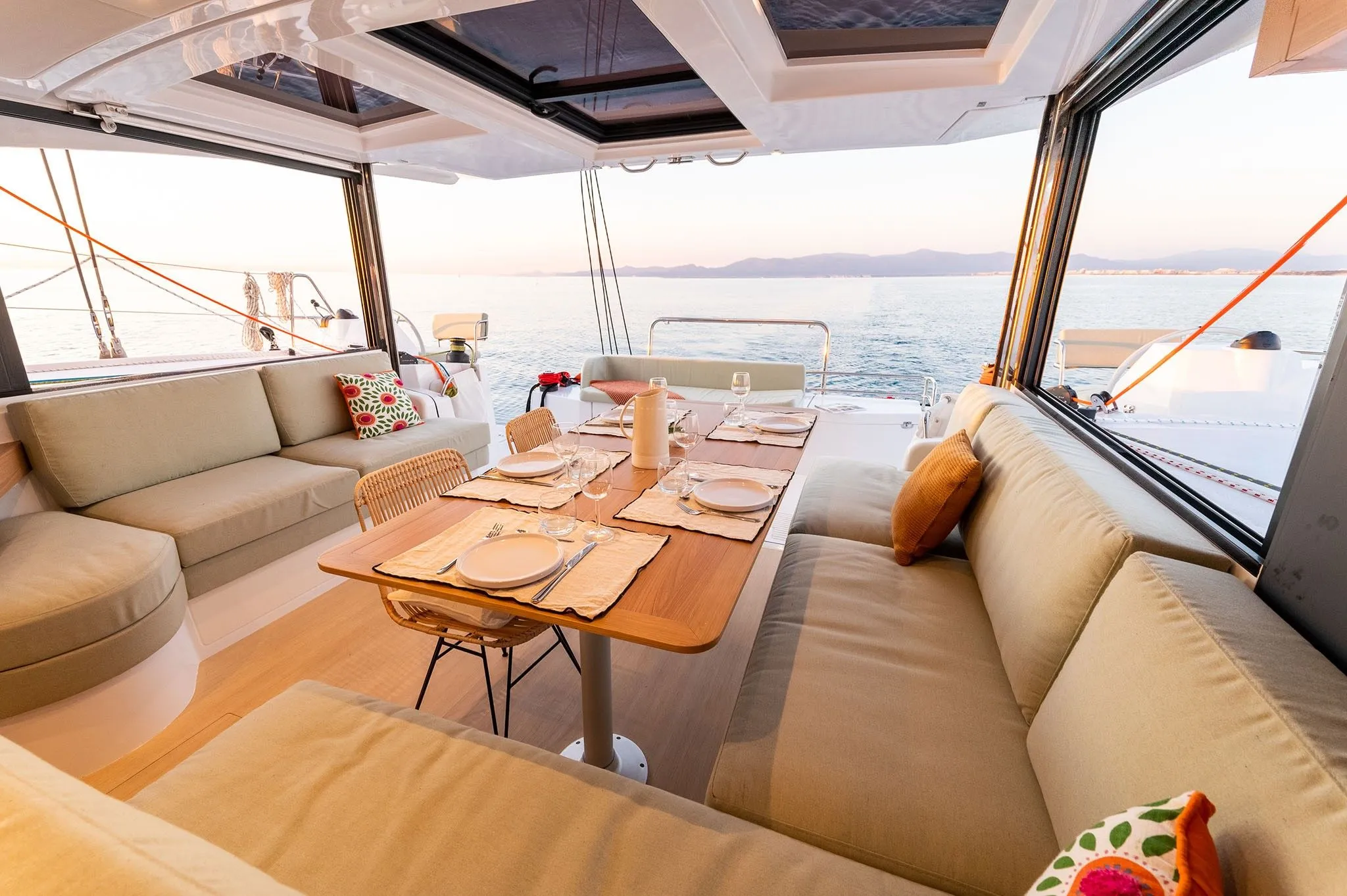
The saloon is arranged around a single large table that seats up to eight, with wide bench seating and a fully equipped galley on the same level — nobody cooking is cut off from the conversation. Window lines are kept low and continuous, so the sea stays visible from every seat rather than only from the cockpit.
The tilting-sliding Bali Door is the piece that changes daily life aboard. It lifts the whole aft bulkhead away, so saloon and cockpit become one room in a few seconds and close back up just as fast when the weather turns. Below, the choice is two, three or four cabins against two heads: the two-cabin version gives an owner a genuinely large private end of the boat, while the four-cabin layout is the one charter operators ask for. Forward, the rigid deck is furniture rather than a place to crawl over netting — it holds cushions, it stays dry, and it is walkable in bare feet at anchor.
The Catsmart opens the Bali range below the 40'5" Catspace, and it is the model that makes the brand's rigid-foredeck argument at the smallest scale: 710 sq ft of usable deck on 39'7", where a trampoline boat of the same length gives you netting you cannot furnish. It is squarely an owner-operator boat, sized to be run by a couple, and the four-cabin layout keeps it viable for a charter fleet.
Cross-brand it lands against the Fountaine Pajot FP41 at 39'8" and the Lagoon 38 — the same entry-to-mid forties cruising class. Against both, the Catsmart's case is deck architecture and ease of handling rather than sail-plan ambition: the rigid foredeck, the coachroof-level boom and the aft twin helms all point the same way.
Choose the Bali Catsmart if you are buying a first serious cruising catamaran for two people and you want the deck to be usable rather than merely present. If the idea of a dry, walkable, cushioned foredeck sounds like the place you would actually spend the evening — rather than a trampoline you climb over to reach an anchor — this is the boat built around that. The 3'7" draft is the other reason to buy: it is the difference between anchoring inside a bank and anchoring outside it.
Take the two- or three-cabin layout unless you are genuinely chartering; four cabins against two heads is a charter configuration and you will feel the head count on a long passage. Be clear-eyed on scale: CE certification is A: 8 persons, tankage is 106 gal of fuel and 175 gal of water, and the helms sit aft at deck level. If you want a flybridge and a raised helm at anchor, step up to the 40'5" Catspace; if you want a door from the saloon straight onto the foredeck, that starts at the 4.2.
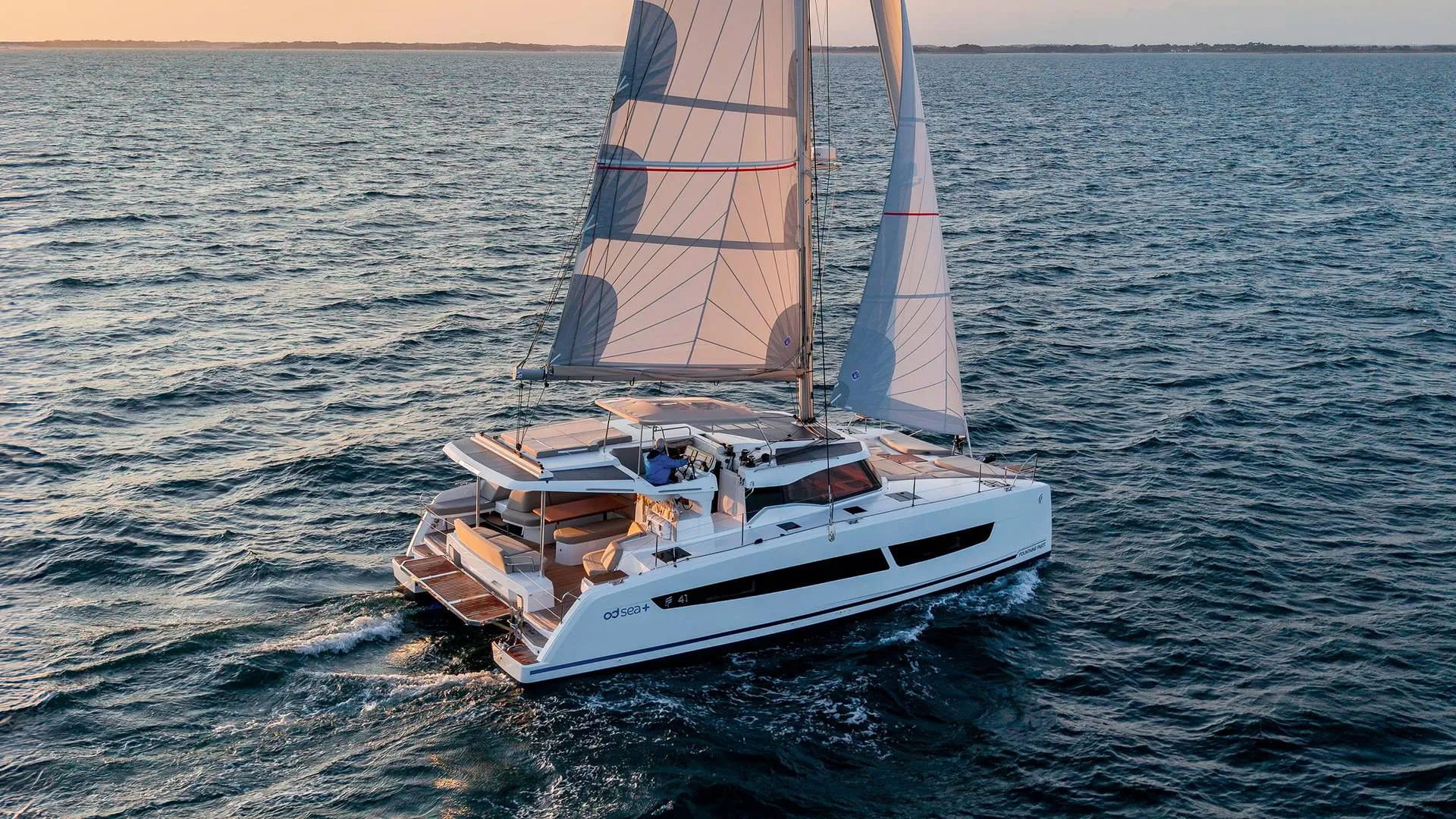
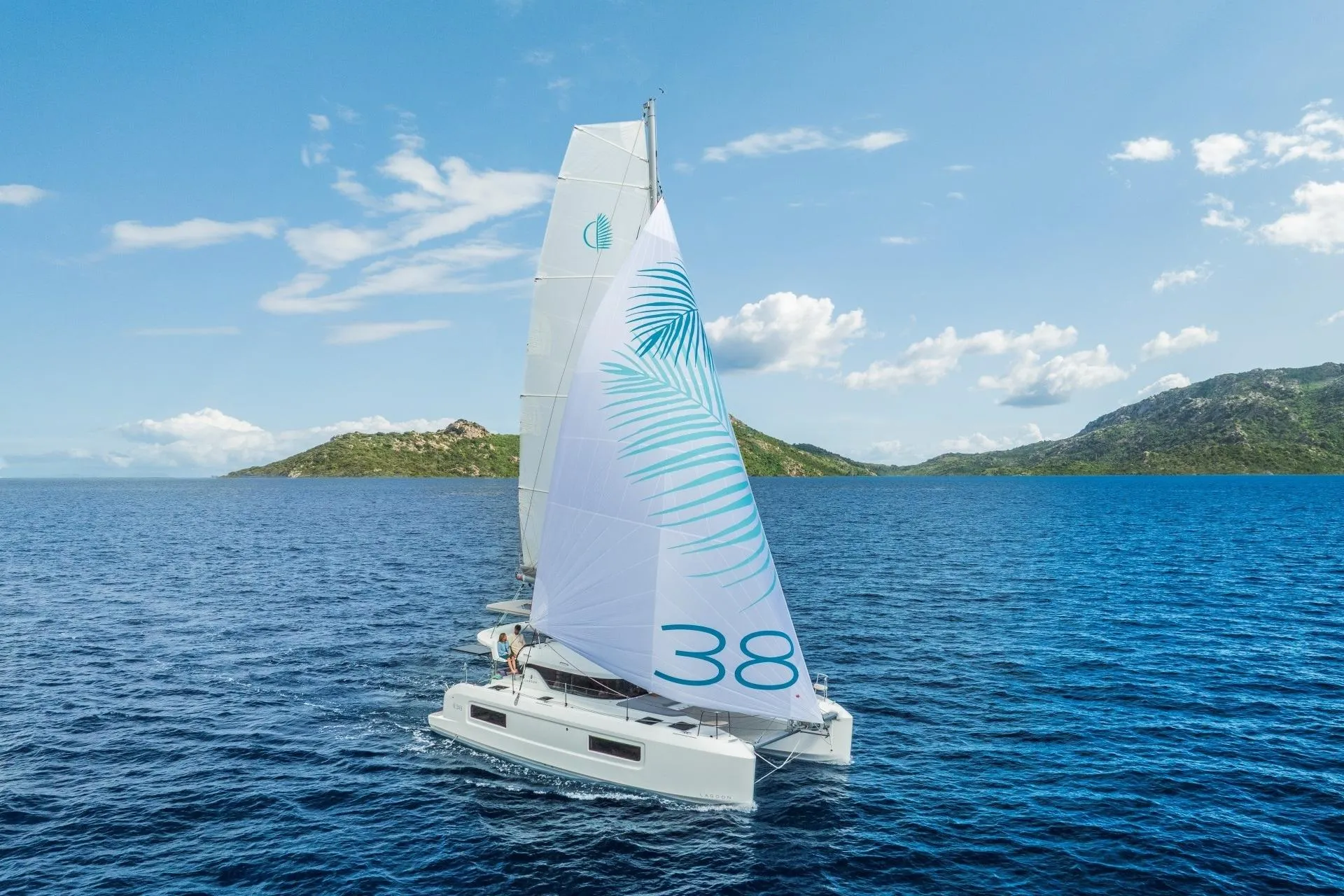
A rigid moulded foredeck. Bali replaces the netting between the bows with a solid platform, which is why the boat measures 710 sq ft (66 m²) of usable deck on a 39-foot hull.
It turns the front of the boat from a walkway into somewhere people actually sit, and it is the single change that most separates a Bali from a conventional cruising catamaran.
106 US gallons of fuel and 175 gallons of fresh water, with twin 21 HP diesels as standard.
For passage planning, get observed consumption at your intended engine settings in writing at sea trial and work your own numbers off the 106 gallons. Light displacement is 19,667 lbs and maximum-load displacement 27,650 lbs.
Two, three or four cabins, against two heads in every version. The two-cabin layout hands a whole hull to the owner; the three- and four-cabin versions add guest or charter berths without changing the head count.
Bali rates the Catsmart at CE category A for eight people, B for ten, C for sixteen and D for twenty.
Aft, at deck level, on both sides. There is no flybridge on this model, and the boom sits at coachroof height to match.
The arrangement keeps whoever is sailing in the cockpit with everyone else rather than up a ladder, which is what makes the boat straightforward for two people to handle and dock short-handed.
It draws 3'7" (1.11 m) on a 21'2" (6.46 m) beam, over 39'7" (12.08 m) length overall. That draft is shallow enough for thin-water cruising in the Bahamas and the Keys.
The beam is the number to take to your marina first. On a catamaran it decides the slip long before length does, and travel-lift width is worth confirming at the same time.