
The 80 Sunreef Power Is the Catamaran That Thinks It's a Superyacht — And Gets Away With It
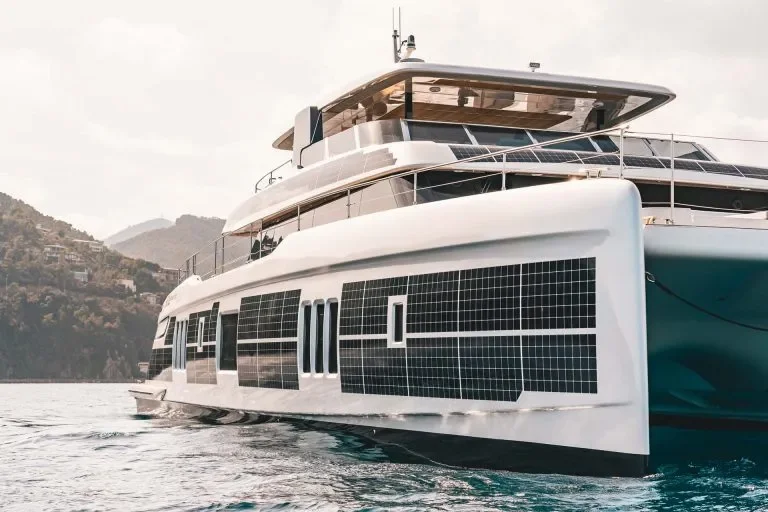
Photo Credit: Sunreef Yachts
When Rafael Nadal commissioned an 80 Sunreef Power and named her Great White, he was not buying a catamaran. He was buying a floating compound — 78 feet of custom-built, semi-custom Polish craftsmanship with nearly 4,000 square feet of living space, a 39-foot beam, and twin 1,200-horsepower engines that push her to 24 knots when the Mediterranean anchorage at the end of the day is calling.
The 80 Sunreef Power is the vessel that made the yachting industry take power catamarans seriously at the superyacht level. Built by Sunreef Yachts in Gdansk, Poland, each hull is a fully bespoke creation — not a production boat with options, but a ground-up semi-custom build where the owner's fingerprint is on every surface, every layout decision, every finish. And with the Eco version offering Sunreef's integrated solar panel system generating up to 40 kW across 200 square meters of hull and superstructure, this platform is as forward-looking as anything afloat.
Who It's For
The 80 Sunreef Power is for the owner who wants superyacht volume and presence without the operational overhead of a monohull in the 100-foot class. You want four to five en-suite cabins for 8-10 guests, a crew of four to six running the boat professionally, and the kind of deck space — foredeck, flybridge, cockpit, beach club — that makes every anchorage feel like a private resort. And you want the stability of a catamaran, which means your guests are comfortable in conditions that would have them reaching for medication on a monohull.
Pricing for the 80 Sunreef Power starts in the range of €6-8 million for standard diesel builds, with Eco versions commanding a premium for the solar-electric hybrid system. That positions it against monohull motor yachts in the 85-100 foot range — vessels that offer less living space, higher fuel consumption, and none of the catamaran's inherent stability advantage. For the buyer who evaluates yachts on livable square footage per dollar and comfort per sea state, the 80 Sunreef Power makes an exceptionally strong case.
Design and Layout: A Full Upper Deck They Forgot to Tell You About
The exterior of the 80 Sunreef Power reads as muscular and purposeful — a robust profile with a sleek, concealed full flybridge deck that gives the yacht a low, fast silhouette despite the enormous volume hidden within. The design hints at performance without overpromising — this is a yacht optimized for smooth, stable, efficient cruising rather than speed records.
The flybridge functions as a genuine upper deck, not an afterthought. The helm sits at the forward end, flanked by guest seating for up to eight. Unobstructed deck space surrounds the helm position, giving the captain clear visual checks along each side during mooring. Behind the helm, a full bar, dining area, and lounging space create a second living zone that rivals the main deck in usable area.
The main deck salon is where Sunreef's semi-custom DNA shows most clearly. Galley placement is owner's choice: positioned aft for a direct connection to the cockpit dining area, or forward to create a presentation kitchen that makes cooking a performance. The salon itself is expansive, with minimalist countertops, full-height cabinetry, and the kind of open sightlines that make 78 feet feel much larger.
Below decks, the catamaran's twin-hull architecture delivers a revelation. Four en-suite cabins — each a genuine full-size room rather than the compressed spaces typical of catamarans in this range — occupy the hulls with generous floor space around double berths and expansive shower rooms. While there is no single dominant owner's cabin in the traditional monohull sense, the overall space distribution means there are no small or cramped cabins aboard. Every guest sleeps well.
The stern is the social epicenter. A hydraulic hi-lo platform handles the tender and launches watercraft at the press of a button, while bathing platforms on both sides create generous water access. Above, the cockpit seating and dining area connects seamlessly to the salon through wide-opening doors. The foredeck adds yet another lounge — two L-shaped sofas, a forward sunpad with storage beneath, and enough space that you could host a cocktail party without anyone knowing there is one happening on the flybridge simultaneously.
Performance: Efficiency as a Design Principle
Standard diesel builds run twin engines ranging from 575 to 1,200 horsepower. The top-spec Great White configuration — twin 1,200 hp — delivers 23-24 knots at full throttle with a comfortable fast cruise of 16 knots. At economical cruise around 13 knots, range stretches to approximately 3,000 nautical miles on the 4,226-gallon fuel load. For context, that is Fort Lauderdale to the Mediterranean with margin to spare.
The Eco version is where the 80 Sunreef Power becomes genuinely distinctive. Sunreef's integrated solar panel system covers up to 200 square meters of hull sides and superstructure with panels that generate approximately 40 kW of energy. Combined with twin electric motors (up to 360 kW), battery banks ranging from 440 to 990 kWh, and optional range-extender gensets, the Eco version offers zero-emission hotel mode at anchor and electric-only cruising at lower speeds.
The practical implications are significant. At anchor in a marine reserve, a protected bay, or simply a quiet cove where you want to hear the water and nothing else — the Eco version delivers silence. No generator hum, no exhaust, no fuel burn. For the owner who plans to spend extended time at anchor (and on a boat this comfortable, you will), that capability changes the experience fundamentally.
A Buyer's Story
Elena had chartered monohull superyachts in Croatia for three summers. She loved the coastline, the anchorages, and the food. She did not love the rolling. Every dinner at anchor involved someone steadying a wine glass, and the overnight passages between islands left half her guests seasick despite stabilizers.
Her broker suggested the 80 Sunreef Power as an alternative. Elena was skeptical — she associated catamarans with bareboat sailing holidays, not superyacht entertaining. The sea trial changed everything. In a 1.5-meter swell that would have produced 8-10 degrees of roll on her chartered monohull, the 80 Sunreef Power barely moved. The foredeck lounge, which she had assumed was decorative, turned out to be where her entire group spent the afternoon. She ordered an Eco version with a custom galley-up layout and took delivery in time for the following summer. The first night at anchor off Vis, with the boat running on battery power in total silence, she called it the best investment she had ever made.
The 80 Sunreef Power Proposition
At 78 feet with a 39-foot beam and nearly 4,000 square feet of living space, the 80 Sunreef Power occupies territory that no monohull can match at this length. It delivers superyacht volume in a semi-custom package, with diesel or solar-electric hybrid propulsion, a 3,000-mile range, and the kind of stability that makes every guest an enthusiastic repeat visitor. With high-profile owners and a growing fleet of Eco versions demonstrating the viability of solar-powered superyacht cruising, the 80 Sunreef Power is not just keeping pace with the future of yachting — it is defining it.
Explore full specifications at YachtSpecsDirect.com
Browse available Sunreef inventory at mintedyachts.com/sunreef