
Sunreef 60 Power: The Power Catamaran That Redefines What a 60-Footer Can Be
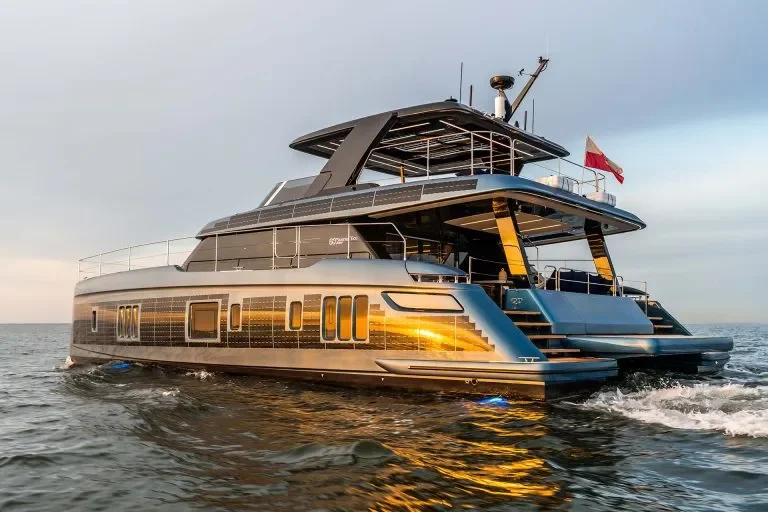
Photo Credit: Sunreef Yachts
Picture this: you wake to the sound of water against the hulls somewhere off the Balearics, no engine noise, no diesel fumes drifting into the cockpit. Your guests are still asleep in four private en-suite cabins spread across two hulls. The hydraulic swim platform sits level with the sea, a Williams tender bobbing behind it. The flybridge, ten meters wide, is set for breakfast with a panoramic sweep of coast that no monohull at this price point could match. If you're aboard the Eco variant, the sun has already been banking kilowatts into the battery pack for an hour.
The Sunreef 60 Power — built by Sunreef Yachts in Gdańsk, Poland — is not a step-up from conventional powerboats. It is a rethinking of what a 60-foot motor yacht can deliver in terms of living space, range, and, increasingly, environmental responsibility. Since winning Best Power Driven Catamaran at the World Yachts Trophies in Cannes, the platform has attracted private owners, charter operators, and sustainability-minded buyers who refuse to sacrifice comfort for conscience.
The model comes in two configurations: the standard 60 Sunreef Power, powered by a menu of diesel engines, and the 60 Sunreef Power Eco, which substitutes electric motors, a lithium battery bank, integrated solar panels, and diesel generators for a hybrid-electric drivetrain. Both share the same hull and fundamental layout architecture. The choice between them is a question of how you want to use the boat and what ownership experience you are after.
Who It's For
The Sunreef 60 Power is built for the owner who values volume and versatility over raw speed. If you are crossing the Atlantic with family, establishing a charter program in the Mediterranean, or demanding hotel-grade comfort without the draft and beam restrictions of a monohull superyacht, this catamaran delivers in ways few boats in its class can match.
The Eco variant attracts a specific buyer: someone who has come from sailing, who prizes silence at anchor and under way, and who wants the economics and environmental positioning that come with reduced fuel dependence. One of the first 60 Power Eco hulls was commissioned by Formula 1 driver Fernando Alonso — a signal of the demographic this boat speaks to: high-achieving owners for whom performance and forward-thinking design are not mutually exclusive.
Charter operators will note that the four- or five-cabin configurations, combined with approximately 300 square meters of total living space including the flybridge, position the boat well above comparable monohulls in both charter yield and guest experience.
Design & Layout
At 18.3 meters (60 feet) LOA with a beam of 10.7 meters (35 feet, 1 inch), the 60 Sunreef Power is notably wide even by catamaran standards. That beam translates directly into livable square footage. According to Sunreef Yachts, total living space reaches 300 square meters including the flybridge, a figure that would require a monohull well in excess of 100 feet to rival.
The main deck saloon is the social center of the boat. Wide sliding glass doors retract nearly full-width to erase the boundary between the aft cockpit and the interior. The cockpit features an alfresco dining table shaded by the flybridge overhang, with sofa seating facing the stern. Panoramic glazing and a skylight keep the saloon flooded with light.
Layouts are extensively customizable. Most builds choose a galley-down configuration, placing the kitchen in the port hull and freeing the main deck for an expansive open saloon with bar area, wine cooler, and lounge seating. A galley-up arrangement is also available. Sunreef's in-house design team treats each hull as a semi-custom project; joinery, materials, and spatial organization respond to the owner's brief rather than a fixed floor plan.
Belowdecks, the standard four-cabin layout delivers an owner's suite in the aft port hull — with king-size bed, walk-in dressing area, and ensuite — and three guest cabins forward, each with private bathroom, individual climate control, and Sunreef's signature triple-stripe hull windows. Headroom reaches approximately 7 feet, 6 inches — figures that would surprise owners accustomed to monohull accommodation at this length. Crew quarters occupy the forward peaks with independent access. Five-cabin builds are also offered.
The flybridge is, as Power & Motoryacht observed after boarding a hull at the 2024 Cannes Yachting Festival, where the sheer scale of the 60-footer is most on display. A teak dining table seats ten at amidships; aft sunpads line the railing; a grill station and three-seat helm complete the space. A hot tub is a popular option. The foredeck adds a third outdoor zone — a sunken lounging area with dining table and sunpads, reached through a weatherproof door from the helm.
A hydraulic stern platform handles tender deployment and doubles as a beach club when lowered flush with the waterline. The aft garage accommodates a jet ski alongside the tender.
Performance
The standard 60 Sunreef Power offers diesel options from 2 x Volvo Penta D6-300 (300 hp each) up to 2 x Cummins QSM11 at 705 hp each, per YachtBuyer's engine comparison. A YachtClass sea trial with the Cummins installation recorded 15.3 knots at full power; 10-knot cruise on the standard 3,000-liter tank yielded approximately 1,850 nm, extending to roughly 2,750 nm with the upgraded tank.
Draft is 4 feet, 11 inches — shallow enough for anchorages that monohulls cannot reach, and the twin-hull platform eliminates the offshore rolling that makes single-hull passages uncomfortable.
The 60 Sunreef Power Eco runs on two 180-kW electric motors, two 80-kW diesel generators (which charge rather than propel), and a 344–375 kWh lithium battery bank. Integrated photovoltaic panels — 7.5 kW standard on the Cannes hull — provide continuous solar recharging. Power & Motoryacht reports an 8.5-knot cruise with roughly 4,500 nm range, three to four hours of battery-only running at cruise speed, and silent port operation for two full days. With the 10,000-liter tank upgrade, range extends to 5,000 nm — adequate for a transatlantic crossing.
Sunreef's in-house solar technology integrates panels less than 1 mm thick directly into the composite structure rather than surface-mounting them, delivering efficiency 25–30 percent above conventional cells and earning the German Design Award 2022 in the Eco Design category.
Ownership
The 60 Sunreef Power Eco carries a base price of approximately $5.6 million, as reported by Power & Motoryacht. Fully optioned examples — upgraded tank, 330 kWh battery pack, teak throughout, hydraulic platform, and MCA commercial compliance — have listed in the $7–8 million range in current brokerage. The standard diesel 60 Sunreef Power enters at a lower base, with pricing varying by engine and customization scope.
Running costs favor the Eco platform meaningfully. YachtBuyer estimates fuel savings of 7–12 percent depending on usage patterns, and electric motors carry substantially fewer moving parts than diesel engines, reducing service intervals and long-term maintenance expense. For charter programs, the Eco's silent, fume-free profile at anchor is a tangible differentiator — the kind of detail that justifies premium rates and earns repeat bookings.
Both versions qualify for the growing network of green marina programs in European waters, where low-emission vessels receive preferential berth access in select destinations — an operational advantage likely to compound as port regulations tighten.
The 60 Sunreef Power sits at a compelling intersection: the interior volume of a much larger yacht, the shallow-water access of a performance catamaran, and — in the Eco configuration — a propulsion system that represents the direction the industry is moving. Whether your priority is a private family flagship or a professionally managed charter asset, this platform warrants serious attention.
Explore full specifications at YachtSpecsDirect.com
To speak with a specialist or view current inventory, visit mintedyachts.com/sunreef