
The Horizon PC60 Is the Power Catamaran That Monohull Owners Keep Switching To
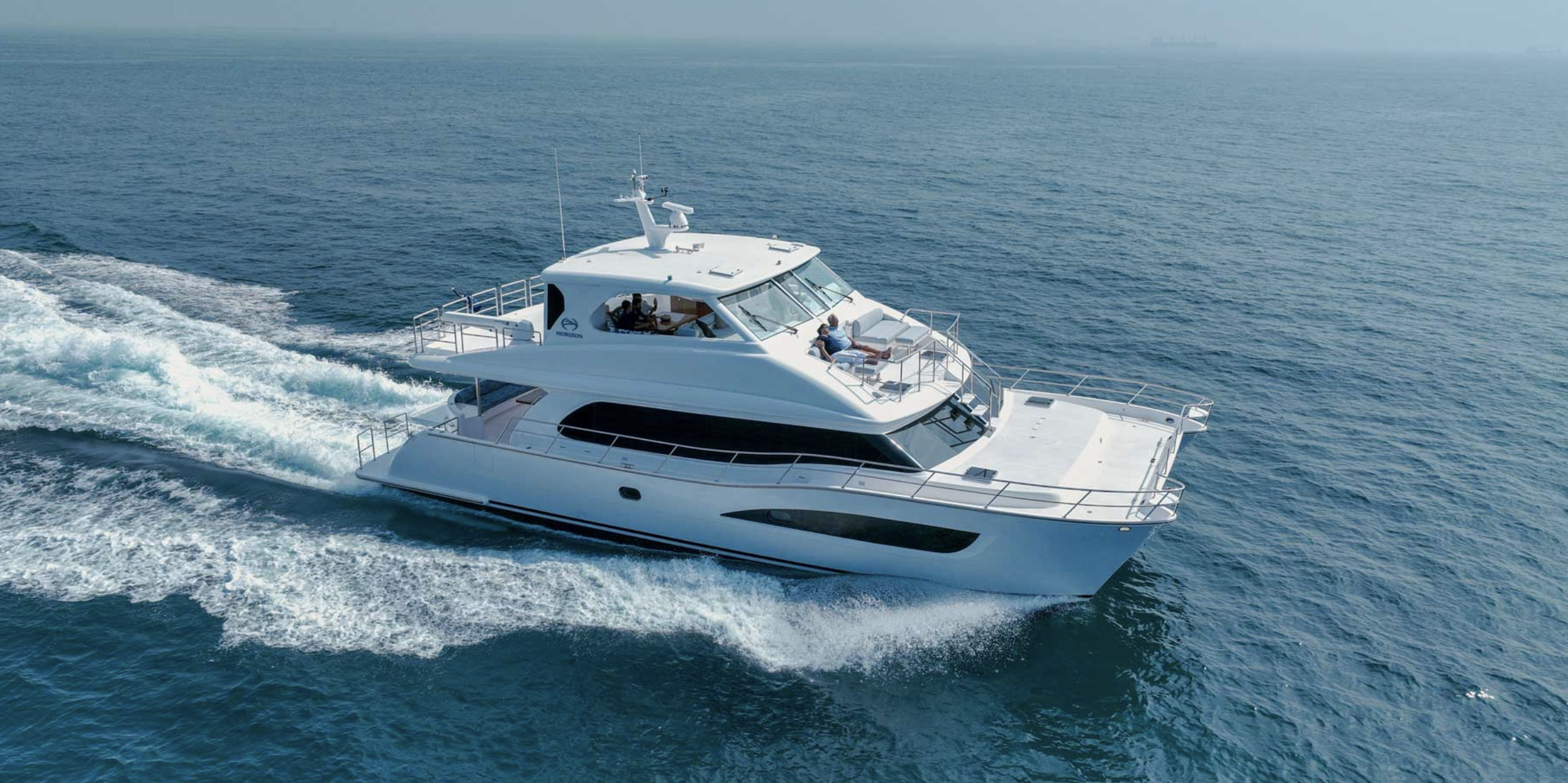
Photo Credit: Horizon Power Catamarans
There is a pattern playing out in marinas from Palm Beach to the Whitsundays: experienced monohull owners step aboard a Horizon PC60, spend 20 minutes walking the beam, and start doing math on a napkin. The numbers always win. At 61 feet with a 24-foot, 6-inch beam, the PC60 delivers the interior volume of a 75-foot monohull, the fuel efficiency of a vessel half its displacement, and a 1,200-nautical-mile range at 9 knots that makes extended coastal cruising not just possible but practical.
Built by Horizon Power Catamarans in Kaohsiung, Taiwan — the same yard that has been building custom yachts since 1987 and consistently ranks among the world's top ten yacht manufacturers — the PC60 carries the build quality and engineering rigor of a much larger program. Now in its 32nd hull with the debut of the Portuguese Deck layout at Palm Beach 2025, the PC60 has matured into one of the most compelling platforms in the 60-foot power catamaran segment.
Who It's For
The PC60 is purpose-built for the owner-operator couple or the lightly crewed family who wants to cover serious distance in genuine comfort. You are planning Bahamas seasons, Great Loop segments, extended Caribbean circuits, or coastal cruising where the next marina might be 200 miles away. You want four private staterooms with three en-suite heads so your guests have real privacy. And you want to handle the boat yourself — confidently, in tight quarters, without a professional crew.
At approximately $2.5-3.5 million depending on configuration and engine choice, the PC60 competes directly with conventional flybridge motor yachts in the 55-65 foot range. The catamaran premium is modest; the volume advantage is enormous. The on-deck master option — which places the owner's cabin on the main deck forward rather than in a hull — is a layout that monohull yachts simply cannot offer at 60 feet. For the buyer who prioritizes livable space, ride comfort, and range per gallon, the PC60 makes the competition look like it is trying too hard.
Design and Layout: The Portuguese Deck Changes the Game
The PC60 has always been a strong platform, but the 2025 Portuguese Deck layout elevates it from good to genuinely outstanding. A centreline companionway now links the flybridge to the foredeck through a hydraulic door, creating a straight-line walk from helm to bow. Two benches positioned forward of the helm station on the Portuguese bridge have already become — by every reviewer's account — the favorite seats on the boat.
Before this update, the forward portion of the upper deck was essentially dead space: no access, no seating, no door. The Portuguese Deck transforms it into a social zone, an observation platform, and a practical working area for line handling — all in one architectural move. It is the kind of thoughtful engineering that separates Horizon from builders who rely on styling alone.
The flybridge helm station features triple Garmin screens — one dedicated to the cockpit camera for aft visibility during maneuvering, the other two handling navigation and engine data. The starboard side can be configured as a day bed or a forward-facing bench for two or three passengers who want to join the skipper and enjoy the ride.
Below, the PC60 offers two layout options. The On-Deck Master places the owner's suite on the main deck forward, with large forward-facing windows, overhead hatches, and side glazing flooding the cabin with natural light. Steps lead down to a private en-suite with a spacious wardrobe area, separate shower, and toilet. The Open Salon option moves all cabins to the hulls, maximizing the main deck living space. Either way, three guest cabins provide comfortable sleeping for up to eight, with thoughtful separation between social and private zones.
The cockpit includes integrated seating, a dining area, fridge, ice maker, and gear locker under a generous overhang. A hydraulic hi-lo platform at the transom handles a jet ski, while the tender — up to 16 feet — stows on the upper boat deck and launches via crane.
Performance: Two Engine Rooms, One Confident Ride
Each hull houses its own engine room — a catamaran advantage that provides redundancy and excellent service access. The PC60 offers two engine options: standard twin Cummins QSM11 at 705 horsepower delivering 24-knot top speed and 18-knot cruise, or the upgraded twin MAN i6-850 at 850 horsepower pushing top speed to 27 knots with a 20-21 knot cruise.
At displacement speed — around 8-9 knots — the PC60's 1,000-gallon fuel capacity delivers over 1,200 nautical miles of range. At fast cruise (18-20 knots), range settles around 550 nautical miles. The flexibility to choose your speed based on the passage ahead is one of the catamaran's practical advantages: sprint between close islands, then stretch the legs for longer crossings.
The Silent Living package — now standard on the PC60 — features a Victron phosphate battery system and Termodinamica variable-speed air conditioning that allows the boat to run for up to 20 hours on battery power alone with no generator. That is a full overnight at anchor in silence — no vibration, no exhaust, no fuel consumption. For the Bahamas cruiser anchored in a glass-calm harbor, it transforms the experience.
Bow and stern thrusters, plus ZipWake trim tabs, complete a maneuvering package that makes close-quarters handling straightforward for an owner-operator.
A Buyer's Story
Mark and Susan had owned a 58-foot flybridge motor yacht for four years. They loved the boat, but two things nagged at them: the fuel bills on their annual Fort Lauderdale-to-Abaco run, and the fact that their two guest cabins felt like afterthoughts — guests always seemed slightly apologetic about retreating to their rooms.
They stepped aboard a PC60 at the Fort Lauderdale show on a whim. The moment Susan walked the main deck — 24 and a half feet of beam, an on-deck master suite she did not have to descend a ladder to reach, and three additional cabins that were actual rooms rather than berths with a door — she looked at Mark and said, "This is it." Mark ran the fuel numbers: the PC60 burned roughly 35 percent less fuel on the Abaco crossing than their monohull at comparable speeds. The Silent Living battery system meant they could anchor at Tahiti Beach without running the generator. They sold the flybridge that spring and took delivery of a PC60 with the Portuguese Deck that fall. First trip out, they made Marsh Harbour in a single hop, slept in silence at anchor, and woke up wondering why they had not done this years earlier.
The PC60 Proposition
The Horizon PC60 is a yacht that reveals its intelligence slowly. It does not shout about its capabilities — it simply delivers them, run after run, season after season. With 32 hulls in the water, the Portuguese Deck elevating an already proven layout, Horizon's legendary build quality underpinning every system, and a price point that competes directly with conventional motor yachts offering half the volume, the PC60 makes one of the strongest arguments in yachting for the catamaran platform. CE-A certified for ocean crossings, comfortable enough for extended live-aboard seasons, and efficient enough to make the fuel dock a less frequent stop — this is the boat that keeps converting monohull owners.
Explore full specifications at YachtSpecsDirect.com
Browse available Horizon inventory at mintedyachts.com/horizon-cats