
The Azimut Seadeck 7 Might Be the Smartest 70-Footer on the Water Right Now
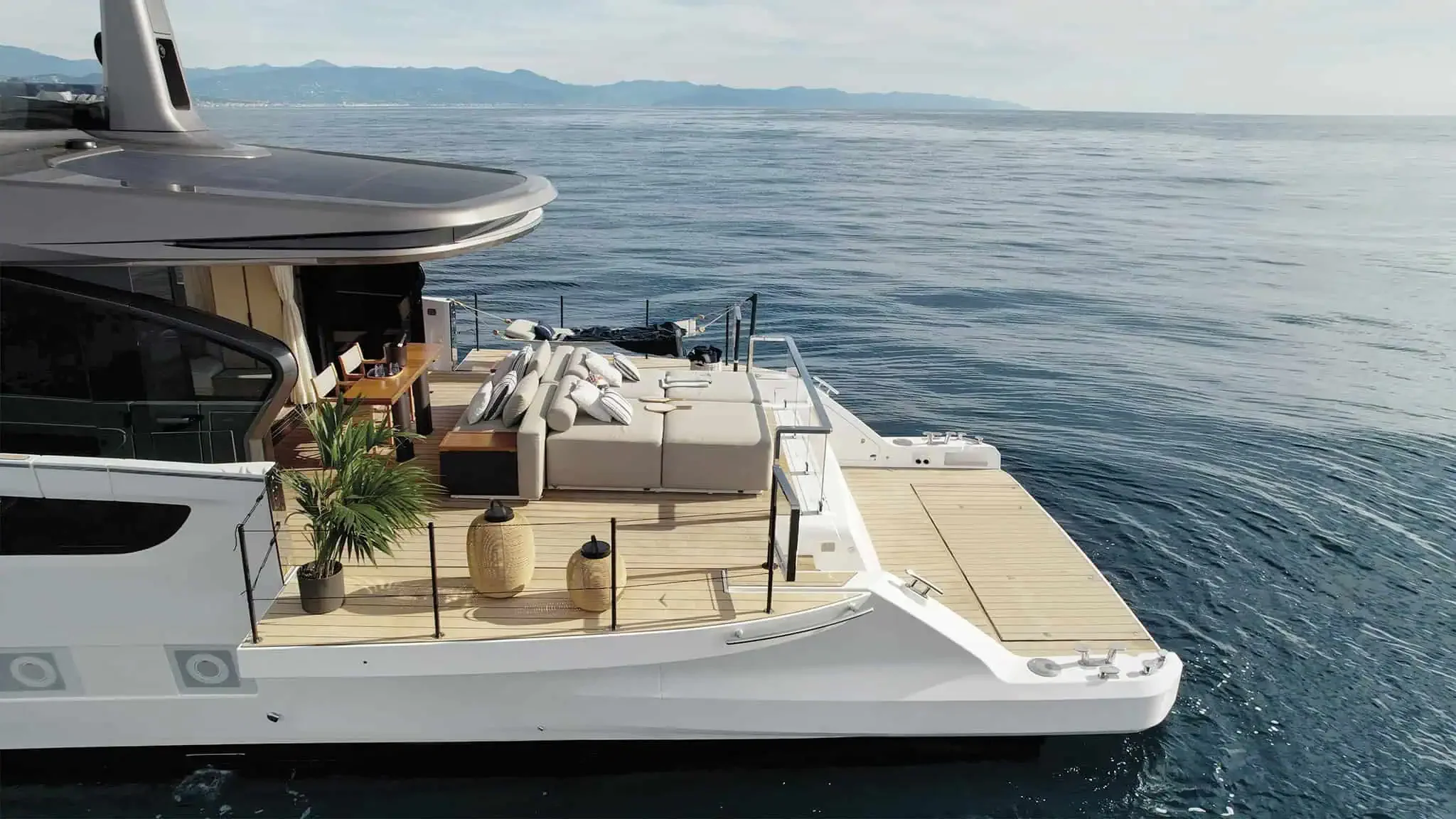
Photo Credit Azimut
Picture a Saturday morning at the fuel dock in Bimini. The engines are off. The air conditioning is running. Your phone is charging. And the only sound on the aft deck is ice shifting in a glass. No generator hum, no diesel rattle — just the 80 kWh lithium battery pack doing what it was designed to do: keep everything running while you decide whether breakfast happens at the cockpit table or down on the swim platform.
That is the Azimut Seadeck 7 in a single scene. It is a 71-foot flybridge yacht that happens to be the first production hybrid in its class — and it does not ask you to sacrifice a single weekend to prove it.
Who This Yacht Is For
The Seadeck 7 sits at 71 feet 2 inches with an 18-foot beam, four guest cabins, a crew cabin forward, and a compact flybridge with a dedicated upper helm. It is not a stripped-down eco demonstrator. It is a fully realized family cruiser that also happens to run cleaner than anything else in the 70-foot flybridge segment.
The ideal owner is someone already comfortable with a 60-to-70-foot flybridge or sport yacht — a Ferretti 780, a Princess Y75, a Sunseeker Manhattan 74 — who wants the next boat to feel genuinely forward-thinking without giving up volume, speed, or livability. If you care about where the industry is headed and want to be early without being experimental, the Seadeck 7 is your shortlist.
Design That Changes How You Use the Boat
Alberto Mancini drew the exterior with one objective: erase the wall between the boat and the water. The result is a low-slung profile with continuous glass along the salon, a 10-foot sliding door to port, and a triple slider aft that removes the barrier between salon and cockpit entirely. Step from the helm to the swim platform without a single threshold change — 7-foot-2-inch headroom the entire way.
The headline is the ""Fun Island"" aft deck. Folding terraces on each side add roughly 450 square feet of usable outdoor space at the push of a button. A modular sunpad converts to dining seating. A double-wide hammock swings from removable carbon-fiber posts over the starboard terrace. A slide-out station with twin grills hides in the transom. Below that, the hydraulic swim platform launches a Williams jet tender from chocks, lowers to water level with wide teak stairs, and doubles as a beach when nobody is moving.
Inside, Matteo Thun and Antonio Rodriguez kept it restrained and deliberate: golden oak, fluted timber, woven thread wall panels, and linen accents. Over 10,000 recycled PET bottles went into the bulkheads and 65 percent of the interior decking. It does not look or feel ""eco."" It looks and feels Italian.
The galley sits forward on the main deck with a pocket door — close it off as a crew zone or open it to extend the living space. Below, the full-beam owner's suite centers amidships with a queen berth, en-suite head, and hull-side windows that actually let in natural light. The forward VIP has an angled berth with walking space on both sides and a view from the pillow. Two additional guest cabins round out the layout for up to eight guests plus crew.
Performance Without the Guilt
Twin Volvo Penta IPS 1200s at 900 horsepower each (with an optional 1,000-hp IPS 1350 upgrade) push the Seadeck 7 to 31 knots at the top end. Cruise is a comfortable 23 knots with a range of 374 nautical miles on 978 gallons. Fast cruise at 26 knots still delivers 332 miles of range. The planing hull — 15 degrees of deadrise at the transom, 21 degrees amidships — was developed by Azimut R&D with the naval architecture firm NAMES, and it shows: reviewers consistently report clean, confident handling through chop and minimal heel in turns.
Here is where it gets interesting. The Volvo Penta hybrid package pairs twin 160 kW electric motors with that 80 kWh battery bank and up to 8.5 square meters of rooftop solar panels producing 1,410 watts. Four navigation modes — Pure Electric (up to 11 knots, zero emissions), Hybrid Standard, Hybrid Boost, and Hotel Mode — give you choices that no other production 70-footer offers. Slip out of a marina at dawn on electric power alone. Anchor for eight hours overnight with full air conditioning and no generator. Azimut claims a 40 percent annual reduction in CO2 emissions when the system is used as designed, and RINA backed that up with a GREEN PLUS Platinum certification in standard configuration.
Two Seakeeper gyrostabilizers — a model 6 for nighttime anchoring and a model 9 for underway use — keep the ride flat whether you are crossing the Gulf Stream or floating in a calm harbor.
Owning the Seadeck 7
A 71-foot flybridge with IPS drives and hybrid systems is not a budget play, but the operating math is more favorable than you might expect. The hybrid system eliminates the generator for most use cases, cutting one of the most maintenance-heavy components on any yacht. IPS pods are well-supported by Volvo's global service network, and the joystick docking system means an experienced owner-operator can handle this boat without a full-time captain for weekend use.
Budgeting in the range of 8 to 12 percent of purchase price annually for a yacht in this class buys you predictable ownership, stress-free weekends, and the freedom to say yes whenever the marine forecast cooperates. The hybrid savings on fuel and generator maintenance take a real bite out of that number over time — and the ability to anchor silently in protected areas that restrict generator use is a practical advantage that only grows as more marinas and marine parks tighten their rules.
Four cabins and crew quarters mean this boat works for extended family trips, buddy cruises to the Bahamas, or a quiet couple's week in the Abacos. The flybridge gives you a private third deck when you need space. The Fun Island gives every anchorage a resort-quality aft deck.
The Right Azimut for What Comes Next
The Seadeck 7 is not a concept boat dressed up for a trade show. It is a production yacht you can order today that happens to be the most forward-thinking 70-footer in the water — with the cabin count, speed, and livability to back it up. If your next yacht decision includes the question ""where is the industry going,"" this is the answer with a hull number attached.
For specs, details, and buying options, start at YachtSpecsDirect.com.
To explore more from Azimut, visit mintedyachts.com/azimut.