
The Sanlorenzo SL110A: When Asymmetry Becomes Your Competitive Advantage
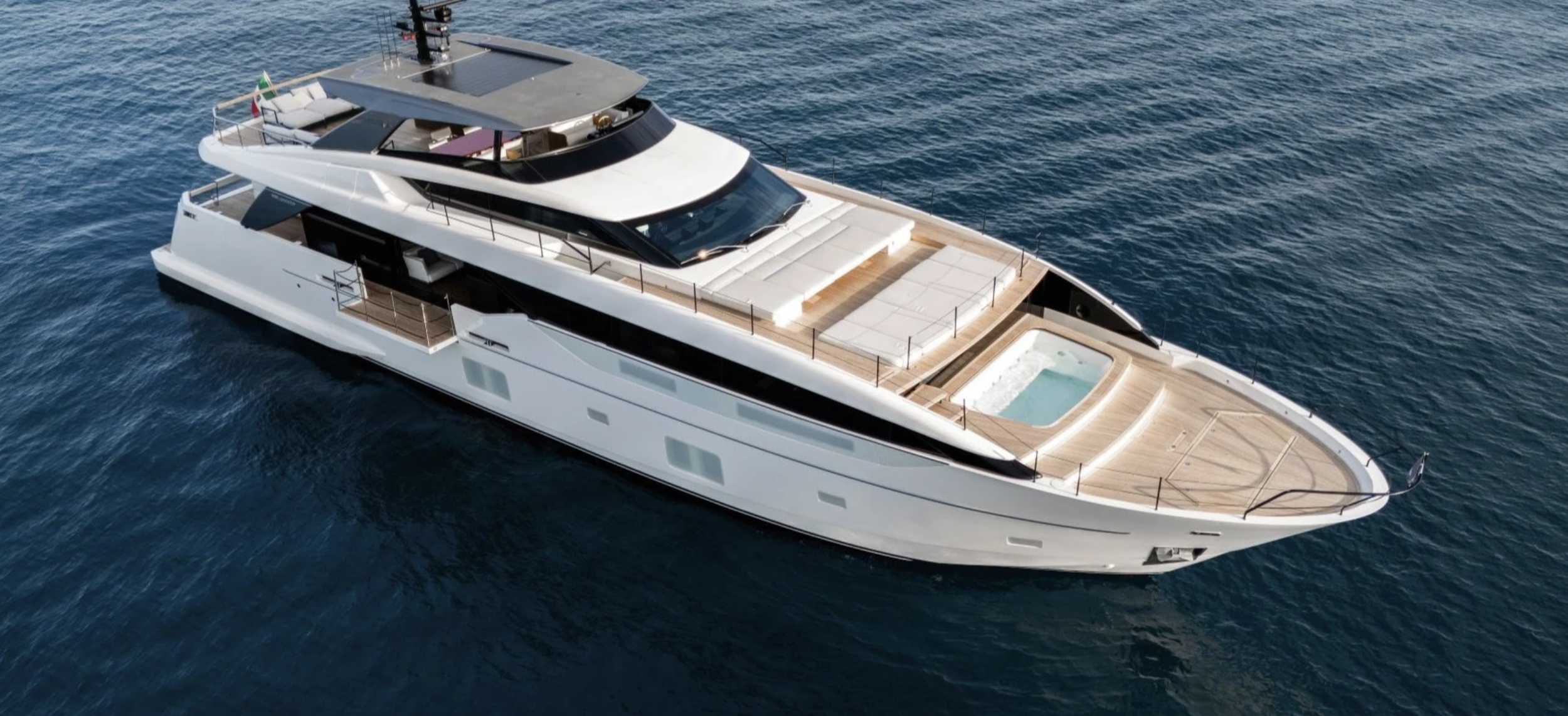
Photo Credit: Sanlorenzo
Picture this: You're anchored off Bimini, guests are on the flybridge, and you walk through your master cabin, slide open the door, and step directly onto a private foredeck with a pool. No hallway. No shared space. No crew traffic. Just 400 square feet of teak that belongs to you alone.
That's the SL110A. Not a gimmick. Not a styling exercise. A fundamentally different approach to how a 110-footer uses its real estate.
Sanlorenzo's asymmetric series has been polarizing since the SL86A launched in 2019. Critics called it radical. Owners called it obvious. The SL110A is the fourth iteration, and by now the concept has matured into something more refined than rebellion. This is architecture with a purpose.
Who It's For
The SL110A is for the owner who has already done the symmetrical yacht. You've had the Azimut Grande, the Ferretti Custom Line, maybe even a Riva. You know the drill: port and starboard side decks, center staircase, master cabin buried below with a porthole view.
This boat is for someone who wants the layout to work harder. You're not interested in tradition for tradition's sake. You want the master cabin on the main deck with panoramic glass and direct foredeck access. You want the salon to feel 20 feet wider than it actually is. You want guests to walk aboard and pause because the sightlines don't make sense at first.
If you're chartering this boat or running it as a family office asset, the asymmetric layout becomes a talking point. It's differentiation in a segment where most 110-footers blur together.
Design & Layout: The Asymmetric Advantage
Here's what Sanlorenzo did: they eliminated the starboard side deck on the main level and pushed that volume inboard. The result is a salon that spans nearly the full 24-foot beam. The master suite sits forward on the main deck with floor-to-ceiling glass on three sides and a private door to the foredeck.
The port side deck remains full-width for docking and crew access. Guests use it once, then forget it exists. Everything they care about happens inside or on the flybridge.
Below deck, you get four additional guest cabins, all en-suite, all with proper headroom and natural light. The VIP forward is a true VIP, not a repurposed crew cabin. Layout options allow for a beach club or a fifth guest cabin aft, depending on how you plan to use the boat.
The flybridge is where this boat earns its keep. Full beam, hardtop with retractable glass panels, wet bar, dining for ten, and a forward sunpad that doubles as overflow seating. It's the social hub, and it's better executed here than on most 120-footers.
Performance: Freedom, Not Just Speed
The SL110A runs on twin MTU 16V 2000 engines. Standard spec is the M96 at 2,434 hp per side, good for 26 knots. Opt for the M96L at 2,637 hp and you'll see 27 knots flat out.
Cruise speed sits around 23 knots, burning roughly 200 gallons per hour. Drop to 10 knots and you're looking at 1,200 nautical miles of range from the 3,196-gallon fuel capacity. That's Miami to the Bahamas and back without a fuel stop. Or Fort Lauderdale to the Dry Tortugas with margin to spare.
The hull is a deep-V planing design, not a semi-displacement compromise. It's built for speed and efficiency in the 20-to-25-knot range, which is where most owners actually run these boats. Sanlorenzo didn't try to make this a trawler. They built it for people who want to get somewhere and still have fuel left to enjoy it.
At 231 gross tons, the SL110A stays under the 300 GT threshold, which keeps survey and manning requirements simpler in most jurisdictions. That matters if you're moving the boat between the U.S., Bahamas, and Caribbean frequently.
Ownership Conversation: Crew vs. Owner-Operator
Let's talk about what this boat actually costs to run. You're looking at crew for five to six, depending on how you staff it. Minimum is captain, engineer, chef, and two stews. That's $350,000 to $450,000 annually in wages, benefits, and training, assuming you're paying market rate for experienced crew in South Florida.
Fuel, insurance, dockage, and maintenance will add another $300,000 to $400,000 per year if you're running 300 hours. That's a $750,000 to $850,000 annual operating budget before you factor in upgrades, haul-outs, or unexpected repairs.
Can you run this boat with less crew? Technically, yes. Some owners run it with a captain and rotating day crew. But at 110 feet, you're giving up the full-service experience that makes ownership enjoyable. The SL110A is designed to be run with a professional crew, and the layout supports that.
If you're comparing this to a 90-footer you can run with a captain and a mate, understand that you're stepping into a different operational category. The upside is that the SL110A holds its value better, charters at a higher rate, and gives you the space to host eight to ten guests comfortably for a week.
Where to Start
The SL110A is not for everyone. It's for the owner who values layout innovation over convention and understands that asymmetry isn't a compromise—it's a feature.
If you're serious about this boat, start by walking one. The layout either clicks immediately or it doesn't. Most owners who choose the asymmetric series do so because they've already owned a traditional yacht and want something different.
Explore full specifications at YachtSpecsDirect.com
Browse available Sanlorenzo inventory at mintedyachts.com/sanlorenzo